Two Hands on the Price Board
Uma história gratuita em inglês de nível B1 para estudantes, para ler online em 7 idiomas, com opção de ouvir no app gratuito Storyteller.
Two rival teenage sellers at a salt flat stop must share one price board when a coach arrives.
Essa foi a prévia! Ouça a história completa no app gratuito Storyteller. Baixar o app
O áudio não está disponível no momento.
The price board at the Saltwater Stop was older than Lior and Dalila put together.
O quadro de preços da Parada Água Salgada era mais velho que Lior e Dalila somados.
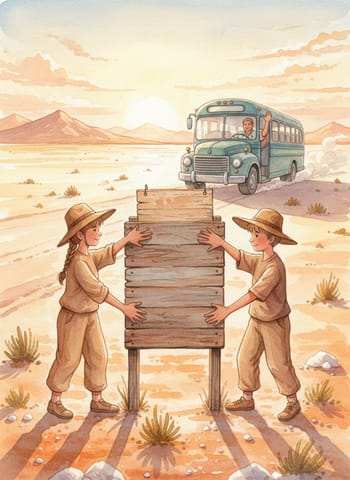
It stood on two crooked posts at the edge of the car park, between their two stalls. Someone had painted it black long ago. The paint had cracked like dry mud. The stop sat on a salt flat so wide that the horizon looked like a drawn line. Coaches came across it twice a day, and the board was the first thing the passengers read.
Ficava sobre dois postes tortos na beira do estacionamento, entre as barracas dos dois. Alguém o havia pintado de preto muito tempo atrás. A tinta tinha rachado como barro seco. A parada ficava numa planície de sal tão larga que o horizonte parecia uma linha desenhada. Os ônibus de viagem atravessavam-na duas vezes por dia, e o quadro era a primeira coisa que os passageiros liam.
Lior sold cold lemon water from a blue cool box. Dalila sold small salt crystals, polished and strung on leather cords. Both of them worked at the stop every summer. Both of them thought the best corner belonged to them.
Lior vendia água com limão gelada, de uma caixa térmica azul. Dalila vendia pequenos cristais de sal, polidos e presos em cordões de couro. Os dois trabalhavam na parada todo verão. Os dois achavam que o melhor canto era seu.
The trouble began with the board.
O problema começou com o quadro.
On Monday, Lior wrote his price in the first row of the board. He wrote "Cold lemon water, three coins" in tall, square letters, like a man signing a letter. On Tuesday, Dalila wiped it with her sleeve. She wrote "Lemon water, three coins, crystals, five coins" in round, curling letters across the whole top half.
Na segunda-feira, Lior escreveu seu preço na primeira linha do quadro. Escreveu "Água com limão gelada, três moedas" em letras altas e quadradas, como um homem assinando uma carta. Na terça, Dalila apagou com a manga. Escreveu "Água com limão, três moedas, cristais, cinco moedas" em letras redondas e cheias de floreios por toda a metade de cima.
On Wednesday, Lior rubbed out her curls. He drew a line down the middle of the board and wrote his name above the left side. He did not write hers on the right.
Na quarta, Lior apagou os floreios dela. Traçou uma linha no meio do quadro e escreveu seu nome acima do lado esquerdo. Não escreveu o dela no direito.
"You cannot split a board that belongs to the stop," Dalila said.
"Você não pode dividir um quadro que pertence à parada", disse Dalila.
"I am not splitting it. I am organising it."
"Não estou dividindo. Estou organizando."
"You are taking it."
"Você está tomando para si."
"You are writing too big."
"Você escreve grande demais."
They did not speak for the rest of the afternoon. Each of them watched the other from behind a stall. Each pretended to be busy. In the evening the light turned the flat pink. They both walked past the board without looking at it.
Não se falaram pelo resto da tarde. Cada um observava o outro de trás da barraca. Cada um fingia estar ocupado. À noite a luz deixou a planície rosada. Os dois passaram pelo quadro sem olhar para ele.
By Friday the board was a mess. There were crossed-out numbers, smudged names, and a line down the middle that went crooked halfway. A man who stopped for a drink read it for a long time. Then he walked on without buying anything.
Na sexta, o quadro era uma bagunça. Havia números riscados, nomes borrados e uma linha no meio que entortava na metade. Um homem que parou para beber algo leu por um bom tempo. Depois foi embora sem comprar nada.
"See what you did," said Dalila.
"Veja o que você fez", disse Dalila.
"Me?" Lior said. "You started it."
"Eu?", disse Lior. "Foi você quem começou."
At noon on Saturday, a big white coach rolled across the flat. It stopped in a cloud of fine salt dust. The door opened with a sigh. A woman in a bright scarf stepped out and clapped her hands.
Ao meio-dia de sábado, um grande ônibus branco rolou pela planície. Parou numa nuvem de fina poeira de sal. A porta se abriu com um suspiro. Uma mulher de lenço colorido desceu e bateu palmas.
"Fifteen minutes, everyone," she called. "Then we leave. The next town is far."
"Quinze minutos, pessoal", chamou ela. "Depois partimos. A próxima cidade é longe."
Forty passengers poured out. They were tired and thirsty, and they carried cameras and empty water bottles. They went straight to the board. For a moment, there was a quiet murmur as they tried to read it.
Quarenta passageiros desceram. Estavam cansados e com sede, e levavam câmeras e garrafas de água vazias. Foram direto ao quadro. Por um momento, houve um murmúrio baixo enquanto tentavam lê-lo.
"What does that say?" a man asked.
"O que está escrito aí?", perguntou um homem.
"I think it says three coins for lemon," said a girl. "Or thirty."
"Acho que diz três moedas pelo limão", disse uma menina. "Ou trinta."
"Is the crystal five, or fifty?"
"O cristal é cinco, ou cinquenta?"
"Where do I pay?"
"Onde eu pago?"
Nobody could tell which price belonged to which stall. Some of the passengers tried Lior's cool box and some tried Dalila's table. Nobody was sure of the numbers, and nobody wanted to argue. A few of them looked at their watches. One man took out his phone and began taking a photograph of the board, shaking his head.
Ninguém sabia dizer qual preço era de qual barraca. Alguns passageiros tentaram a caixa térmica de Lior, outros a mesa de Dalila. Ninguém tinha certeza dos números, e ninguém queria discutir. Alguns olharam os relógios. Um homem pegou o celular e começou a fotografar o quadro, balançando a cabeça.
The woman in the scarf walked over to the stalls. She had kind eyes, but she looked worried.
A mulher de lenço foi até as barracas. Tinha olhos gentis, mas parecia preocupada.
"I need to know," she said, "if my passengers can buy things here, and quickly. If they can't read your board, they will go back to the coach and wait. I have done this journey many times. The stop with a clear board gets the money."
"Preciso saber", disse ela, "se meus passageiros podem comprar coisas aqui, e rápido. Se não conseguem ler o quadro, voltam para o ônibus e esperam. Já fiz esta viagem muitas vezes. A parada com o quadro claro fica com o dinheiro."
Lior opened his mouth. Dalila opened hers. Neither of them said a word.
Lior abriu a boca. Dalila abriu a dela. Nenhum dos dois disse uma palavra.
The woman waited. "I will say it plainly," she said. "You have thirteen minutes. If you cannot give me one clear price list, I will drive away. The next coach will see the same mess."
A mulher esperou. "Vou dizer com clareza", disse ela. "Vocês têm treze minutos. Se não puderem me dar uma lista de preços clara, vou embora. O próximo ônibus verá a mesma bagunça."
She walked back to the coach. The passengers stood in the sun and waited.
Ela voltou ao ônibus. Os passageiros ficaram ao sol, esperando.
Lior looked at Dalila. Dalila looked at the board. For a long moment, the only sound was the hum of the cool box.
Lior olhou para Dalila. Dalila olhou para o quadro. Por um longo momento, o único som era o zumbido da caixa térmica.
"I have a rag," Lior said at last.
"Eu tenho um pano", disse Lior por fim.
"I have a bucket," said Dalila, and her voice was small.
"Eu tenho um balde", disse Dalila, e sua voz era pequena.
They worked quickly. Lior wet the rag in the bucket and wiped the board clean. Dalila fetched a thick white marker from her stall and shook it hard. The surface shone dark and wet for a few seconds. Then it began to dry in the sun.
Trabalharam rápido. Lior molhou o pano no balde e limpou o quadro. Dalila foi buscar na barraca um pincel atômico branco e grosso e o sacudiu com força. A superfície brilhou escura e molhada por alguns segundos. Depois começou a secar ao sol.
"You do the numbers," she said. "Your numbers are clear."
"Você faz os números", disse ela. "Os seus números são claros."
"You do the words. Yours are pretty."
"Você faz as palavras. As suas são bonitas."
"Pretty words do not help anyone who is thirsty."
"Palavras bonitas não ajudam quem está com sede."
"They help if people can read them."
"Ajudam se as pessoas conseguirem ler."
Dalila almost smiled. She took the marker and wrote the first line in her round hand: "Lemon water, with ice." Lior took a marker from the cool box lid. Beside it he added the price in his tall, square figures: "3." Then she wrote "Salt crystal on a cord," and he wrote "5."
Dalila quase sorriu. Pegou o pincel e escreveu a primeira linha com sua letra redonda: "Água com limão, com gelo." Lior pegou uma caneta na tampa da caixa térmica. Ao lado, acrescentou o preço com seus algarismos altos e quadrados: "3." Depois ela escreveu "Cristal de sal num cordão", e ele escreveu "5."
The letters were different, but they sat side by side, and the board looked better at once.
As letras eram diferentes, mas ficavam lado a lado, e o quadro melhorou na hora.
"We could do one more thing," Dalila said. She was talking fast now. "If someone buys both, they pay seven coins and not eight."
"Podemos fazer mais uma coisa", disse Dalila. Agora falava rápido. "Se alguém comprar os dois, paga sete moedas e não oito."
"Seven," said Lior. "That is fair." He wrote it at the bottom and drew a neat line beneath it.
"Sete", disse Lior. "É justo." Escreveu embaixo e traçou uma linha reta abaixo.
They stepped back. In the middle of the board, the two kinds of handwriting leaned together like two people talking quietly.
Deram um passo para trás. No meio do quadro, os dois tipos de letra se inclinavam um para o outro como duas pessoas conversando baixinho.
"Ready?" he said.
"Pronta?", disse ele.
"Ready."
"Pronta."
The woman in the scarf blew a whistle, and the forty passengers came back. This time nobody asked what the numbers meant. A girl took three coins out of her pocket and bought a lemon water. A man with a camera bought a crystal for his daughter. Then they started buying both, and the line grew so long that Lior ran out of cups. Dalila ran to a crate behind the stall to fetch more. Lior counted the coins into a tin and called out the prices. Together they served the whole coach in eleven minutes.
A mulher de lenço soprou um apito, e os quarenta passageiros voltaram. Desta vez ninguém perguntou o que os números queriam dizer. Uma menina tirou três moedas do bolso e comprou uma água com limão. Um homem com câmera comprou um cristal para a filha. Depois começaram a comprar os dois, e a fila ficou tão longa que Lior ficou sem copos. Dalila correu até uma caixa atrás da barraca para buscar mais. Lior contou as moedas dentro de uma lata e anunciou os preços em voz alta. Juntos, atenderam o ônibus inteiro em onze minutos.
When the woman in the scarf climbed the steps, she looked down at them from the door.
Quando a mulher de lenço subiu os degraus, olhou para eles da porta.
"That," she said, "is a good board."
"Isso", disse ela, "é um bom quadro."
The coach rolled away across the flat, and the dust settled slowly behind it.
O ônibus se afastou rolando pela planície, e a poeira baixou devagar atrás dele.
For a while they sat on the cool box and counted the coins. The tin was almost full. Neither of them said who had earned more. Lior pushed the tin across the lid, and Dalila took half. Then she pushed one extra coin back to him, because he had run out of cups so fast.
Por um tempo, sentaram na caixa térmica e contaram as moedas. A lata estava quase cheia. Nenhum dos dois disse quem tinha ganhado mais. Lior empurrou a lata pela tampa, e Dalila pegou metade. Depois ela empurrou uma moeda extra de volta para ele, porque ele ficara sem copos tão depressa.
"The line under the seven is crooked," she said.
"A linha embaixo do sete está torta", disse ela.
"I know. I will fix it tomorrow."
"Eu sei. Amanhã eu conserto."
"Do not," said Dalila. "Leave it."
"Não", disse Dalila. "Deixe."
By evening the sun sank low, and the flat turned from white to pale gold. The shadows of the crooked posts stretched away across the salt. The board stood between the two stalls, and the last light touched the writing on it. There were tall, square numbers and round, curling words. In the stillness, it looked as if the two hands had been working there together for years.
Ao entardecer, o sol baixou, e a planície passou de branca a dourado-pálido. As sombras dos postes tortos se estenderam pelo sal. O quadro estava entre as duas barracas, e a última luz tocava a escrita nele. Havia números altos e quadrados e palavras redondas e cheias de floreios. Na quietude, parecia que as duas mãos trabalhavam ali juntas havia anos.