Two Hands on the Price Board
A free B1-level English story for language learners, readable online in 7 languages, with an option to listen via the free Storyteller app.
Two rival teenage sellers at a salt flat stop must share one price board when a coach arrives.
That was the preview! Hear the full story in the free Storyteller app. Get the app
Audio isn't available right now.
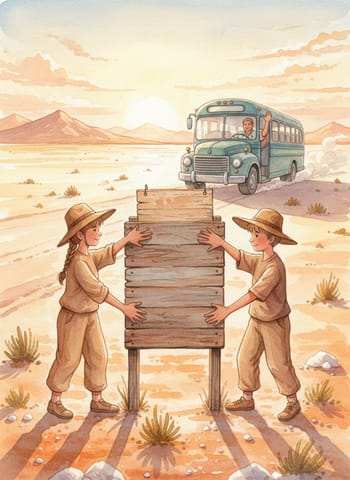
The price board at the Saltwater Stop was older than Lior and Dalila put together.
It stood on two crooked posts at the edge of the car park, between their two stalls. Someone had painted it black long ago. The paint had cracked like dry mud. The stop sat on a salt flat so wide that the horizon looked like a drawn line. Coaches came across it twice a day, and the board was the first thing the passengers read.
Lior sold cold lemon water from a blue cool box. Dalila sold small salt crystals, polished and strung on leather cords. Both of them worked at the stop every summer. Both of them thought the best corner belonged to them.
The trouble began with the board.
On Monday, Lior wrote his price in the first row of the board. He wrote "Cold lemon water, three coins" in tall, square letters, like a man signing a letter. On Tuesday, Dalila wiped it with her sleeve. She wrote "Lemon water, three coins, crystals, five coins" in round, curling letters across the whole top half.
On Wednesday, Lior rubbed out her curls. He drew a line down the middle of the board and wrote his name above the left side. He did not write hers on the right.
"You cannot split a board that belongs to the stop," Dalila said.
"I am not splitting it. I am organising it."
"You are taking it."
"You are writing too big."
They did not speak for the rest of the afternoon. Each of them watched the other from behind a stall. Each pretended to be busy. In the evening the light turned the flat pink. They both walked past the board without looking at it.
By Friday the board was a mess. There were crossed-out numbers, smudged names, and a line down the middle that went crooked halfway. A man who stopped for a drink read it for a long time. Then he walked on without buying anything.
"See what you did," said Dalila.
"Me?" Lior said. "You started it."
At noon on Saturday, a big white coach rolled across the flat. It stopped in a cloud of fine salt dust. The door opened with a sigh. A woman in a bright scarf stepped out and clapped her hands.
"Fifteen minutes, everyone," she called. "Then we leave. The next town is far."
Forty passengers poured out. They were tired and thirsty, and they carried cameras and empty water bottles. They went straight to the board. For a moment, there was a quiet murmur as they tried to read it.
"What does that say?" a man asked.
"I think it says three coins for lemon," said a girl. "Or thirty."
"Is the crystal five, or fifty?"
"Where do I pay?"
Nobody could tell which price belonged to which stall. Some of the passengers tried Lior's cool box and some tried Dalila's table. Nobody was sure of the numbers, and nobody wanted to argue. A few of them looked at their watches. One man took out his phone and began taking a photograph of the board, shaking his head.
The woman in the scarf walked over to the stalls. She had kind eyes, but she looked worried.
"I need to know," she said, "if my passengers can buy things here, and quickly. If they can't read your board, they will go back to the coach and wait. I have done this journey many times. The stop with a clear board gets the money."
Lior opened his mouth. Dalila opened hers. Neither of them said a word.
The woman waited. "I will say it plainly," she said. "You have thirteen minutes. If you cannot give me one clear price list, I will drive away. The next coach will see the same mess."
She walked back to the coach. The passengers stood in the sun and waited.
Lior looked at Dalila. Dalila looked at the board. For a long moment, the only sound was the hum of the cool box.
"I have a rag," Lior said at last.
"I have a bucket," said Dalila, and her voice was small.
They worked quickly. Lior wet the rag in the bucket and wiped the board clean. Dalila fetched a thick white marker from her stall and shook it hard. The surface shone dark and wet for a few seconds. Then it began to dry in the sun.
"You do the numbers," she said. "Your numbers are clear."
"You do the words. Yours are pretty."
"Pretty words do not help anyone who is thirsty."
"They help if people can read them."
Dalila almost smiled. She took the marker and wrote the first line in her round hand: "Lemon water, with ice." Lior took a marker from the cool box lid. Beside it he added the price in his tall, square figures: "3." Then she wrote "Salt crystal on a cord," and he wrote "5."
The letters were different, but they sat side by side, and the board looked better at once.
"We could do one more thing," Dalila said. She was talking fast now. "If someone buys both, they pay seven coins and not eight."
"Seven," said Lior. "That is fair." He wrote it at the bottom and drew a neat line beneath it.
They stepped back. In the middle of the board, the two kinds of handwriting leaned together like two people talking quietly.
"Ready?" he said.
"Ready."
The woman in the scarf blew a whistle, and the forty passengers came back. This time nobody asked what the numbers meant. A girl took three coins out of her pocket and bought a lemon water. A man with a camera bought a crystal for his daughter. Then they started buying both, and the line grew so long that Lior ran out of cups. Dalila ran to a crate behind the stall to fetch more. Lior counted the coins into a tin and called out the prices. Together they served the whole coach in eleven minutes.
When the woman in the scarf climbed the steps, she looked down at them from the door.
"That," she said, "is a good board."
The coach rolled away across the flat, and the dust settled slowly behind it.
For a while they sat on the cool box and counted the coins. The tin was almost full. Neither of them said who had earned more. Lior pushed the tin across the lid, and Dalila took half. Then she pushed one extra coin back to him, because he had run out of cups so fast.
"The line under the seven is crooked," she said.
"I know. I will fix it tomorrow."
"Do not," said Dalila. "Leave it."
By evening the sun sank low, and the flat turned from white to pale gold. The shadows of the crooked posts stretched away across the salt. The board stood between the two stalls, and the last light touched the writing on it. There were tall, square numbers and round, curling words. In the stillness, it looked as if the two hands had been working there together for years.