The Ball on the Roof
A free B1-level English story for language learners, readable online in 7 languages, with an option to listen via the free Storyteller app.
A luggage clerk who always helps others lets a nervous English learner climb onto a roof to fetch a child's lost ball.
That was the preview! Hear the full story in the free Storyteller app. Get the app
Audio isn't available right now.
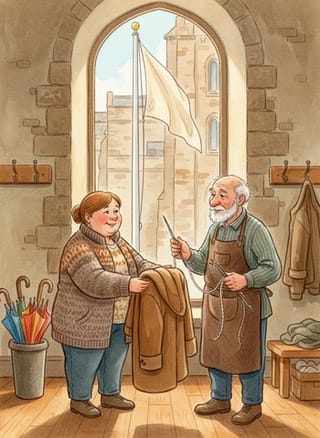
The left-luggage room at Gate Street is a long, narrow room with a counter at one end. Behind the counter stand rows of metal shelves, and every shelf is full of other people's lives. There are suitcases, guitar cases, boxes tied with string and one stuffed rabbit. Lorna has worked here for three years.
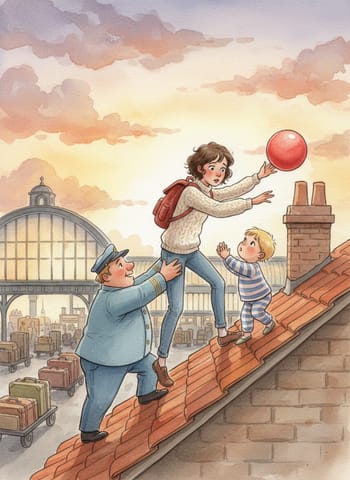
At the back of the room, high on the wall, there is a small window. It looks out onto the flat roof of the ticket office next door. For one month, a blue-and-white ball has sat on that roof. It leans against a metal vent, and Lorna looks at it every morning.
She knows exactly how it got there. A little girl was waiting for a bus with her father. She kicked the ball too hard, and it flew over the wall and rolled onto the roof. The girl did not cry. She stood still and looked up, as if the ball might change its mind.
"I'll get it down for you," Lorna told her father. "Come back tomorrow."
He has come back every day since. He never asks about the ball. He simply stands at the counter, and Lorna says, "Not yet," and he nods and leaves.
The roof is the problem. The only way up is a hatch behind the tallest shelf, and nobody has opened it for years. Lorna does not have the key. She also has no ladder and no permission, and the manager is away until next week. So the ball waits, and so does Lorna.
On a quiet afternoon a man walks in, carrying a heavy blue bag. He is perhaps thirty, with a dark beard and a careful way of standing. He puts a small book on the counter and opens it to a page with a pencil mark.
"Good afternoon," he reads. "I would like to leave my bag. It is for six hours. Is it possible?"
"Of course," says Lorna. "Name, please?"
"Fabrice." He smiles with relief. "Your English is very fast. My English is slow, but I am learning."
"Your English is fine," says Lorna. "You've said it better than most people I know."
She writes a ticket and takes the bag. Fabrice has a bus to catch at nine, and he has six hours to fill before it leaves. He does not seem to know what to do with them. He walks to the end of the room and back. Then he stops by the little window at the back, and he stays there.
"Excuse me," he says. "What is this? On the roof?"
"A ball," Lorna says.
"I see that it is a ball. But why is it there?"
So she tells him. She does it slowly, with simple words. She does the same with every visitor who carries a phrase book. Fabrice listens with his head on one side. When she says "kicked," he repeats it quietly. When she says "hatch," he asks her to draw one.
She draws a square on the back of a ticket. He studies it as if it is a map.
"I know this," he says. "In my country, I am a roofer. For eleven years I climb roofs. This hatch is easy."
"It is locked," says Lorna. "And there's no ladder."
"Is there a… " He searches for the word and makes a shape in the air with his hands.
"A trolley?" asks Lorna. "A big one for the bags?"
"Yes! A trolley. And a long stick?"
Lorna looks at him. For three years she has been the person who helps. She gives directions, finds lost tickets and teaches people to say "platform." Nobody has ever offered to climb a roof for her. She feels something unfamiliar, and it takes her a moment to name it. It is the feeling of being helped.
"I have a broom," she says. "And there's a screwdriver in the drawer."
The hatch is old and stiff. Fabrice pulls the tallest shelf away from the wall with a loud squeal. A cloud of dust rises. Lorna holds her hand over her mouth. He does not mind the dust. He takes the screwdriver and starts on the lock. He hums a tune that sounds very old.
"Do you do this often?" she asks.
"Every day, at home. Here it is a holiday." He grins. "But my hands remember."
It takes twenty minutes. At last the lock gives a small click, and the hatch swings open. A square of white sky appears above them. Fabrice puts one foot on the trolley, and it rolls. He says a word in his own language, and Lorna catches the trolley with both hands.
"Hold it," he says. "Please. Strongly."
"I'm holding!"
He climbs through the hatch, first his arms, then his shoulders, then his knees. For a moment only his boots hang in the air. Then they disappear too. Lorna stands alone in the left-luggage room. She holds the trolley with all her weight and listens to footsteps on the ceiling.
"Can you see it?" she calls.
"I see it! It is behind the vent." The footsteps stop. "It is hard to reach. I must lie down."
Lorna waits. A bus engine starts outside, and then another. Customers come and go behind her, but today they find a closed counter with a note. She has written, "Back in ten minutes," and then crossed out ten, and written twenty.
"Lorna!" The voice is high above her. "I have it!"
A moment later the ball drops through the hatch and bounces twice on the floor. She picks it up. It is dusty and a little soft, but whole. A thin line of grey marker runs round its middle, as if someone wrote on it long ago.
Fabrice comes down the same way he went up, backwards and slowly. His shirt is black with dirt, and he is smiling like a boy. He sits on the trolley and shakes the dust out of his beard.
"Thank you," Lorna says. The words feel too small. "I mean it. Thank you."
"No, no," says Fabrice. "Thank you. You speak with me for one hour. I speak English more than in one month."
The girl's father arrives at four, as he does every day. He stands at the counter and looks at Lorna, and she says nothing at all. She just puts the ball in his hands. He looks at it for a long time. Then he laughs and says a few words in an unsteady voice. He hurries out to find his daughter.
Lorna wipes the counter and turns back to the room. Fabrice is washing his hands at the small sink. Beside him lies his phrase book, still open, and she sees a new pencil mark on the page. It is next to the word "hatch."
When she dusts the shelves that evening, she notices something else. The ball has left a faint ring of dust on the floor where she put it down. In the middle of the ring lies a small bit of paper, that came off the ball. It has a few letters in grey marker, and a place name she does not know.
Fabrice walks over to look. He reads it once, and then again. His mouth opens, and then it closes.
"What does it say?" Lorna asks.
Outside, the loudspeaker crackles into life. A voice announces the nine o'clock bus. Fabrice folds the paper twice and puts it in his pocket.