The Flag That Would Not Rise
A free B1-level English story for language learners, readable online in 7 languages, with an option to listen via the free Storyteller app.
A museum cloakroom worker meets a sailmaker who knows why the building's flag has never reached the top of its pole.
That was the preview! Hear the full story in the free Storyteller app. Get the app
Audio isn't available right now.
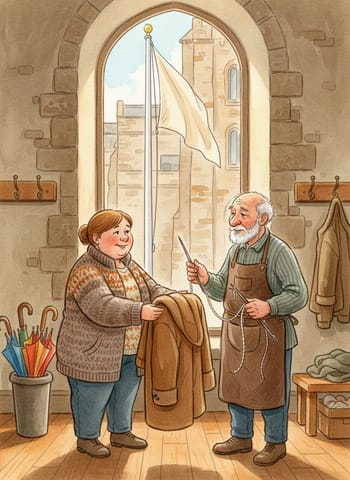
Every morning at eight, Abena turned the brass wheel in the back corner of the cloakroom. The wheel was old and heavy. It pulled a long cord up through the wall and over the roof. The cord ran out to the flagpole above the museum door.
For eleven years the flag had risen halfway and then stopped. Nobody at the museum knew why. Abena always gave the wall two soft knocks and said good morning to the flag in her head. Then she went back to her counter.
She liked her routine. She liked the smell of floor polish and the quiet before the first visitors came. She liked the long rows of empty hooks, waiting for coats.
On a Monday in March, somebody tapped on the counter. It was ten past eight, and the museum was still closed. Abena had not turned the wheel yet. She looked up from her list of school visits, annoyed with herself.
A tall man stood there with a canvas bag on his shoulder. He held a coil of thin rope in one hand. He looked friendly and slightly unsure of himself.
"Sorry to bother you," he said. "I know you are not open yet. Is this where the flag cord comes into the building?"
Abena stared at him. "How do you know about the cord?"
"I work across the road," he said. "I mend sails and tents. My workshop window looks straight at your roof."
"Every morning your flag goes up halfway and stops. I have seen it a thousand times. Today I finally decided to come over."
"It has done that for eleven years," Abena said.
The man laughed. "Then I am very late. My name is Anand. May I look at it?"
"The wheel belongs to the building," Abena said. "The director says nobody may touch it. It is on a list of old things."
"I will not touch the wheel," said Anand. "I only want to look at the roof. If I am wrong, I will go away and never mention the flag again."
Abena thought about it. She did not usually say yes to strangers with rope. But he sounded honest, and eleven years was a long time to knock on a wall.
She phoned the director's office. An assistant listened, sighed, and said the caretaker could take Anand up, if Anand signed a paper first.
Anand signed it. Then they found the caretaker, a man with a bad knee, drinking his coffee.
The caretaker looked at the stairs, then at his knee, then at Abena. "You go with him," he said, and gave her a ring of keys. "You know that wheel better than anyone. Bring the keys back."
So Abena climbed the narrow stairs behind a stranger, which she had never done before. The last door opened onto a flat roof with a low wall around it. The flagpole stood at the far end, thin and dark against the pale sky.
Anand knelt at the base of the pole. "Come and see," he said.
The cord crossed the roof and turned a corner over a small wooden pulley. Then it climbed the pole. A long crack split the wood down the middle.
"There is your problem," Anand said. "The wheel in your cloakroom is fine. This pulley is old and soft."
He pulled gently on the cord, and a fat knot slid into view. "Somebody joined two pieces of cord here and tied them together. When the knot reaches the crack, it catches. Then everything stops."
"Somebody in a hurry," Abena said.
"Somebody in a hurry, eleven years ago," Anand agreed. "If you force the knot through, the wood will split. Please leave the flag down today."
"Can you fix it?" she asked.
He shook his head. "I need a small metal pulley, and I do not have one. But I know a man with a lathe. If I ask politely, he will make me a brass wheel. It will take two days."
Abena looked at the bare pole. She remembered the photographs in the entrance hall, where the flag stood proudly at the very top.
"Two days is nothing," she said. "I have waited eleven years."
The museum opened at half past nine, and the first problem arrived at once. A boy in a school group pointed through the glass door. "Why is there no flag?"
"It is on holiday," said Abena. The boy accepted this immediately. His teacher did not look so sure.
All morning, coats came across her counter, thirty and then forty more. Abena hung each one on a hook and handed out numbered tokens. She loved the rhythm of the work. But that day she kept glancing at the glass door. The man with the rope might walk back through it.
On Tuesday, Anand did not come. At eight o'clock Abena put her hand on the wheel out of habit, then took it away again. The cloakroom was as quiet as always. For some reason, the quiet no longer felt comfortable.
On Wednesday morning, he did not come either. She told herself that this was normal. People had jobs. Brass wheels were difficult to make. She checked the clock eleven times before lunch.
He walked in at closing time, when the last visitors were leaving. There was a dark smudge on his cheek, and he held something wrapped in a cloth.
"I am sorry," he said. "My friend had to start again twice. The first wheel was not round enough."
"Is it round now?" Abena asked.
"Perfectly round." Anand opened the cloth. The little brass wheel shone in his hand. "I also brought a new cord. I will weave the ends together instead of tying a knot. Then nothing can catch."
The caretaker had already gone home, so Abena took the keys herself. They climbed the stairs together in the half dark. She held the lamp while Anand worked. Their fingers touched once when he passed her the old pulley.
He set the brass wheel in its place. Then he joined the cord with a smooth, thick weave of strands. She could not follow it with her eyes. His hands were careful and quick, like the hands of a surgeon.
"Where did you learn to do that?" she asked.
"On boats," he said. "My father repaired sails. Now I live in a town with no harbour, and I mend tents." He smiled. "Somebody has to look after the things that lift."
At last he stood up and wiped his hands on his trousers. "Go downstairs," he said. "Turn the wheel slowly. I will stay here and watch the pulley."
Abena went down through the empty museum. The cloakroom was dim and smelled of polish. The hooks stood in their rows like a small, quiet crowd. She put both hands on the brass wheel and turned.
It moved easily, with a soft click at every tooth. She turned, and turned, and kept turning. She waited for the stop that had come every morning for eleven years. It did not come.
Then the wheel gave a small jump and held firm by itself. Abena stood very still.
She walked out through the glass doors and onto the front steps. The street lamps had just come on. A minute later, Anand appeared beside her, breathing hard from the stairs.
High above the door, the flag hung at the very top of the pole. It was fully open for the first time in eleven years.
Neither of them spoke. His shoulder was close to hers. Above them the cord hummed softly against the new brass wheel. The flag moved a little in the dark, as if it were breathing.