The Flag That Would Not Rise
Una historia gratuita en inglés de nivel B1 para estudiantes, para leer en línea en 7 idiomas, con opción de escucharla en la app gratuita Storyteller.
A museum cloakroom worker meets a sailmaker who knows why the building's flag has never reached the top of its pole.
¡Ese fue el avance! Escucha la historia completa en la app gratuita Storyteller. Descargar la app
El audio no está disponible en este momento.
Every morning at eight, Abena turned the brass wheel in the back corner of the cloakroom. The wheel was old and heavy. It pulled a long cord up through the wall and over the roof. The cord ran out to the flagpole above the museum door.
Cada mañana a las ocho, Abena giraba la rueda de bronce en el rincón del fondo del guardarropa. La rueda era vieja y pesada. Tiraba de un largo cordel que subía por la pared y pasaba sobre el techo. El cordel llegaba hasta el asta de la bandera sobre la puerta del museo.
For eleven years the flag had risen halfway and then stopped. Nobody at the museum knew why. Abena always gave the wall two soft knocks and said good morning to the flag in her head. Then she went back to her counter.
Durante once años la bandera había subido hasta la mitad y se había detenido. Nadie en el museo sabía por qué. Abena siempre le daba a la pared dos golpecitos suaves y le decía buenos días a la bandera en su cabeza. Luego volvía a su mostrador.
She liked her routine. She liked the smell of floor polish and the quiet before the first visitors came. She liked the long rows of empty hooks, waiting for coats.
Le gustaba su rutina. Le gustaba el olor a cera para pisos y la quietud antes de que llegaran los primeros visitantes. Le gustaban las largas hileras de ganchos vacíos, esperando abrigos.
On a Monday in March, somebody tapped on the counter. It was ten past eight, and the museum was still closed. Abena had not turned the wheel yet. She looked up from her list of school visits, annoyed with herself.
Un lunes de marzo, alguien golpeó el mostrador. Eran las ocho y diez, y el museo todavía estaba cerrado. Abena aún no había girado la rueda. Levantó la vista de su lista de visitas escolares, molesta consigo misma.
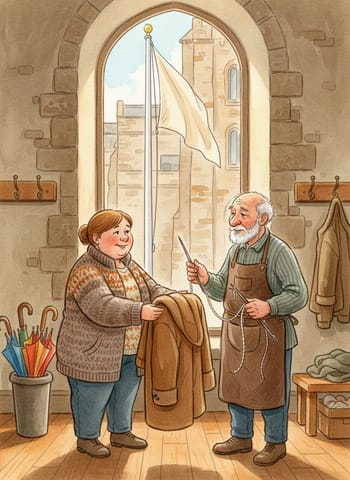
A tall man stood there with a canvas bag on his shoulder. He held a coil of thin rope in one hand. He looked friendly and slightly unsure of himself.
Un hombre alto estaba ahí, con un bolso de lona al hombro. Tenía en una mano un rollo de cuerda delgada. Parecía amable y un poco inseguro.
"Sorry to bother you," he said. "I know you are not open yet. Is this where the flag cord comes into the building?"
«Perdone la molestia», dijo. «Sé que todavía no abren. ¿Es aquí donde entra el cordel de la bandera al edificio?».
Abena stared at him. "How do you know about the cord?"
Abena lo miró fijamente. «¿Cómo sabe usted lo del cordel?».
"I work across the road," he said. "I mend sails and tents. My workshop window looks straight at your roof."
«Trabajo al otro lado de la calle», dijo. «Arreglo velas y carpas. La ventana de mi taller da justo a su techo».
"Every morning your flag goes up halfway and stops. I have seen it a thousand times. Today I finally decided to come over."
«Todas las mañanas su bandera sube hasta la mitad y se detiene. La he visto mil veces. Hoy por fin me decidí a venir».
"It has done that for eleven years," Abena said.
«Lleva once años haciendo eso», dijo Abena.
The man laughed. "Then I am very late. My name is Anand. May I look at it?"
El hombre se rió. «Entonces llego muy tarde. Me llamo Anand. ¿Puedo mirarlo?».
"The wheel belongs to the building," Abena said. "The director says nobody may touch it. It is on a list of old things."
«La rueda pertenece al edificio», dijo Abena. «La directora dice que nadie puede tocarla. Está en una lista de cosas antiguas».
"I will not touch the wheel," said Anand. "I only want to look at the roof. If I am wrong, I will go away and never mention the flag again."
«No tocaré la rueda», dijo Anand. «Solo quiero ver el techo. Si me equivoco, me iré y no volveré a mencionar la bandera».
Abena thought about it. She did not usually say yes to strangers with rope. But he sounded honest, and eleven years was a long time to knock on a wall.
Abena lo pensó. Normalmente no le decía que sí a desconocidos con cuerdas. Pero sonaba honesto, y once años era mucho tiempo para golpear una pared.
She phoned the director's office. An assistant listened, sighed, and said the caretaker could take Anand up, if Anand signed a paper first.
Llamó por teléfono a la oficina de la directora. Una asistente escuchó, suspiró y dijo que el encargado podía llevar a Anand arriba, si Anand firmaba antes un papel.
Anand signed it. Then they found the caretaker, a man with a bad knee, drinking his coffee.
Anand lo firmó. Luego buscaron al encargado, un hombre con la rodilla mala, que se tomaba su café.
The caretaker looked at the stairs, then at his knee, then at Abena. "You go with him," he said, and gave her a ring of keys. "You know that wheel better than anyone. Bring the keys back."
El encargado miró las escaleras, luego su rodilla, luego a Abena. «Vaya usted con él», dijo, y le dio un llavero con llaves. «Usted conoce esa rueda mejor que nadie. Devuélvame las llaves».
So Abena climbed the narrow stairs behind a stranger, which she had never done before. The last door opened onto a flat roof with a low wall around it. The flagpole stood at the far end, thin and dark against the pale sky.
Así que Abena subió por la estrecha escalera detrás de un desconocido, algo que nunca había hecho. La última puerta daba a una azotea plana con un muro bajo alrededor. El asta se alzaba en el extremo opuesto, delgada y oscura contra el cielo pálido.
Anand knelt at the base of the pole. "Come and see," he said.
Anand se arrodilló al pie del asta. «Venga a ver», dijo.
The cord crossed the roof and turned a corner over a small wooden pulley. Then it climbed the pole. A long crack split the wood down the middle.
El cordel cruzaba la azotea y doblaba una esquina sobre una pequeña polea de madera. Luego trepaba por el asta. Una larga grieta partía la madera por el medio.
"There is your problem," Anand said. "The wheel in your cloakroom is fine. This pulley is old and soft."
«Ahí está su problema», dijo Anand. «La rueda de su guardarropa está bien. Esta polea es vieja y blanda».
He pulled gently on the cord, and a fat knot slid into view. "Somebody joined two pieces of cord here and tied them together. When the knot reaches the crack, it catches. Then everything stops."
Tiró suavemente del cordel y un nudo grueso apareció a la vista. «Alguien unió aquí dos pedazos de cordel y los amarró. Cuando el nudo llega a la grieta, se atora. Entonces todo se detiene».
"Somebody in a hurry," Abena said.
«Alguien con prisa», dijo Abena.
"Somebody in a hurry, eleven years ago," Anand agreed. "If you force the knot through, the wood will split. Please leave the flag down today."
«Alguien con prisa, hace once años», concordó Anand. «Si fuerza el nudo para que pase, la madera se partirá. Por favor, deje la bandera abajo hoy».
"Can you fix it?" she asked.
«¿Puede arreglarlo?», preguntó ella.
He shook his head. "I need a small metal pulley, and I do not have one. But I know a man with a lathe. If I ask politely, he will make me a brass wheel. It will take two days."
Él negó con la cabeza. «Necesito una polea pequeña de metal, y no tengo ninguna. Pero conozco a un hombre con un torno. Si se lo pido con amabilidad, me hará una rueda de bronce. Tardará dos días».
Abena looked at the bare pole. She remembered the photographs in the entrance hall, where the flag stood proudly at the very top.
Abena miró el asta desnuda. Recordó las fotografías en el vestíbulo de entrada, donde la bandera se alzaba orgullosa en lo más alto.
"Two days is nothing," she said. "I have waited eleven years."
«Dos días no es nada», dijo. «He esperado once años».
The museum opened at half past nine, and the first problem arrived at once. A boy in a school group pointed through the glass door. "Why is there no flag?"
El museo abrió a las nueve y media, y el primer problema llegó de inmediato. Un niño de un grupo escolar señaló a través de la puerta de vidrio. «¿Por qué no hay bandera?».
"It is on holiday," said Abena. The boy accepted this immediately. His teacher did not look so sure.
«Está de vacaciones», dijo Abena. El niño lo aceptó al instante. Su maestra no parecía tan convencida.
All morning, coats came across her counter, thirty and then forty more. Abena hung each one on a hook and handed out numbered tokens. She loved the rhythm of the work. But that day she kept glancing at the glass door. The man with the rope might walk back through it.
Toda la mañana, los abrigos pasaron por su mostrador, treinta y luego cuarenta más. Abena colgaba cada uno en un gancho y repartía fichas numeradas. Le encantaba el ritmo del trabajo. Pero ese día no dejaba de mirar la puerta de vidrio. El hombre de la cuerda podía volver a cruzarla.
On Tuesday, Anand did not come. At eight o'clock Abena put her hand on the wheel out of habit, then took it away again. The cloakroom was as quiet as always. For some reason, the quiet no longer felt comfortable.
El martes, Anand no vino. A las ocho Abena puso la mano en la rueda por costumbre, y luego la retiró. El guardarropa estaba tan silencioso como siempre. Por alguna razón, el silencio ya no se sentía cómodo.
On Wednesday morning, he did not come either. She told herself that this was normal. People had jobs. Brass wheels were difficult to make. She checked the clock eleven times before lunch.
El miércoles por la mañana, tampoco vino. Se dijo que eso era normal. La gente tenía trabajo. Las ruedas de bronce eran difíciles de hacer. Miró el reloj once veces antes del almuerzo.
He walked in at closing time, when the last visitors were leaving. There was a dark smudge on his cheek, and he held something wrapped in a cloth.
Entró a la hora de cierre, cuando los últimos visitantes se iban. Tenía una mancha oscura en la mejilla y sostenía algo envuelto en un trapo.
"I am sorry," he said. "My friend had to start again twice. The first wheel was not round enough."
«Lo siento», dijo. «Mi amigo tuvo que empezar de nuevo dos veces. La primera rueda no era lo bastante redonda».
"Is it round now?" Abena asked.
«¿Y ahora es redonda?», preguntó Abena.
"Perfectly round." Anand opened the cloth. The little brass wheel shone in his hand. "I also brought a new cord. I will weave the ends together instead of tying a knot. Then nothing can catch."
«Perfectamente redonda». Anand abrió el trapo. La pequeña rueda de bronce brillaba en su mano. «También traje un cordel nuevo. Trenzaré los extremos en lugar de hacer un nudo. Así nada se podrá atorar».
The caretaker had already gone home, so Abena took the keys herself. They climbed the stairs together in the half dark. She held the lamp while Anand worked. Their fingers touched once when he passed her the old pulley.
El encargado ya se había ido a casa, así que Abena tomó las llaves ella misma. Subieron juntos las escaleras en la penumbra. Ella sostuvo la lámpara mientras Anand trabajaba. Sus dedos se tocaron una vez cuando él le pasó la polea vieja.
He set the brass wheel in its place. Then he joined the cord with a smooth, thick weave of strands. She could not follow it with her eyes. His hands were careful and quick, like the hands of a surgeon.
Colocó la rueda de bronce en su lugar. Luego unió el cordel con una trenza lisa y gruesa de hebras. Ella no podía seguirlo con los ojos. Sus manos eran cuidadosas y rápidas, como las de un cirujano.
"Where did you learn to do that?" she asked.
«¿Dónde aprendió a hacer eso?», preguntó ella.
"On boats," he said. "My father repaired sails. Now I live in a town with no harbour, and I mend tents." He smiled. "Somebody has to look after the things that lift."
«En los barcos», dijo él. «Mi padre reparaba velas. Ahora vivo en un pueblo sin puerto, y arreglo carpas». Sonrió. «Alguien tiene que cuidar las cosas que elevan».
At last he stood up and wiped his hands on his trousers. "Go downstairs," he said. "Turn the wheel slowly. I will stay here and watch the pulley."
Por fin se puso de pie y se limpió las manos en los pantalones. «Baje», dijo. «Gire la rueda despacio. Yo me quedo aquí a vigilar la polea».
Abena went down through the empty museum. The cloakroom was dim and smelled of polish. The hooks stood in their rows like a small, quiet crowd. She put both hands on the brass wheel and turned.
Abena bajó por el museo vacío. El guardarropa estaba en penumbra y olía a cera. Los ganchos estaban en sus hileras como una pequeña multitud silenciosa. Puso las dos manos en la rueda de bronce y giró.
It moved easily, with a soft click at every tooth. She turned, and turned, and kept turning. She waited for the stop that had come every morning for eleven years. It did not come.
Se movió con facilidad, con un suave clic en cada diente. Giró, y giró, y siguió girando. Esperó el tope que había llegado cada mañana durante once años. No llegó.
Then the wheel gave a small jump and held firm by itself. Abena stood very still.
Entonces la rueda dio un pequeño salto y se sostuvo firme por sí sola. Abena se quedó muy quieta.
She walked out through the glass doors and onto the front steps. The street lamps had just come on. A minute later, Anand appeared beside her, breathing hard from the stairs.
Salió por las puertas de vidrio hasta los escalones del frente. Las lámparas de la calle acababan de encenderse. Un minuto después, Anand apareció a su lado, jadeando por las escaleras.
High above the door, the flag hung at the very top of the pole. It was fully open for the first time in eleven years.
Muy arriba de la puerta, la bandera colgaba en lo más alto del asta. Estaba completamente desplegada por primera vez en once años.
Neither of them spoke. His shoulder was close to hers. Above them the cord hummed softly against the new brass wheel. The flag moved a little in the dark, as if it were breathing.
Ninguno de los dos habló. Su hombro estaba cerca del de ella. Sobre ellos el cordel zumbaba suavemente contra la nueva rueda de bronce. La bandera se movía un poco en la oscuridad, como si respirara.