The Flag That Would Not Rise
Uma história gratuita em inglês de nível B1 para estudantes, para ler online em 7 idiomas, com opção de ouvir no app gratuito Storyteller.
A museum cloakroom worker meets a sailmaker who knows why the building's flag has never reached the top of its pole.
Essa foi a prévia! Ouça a história completa no app gratuito Storyteller. Baixar o app
O áudio não está disponível no momento.
Every morning at eight, Abena turned the brass wheel in the back corner of the cloakroom. The wheel was old and heavy. It pulled a long cord up through the wall and over the roof. The cord ran out to the flagpole above the museum door.
Toda manhã às oito, Abena girava a roda de latão no canto dos fundos do guarda-volumes. A roda era velha e pesada. Ela puxava um longo cabo por dentro da parede e por cima do telhado. O cabo seguia até o mastro acima da porta do museu.
For eleven years the flag had risen halfway and then stopped. Nobody at the museum knew why. Abena always gave the wall two soft knocks and said good morning to the flag in her head. Then she went back to her counter.
Havia onze anos que a bandeira subia até a metade e parava. Ninguém no museu sabia por quê. Abena sempre dava duas batidinhas na parede e dizia bom dia à bandeira em pensamento. Depois voltava para o balcão.
She liked her routine. She liked the smell of floor polish and the quiet before the first visitors came. She liked the long rows of empty hooks, waiting for coats.
Ela gostava da sua rotina. Gostava do cheiro de cera de piso e do silêncio antes de os primeiros visitantes chegarem. Gostava das longas fileiras de cabides vazios, esperando casacos.
On a Monday in March, somebody tapped on the counter. It was ten past eight, and the museum was still closed. Abena had not turned the wheel yet. She looked up from her list of school visits, annoyed with herself.
Numa segunda-feira de março, alguém bateu no balcão. Eram oito e dez, e o museu ainda estava fechado. Abena ainda não tinha girado a roda. Ergueu os olhos da lista de visitas escolares, irritada consigo mesma.
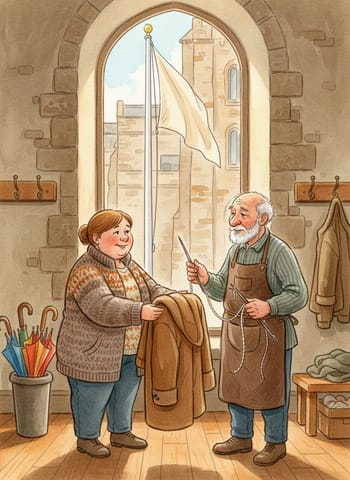
A tall man stood there with a canvas bag on his shoulder. He held a coil of thin rope in one hand. He looked friendly and slightly unsure of himself.
Um homem alto estava ali, com uma bolsa de lona no ombro. Segurava um rolo de corda fina numa das mãos. Tinha um jeito simpático e um pouco inseguro.
"Sorry to bother you," he said. "I know you are not open yet. Is this where the flag cord comes into the building?"
"Desculpe incomodar", disse ele. "Sei que ainda não abriram. É aqui que o cabo da bandeira entra no prédio?"
Abena stared at him. "How do you know about the cord?"
Abena o encarou. "Como você sabe do cabo?"
"I work across the road," he said. "I mend sails and tents. My workshop window looks straight at your roof."
"Trabalho do outro lado da rua", disse ele. "Conserto velas e tendas. A janela da minha oficina dá direto para o seu telhado."
"Every morning your flag goes up halfway and stops. I have seen it a thousand times. Today I finally decided to come over."
"Toda manhã a sua bandeira sobe até a metade e para. Já vi isso mil vezes. Hoje finalmente resolvi vir aqui."
"It has done that for eleven years," Abena said.
"Faz isso há onze anos", disse Abena.
The man laughed. "Then I am very late. My name is Anand. May I look at it?"
O homem riu. "Então estou muito atrasado. Meu nome é Anand. Posso dar uma olhada?"
"The wheel belongs to the building," Abena said. "The director says nobody may touch it. It is on a list of old things."
"A roda pertence ao prédio", disse Abena. "O diretor diz que ninguém pode mexer nela. Está numa lista de coisas antigas."
"I will not touch the wheel," said Anand. "I only want to look at the roof. If I am wrong, I will go away and never mention the flag again."
"Não vou mexer na roda", disse Anand. "Só quero olhar o telhado. Se eu estiver errado, vou embora e nunca mais menciono a bandeira."
Abena thought about it. She did not usually say yes to strangers with rope. But he sounded honest, and eleven years was a long time to knock on a wall.
Abena pensou. Normalmente não dizia sim a estranhos com corda. Mas ele parecia honesto, e onze anos era muito tempo batendo numa parede.
She phoned the director's office. An assistant listened, sighed, and said the caretaker could take Anand up, if Anand signed a paper first.
Ela telefonou para o escritório do diretor. Uma assistente ouviu, suspirou e disse que o zelador poderia levar Anand lá em cima, se Anand assinasse um papel antes.
Anand signed it. Then they found the caretaker, a man with a bad knee, drinking his coffee.
Anand assinou. Depois encontraram o zelador, um homem de joelho ruim, tomando café.
The caretaker looked at the stairs, then at his knee, then at Abena. "You go with him," he said, and gave her a ring of keys. "You know that wheel better than anyone. Bring the keys back."
O zelador olhou para a escada, depois para o joelho, depois para Abena. "Você vai com ele", disse, e lhe deu um molho de chaves. "Você conhece aquela roda melhor do que ninguém. Traga as chaves de volta."
So Abena climbed the narrow stairs behind a stranger, which she had never done before. The last door opened onto a flat roof with a low wall around it. The flagpole stood at the far end, thin and dark against the pale sky.
Assim, Abena subiu a escada estreita atrás de um desconhecido, algo que nunca tinha feito. A última porta se abria para um terraço plano cercado por um muro baixo. O mastro ficava na outra ponta, fino e escuro contra o céu pálido.
Anand knelt at the base of the pole. "Come and see," he said.
Anand se ajoelhou na base do mastro. "Venha ver", disse.
The cord crossed the roof and turned a corner over a small wooden pulley. Then it climbed the pole. A long crack split the wood down the middle.
O cabo atravessava o terraço e fazia uma curva sobre uma pequena roldana de madeira. Depois subia pelo mastro. Uma longa rachadura partia a madeira ao meio.
"There is your problem," Anand said. "The wheel in your cloakroom is fine. This pulley is old and soft."
"Aí está o seu problema", disse Anand. "A roda do guarda-volumes está ótima. Esta roldana é velha e mole."
He pulled gently on the cord, and a fat knot slid into view. "Somebody joined two pieces of cord here and tied them together. When the knot reaches the crack, it catches. Then everything stops."
Ele puxou o cabo com delicadeza, e um nó grosso apareceu. "Alguém emendou dois pedaços de corda aqui e os amarrou. Quando o nó chega na rachadura, ele prende. Aí tudo para."
"Somebody in a hurry," Abena said.
"Alguém com pressa", disse Abena.
"Somebody in a hurry, eleven years ago," Anand agreed. "If you force the knot through, the wood will split. Please leave the flag down today."
"Alguém com pressa, onze anos atrás", concordou Anand. "Se você forçar o nó a passar, a madeira vai rachar de vez. Por favor, deixe a bandeira embaixo hoje."
"Can you fix it?" she asked.
"Você consegue consertar?", perguntou ela.
He shook his head. "I need a small metal pulley, and I do not have one. But I know a man with a lathe. If I ask politely, he will make me a brass wheel. It will take two days."
Ele balançou a cabeça. "Preciso de uma roldana de metal pequena, e não tenho nenhuma. Mas conheço um homem que tem um torno. Se eu pedir com educação, ele faz uma roda de latão para mim. Vai levar dois dias."
Abena looked at the bare pole. She remembered the photographs in the entrance hall, where the flag stood proudly at the very top.
Abena olhou para o mastro nu. Lembrou das fotografias no saguão de entrada, em que a bandeira se erguia orgulhosa lá no alto.
"Two days is nothing," she said. "I have waited eleven years."
"Dois dias não é nada", disse ela. "Esperei onze anos."
The museum opened at half past nine, and the first problem arrived at once. A boy in a school group pointed through the glass door. "Why is there no flag?"
O museu abriu às nove e meia, e o primeiro problema apareceu na hora. Um menino de um grupo escolar apontou através da porta de vidro. "Por que não tem bandeira?"
"It is on holiday," said Abena. The boy accepted this immediately. His teacher did not look so sure.
"Ela está de férias", disse Abena. O menino aceitou na mesma hora. A professora dele não pareceu tão convencida.
All morning, coats came across her counter, thirty and then forty more. Abena hung each one on a hook and handed out numbered tokens. She loved the rhythm of the work. But that day she kept glancing at the glass door. The man with the rope might walk back through it.
A manhã inteira, casacos passaram pelo balcão dela, trinta e depois mais quarenta. Abena pendurava cada um num cabide e distribuía fichas numeradas. Adorava o ritmo do trabalho. Mas naquele dia ficava olhando de relance para a porta de vidro. O homem da corda podia voltar por ela.
On Tuesday, Anand did not come. At eight o'clock Abena put her hand on the wheel out of habit, then took it away again. The cloakroom was as quiet as always. For some reason, the quiet no longer felt comfortable.
Na terça-feira, Anand não veio. Às oito horas Abena pôs a mão na roda por hábito e depois a tirou. O guarda-volumes estava tão quieto como sempre. Por algum motivo, o silêncio já não parecia confortável.
On Wednesday morning, he did not come either. She told herself that this was normal. People had jobs. Brass wheels were difficult to make. She checked the clock eleven times before lunch.
Na quarta-feira de manhã, ele também não veio. Ela disse a si mesma que isso era normal. As pessoas tinham empregos. Rodas de latão eram difíceis de fazer. Conferiu o relógio onze vezes antes do almoço.
He walked in at closing time, when the last visitors were leaving. There was a dark smudge on his cheek, and he held something wrapped in a cloth.
Ele entrou na hora de fechar, quando os últimos visitantes estavam saindo. Havia uma mancha escura em sua bochecha, e ele segurava algo embrulhado num pano.
"I am sorry," he said. "My friend had to start again twice. The first wheel was not round enough."
"Desculpe", disse. "Meu amigo teve que recomeçar duas vezes. A primeira roda não estava redonda o bastante."
"Is it round now?" Abena asked.
"E agora está redonda?", perguntou Abena.
"Perfectly round." Anand opened the cloth. The little brass wheel shone in his hand. "I also brought a new cord. I will weave the ends together instead of tying a knot. Then nothing can catch."
"Perfeitamente redonda." Anand abriu o pano. A pequena roda de latão brilhou na mão dele. "Trouxe também um cabo novo. Vou trançar as pontas em vez de dar um nó. Assim nada pode prender."
The caretaker had already gone home, so Abena took the keys herself. They climbed the stairs together in the half dark. She held the lamp while Anand worked. Their fingers touched once when he passed her the old pulley.
O zelador já tinha ido para casa, então Abena pegou as chaves ela mesma. Subiram a escada juntos na penumbra. Ela segurou a lamparina enquanto Anand trabalhava. Seus dedos se tocaram uma vez, quando ele lhe passou a roldana velha.
He set the brass wheel in its place. Then he joined the cord with a smooth, thick weave of strands. She could not follow it with her eyes. His hands were careful and quick, like the hands of a surgeon.
Ele colocou a roda de latão no lugar. Depois uniu o cabo com uma trama lisa e grossa de fios. Ela não conseguia acompanhar com os olhos. As mãos dele eram cuidadosas e rápidas, como as de um cirurgião.
"Where did you learn to do that?" she asked.
"Onde você aprendeu a fazer isso?", perguntou ela.
"On boats," he said. "My father repaired sails. Now I live in a town with no harbour, and I mend tents." He smiled. "Somebody has to look after the things that lift."
"Em barcos", disse ele. "Meu pai consertava velas. Agora moro numa cidade sem porto, e conserto tendas." Sorriu. "Alguém tem que cuidar das coisas que erguem."
At last he stood up and wiped his hands on his trousers. "Go downstairs," he said. "Turn the wheel slowly. I will stay here and watch the pulley."
Por fim ele se levantou e limpou as mãos na calça. "Desça", disse. "Gire a roda devagar. Eu fico aqui e olho a roldana."
Abena went down through the empty museum. The cloakroom was dim and smelled of polish. The hooks stood in their rows like a small, quiet crowd. She put both hands on the brass wheel and turned.
Abena desceu pelo museu vazio. O guarda-volumes estava na penumbra e cheirava a cera. Os cabides formavam suas fileiras como uma pequena multidão silenciosa. Ela pôs as duas mãos na roda de latão e girou.
It moved easily, with a soft click at every tooth. She turned, and turned, and kept turning. She waited for the stop that had come every morning for eleven years. It did not come.
Ela se movia com facilidade, com um clique suave a cada dente. Abena girou, e girou, e continuou girando. Esperou pela parada que vinha toda manhã havia onze anos. Ela não veio.
Then the wheel gave a small jump and held firm by itself. Abena stood very still.
Então a roda deu um pequeno pulo e se firmou sozinha. Abena ficou muito quieta.
She walked out through the glass doors and onto the front steps. The street lamps had just come on. A minute later, Anand appeared beside her, breathing hard from the stairs.
Saiu pelas portas de vidro e foi até os degraus da frente. Os postes de luz tinham acabado de acender. Um minuto depois, Anand apareceu ao lado dela, ofegante da escada.
High above the door, the flag hung at the very top of the pole. It was fully open for the first time in eleven years.
Bem alto, acima da porta, a bandeira pendia no topo do mastro. Estava totalmente aberta pela primeira vez em onze anos.
Neither of them spoke. His shoulder was close to hers. Above them the cord hummed softly against the new brass wheel. The flag moved a little in the dark, as if it were breathing.
Nenhum dos dois falou. O ombro dele estava perto do dela. Acima deles, o cabo zumbia baixinho contra a roda de latão nova. A bandeira se mexeu um pouco no escuro, como se estivesse respirando.