The Name Under the Sandpaper
Uma história gratuita em inglês de nível B1 para estudantes, para ler online em 7 idiomas, com opção de ouvir no app gratuito Storyteller.
Teo wants to return a borrowed guitar looking new, but his careful polishing erases the one thing that made it his friend's.
Essa foi a prévia! Ouça a história completa no app gratuito Storyteller. Baixar o app
O áudio não está disponível no momento.
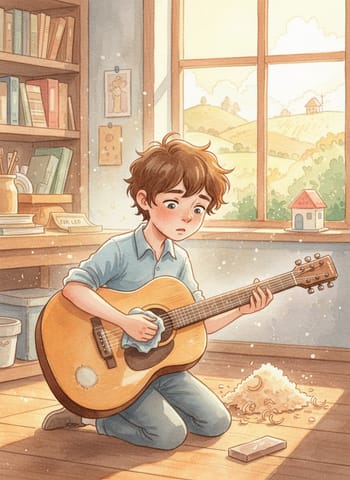
Teo sits on an upturned crate at the far end of the fishing pier. The light is low, and the water under the boards looks like melted copper. Across his knees lies a battered guitar.
Teo está sentado num caixote virado, na ponta do cais de pesca. A luz está baixa, e a água sob as tábuas parece cobre derretido. Sobre os joelhos dele repousa um violão surrado.
The guitar has seen better years. A long scratch runs across the front. There is a dent near the neck, and one tuning peg is newer than the others. Teo loves every mark on it, but tonight he wants it to shine.
O violão já viu dias melhores. Um longo arranhão corta a frente. Há um amassado perto do braço, e uma das tarraxas é mais nova que as outras. Teo ama cada marca dele, mas esta noite quer que ele brilhe.
The guitar belongs to Gaspar. Three months ago, Gaspar put it into Teo's hands. "Keep it until you can buy your own," he said. Tomorrow Teo gets his first pay from the fish market. On Saturday he plans to buy a guitar and give this one back.
O violão é do Gaspar. Três meses atrás, Gaspar o colocou nas mãos de Teo. "Fique com ele até poder comprar o seu", disse. Amanhã Teo recebe o primeiro pagamento do mercado de peixe. No sábado, planeja comprar um violão e devolver este.
A friend like that deserves a guitar that looks new. That is what Teo tells himself, anyway.
Um amigo assim merece um violão com cara de novo. Pelo menos é o que Teo diz a si mesmo.
The woman from the bait shop leans over the rail beside him. She has a folded sheet of sandpaper in one hand and a tin of wax in the other.
A mulher da loja de iscas se debruça na grade ao lado dele. Tem uma folha de lixa dobrada numa das mãos e uma lata de cera na outra.
"Your back is a mess," she says, looking at the guitar. "The old varnish is cracked. Take these. Go slowly, and your friend will never know."
"As costas dele estão uma bagunça", diz ela, olhando o violão. "O verniz velho está rachado. Pegue isto. Vá devagar, e seu amigo nunca vai saber."
"Thank you," Teo says. "I will bring them back tomorrow."
"Obrigado", diz Teo. "Devolvo amanhã."
"Keep them," she says, and walks away with her bucket.
"Pode ficar", diz ela, e se afasta com o balde.
Along the pier, the lamps click on one by one. Men and women sit in a long row with their fishing lines hanging into the dark. The air smells of salt and bait and cold metal. Somewhere behind Teo, a radio plays very quietly.
Ao longo do cais, os lampiões se acendem com um clique, um por um. Homens e mulheres estão sentados numa longa fileira, com as linhas de pesca pendendo no escuro. O ar cheira a sal, isca e metal frio. Em algum lugar atrás de Teo, um rádio toca bem baixinho.
He turns the guitar over and starts on the back. The old varnish comes off in a fine, pale dust. Under it the wood is warm and yellow, like the inside of a lemon. Teo sands in long strokes, as the woman showed him, and blows the dust away every minute.
Ele vira o violão e começa pelas costas. O verniz velho sai numa poeira fina e clara. Por baixo, a madeira é quente e amarela, como o interior de um limão. Teo lixa em movimentos longos, como a mulher lhe mostrou, e sopra a poeira a cada minuto.
The deepest scratches take the longest. They run across the middle of the back in a rough, wobbly line. Teo does not think about them much. They look like damage to him, so he sands them until they disappear.
Os arranhões mais fundos levam mais tempo. Correm pelo meio das costas numa linha torta e irregular. Teo não pensa muito neles. Parecem estrago, então ele lixa até desaparecerem.
When he finishes, the back is as smooth as a plate. He rubs in the wax with his thumb and holds the guitar up to the lamp. It shines. He feels proud for the first time all week.
Quando termina, as costas estão lisas como um prato. Esfrega a cera com o polegar e ergue o violão contra o lampião. Ele brilha. Teo sente orgulho pela primeira vez na semana inteira.
He plays a chord. It sounds exactly the same as before, with a little buzz on the lowest string. Teo frowns. A new back does not change a sound, he realises. Only practice does that.
Toca um acorde. Soa exatamente igual a antes, com um leve zumbido na corda mais grave. Teo franze a testa. Percebe que costas novas não mudam o som. Só a prática muda.
"Hey, look at you," says a voice behind him. "A man at work."
"Ei, olha só você", diz uma voz atrás dele. "Um homem trabalhando."
Gaspar walks out of the half dark with two fishing rods over his shoulder. He carries a paper bag of hot chips. He is grinning, and the smell of vinegar follows him along the boards.
Gaspar sai da meia-escuridão com duas varas de pescar no ombro. Traz um saco de papel com batatas fritas quentes. Está sorrindo, e o cheiro de vinagre o acompanha pelas tábuas.
"I wanted to surprise you," Teo says. "Look. I fixed it up. No more scratches."
"Eu queria fazer uma surpresa", diz Teo. "Olhe. Dei um jeito nele. Sem mais arranhões."
Gaspar puts down the rods. He takes the guitar and turns it over to admire the back. Then he stops smiling.
Gaspar larga as varas. Pega o violão e o vira para admirar as costas. Então para de sorrir.
He runs his thumb slowly over the smooth wood, from one end to the other. He does it a second time, more slowly. Teo watches his friend's hand and feels something cold begin in his stomach.
Passa o polegar devagar pela madeira lisa, de ponta a ponta. Faz isso uma segunda vez, mais devagar. Teo observa a mão do amigo e sente algo gelado começar no estômago.
"What is wrong?" Teo asks.
"O que foi?", pergunta Teo.
"My name was here," Gaspar says quietly.
"Meu nome estava aqui", diz Gaspar baixinho.
"Your name?"
"Seu nome?"
"I carved it when I was eight, with a bent nail." Gaspar's voice is flat. "My dad had just let me hold the guitar for the first time. I was so excited that I scratched my name on the back. He was angry for about a minute."
"Eu o gravei quando tinha oito anos, com um prego torto." A voz de Gaspar está sem expressão. "Meu pai tinha acabado de me deixar segurar o violão pela primeira vez. Fiquei tão animado que risquei meu nome nas costas. Ele ficou bravo por uns dez minutos."
He gives a short laugh with no happiness in it. "Then he said, if you put your name on it, you have to learn to play it. I never did. I just kept the guitar in the cupboard for six years."
Dá uma risada curta, sem alegria. "Depois disse: se você pôs seu nome nele, vai ter que aprender a tocar. Nunca aprendi. Só guardei o violão no armário por seis anos."
Teo cannot speak. He remembers the rough wobbly line across the middle of the back. He remembers a crooked letter at one end, shaped like a fishing hook. He did not read it as a letter. He read it as damage.
Teo não consegue falar. Lembra da linha torta e irregular no meio das costas. Lembra de uma letra torta numa ponta, em forma de anzol. Não a leu como letra. Leu como estrago.
"Gaspar, I am so sorry," he says at last. "I thought it was only scratches. I thought I was helping."
"Gaspar, sinto muitíssimo", diz por fim. "Achei que eram só arranhões. Achei que estava ajudando."
"I know you did." Gaspar sits down on the boards with his back against the rail. He holds the guitar on his knees and says nothing for a long time.
"Eu sei que achou." Gaspar se senta nas tábuas, encostado na grade. Segura o violão nos joelhos e não diz nada por um bom tempo.
The radio behind them goes on playing. A fisherman at the next post reels in his line and puts it out again. The lamp above them hums.
O rádio atrás deles continua tocando. Um pescador no poste ao lado recolhe a linha e a lança de novo. O lampião acima deles zumbe.
"I should have told you what the marks were," Gaspar says. "It was never your fault. It is just that I did not know I cared until it was gone."
"Eu devia ter contado o que eram aquelas marcas", diz Gaspar. "Nunca foi culpa sua. É que eu não sabia que me importava até sumir."
Teo kneels in front of him. His hands are still covered in pale dust. "Tell me how to fix it," he says. "Please. I will do anything."
Teo se ajoelha na frente dele. As mãos ainda estão cobertas de poeira clara. "Diga como consertar", pede. "Por favor. Faço qualquer coisa."
"You cannot put wood back." Gaspar rubs his eyes with the heel of his hand. "It is gone."
"Não dá para recolocar madeira." Gaspar esfrega os olhos com a base da mão. "Foi-se."
"I cannot put it back," Teo agrees. "But I can carve it again. Deeper this time, so nobody can sand it away by accident."
"Não dá para recolocar", concorda Teo. "Mas posso gravar de novo. Mais fundo desta vez, para ninguém lixar sem querer."
Gaspar looks at him for a long moment. Then, to Teo's surprise, he pulls a small tin from his jacket. It is full of hooks and weights and bits of line. At the bottom lies a bent nail, black with age.
Gaspar o olha por um longo momento. Então, para surpresa de Teo, tira uma latinha da jaqueta. Está cheia de anzóis, chumbadas e pedaços de linha. No fundo há um prego torto, preto de velho.
"This is the same nail," Gaspar says. "I kept it. Silly, right?"
"É o mesmo prego", diz Gaspar. "Guardei. Bobagem, não é?"
"Not silly," says Teo.
"Não é bobagem", diz Teo.
They move under the nearest lamp. Gaspar takes a pencil from behind his ear, which makes Teo laugh in spite of everything. He draws the six letters on the smooth wood. They are large and a little crooked, the way he remembers them. The G has its hooked tail.
Vão para baixo do lampião mais próximo. Gaspar pega um lápis de trás da orelha, o que faz Teo rir apesar de tudo. Desenha as seis letras na madeira lisa. São grandes e um pouco tortas, como ele se lembra. O G tem a cauda em forma de anzol.
"Now you," he says, and hands Teo the nail.
"Agora você", diz, e entrega o prego a Teo.
Teo takes a deep breath. He presses the point into the wood on the first line of the G. It is harder than it looks. The nail slips, and Gaspar puts his hand over Teo's to hold it steady.
Teo respira fundo. Pressiona a ponta na madeira, no primeiro traço do G. É mais difícil do que parece. O prego escorrega, e Gaspar põe a mão sobre a de Teo para firmá-la.
"Slowly," Gaspar says. "Let the nail do the work."
"Devagar", diz Gaspar. "Deixe o prego fazer o trabalho."
They go from letter to letter, one stroke at a time. The pier grows quieter around them. A few of the fishermen glance over, then look back at their lines. When Teo reaches the last R, his arm aches, but the letters are clean and deep.
Vão de letra em letra, um traço de cada vez. O cais fica mais quieto em volta deles. Alguns pescadores olham de relance e voltam às suas linhas. Quando Teo chega ao último R, o braço dói, mas as letras estão limpas e fundas.
"One more thing," Gaspar says. He takes the nail and holds it out. "Underneath, a little smaller. Put your name."
"Mais uma coisa", diz Gaspar. Pega o prego e o estende. "Embaixo, um pouco menor. Ponha o seu nome."
"It is your guitar."
"O violão é seu."
"Not any more," Gaspar says. "Rule number one in my house. If your name is on it, you play it. So play it, Teo. You do not need to buy another one."
"Não mais", diz Gaspar. "Regra número um na minha casa. Se o seu nome está nele, você toca. Então toque, Teo. Você não precisa comprar outro."
Teo cannot say anything. He carves three small letters under the big ones, slowly and carefully. Then he blows the dust from the wood and turns the guitar over. He places his fingers on the strings.
Teo não consegue dizer nada. Grava três letrinhas sob as grandes, devagar e com cuidado. Depois sopra a poeira da madeira e vira o violão. Coloca os dedos nas cordas.
He plays the first chord, and the sound runs out across the dark water.
Toca o primeiro acorde, e o som corre pela água escura.