The Boy and the Squeaky Trolley
Uma história gratuita em inglês de nível B1 para estudantes, para ler online em 7 idiomas, com opção de ouvir no app gratuito Storyteller.
Ferran wishes the balloon pilots would learn his name, and a loud wheel gives him one he never expected.
Essa foi a prévia! Ouça a história completa no app gratuito Storyteller. Baixar o app
O áudio não está disponível no momento.
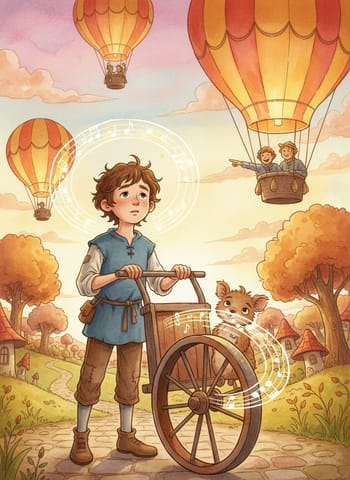
The trolley had one bad wheel, and everyone on the launch field knew it.
O carrinho tinha uma roda ruim, e todo mundo no campo de lançamento sabia disso.
It sat at the front on the left side, and it squeaked at every turn. It was a thin, high noise, like a mouse singing in a cupboard. He pushed the trolley across the grass in the early light. The wheel announced him to the whole field before he arrived.
Ficava na frente, do lado esquerdo, e chiava a cada curva. Era um ruído fino e agudo, como um rato cantando dentro de um armário. Ele empurrava o carrinho pela grama na luz da madrugada. A roda o anunciava ao campo inteiro antes de ele chegar.
He was fifteen, and this was his first summer job. Every morning he reached the field at four o'clock, when the sky was still dark blue. His work was simple. He loaded the trolley with baskets, burner pipes and folded fabric. Then he wheeled it from the van to the launch line. Then he waited for the next load.
Tinha quinze anos, e aquele era o seu primeiro emprego de verão. Toda manhã chegava ao campo às quatro horas, quando o céu ainda estava azul-escuro. O trabalho era simples. Carregava o carrinho com cestas, tubos de queimador e tecido dobrado. Depois o levava da van até a linha de lançamento. Depois esperava a carga seguinte.
The balloon pilots arrived in twos and threes, drinking coffee from paper cups. They were friendly, but they never used his name. They said, "Hey, trolley boy," or, "Where is the trolley?" or just, "You." Ferran had told them his name on the first day. Two weeks later, he was still waiting for someone to use it.
Os pilotos de balão chegavam em duplas e trios, tomando café em copos de papel. Eram simpáticos, mas nunca usavam o nome dele. Diziam: "Ei, menino do carrinho", ou "Cadê o carrinho?", ou só "Você". Ferran tinha dito o nome no primeiro dia. Duas semanas depois, ainda esperava que alguém o usasse.
It was a small thing, and it mattered more every day.
Era uma coisa pequena, e importava mais a cada dia.
On a quiet Thursday, he stood at the edge of the field. He watched the first balloon fill with warm air. The fabric rose slowly from the grass, round and glowing. It looked like a lamp the size of a house. A young woman in a green jacket stood beside the basket, checking a line of small flags. This was Yelena. She was the youngest pilot on the field. She was also the only one who ever said thank you.
Numa quinta-feira tranquila, ele estava na beira do campo. Via o primeiro balão se encher de ar quente. O tecido subia devagar da grama, redondo e luminoso. Parecia um lampião do tamanho de uma casa. Uma jovem de jaqueta verde estava ao lado da cesta, conferindo uma fileira de bandeirinhas. Era Yelena. A piloto mais jovem do campo. E também a única que dizia obrigada.
"Good morning," she called. "Is that your trolley making all that noise?"
"Bom dia", chamou ela. "É o seu carrinho que está fazendo todo esse barulho?"
"Yes," Ferran said. He felt his shoulders go stiff. "I'm sorry. I've tried to fix it. It won't stop."
"É", disse Ferran. Sentiu os ombros enrijecerem. "Desculpe. Eu tentei consertar. Ele não para."
"Don't be sorry. I can hear you coming from the other side of the field." She smiled at him. "It's useful."
"Não peça desculpas. Eu ouço você chegando do outro lado do campo." Ela sorriu para ele. "É útil."
"I wish somebody would just say my name," Ferran said. He did not mean to say it aloud. The words simply fell out of his mouth.
"Eu queria que alguém simplesmente dissesse o meu nome", disse Ferran. Não pretendia dizer em voz alta. As palavras simplesmente caíram da boca.
Yelena tilted her head. "What is your name?"
Yelena inclinou a cabeça. "Qual é o seu nome?"
"Ferran."
"Ferran."
"Ferran," she repeated, slowly, as if she were tasting it. "That's a good name. But I think I can do better than that."
"Ferran", repetiu ela, devagar, como se o saboreasse. "É um bom nome. Mas acho que posso fazer melhor."
"Better?"
"Melhor?"
"A name that people will remember." She grinned. "Leave it with me."
"Um nome de que as pessoas se lembrem." Ela abriu um sorriso. "Deixe comigo."
Ferran did not know what that meant, so he decided to forget it.
Ferran não sabia o que aquilo queria dizer, então decidiu esquecer.
The next day, he arrived at the field and heard the news before he saw anyone. A voice was shouting across the grass.
No dia seguinte, chegou ao campo e ouviu a novidade antes de ver alguém. Uma voz gritava do outro lado da grama.
"Squeak! Hey, Squeak! Over here!"
"Rangido! Ei, Rangido! Aqui!"
It was the oldest pilot, a tall man with a moustache. He waved both arms. Another pilot came running with a coffee in each hand.
Era o piloto mais velho, um homem alto de bigode. Acenava com os dois braços. Outro piloto veio correndo com um café em cada mão.
"Squeak, can you bring the big basket? Please?"
"Rangido, pode trazer a cesta grande? Por favor?"
"Squeak, where is the spare burner?"
"Rangido, cadê o queimador reserva?"
Ferran stood in the middle of the field and stared at them. Behind a balloon, Yelena was trying very hard not to laugh.
Ferran parou no meio do campo e ficou olhando para eles. Atrás de um balão, Yelena se esforçava muito para não rir.
"You told them to call me that," he said.
"Você disse a eles para me chamarem assim", falou.
"I told them it was your name," she said. "Pilot's honour."
"Eu disse que era o seu nome", respondeu ela. "Palavra de piloto."
"It's not my name! It's the sound of a broken wheel."
"Não é o meu nome! É o som de uma roda quebrada."
"It's a nickname. They are different things." Yelena put a hand on his shoulder. "Nobody forgets a nickname. Besides, it is much better than trolley boy."
"É um apelido. São coisas diferentes." Yelena pôs a mão no ombro dele. "Ninguém esquece um apelido. Além disso, é muito melhor do que menino do carrinho."
Ferran wanted to be angry. He looked at her face and then at the pilots waving at him. He could not find the anger anywhere. Something warm sat in his chest instead, and it felt a little bit like being at home.
Ferran queria ficar com raiva. Olhou para o rosto dela e depois para os pilotos acenando para ele. Não encontrou raiva em lugar nenhum. Em vez disso, algo quente se instalou no peito, e era um pouco como estar em casa.
"I wished for a name," he said finally. "I didn't wish for that one."
"Eu desejei um nome", disse por fim. "Não desejei esse."
"Wishes never come in the shape you expect," Yelena said. "That's how you know they are real."
"Os desejos nunca vêm na forma que a gente espera", disse Yelena. "É assim que você sabe que são de verdade."
For the next week, everybody on the field used the word. Ferran got used to it. He began to answer to it without thinking, the way a dog answers to its own name.
Durante a semana seguinte, todos no campo usaram a palavra. Ferran se acostumou. Começou a atender sem pensar, como um cachorro atende ao próprio nome.
Then came Saturday.
Então veio o sábado.
It was the biggest morning of the summer. Seven balloons lifted off together, and the sky filled with colour. Ferran stood at the launch line with a hot cup in his hands. He watched them climb, one after another, into the pink morning light. Yelena's balloon was the last. It was white and gold, and it rose without a sound.
Foi a maior manhã do verão. Sete balões decolaram juntos, e o céu se encheu de cor. Ferran estava na linha de lançamento com um copo quente nas mãos. Via os balões subirem, um após o outro, na luz rosada da manhã. O de Yelena foi o último. Era branco e dourado, e subiu sem fazer som.
Normally the pilots landed within a few miles, and the chase crew drove out to collect them. But that morning the air carried Yelena a very long way. She drifted past the river and over the low hills. At last she came down in a huge field of tall maize, far from any road.
Normalmente os pilotos pousavam a poucos quilômetros, e a equipe de apoio saía de carro para buscá-los. Mas naquela manhã o vento levou Yelena muito longe. Ela passou pelo rio e sobre as colinas baixas. Por fim desceu num enorme milharal alto, longe de qualquer estrada.
Ferran heard the news ten minutes later, when the chase driver called the field on the radio.
Ferran soube da notícia dez minutos depois, quando o motorista da equipe de apoio chamou o campo pelo rádio.
"We can't find her," the driver said. His voice was tight. "The maize is taller than a man. We can see the balloon from the road, but there is no track to it. We have driven round the whole field twice, and she has no signal on her phone."
"Não conseguimos encontrá-la", disse o motorista. A voz estava tensa. "O milharal é mais alto que um homem. Vemos o balão da estrada, mas não há caminho até ele. Demos a volta no campo inteiro duas vezes, e o celular dela está sem sinal."
The crew chief frowned. "Send the trolley," he said. "We need someone on foot with the equipment bags. Squeak, can you go with the second van?"
O chefe da equipe franziu a testa. "Mandem o carrinho", disse. "Precisamos de alguém a pé com as bolsas de equipamento. Rangido, você pode ir na segunda van?"
"I can," Ferran said.
"Posso", disse Ferran.
He loaded the empty envelope bags and climbed into the van beside the driver. Twenty minutes later, they stood at the edge of the maize. The stalks made a green wall in front of them.
Ele carregou as bolsas vazias dos envelopes e subiu na van ao lado do motorista. Vinte minutos depois, estavam na beira do milharal. Os pés de milho formavam uma muralha verde diante deles.
"She's in there somewhere," the driver said. "But I can't drive through it, and I can't hear her."
"Ela está lá dentro em algum lugar", disse o motorista. "Mas não posso passar de carro, e não consigo ouvi-la."
Ferran looked at the wall of maize. He looked at the trolley in the back of the van, with its one bad wheel. Then he had an idea. It came so fast that he did not dare to say it aloud.
Ferran olhou para a muralha de milho. Olhou para o carrinho no fundo da van, com sua única roda ruim. Então teve uma ideia. Veio tão depressa que ele não ousou dizê-la em voz alta.
He lifted the trolley down onto the track. He took hold of the handle. He began to push it slowly along the edge of the field, back and forth, back and forth.
Desceu o carrinho para o chão da trilha. Segurou o cabo. Começou a empurrá-lo devagar ao longo da beira do campo, para lá e para cá, para lá e para cá.
Squeak, went the wheel, again and again.
Nhec, fazia a roda, uma vez após a outra.
The sound was thin and high, and it carried across the maize like the call of a bird.
O som era fino e agudo, e se espalhava pelo milharal como o canto de um pássaro.
"What are you doing?" the driver asked.
"O que você está fazendo?", perguntou o motorista.
"Wait," Ferran said. "She told me she could hear me from the other side of the field."
"Espere", disse Ferran. "Ela me disse que me ouvia do outro lado do campo."
They stood in silence. Ferran pushed the trolley another ten steps, and then another ten. His arms were beginning to ache.
Ficaram em silêncio. Ferran empurrou o carrinho mais dez passos, e mais dez. Os braços começavam a doer.
Then, far inside the maize, a voice rose.
Então, bem lá no fundo do milharal, uma voz se levantou.
"Squeak!"
"Rangido!"
Ferran stopped. His heart jumped.
Ferran parou. O coração deu um pulo.
"Is that you? I can hear you! Keep going!"
"É você? Eu estou ouvindo! Continue!"
"She's to the left," the driver said. "Past that tall tree!"
"Ela está à esquerda", disse o motorista. "Depois daquela árvore alta!"
Ferran pushed harder. He turned the trolley, and the wheel sang out loudly, and the voice answered from a little closer. The driver found a narrow gap between the stalks and started cutting a path. Ferran followed with the trolley, step after step. The voice grew nearer until he could hear laughing in it.
Ferran empurrou com mais força. Virou o carrinho, a roda cantou alto, e a voz respondeu um pouco mais perto. O motorista achou uma passagem estreita entre os pés de milho e começou a abrir um caminho. Ferran o seguiu com o carrinho, passo após passo. A voz foi se aproximando até que ele pôde ouvir risos nela.
Then the stalks parted, and there she was. Yelena stood in a small clearing beside her fallen balloon. Her jacket was covered in leaves, and her hair was full of pollen. She looked tired and very glad to see him.
Então os pés de milho se abriram, e lá estava ela. Yelena estava numa pequena clareira ao lado do balão caído. A jaqueta estava coberta de folhas, e o cabelo, cheio de pólen. Parecia cansada e muito feliz em vê-lo.
"I knew it," she said. "I told them. Nobody could lose a trolley with a wheel like that."
"Eu sabia", disse ela. "Falei para eles. Ninguém consegue perder um carrinho com uma roda dessas."
Ferran laughed. He could not help it. He stood in the middle of the maize. The balloon lay spread beside him like a great gold flower. He laughed until his eyes were wet.
Ferran riu. Não conseguiu evitar. Estava no meio do milharal. O balão estava estendido ao lado dele como uma grande flor dourada. Riu até os olhos ficarem molhados.
"Thank you, Squeak," Yelena said.
"Obrigada, Rangido", disse Yelena.
"You're welcome," said Ferran.
"De nada", disse Ferran.
He took the trolley's handle again. The wheel turned once, and spoke for him.
Ele segurou o cabo do carrinho de novo. A roda girou uma vez e falou por ele.
Squeak.
Rangido.