The Boy and the Squeaky Trolley
Una historia gratuita en inglés de nivel B1 para estudiantes, para leer en línea en 7 idiomas, con opción de escucharla en la app gratuita Storyteller.
Ferran wishes the balloon pilots would learn his name, and a loud wheel gives him one he never expected.
¡Ese fue el avance! Escucha la historia completa en la app gratuita Storyteller. Descargar la app
El audio no está disponible en este momento.
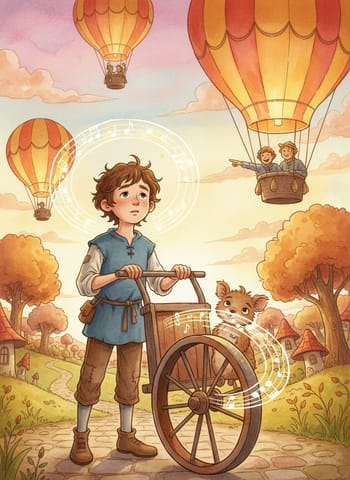
The trolley had one bad wheel, and everyone on the launch field knew it.
El carrito tenía una rueda mala, y todos en el campo de lanzamiento lo sabían.
It sat at the front on the left side, and it squeaked at every turn. It was a thin, high noise, like a mouse singing in a cupboard. He pushed the trolley across the grass in the early light. The wheel announced him to the whole field before he arrived.
Estaba adelante, en el lado izquierdo, y chirriaba en cada giro. Era un ruido fino y agudo, como un ratón cantando en un armario. Empujaba el carrito por el pasto a la luz de la madrugada. La rueda lo anunciaba a todo el campo antes de que llegara.
He was fifteen, and this was his first summer job. Every morning he reached the field at four o'clock, when the sky was still dark blue. His work was simple. He loaded the trolley with baskets, burner pipes and folded fabric. Then he wheeled it from the van to the launch line. Then he waited for the next load.
Tenía quince años, y este era su primer trabajo de verano. Cada mañana llegaba al campo a las cuatro, cuando el cielo todavía era de un azul oscuro. Su trabajo era sencillo. Cargaba el carrito con canastas, tubos de quemador y tela doblada. Luego lo llevaba de la camioneta a la línea de lanzamiento. Luego esperaba la siguiente carga.
The balloon pilots arrived in twos and threes, drinking coffee from paper cups. They were friendly, but they never used his name. They said, "Hey, trolley boy," or, "Where is the trolley?" or just, "You." Ferran had told them his name on the first day. Two weeks later, he was still waiting for someone to use it.
Los pilotos de globo llegaban de a dos o de a tres, tomando café en vasos de papel. Eran amables, pero nunca usaban su nombre. Decían: «Eh, chico del carrito», o «¿Dónde está el carrito?», o simplemente: «Tú». Ferran les había dicho su nombre el primer día. Dos semanas después, seguía esperando que alguien lo usara.
It was a small thing, and it mattered more every day.
Era algo pequeño, y importaba más cada día.
On a quiet Thursday, he stood at the edge of the field. He watched the first balloon fill with warm air. The fabric rose slowly from the grass, round and glowing. It looked like a lamp the size of a house. A young woman in a green jacket stood beside the basket, checking a line of small flags. This was Yelena. She was the youngest pilot on the field. She was also the only one who ever said thank you.
Un jueves tranquilo, estaba parado en el borde del campo. Miraba cómo se llenaba de aire caliente el primer globo. La tela se elevaba lentamente del pasto, redonda y brillante. Parecía una lámpara del tamaño de una casa. Una joven con chaqueta verde estaba junto a la canasta, revisando una hilera de banderitas. Era Yelena. Era la piloto más joven del campo. También era la única que alguna vez decía gracias.
"Good morning," she called. "Is that your trolley making all that noise?"
«Buenos días», llamó. «¿Ese es tu carrito el que hace todo ese ruido?».
"Yes," Ferran said. He felt his shoulders go stiff. "I'm sorry. I've tried to fix it. It won't stop."
«Sí», dijo Ferran. Sintió que los hombros se le ponían rígidos. «Lo siento. He intentado arreglarlo. No para».
"Don't be sorry. I can hear you coming from the other side of the field." She smiled at him. "It's useful."
«No lo sientas. Te oigo venir desde el otro lado del campo». Le sonrió. «Es útil».
"I wish somebody would just say my name," Ferran said. He did not mean to say it aloud. The words simply fell out of his mouth.
«Ojalá alguien dijera mi nombre, sin más», dijo Ferran. No pretendía decirlo en voz alta. Las palabras simplemente se le cayeron de la boca.
Yelena tilted her head. "What is your name?"
Yelena ladeó la cabeza. «¿Cómo te llamas?».
"Ferran."
«Ferran».
"Ferran," she repeated, slowly, as if she were tasting it. "That's a good name. But I think I can do better than that."
«Ferran», repitió, despacio, como si lo saboreara. «Es un buen nombre. Pero creo que puedo hacerlo mejor».
"Better?"
«¿Mejor?».
"A name that people will remember." She grinned. "Leave it with me."
«Un nombre que la gente recuerde». Sonrió de oreja a oreja. «Déjamelo a mí».
Ferran did not know what that meant, so he decided to forget it.
Ferran no sabía qué significaba eso, así que decidió olvidarlo.
The next day, he arrived at the field and heard the news before he saw anyone. A voice was shouting across the grass.
Al día siguiente, llegó al campo y oyó la noticia antes de ver a nadie. Una voz gritaba a través del pasto.
"Squeak! Hey, Squeak! Over here!"
«¡Chirrido! ¡Eh, Chirrido! ¡Por aquí!».
It was the oldest pilot, a tall man with a moustache. He waved both arms. Another pilot came running with a coffee in each hand.
Era el piloto más viejo, un hombre alto con bigote. Agitaba los dos brazos. Otro piloto llegó corriendo con un café en cada mano.
"Squeak, can you bring the big basket? Please?"
«Chirrido, ¿puedes traer la canasta grande? ¿Por favor?».
"Squeak, where is the spare burner?"
«Chirrido, ¿dónde está el quemador de repuesto?».
Ferran stood in the middle of the field and stared at them. Behind a balloon, Yelena was trying very hard not to laugh.
Ferran se quedó en medio del campo mirándolos fijamente. Detrás de un globo, Yelena se esforzaba mucho por no reírse.
"You told them to call me that," he said.
«Les dijiste que me llamaran así», dijo.
"I told them it was your name," she said. "Pilot's honour."
«Les dije que era tu nombre», dijo ella. «Palabra de piloto».
"It's not my name! It's the sound of a broken wheel."
«¡No es mi nombre! ¡Es el ruido de una rueda rota!».
"It's a nickname. They are different things." Yelena put a hand on his shoulder. "Nobody forgets a nickname. Besides, it is much better than trolley boy."
«Es un apodo. Son cosas distintas». Yelena le puso una mano en el hombro. «Nadie olvida un apodo. Además, es mucho mejor que chico del carrito».
Ferran wanted to be angry. He looked at her face and then at the pilots waving at him. He could not find the anger anywhere. Something warm sat in his chest instead, and it felt a little bit like being at home.
Ferran quería enojarse. La miró a la cara y luego a los pilotos que lo saludaban con la mano. No encontró el enojo por ningún lado. En cambio, algo cálido se instaló en su pecho, y se sentía un poco como estar en casa.
"I wished for a name," he said finally. "I didn't wish for that one."
«Pedí un nombre», dijo por fin. «No pedí ese».
"Wishes never come in the shape you expect," Yelena said. "That's how you know they are real."
«Los deseos nunca llegan con la forma que esperas», dijo Yelena. «Así sabes que son de verdad».
For the next week, everybody on the field used the word. Ferran got used to it. He began to answer to it without thinking, the way a dog answers to its own name.
Durante la semana siguiente, todos en el campo usaron la palabra. Ferran se acostumbró. Empezó a responder sin pensarlo, como un perro responde a su nombre.
Then came Saturday.
Entonces llegó el sábado.
It was the biggest morning of the summer. Seven balloons lifted off together, and the sky filled with colour. Ferran stood at the launch line with a hot cup in his hands. He watched them climb, one after another, into the pink morning light. Yelena's balloon was the last. It was white and gold, and it rose without a sound.
Era la mañana más grande del verano. Siete globos despegaron juntos, y el cielo se llenó de colores. Ferran estaba en la línea de lanzamiento con una taza caliente en las manos. Los veía subir, uno tras otro, hacia la luz rosada de la mañana. El globo de Yelena fue el último. Era blanco y dorado, y se elevó sin un sonido.
Normally the pilots landed within a few miles, and the chase crew drove out to collect them. But that morning the air carried Yelena a very long way. She drifted past the river and over the low hills. At last she came down in a huge field of tall maize, far from any road.
Normalmente los pilotos aterrizaban a pocos kilómetros, y el equipo de rescate salía en auto a recogerlos. Pero esa mañana el aire llevó a Yelena muy lejos. Pasó el río y las colinas bajas. Por fin descendió en un enorme campo de maíz alto, lejos de cualquier camino.
Ferran heard the news ten minutes later, when the chase driver called the field on the radio.
Ferran supo la noticia diez minutos después, cuando el conductor del equipo de rescate llamó al campo por la radio.
"We can't find her," the driver said. His voice was tight. "The maize is taller than a man. We can see the balloon from the road, but there is no track to it. We have driven round the whole field twice, and she has no signal on her phone."
«No la encontramos», dijo el conductor. Su voz estaba tensa. «El maíz es más alto que un hombre. Vemos el globo desde el camino, pero no hay sendero hasta él. Hemos rodeado todo el campo dos veces, y ella no tiene señal en el teléfono».
The crew chief frowned. "Send the trolley," he said. "We need someone on foot with the equipment bags. Squeak, can you go with the second van?"
El jefe del equipo frunció el ceño. «Manden el carrito», dijo. «Necesitamos a alguien a pie con las bolsas de equipo. Chirrido, ¿puedes ir con la segunda camioneta?».
"I can," Ferran said.
«Puedo», dijo Ferran.
He loaded the empty envelope bags and climbed into the van beside the driver. Twenty minutes later, they stood at the edge of the maize. The stalks made a green wall in front of them.
Cargó las bolsas vacías para la tela y subió a la camioneta junto al conductor. Veinte minutos después, estaban en el borde del maizal. Los tallos formaban una pared verde frente a ellos.
"She's in there somewhere," the driver said. "But I can't drive through it, and I can't hear her."
«Está ahí dentro en alguna parte», dijo el conductor. «Pero no puedo manejar por ahí, y no puedo oírla».
Ferran looked at the wall of maize. He looked at the trolley in the back of the van, with its one bad wheel. Then he had an idea. It came so fast that he did not dare to say it aloud.
Ferran miró la pared de maíz. Miró el carrito en la parte de atrás de la camioneta, con su única rueda mala. Entonces tuvo una idea. Le llegó tan rápido que no se atrevió a decirla en voz alta.
He lifted the trolley down onto the track. He took hold of the handle. He began to push it slowly along the edge of the field, back and forth, back and forth.
Bajó el carrito al sendero. Agarró el manubrio. Empezó a empujarlo lentamente por el borde del campo, de un lado a otro, de un lado a otro.
Squeak, went the wheel, again and again.
Chirrido, hacía la rueda, una y otra vez.
The sound was thin and high, and it carried across the maize like the call of a bird.
El sonido era fino y agudo, y viajaba a través del maizal como el canto de un pájaro.
"What are you doing?" the driver asked.
«¿Qué haces?», preguntó el conductor.
"Wait," Ferran said. "She told me she could hear me from the other side of the field."
«Espere», dijo Ferran. «Ella me dijo que me oía desde el otro lado del campo».
They stood in silence. Ferran pushed the trolley another ten steps, and then another ten. His arms were beginning to ache.
Se quedaron en silencio. Ferran empujó el carrito diez pasos más, y luego otros diez. Los brazos empezaban a dolerle.
Then, far inside the maize, a voice rose.
Entonces, muy adentro del maizal, se alzó una voz.
"Squeak!"
«¡Chirrido!».
Ferran stopped. His heart jumped.
Ferran se detuvo. El corazón le dio un salto.
"Is that you? I can hear you! Keep going!"
«¿Eres tú? ¡Te oigo! ¡Sigue!».
"She's to the left," the driver said. "Past that tall tree!"
«Está a la izquierda», dijo el conductor. «¡Pasando ese árbol alto!».
Ferran pushed harder. He turned the trolley, and the wheel sang out loudly, and the voice answered from a little closer. The driver found a narrow gap between the stalks and started cutting a path. Ferran followed with the trolley, step after step. The voice grew nearer until he could hear laughing in it.
Ferran empujó más fuerte. Giró el carrito, y la rueda cantó muy fuerte, y la voz respondió desde un poco más cerca. El conductor encontró un hueco estrecho entre los tallos y empezó a cortar un camino. Ferran lo siguió con el carrito, paso tras paso. La voz se acercaba hasta que él pudo oír risas en ella.
Then the stalks parted, and there she was. Yelena stood in a small clearing beside her fallen balloon. Her jacket was covered in leaves, and her hair was full of pollen. She looked tired and very glad to see him.
Entonces los tallos se abrieron, y ahí estaba ella. Yelena estaba de pie en un pequeño claro junto a su globo caído. Su chaqueta estaba cubierta de hojas, y su pelo lleno de polen. Se veía cansada y muy contenta de verlo.
"I knew it," she said. "I told them. Nobody could lose a trolley with a wheel like that."
«Lo sabía», dijo. «Se lo dije. Nadie podría perder un carrito con una rueda así».
Ferran laughed. He could not help it. He stood in the middle of the maize. The balloon lay spread beside him like a great gold flower. He laughed until his eyes were wet.
Ferran se rio. No pudo evitarlo. Estaba de pie en medio del maizal. El globo yacía extendido junto a él como una gran flor dorada. Se rio hasta que se le humedecieron los ojos.
"Thank you, Squeak," Yelena said.
«Gracias, Chirrido», dijo Yelena.
"You're welcome," said Ferran.
«De nada», dijo Ferran.
He took the trolley's handle again. The wheel turned once, and spoke for him.
Volvió a tomar el manubrio del carrito. La rueda dio una vuelta, y habló por él.
Squeak.
Chirrido.