The Jar of Nameless Seeds
Una historia gratuita en inglés de nivel B1 para estudiantes, para leer en línea en 7 idiomas, con opción de escucharla en la app gratuita Storyteller.
A young diner worker learns patience when a lorry driver leaves her seeds that refuse to grow the easy way.
¡Ese fue el avance! Escucha la historia completa en la app gratuita Storyteller. Descargar la app
El audio no está disponible en este momento.
Aiko has worked at the Sundown Diner for four months. She came for one week, only to earn enough money for a bus ticket. Then the week became a month, and the month became a habit. Now she knows the sound of every lorry that turns off the long desert road.
Aiko lleva cuatro meses trabajando en el Sundown Diner. Vino por una semana, solo para ganar el dinero de un boleto de autobús. Luego la semana se volvió un mes, y el mes se volvió costumbre. Ahora conoce el sonido de cada camión que sale de la larga carretera del desierto.
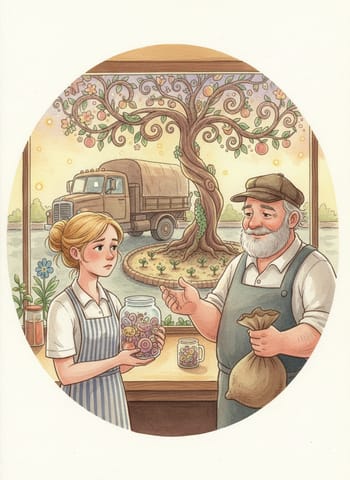
Today, a heavy lorry with a dented door stops outside at noon. The driver, a man with a grey beard, eats a plate of eggs and says almost nothing. When he finishes, he puts a glass jar on the counter.
Hoy, un camión pesado con la puerta abollada se detiene afuera al mediodía. El conductor, un hombre de barba gris, come un plato de huevos y casi no dice nada. Cuando termina, deja un frasco de vidrio sobre el mostrador.
"These are for you," he says. "A woman gave them to me at a petrol station a thousand miles back. She had no label, no name, nothing."
«Esto es para ti», dice. «Una mujer me lo dio en una gasolinera hace mil millas. No tenía etiqueta, ni nombre, nada».
Aiko lifts the jar. It is full of tiny brown seeds, each one hard and shiny like a grain of black pepper. "What do they grow into?" she asks.
Aiko levanta el frasco. Está lleno de semillas marrones diminutas, cada una dura y brillante como un grano de pimienta negra. «¿En qué se convierten?», pregunta.
"I have no idea. I live in a lorry. Plant them and find out." He pays for his meal, tips his cap, and drives away.
«Ni idea. Vivo en un camión. Plántalas y averígualo». Paga su comida, se toca la gorra y se va.
Safiya, who owns the diner, looks up from the grill. She is a calm woman who has cooked here for fifteen years. "Don't get excited," she says. "Nothing grows out here except weeds and bad ideas."
Safiya, la dueña del restaurante, levanta la vista de la plancha. Es una mujer serena que lleva quince años cocinando aquí. «No te emociones», dice. «Aquí afuera no crece nada excepto maleza y malas ideas».
But Aiko is already excited. For four months she has watched the same flat horizon. Now she holds something that might become alive. That evening, she finds an empty coffee can behind the kitchen. She fills it with soil from the car park and pushes thirty seeds into it. Then she puts it on the windowsill.
Pero Aiko ya está emocionada. Durante cuatro meses ha visto el mismo horizonte plano. Ahora tiene en las manos algo que podría cobrar vida. Esa noche, encuentra una lata de café vacía detrás de la cocina. La llena con tierra del estacionamiento y entierra treinta semillas. Luego la pone en el alféizar de la ventana.
She waters the can twice a day, once before the lunch crowd and once after. She talks to it a little, which she would never admit to anyone. On the fifth day, nothing has changed, so she gives it a double dose of water.
Riega la lata dos veces al día, una antes de la hora del almuerzo y otra después. Le habla un poco, cosa que jamás admitiría ante nadie. El quinto día, nada ha cambiado, así que le da una dosis doble de agua.
"You are going to drown it," Safiya says, passing with a tray of plates.
«La vas a ahogar», dice Safiya, pasando con una bandeja de platos.
"I'm helping it," Aiko answers. "Plants need water."
«La estoy ayudando», responde Aiko. «Las plantas necesitan agua».
On the ninth morning, a sour smell comes from the can. Aiko lifts it to the light. A grey fuzz covers the soil, and the seeds underneath have turned soft and dark. She stares at the mess, and her stomach drops.
La novena mañana, sale un olor agrio de la lata. Aiko la levanta hacia la luz. Una pelusa gris cubre la tierra, y las semillas de abajo se han vuelto blandas y oscuras. Mira fijamente el desastre y se le encoge el estómago.
This feeling is not new to her. She quit her first course at university after one hard exam. She quit her second job after one bad week. Every time something fails on the first try, she decides that she was wrong to want it. She almost throws the can into the bin.
Este sentimiento no es nuevo para ella. Dejó su primer curso en la universidad después de un examen difícil. Dejó su segundo trabajo después de una mala semana. Cada vez que algo falla al primer intento, decide que se equivocó al quererlo. Casi tira la lata a la basura.
"Wait." Safiya takes the jar from the shelf and pours a few seeds into her palm. She rolls one between her fingers, and then she bites it gently. "Hard as a pebble," she says. "These are desert seeds. They don't wake up because you water them. They wake up when something breaks the shell."
«Espera». Safiya toma el frasco del estante y vierte unas semillas en la palma. Hace rodar una entre los dedos y luego la muerde con suavidad. «Dura como una piedrita», dice. «Son semillas del desierto. No despiertan porque las riegues. Despiertan cuando algo rompe la cáscara».
"How do you know that?" Aiko asks.
«¿Cómo lo sabes?», pregunta Aiko.
"Fifteen years of watching what survives behind this building." Safiya nods toward the back lot, where a few stubborn flowers grow through cracks in the concrete. "Everything that lives there had a rough start. Nobody hands it an easy one."
«Quince años viendo lo que sobrevive detrás de este edificio». Safiya señala con la cabeza el terreno de atrás, donde unas pocas flores tercas crecen entre las grietas del concreto. «Todo lo que vive ahí tuvo un comienzo duro. A nadie le dan uno fácil».
Aiko looks at the jar. Thirty seeds are gone, but about seventy remain. "So I get another try," she says.
Aiko mira el frasco. Treinta semillas se han perdido, pero quedan unas setenta. «Entonces tengo otro intento», dice.
"You get a better try," Safiya says. "If you listen to the seed this time and not to yourself."
«Tienes un intento mejor», dice Safiya. «Si esta vez escuchas a la semilla y no a ti misma».
That night, after closing, Aiko tries a different plan. She finds a sheet of sandpaper in the storeroom. One by one, she rubs ten seeds on the paper. A pale spot shows on each shell. It is slow work, and her fingers ache, but she does not hurry. Then she drops them in a cup of warm water from the coffee machine. They soak overnight.
Esa noche, después de cerrar, Aiko prueba un plan distinto. Encuentra una hoja de papel de lija en la bodega. Una por una, frota diez semillas contra el papel. En cada cáscara aparece una mancha pálida. Es un trabajo lento y los dedos le duelen, pero no se apresura. Luego las deja caer en una taza de agua tibia de la cafetera. Se remojan toda la noche.
The next morning, she carries the cup to the back lot. Behind the building, an old ice machine drips slowly onto a strip of gravel. The drops fall one at a time, with a small, steady sound. Aiko digs ten shallow holes along the edge of the wet patch. She drops one seed into each hole and covers it with a thin layer of sand. At the last moment, she places a flat stone on the west side. Now the afternoon sun cannot hit the ground so hard.
A la mañana siguiente, lleva la taza al terreno de atrás. Detrás del edificio, una vieja máquina de hielo gotea lentamente sobre una franja de grava. Las gotas caen una a una, con un sonido pequeño y constante. Aiko cava diez hoyos poco profundos a lo largo del borde de la zona húmeda. Deja caer una semilla en cada hoyo y la cubre con una fina capa de arena. En el último momento, coloca una piedra plana en el lado oeste. Ahora el sol de la tarde no podrá golpear el suelo con tanta fuerza.
"That's all?" Safiya asks from the back door. She holds a cup of coffee.
«¿Eso es todo?», pregunta Safiya desde la puerta trasera. Sostiene una taza de café.
"That's all. No extra water, and no talking to it." Aiko wipes her hands on her apron. "I will just check every morning before work."
«Eso es todo. Sin agua extra y sin hablarle». Aiko se limpia las manos en el delantal. «Solo la revisaré cada mañana antes del trabajo».
For eight days, she checks and sees only gravel. Each time, she wants to dig, to water, to do something. Each time, she makes herself stand still for one minute and then walk away. By the sixth day, the minute has become a habit too. She notices small things instead. There is a lizard on the wall, and the light turns gold on the stone.
Durante ocho días, revisa y solo ve grava. Cada vez, quiere cavar, regar, hacer algo. Cada vez, se obliga a quedarse quieta un minuto y luego alejarse. Para el sexto día, el minuto también se ha vuelto costumbre. En cambio, nota cosas pequeñas. Hay una lagartija en la pared y la luz se vuelve dorada sobre la piedra.
On the ninth day, she kneels down and holds her breath. A tiny green hook is pushing out of the sand. It is bent like a question mark and no bigger than a grain of rice. Beside it, a second one is beginning to lift.
El noveno día, se arrodilla y contiene la respiración. Un diminuto gancho verde está empujando para salir de la arena. Está doblado como un signo de interrogación y no es más grande que un grano de arroz. A su lado, un segundo comienza a levantarse.
She runs inside with sandy knees. "Safiya! Come and look!"
Entra corriendo con las rodillas llenas de arena. «¡Safiya! ¡Ven a ver!».
Safiya follows her out, drying her hands on a towel. She crouches and looks for a long time. "Well," she says at last. "Look at that. Out here, of all places."
Safiya la sigue afuera, secándose las manos con una toalla. Se agacha y mira durante mucho rato. «Bueno», dice al fin. «Mira eso. Aquí afuera, de todos los lugares».
"Seven," Aiko whispers, after she counts. "Seven came up."
«Siete», susurra Aiko, después de contar. «Salieron siete».
"Seven out of ten is a very good year." Safiya stands and smiles, which she does only rarely. "Tomorrow I'll cut you a piece of metal for shade. Don't touch the roots."
«Siete de diez es un año muy bueno». Safiya se pone de pie y sonríe, algo que hace rara vez. «Mañana te corto un trozo de metal para dar sombra. No toques las raíces».
By the end of the month, the seedlings are as tall as a pencil. Lorry drivers who stop for pie begin to walk around the back with their coffee. They ask what the plants are. Aiko tells them the same answer every time: "Nobody knows." Some of them laugh, and a few of them take photographs.
A fines del mes, las plántulas son tan altas como un lápiz. Los camioneros que paran por un pedazo de pay empiezan a caminar hasta atrás con su café. Preguntan qué son las plantas. Aiko les da siempre la misma respuesta: «Nadie lo sabe». Algunos se ríen y unos cuantos toman fotografías.
One morning, a thin stem of the tallest plant forms a hard little knot near the top. It is tight and silver, like a closed fist. Aiko does not recognise it from any garden she has ever seen. She checks the other six plants, but only this one has made a knot.
Una mañana, un tallo delgado de la planta más alta forma un pequeño nudo duro cerca de la punta. Es apretado y plateado, como un puño cerrado. Aiko no lo reconoce de ningún jardín que haya visto. Revisa las otras seis plantas, pero solo esta ha formado un nudo.
She finds a paper card in her apron. She writes "Name:" at the top and then stops with the pen above the line. After a moment, she leans the card against the flat stone and leaves the line empty. Then she goes back inside to refill the coffee.
Encuentra una tarjeta de papel en su delantal. Escribe «Nombre:» arriba y luego se detiene con el bolígrafo sobre la línea. Después de un momento, apoya la tarjeta contra la piedra plana y deja la línea vacía. Luego vuelve adentro a rellenar el café.