The Misprint in the Paper Boat
Una historia gratuita en inglés de nivel B1 para estudiantes, para leer en línea en 7 idiomas, con opción de escucharla en la app gratuita Storyteller.
In a busy print shop, a folded paper boat helps a new assistant spot an error that its owner can no longer see.
¡Ese fue el avance! Escucha la historia completa en la app gratuita Storyteller. Descargar la app
El audio no está disponible en este momento.
The print shop opens at seven, but Jabu is always there by six. He likes the hour when the machines are cold and the floor still smells of last night's ink. He walks between the tables, touches the stacks of paper and listens to the building wake up.
La imprenta abre a las siete, pero Jabu siempre está allí a las seis. Le gusta la hora en que las máquinas están frías y el piso todavía huele a la tinta de anoche. Camina entre las mesas, toca las pilas de papel y escucha cómo despierta el edificio.
Today, the first job on the board is a big one. A river club has ordered three hundred posters for its annual boat parade. The club's organiser is coming for them at five o'clock. She has already asked about them twice.
Hoy, el primer trabajo del tablero es grande. Un club de remo ha encargado trescientos carteles para su desfile anual de botes. La organizadora del club vendrá por ellos a las cinco. Ya ha preguntado por ellos dos veces.
Nils arrives at half past seven with two coffees and a paper bag. He is new, and he has worked at the shop for only three weeks. Before that, he spent ten years behind a desk at an insurance office. He says he left because he was tired of reading things nobody wanted to read.
Nils llega a las siete y media con dos cafés y una bolsa de papel. Es nuevo, y lleva solo tres semanas en la imprenta. Antes pasó diez años detrás de un escritorio en una oficina de seguros. Dice que se fue porque estaba cansado de leer cosas que nadie quería leer.
"What are we printing?" he asks.
«¿Qué vamos a imprimir?», pregunta.
"A poster with a big blue boat and a lot of words," Jabu says. "It has to be perfect. The club pays well, and they send us work every year."
«Un cartel con un gran bote azul y muchas palabras», dice Jabu. «Tiene que ser perfecto. El club paga bien, y nos manda trabajo todos los años».
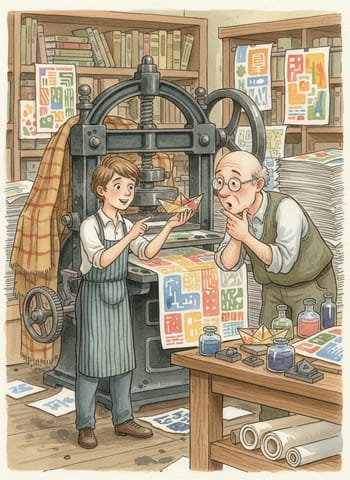
Jabu has already prepared the proof on his screen. He shows it to Nils, who reads it slowly, from top to bottom. The headline says River Boat Parade in tall yellow letters. Below it come the street, the name of the club and a small map. At the bottom are the date and the time.
Jabu ya ha preparado la prueba en su pantalla. Se la muestra a Nils, que la lee despacio, de arriba abajo. El título dice Desfile de Botes del Río en altas letras amarillas. Debajo vienen la calle, el nombre del club y un pequeño mapa. Abajo están la fecha y la hora.
"It looks good," Nils says.
«Se ve bien», dice Nils.
"It looks good because I have read it fifty times," Jabu says. He smiles. "Come, I will show you how to load the paper."
«Se ve bien porque la he leído cincuenta veces», dice Jabu. Sonríe. «Ven, te enseñaré a cargar el papel».
All morning, the press runs with a steady, heavy rhythm. Jabu teaches Nils to fan the sheets so they do not stick together. He shows him how to check the ink. He explains how to feel a dry roller and how to hear a change in the sound. Nils learns fast. He asks questions and writes the answers in a small notebook.
Toda la mañana, la prensa funciona con un ritmo constante y pesado. Jabu le enseña a Nils a abanicar las hojas para que no se peguen. Le muestra cómo revisar la tinta. Le explica cómo sentir un rodillo seco y cómo oír un cambio en el sonido. Nils aprende rápido. Hace preguntas y anota las respuestas en una libretita.
By noon, the first hundred and twenty posters lie in neat piles on the drying rack. The blue boat shines in the light from the window. Jabu picks one up, nods, and puts it down again.
Al mediodía, los primeros ciento veinte carteles están en pilas ordenadas en el estante de secado. El bote azul brilla con la luz de la ventana. Jabu levanta uno, asiente y lo vuelve a dejar.
"Lunch," he says. "Then we finish the rest."
«Almuerzo», dice. «Luego terminamos el resto».
They eat standing up, at the counter by the front door. Afterwards, Nils goes back to the press room alone. He finds a spoiled sheet in the waste box. It has a long grey streak across the corner. He smooths it on the table and begins to fold.
Comen de pie, en el mostrador junto a la puerta de entrada. Después, Nils vuelve solo a la sala de la prensa. Encuentra una hoja echada a perder en la caja de desechos. Tiene una larga mancha gris en la esquina. La alisa sobre la mesa y empieza a doblar.
He does it without thinking. His fingers know the steps from childhood. Fold in half, fold the corners, fold up the edges, pull the sides apart. A small boat comes out of the paper, with a flat bottom and a sharp front. He has made hundreds of them in his life, usually in meetings that were too long.
Lo hace sin pensar. Sus dedos conocen los pasos desde la infancia. Doblar por la mitad, doblar las esquinas, doblar los bordes hacia arriba, separar los lados. Del papel sale un pequeño bote, con el fondo plano y la proa afilada. Ha hecho cientos en su vida, por lo general en reuniones demasiado largas.
He sets the boat on the table and looks at it. Something about it feels odd.
Deja el bote sobre la mesa y lo mira. Hay algo en él que se siente raro.
The folds have hidden the big blue picture and the headline. He sees only the bottom strip of the poster, folded into the hull. It shows two short lines in plain black letters. Saturday, the twenty-first of June. Parade starts at nine in the evening.
Los dobleces han escondido la gran imagen azul y el título. Solo ve la franja inferior del cartel, doblada en el casco. Muestra dos líneas cortas en letras negras sencillas. Sábado 21 de junio. El desfile comienza a las nueve de la noche.
Nils reads it twice. Then he takes out his phone and finds the club's email, which Jabu forwarded on his first morning. He scrolls down to the third paragraph.
Nils lo lee dos veces. Luego saca su teléfono y busca el correo del club, que Jabu le reenvió su primera mañana. Baja hasta el tercer párrafo.
Please note that the parade begins at nine o'clock in the morning, before the sun is high.
Tenga en cuenta que el desfile comienza a las nueve de la mañana, antes de que el sol esté alto.
He walks quickly into the office. Jabu is on the phone, but he hangs up when he sees Nils's face.
Entra rápido a la oficina. Jabu está hablando por teléfono, pero cuelga cuando ve la cara de Nils.
"What is wrong?" Jabu asks.
«¿Qué pasa?», pregunta Jabu.
"I may be wrong," Nils says. "But I think the time is wrong on the posters."
«Puede que me equivoque», dice Nils. «Pero creo que la hora está mal en los carteles».
Jabu frowns. He takes the paper boat from Nils's hand and holds it up. For a moment, he says nothing at all. Then he sits down heavily in his chair.
Jabu frunce el ceño. Toma el bote de papel de la mano de Nils y lo levanta. Por un momento no dice nada. Luego se sienta pesadamente en su silla.
"Nine in the evening," he reads aloud. "Nine in the evening. How can that be?"
«Nueve de la noche», lee en voz alta. «Nueve de la noche. ¿Cómo puede ser?»
"It says nine in the morning in the email."
«En el correo dice nueve de la mañana».
"I know what the email says. I typed it myself." Jabu rubs his forehead. "I must have changed it when I fixed the spacing, and I never saw it. I read that poster so many times that my eyes only saw what I expected."
«Sé lo que dice el correo. Yo mismo lo escribí». Jabu se frota la frente. «Debí de cambiarlo cuando arreglé el espaciado, y nunca lo vi. Leí ese cartel tantas veces que mis ojos solo vieron lo que esperaban».
"The boat showed it to me because it hid everything else," Nils says quietly.
«El bote me lo mostró porque ocultó todo lo demás», dice Nils en voz baja.
Jabu laughs, but it is not a happy sound. He looks at the clock above the door. It is ten past one.
Jabu se ríe, pero no es un sonido feliz. Mira el reloj sobre la puerta. Es la una y diez.
"A hundred and twenty are printed," he says. "One hundred and eighty are still to go. And they are all wrong."
«Ciento veinte están impresos», dice. «Faltan ciento ochenta. Y todos están mal».
"Could we stop the press?"
«¿Podríamos detener la prensa?»
"I stopped it for lunch an hour ago. That is the only good news." Jabu stands up. His shoulders are straight again, and his voice is calm. He has been in the business for thirty years, and he knows that panic costs more than paper. "Come with me."
«La detuve para el almuerzo hace una hora. Esa es la única buena noticia». Jabu se levanta. Sus hombros están rectos otra vez, y su voz es tranquila. Lleva treinta años en el negocio, y sabe que el pánico cuesta más que el papel. «Ven conmigo».
In the press room, he walks to the machine and runs his finger over the plate. The error is small, a single word on a metal sheet. He takes the plate out and carries it to the computer.
En la sala de la prensa, camina hasta la máquina y pasa el dedo sobre la plancha. El error es pequeño, una sola palabra en una lámina de metal. Saca la plancha y la lleva a la computadora.
"First, we fix the file," he says. "Not just the time. I want you to read the whole poster aloud, line by line, from the bottom. Slowly."
«Primero, arreglamos el archivo», dice. «No solo la hora. Quiero que leas el cartel entero en voz alta, línea por línea, desde abajo. Despacio».
"From the bottom?"
«¿Desde abajo?»
"A page looks different from the bottom. Your eyes cannot jump ahead because you have to read every word alone." Jabu lifts his eyebrows. "Your boat is a clever way to do the same thing."
«Una página se ve distinta desde abajo. Tus ojos no pueden saltar adelante porque tienes que leer cada palabra sola». Jabu levanta las cejas. «Tu bote es una manera ingeniosa de hacer lo mismo».
Nils reads. Jabu listens. They find the correct time, and they find nothing else. Jabu makes a new plate, and Nils helps him lock it into the machine.
Nils lee. Jabu escucha. Encuentran la hora correcta, y no encuentran nada más. Jabu hace una plancha nueva, y Nils lo ayuda a fijarla en la máquina.
At two o'clock, the press starts again. This time, Jabu does not leave the room. Every ten minutes, he pulls a sheet from the tray and passes it to Nils. Nils reads it from the bottom up and nods.
A las dos, la prensa arranca de nuevo. Esta vez, Jabu no sale de la sala. Cada diez minutos saca una hoja de la bandeja y se la pasa a Nils. Nils la lee de abajo hacia arriba y asiente.
When the three hundred copies are finished, Jabu looks at the old posters. A hundred and twenty beautiful sheets, with a blue boat and the wrong hour, wait on the rack.
Cuando las trescientas copias están terminadas, Jabu mira los carteles viejos. Ciento veinte hermosas hojas, con un bote azul y la hora equivocada, esperan en el estante.
"We cannot give them away," Nils says. "People will come at night."
«No podemos regalarlos», dice Nils. «La gente vendrá de noche».
"We cannot sell them either. But we can use them." Jabu pulls out a pencil and writes a short note on a card. "I will give them to the school next door, with the back side blank. The children can draw on the empty paper."
«Tampoco podemos venderlos. Pero podemos usarlos». Jabu saca un lápiz y escribe una nota corta en una tarjeta. «Se los daré a la escuela de al lado, con el reverso en blanco. Los niños pueden dibujar en el papel vacío».
At twenty to five, the organiser arrives. She is a quick, energetic woman with sunglasses on her head, and she walks straight to the counter. Jabu has the new posters ready, wrapped in brown paper.
A las cinco menos veinte llega la organizadora. Es una mujer rápida y enérgica con gafas de sol en la cabeza, y va directo al mostrador. Jabu tiene los carteles nuevos listos, envueltos en papel marrón.
"Everything correct?" she asks.
«¿Todo correcto?», pregunta.
"Everything correct," Jabu says. "We checked it twice. The second time, someone read it to me from the bottom."
«Todo correcto», dice Jabu. «Lo revisamos dos veces. La segunda vez, alguien me lo leyó desde abajo».
She laughs, though she does not understand the joke. She pays, takes the posters and leaves with the bell ringing above the door.
Ella se ríe, aunque no entiende el chiste. Paga, toma los carteles y se va con la campanilla sonando sobre la puerta.
The shop is quiet again. Jabu walks back to the press room. Nils is already there, sweeping paper dust from the floor. On the table, the little paper boat still sits where he left it.
La imprenta queda en silencio otra vez. Jabu vuelve a la sala de la prensa. Nils ya está allí, barriendo el polvo de papel del piso. Sobre la mesa, el pequeño bote de papel sigue donde él lo dejó.
Jabu picks it up and turns it in his hand. Then he walks to the shelf above the press, where he keeps his coffee cup. He places the boat in the centre of the shelf, with the mistake showing. Then he presses the green button and starts the next job.
Jabu lo recoge y lo gira en la mano. Luego camina hasta el estante sobre la prensa, donde guarda su taza de café. Coloca el bote en el centro del estante, con el error a la vista. Luego aprieta el botón verde y empieza el siguiente trabajo.