The Curtain That Would Not Close
Una historia gratuita en inglés de nivel B1 para estudiantes, para leer en línea en 7 idiomas, con opción de escucharla en la app gratuita Storyteller.
A new rowing club member asks the one question that everyone else has avoided for nine years.
¡Ese fue el avance! Escucha la historia completa en la app gratuita Storyteller. Descargar la app
El audio no está disponible en este momento.
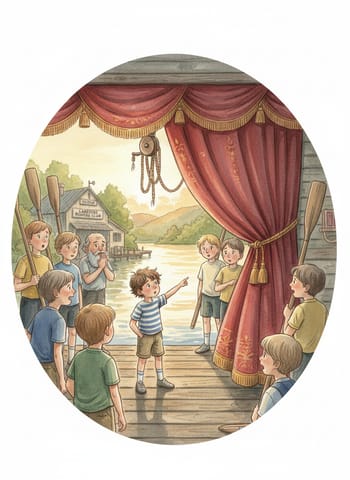
The stage curtain in the boathouse hall closed only halfway. It had done this for nine years, and everyone at the Riverside Rowing Club knew it.
El telón del escenario del salón del cobertizo de botes se cerraba solo hasta la mitad. Llevaba nueve años haciéndolo, y todos en el Club de Remo Riverside lo sabían.
Every autumn the club held a show to end the season. Members sang songs, told jokes and read funny reports about lost oars. Every year the curtain stuck, and every year somebody found a different way around the problem.
Todos los otoños el club hacía un espectáculo para cerrar la temporada. Los socios cantaban canciones, contaban chistes y leían informes graciosos sobre remos perdidos. Todos los años el telón se atascaba, y todos los años alguien encontraba una manera distinta de sortear el problema.
This year the show belonged to Yusra. She was thirty-four and had joined the club in June. She did not yet know the rules that nobody had written down.
Este año el espectáculo era responsabilidad de Yusra. Tenía treinta y cuatro años y se había unido al club en junio. Todavía no conocía las reglas que nadie había escrito.
"Use the chair," said the man who looked after the boats. "Put it on the left side. It stops the curtain from swinging back."
«Usa la silla», dijo el hombre que cuidaba los botes. «Ponla del lado izquierdo. Evita que el telón se balancee de vuelta».
Yusra looked at the chair. It was a kitchen chair with one short leg, and someone had wrapped that leg in blue tape.
Yusra miró la silla. Era una silla de cocina con una pata más corta, y alguien había envuelto esa pata con cinta azul.
"Does it work?" she asked.
«¿Funciona?», preguntó.
"Mostly," he said. "Last year it fell over during the quiz. Nobody minded."
«Casi siempre», dijo él. «El año pasado se cayó durante el concurso. A nadie le importó».
On Saturday morning she climbed the ladder and pulled the curtain by hand. It was heavy dark velvet, and it smelled of dust and old rope. It moved smoothly for three metres. Then it stopped, as if it had hit a wall.
El sábado por la mañana subió la escalera y tiró del telón con la mano. Era de terciopelo oscuro y pesado, y olía a polvo y soga vieja. Se movió con suavidad durante tres metros. Luego se detuvo, como si hubiera chocado con una pared.
She tried again, and the same thing happened. She tried a third time with both hands, and a small cloud of dust fell onto her hair.
Lo intentó de nuevo, y pasó lo mismo. Lo intentó una tercera vez con ambas manos, y una pequeña nube de polvo le cayó en el pelo.
"Don't pull so hard," said a voice from below. "You will only make it worse."
«No tires tan fuerte», dijo una voz desde abajo. «Solo lo empeorarás».
It was Nadine, the club captain. She had rowed for the club for twenty years. She had won more medals than the trophy cabinet could hold. She carried a clipboard everywhere, even down to the river.
Era Nadine, la capitana del club. Había remado para el club durante veinte años. Había ganado más medallas de las que cabían en la vitrina de trofeos. Llevaba una tablilla a todas partes, incluso hasta el río.
"I am not pulling hard," Yusra said. "I am pulling normally. Something is blocking it."
«No estoy tirando fuerte», dijo Yusra. «Estoy tirando normal. Algo lo está bloqueando».
"Everybody says that," Nadine said. "Then they stop pulling and tie a rope to it."
«Todos dicen eso», dijo Nadine. «Luego dejan de tirar y le atan una soga».
She pointed at a thick rope that ran from the curtain to a hook on the wall. Yusra had thought it was part of the decoration.
Señaló una gruesa soga que iba del telón a un gancho en la pared. Yusra había pensado que era parte de la decoración.
"So the rope closes it?"
«¿Entonces la soga lo cierra?».
"Two people pull the rope," Nadine said. "A third person holds the chair. A fourth person runs backstage and shouts when it is closed."
«Dos personas tiran de la soga», dijo Nadine. «Una tercera persona sostiene la silla. Una cuarta persona corre detrás del escenario y grita cuando está cerrado».
"That is four people for one curtain," said Yusra.
«Son cuatro personas para un telón», dijo Yusra.
"It is a tradition," Nadine said, and she smiled in a tired way. "Traditions need people."
«Es una tradición», dijo Nadine, y sonrió con aire cansado. «Las tradiciones necesitan gente».
For the rest of the day, Yusra watched how the club lived with the curtain. The singers practised their entrance so they could slip through the gap. The comedian wrote a joke about it. The treasurer counted every coin the club owned. He walked past the stuck velvet twice and never looked up.
Durante el resto del día, Yusra observó cómo vivía el club con el telón. Los cantantes ensayaban su entrada para poder colarse por la abertura. El humorista escribió un chiste sobre eso. El tesorero contaba cada moneda que poseía el club. Pasó junto al terciopelo atascado dos veces y nunca levantó la vista.
Nobody seemed angry. Nobody seemed surprised. The curtain had become like the leaking roof of the changing room. It was like the bench that wobbled on the dock. Everyone knew about it, and everyone had decided it was normal.
Nadie parecía enojado. Nadie parecía sorprendido. El telón se había vuelto como el techo con goteras del vestuario. Era como el banco que se tambaleaba en el muelle. Todos lo sabían, y todos habían decidido que era normal.
That night she sat alone in the empty hall with an apple. She looked at the rail above the stage. It was a long metal pipe, and one end was bent like a tired arm. Behind it, the ceiling had a dark stain.
Esa noche se sentó sola en el salón vacío con una manzana. Miró el riel sobre el escenario. Era un largo tubo de metal, y uno de sus extremos estaba doblado como un brazo cansado. Detrás, el techo tenía una mancha oscura.
She asked herself a simple question. Why had nobody fixed it?
Se hizo una pregunta sencilla. ¿Por qué nadie lo había arreglado?
The next morning she asked the man who looked after the boats.
A la mañana siguiente se lo preguntó al hombre que cuidaba los botes.
"The committee said no," he told her. "Years ago. There was never any money."
«El comité dijo que no», le contestó. «Hace años. Nunca hubo dinero».
She asked the comedian, who gave the same answer. She asked a girl from the junior team, who said her mother had told her the same thing. Everyone knew the committee had said no. Nobody could remember who had asked, or when.
Se lo preguntó al humorista, que dio la misma respuesta. Se lo preguntó a una chica del equipo juvenil, que dijo que su madre le había dicho lo mismo. Todos sabían que el comité había dicho que no. Nadie recordaba quién lo había pedido, ni cuándo.
"Did you ask them?" Yusra said to Nadine that afternoon.
«¿Les preguntaste?», le dijo Yusra a Nadine esa tarde.
"Me?" Nadine put down her clipboard. "No. It was before I became captain. I assumed…"
«¿Yo?». Nadine dejó su tablilla. «No. Fue antes de que yo fuera capitana. Supuse…».
She stopped.
Se detuvo.
"You assumed what?"
«¿Qué supusiste?».
"That someone had asked," Nadine said slowly. "And that the answer was no."
«Que alguien había preguntado», dijo Nadine despacio. «Y que la respuesta fue no».
They looked at each other. Above them, the curtain hung in its usual crooked way.
Se miraron. Sobre ellas, el telón colgaba de su usual manera torcida.
"It is strange," said Yusra. "A whole club has agreed not to ask one question."
«Es extraño», dijo Yusra. «Un club entero se puso de acuerdo en no hacer una pregunta».
"It is a small question," Nadine said. "Small questions are the hardest. If you ask and the answer is no, then you have to stop hoping."
«Es una pregunta pequeña», dijo Nadine. «Las preguntas pequeñas son las más difíciles. Si preguntas y la respuesta es no, entonces tienes que dejar de esperar».
Yusra thought about this. She could understand it. Hope was cheap, and a no could feel expensive.
Yusra pensó en esto. Podía entenderlo. La esperanza era barata, y un no podía sentirse caro.
"But if we never ask, the answer stays no forever," she said. "Even when the world has changed."
«Pero si nunca preguntamos, la respuesta se queda en no para siempre», dijo. «Incluso cuando el mundo ha cambiado».
Nadine rubbed her neck. "The committee meets on Tuesday evening. Seven o'clock, in the room above the boat store."
Nadine se frotó el cuello. «El comité se reúne el martes por la tarde. A las siete, en la sala sobre el depósito de botes».
"I know," said Yusra. "I looked it up."
«Lo sé», dijo Yusra. «Lo busqué».
On Tuesday, at five to seven, she climbed the stairs above the boat store. Her hands were cold. In her bag she had a photograph of the bent rail and a page of notes.
El martes, a cinco para las siete, subió las escaleras sobre el depósito de botes. Tenía las manos frías. En su bolso llevaba una fotografía del riel doblado y una hoja de apuntes.
Seven people sat around a long table. The treasurer had a calculator. The head of the committee had a mug shaped like a boat. Nadine sat at the far end and gave Yusra a small nod.
Siete personas estaban sentadas alrededor de una larga mesa. El tesorero tenía una calculadora. La presidenta del comité tenía una taza con forma de bote. Nadine estaba sentada en el extremo lejano y le hizo a Yusra un pequeño gesto con la cabeza.
Yusra was item eleven on the list. It said, in tiny letters, "Curtain (Y.)". She waited through the discussion about new oars and the broken gate of the car park. When her turn came, her voice shook.
Yusra era el punto once de la lista. Decía, con letra diminuta: «Telón (Y.)». Esperó durante la discusión sobre remos nuevos y la puerta rota del estacionamiento. Cuando llegó su turno, le temblaba la voz.
"I would like to ask about the stage curtain," she said. "Has the club ever asked for money to fix the rail?"
«Quisiera preguntar sobre el telón del escenario», dijo. «¿Alguna vez el club ha pedido dinero para arreglar el riel?».
Nobody spoke. The calculator beeped because the treasurer touched it by mistake.
Nadie habló. La calculadora pitó porque el tesorero la tocó por error.
"Fix it?" said the head of the committee. "I thought we could not."
«¿Arreglarlo?», dijo la presidenta del comité. «Pensé que no se podía».
"Why not?" Yusra asked.
«¿Por qué no?», preguntó Yusra.
"Because…" The head looked around the table. "Because it has always been like that."
«Porque…». La presidenta miró alrededor de la mesa. «Porque siempre ha sido así».
The treasurer opened a folder and searched through the pages. Then he went very quiet.
El tesorero abrió una carpeta y buscó entre las páginas. Luego se quedó muy callado.
"There is a line in the budget," he said at last. "Hall repairs. We have kept it every year since the roof was done. Nobody has spent a single coin from it."
«Hay una línea en el presupuesto», dijo por fin. «Reparaciones del salón. La hemos mantenido todos los años desde que se arregló el techo. Nadie ha gastado ni una sola moneda de ella».
"How much is there?" Nadine asked.
«¿Cuánto hay?», preguntó Nadine.
He told her. It was more than enough for a new rail and a good fitter.
Él se lo dijo. Era más que suficiente para un riel nuevo y un buen instalador.
Someone laughed, a short and surprised laugh. Then another person laughed. Soon the whole table was laughing. Even the treasurer laughed, and he held his folder against his chest.
Alguien rio, una risa corta y sorprendida. Luego rio otra persona. Pronto toda la mesa se reía. Hasta el tesorero rio, y apretó su carpeta contra el pecho.
"Nine years," said the head of the committee, wiping her eyes. "We have tied ropes to a problem we could have solved."
«Nueve años», dijo la presidenta del comité, secándose los ojos. «Le hemos atado sogas a un problema que podríamos haber resuelto».
They voted in two minutes. The vote was seven to nothing.
Votaron en dos minutos. El voto fue siete a cero.
"There is one difficulty," said the treasurer. "The fitter is busy for six weeks. The curtain will not be ready for the show."
«Hay una dificultad», dijo el tesorero. «El instalador está ocupado durante seis semanas. El telón no estará listo para el espectáculo».
"Then we do the show the old way," Nadine said. "Rope, chair and four people. But it will be the last time."
«Entonces hacemos el espectáculo a la antigua», dijo Nadine. «Soga, silla y cuatro personas. Pero será la última vez».
Afterwards, Nadine found Yusra on the stairs.
Después, Nadine encontró a Yusra en las escaleras.
"I should have asked in my first year," she said. "Maybe in my first week."
«Debí preguntar en mi primer año», dijo. «Quizás en mi primera semana».
"You were busy winning medals," said Yusra.
«Estabas ocupada ganando medallas», dijo Yusra.
"That is not an excuse." Nadine looked at her clipboard and then put it under her arm. "Next time I hear that something cannot be changed, I will ask who decided it."
«Eso no es excusa». Nadine miró su tablilla y luego se la puso bajo el brazo. «La próxima vez que oiga que algo no se puede cambiar, preguntaré quién lo decidió».
They walked down to the empty hall together. The curtain hung there, dark and heavy and crooked, but it looked different to Yusra now. It looked like something that was waiting, not something that was broken.
Bajaron juntas al salón vacío. El telón colgaba allí, oscuro, pesado y torcido, pero ahora a Yusra le parecía distinto. Parecía algo que estaba esperando, no algo que estuviera roto.
"The fitter will need the exact length of the rail," she said. "And the height of the ceiling."
«El instalador necesitará la longitud exacta del riel», dijo. «Y la altura del techo».
"I can find the tape measure," Nadine said.
«Puedo encontrar la cinta métrica», dijo Nadine.
Yusra pulled the ladder across the floor and set it under the bent pipe. Nadine held the bottom with both hands. Yusra climbed to the top, hooked the end of the tape onto the metal, and began to measure.
Yusra arrastró la escalera por el piso y la puso bajo el tubo doblado. Nadine sostuvo la base con ambas manos. Yusra subió hasta arriba, enganchó el extremo de la cinta en el metal y empezó a medir.