The Ticket with Two Stamps
Una historia gratuita en inglés de nivel B1 para estudiantes, para leer en línea en 7 idiomas, con opción de escucharla en la app gratuita Storyteller.
Two rival apple pickers are tied on the last day of harvest, and a clerk's double stamp forces them up the hill together.
¡Ese fue el avance! Escucha la historia completa en la app gratuita Storyteller. Descargar la app
El audio no está disponible en este momento.
On the last day of the apple harvest, the Hollow Farm holds its picking contest. Every picker gets a book of paper tickets. Each full crate earns one ticket. The clerk at the weigh shed stamps it with a blue circle. At sunset, the person with the most stamps wins the Golden Ladder and a bonus for the week.
El último día de la cosecha de manzanas, la Granja Hollow celebra su concurso de recolección. Cada recolector recibe un talonario de boletos de papel. Cada cajón lleno vale un boleto. El empleado de la caseta de pesaje lo sella con un círculo azul. Al atardecer, quien tenga más sellos gana la Escalera Dorada y un bono para la semana.
For three years, the winner has been either Zuri or Yaw. They work in neighbouring rows, and they hate to lose.
Durante tres años, el ganador ha sido Zuri o Yaw. Trabajan en hileras vecinas y odian perder.
This morning, they stand side by side at the gate, looking at the trees. The orchard stretches up the hill in neat green lines. The air smells of cut grass and sweet fruit.
Esta mañana están uno al lado del otro en la entrada, mirando los árboles. El huerto se extiende colina arriba en ordenadas líneas verdes. El aire huele a hierba cortada y a fruta dulce.
"You have been practising," Zuri says.
«Has estado practicando», dice Zuri.
"I have been resting," Yaw says. "It is a different thing. You should try it."
«He estado descansando», dice Yaw. «Es diferente. Deberías probarlo».
"I rested last year. It cost me the ladder."
«Descansé el año pasado. Me costó la escalera».
"I know." Yaw smiles. "It was a beautiful ladder."
«Lo sé». Yaw sonríe. «Era una escalera hermosa».
Then the horn sounds, and the contest begins.
Entonces suena la bocina y comienza el concurso.
By ten o'clock, both of them are moving like machines. Zuri works with long, smooth reaches. She twists each apple off the branch and lays it in the basket without a bruise. Yaw is quicker but rougher. He climbs his ladder four times for every one of hers. His basket is always full before hers.
Para las diez, ambos se mueven como máquinas. Zuri trabaja con alcances largos y suaves. Gira cada manzana hasta soltarla de la rama y la deja en la canasta sin un golpe. Yaw es más rápido pero más brusco. Sube su escalera cuatro veces por cada una de ella. Su canasta siempre se llena antes que la de ella.
But the clerk checks every apple, and Yaw loses points for the bruised ones. The two of them trade the lead all morning. At noon, they sit under a tree and eat sandwiches without speaking. Each of them counts a small number in their head. Neither of them says it aloud.
Pero el empleado revisa cada manzana, y Yaw pierde puntos por las magulladas. Los dos se turnan el liderazgo toda la mañana. Al mediodía, se sientan bajo un árbol y comen sándwiches sin hablar. Cada uno cuenta un pequeño número en su cabeza. Ninguno lo dice en voz alta.
In the afternoon, the pace grows even faster. The sun slides lower, and the shadows of the trees stretch down the hill like long fingers. People call out their numbers from row to row. A boy cheers for Yaw. A group of older pickers cheers for Zuri. Neither of them hears a word.
Por la tarde, el ritmo se acelera aún más. El sol se desliza más bajo, y las sombras de los árboles se estiran colina abajo como largos dedos. La gente grita sus números de hilera en hilera. Un niño anima a Yaw. Un grupo de recolectores mayores anima a Zuri. Ninguno de los dos oye una palabra.
At half past five, with one hour left, Zuri brings her next crate to the weigh shed. The clerk is a quiet man with a rubber stamp and a very tired wrist. He weighs the crate and takes her ticket.
A las cinco y media, con una hora por delante, Zuri lleva su siguiente cajón a la caseta de pesaje. El empleado es un hombre callado con un sello de goma y una muñeca muy cansada. Pesa el cajón y toma su boleto.
Thunk, goes the stamp. Then, without thinking, he does it again.
Tunk, hace el sello. Luego, sin pensar, lo hace otra vez.
A second blue circle lands on the first.
Un segundo círculo azul cae sobre el primero.
Zuri looks at the ticket. The two circles sit almost on top of each other.
Zuri mira el boleto. Los dos círculos están casi uno encima del otro.
"You stamped it twice," she says.
«Lo selló dos veces», dice.
"Did I?" The clerk looks at the paper. "Oh no. I am so sorry. My hand is on automatic."
«¿Sí?». El empleado mira el papel. «Ay, no. Lo siento muchísimo. Mi mano está en automático».
"So, does it count as two crates?"
«Entonces, ¿cuenta como dos cajones?».
"No." The clerk shakes his head firmly. "Absolutely not. The rule says a double stamp makes the ticket void. It is nothing. It does not count at all."
«No». El empleado sacude la cabeza con firmeza. «Para nada. La regla dice que un sello doble anula el boleto. No es nada. No cuenta en absoluto».
"That is not fair," says a voice behind her.
«Eso no es justo», dice una voz a su espalda.
It is Yaw. He has just arrived with his own crate, and he heard everything. He takes the ticket from the clerk's hand and holds it up to the light.
Es Yaw. Acaba de llegar con su propio cajón y lo oyó todo. Toma el boleto de la mano del empleado y lo sostiene a la luz.
"She picked that crate fairly," he says. "I watched her pick it. Look at the weight on the card. It is the biggest crate of the day."
«Ella recogió ese cajón limpiamente», dice. «La vi recogerlo. Mira el peso en la tarjeta. Es el cajón más grande del día».
Zuri stares at him. She does not expect this from her biggest rival.
Zuri lo mira fijamente. No esperaba esto de su mayor rival.
"I know it does not help me," Yaw says. "But the clerk made the mistake. She should not lose for it."
«Sé que a mí no me ayuda», dice Yaw. «Pero el error lo cometió el empleado. Ella no debería perder por eso».
"Thank you," Zuri says slowly. "That is very decent of you."
«Gracias», dice Zuri despacio. «Es muy decente de tu parte».
"Do not get used to it," says Yaw.
«No te acostumbres», dice Yaw.
They both look at the clerk. He looks at his stamp, and then at the two pickers, and he sighs.
Los dos miran al empleado. Él mira su sello, luego a los dos recolectores, y suspira.
"I cannot change the rules," he says. "But I can ask the owner."
«No puedo cambiar las reglas», dice. «Pero puedo preguntarle a la dueña».
The owner of Hollow Farm arrives five minutes later. She is a big woman in muddy boots, with a pencil behind her ear. She looks at the ticket for a long time. Then she looks at the tally board, where the two names stand side by side.
La dueña de la Granja Hollow llega cinco minutos después. Es una mujer corpulenta con botas embarradas y un lápiz detrás de la oreja. Mira el boleto durante mucho rato. Luego mira el tablero de puntuación, donde los dos nombres están uno junto al otro.
"Forty for Zuri and forty-one for Yaw," she says. "Interesting."
«Cuarenta para Zuri y cuarenta y uno para Yaw», dice. «Interesante».
"With the double ticket, I would have forty-one," Zuri says.
«Con el boleto doble, yo tendría cuarenta y uno», dice Zuri.
"Then it is a tie. Without it, Yaw wins by one." The owner scratches her chin. "A tie is boring, and a void is unfair. I have an idea."
«Entonces es un empate. Sin él, Yaw gana por uno». La dueña se rasca la barbilla. «Un empate es aburrido y una anulación es injusta. Tengo una idea».
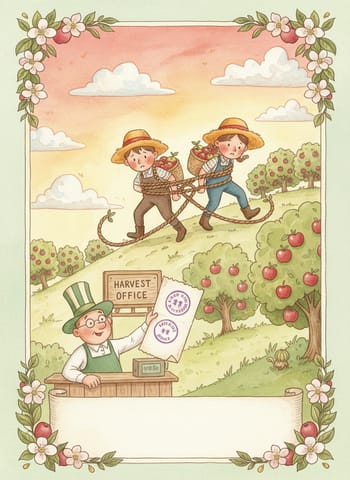
She points up the hill with her pencil. At the very top of the orchard, a single row of old, tall trees stands against the sky. They are the Winter Queens, the oldest trees on the farm. Their apples are the best of the harvest, pale and golden and heavy with juice. But the branches grow almost eight metres above the ground.
Señala colina arriba con su lápiz. En lo más alto del huerto, una sola hilera de árboles viejos y altos se recorta contra el cielo. Son las Reinas de Invierno, los árboles más antiguos de la granja. Sus manzanas son las mejores de la cosecha, pálidas, doradas y cargadas de jugo. Pero las ramas crecen a casi ocho metros del suelo.
"Nobody picks the Winter Queens," the owner says. "My best ladder is too short, and the ground up there is stony. The apples are going to waste. Pick one full crate from those trees before the horn, and I will honour this ticket."
«Nadie recoge las Reinas de Invierno», dice la dueña. «Mi mejor escalera es demasiado corta y el suelo de allá arriba es pedregoso. Las manzanas se están desperdiciando. Recojan un cajón lleno de esos árboles antes de la bocina y honraré este boleto».
"By myself?" Zuri asks.
«¿Yo sola?», pregunta Zuri.
"One of you on the ladder, and one of you holding it steady," the owner says. "Because nobody climbs those trees alone. If the ladder moves, the person on top falls."
«Una de ustedes en la escalera y otra sujetándola», dice la dueña. «Porque nadie sube a esos árboles solo. Si la escalera se mueve, el que está arriba cae».
Zuri and Yaw look at each other. Neither of them speaks.
Zuri y Yaw se miran. Ninguno habla.
"We have fifty minutes," Yaw says at last.
«Tenemos cincuenta minutos», dice Yaw por fin.
"I am lighter," Zuri says. "I should climb."
«Yo soy más ligera», dice Zuri. «Debería subir yo».
"I am stronger," says Yaw. "I should hold."
«Yo soy más fuerte», dice Yaw. «Debería sujetar yo».
"If you let go, I will never forgive you."
«Si me sueltas, nunca te lo perdonaré».
"If you drop the apples, I will never forgive you," Yaw says.
«Si dejas caer las manzanas, nunca te lo perdonaré», dice Yaw.
They race up the hill together, carrying the empty crate between them. It is the first time all day that they have walked side by side.
Corren juntos colina arriba, cargando entre los dos el cajón vacío. Es la primera vez en todo el día que caminan lado a lado.
The ground under the Winter Queens is stony and uneven, just as the owner said. Yaw plants the ladder carefully and pushes the legs into the earth. He puts his shoulder against it and plants his feet.
El suelo bajo las Reinas de Invierno es pedregoso y desigual, tal como dijo la dueña. Yaw coloca la escalera con cuidado y hunde las patas en la tierra. Apoya el hombro contra ella y planta los pies.
"Ready," he says.
«Listo», dice.
Zuri climbs. Each step makes the ladder shiver, and Yaw leans in harder. Higher and higher she goes, until she is among the branches. The fruit hangs round her like lamps.
Zuri sube. Cada peldaño hace temblar la escalera, y Yaw se apoya con más fuerza. Sube cada vez más alto, hasta que está entre las ramas. La fruta cuelga a su alrededor como lámparas.
"Left a little," she calls down. "No, your left. Good. Hold it there."
«Un poco a la izquierda», grita hacia abajo. «No, tu izquierda. Bien. Sostén ahí».
"I am holding it. I am holding it. Are you picking or talking?"
«Estoy sosteniendo. Estoy sosteniendo. ¿Estás recogiendo o hablando?».
"Both. Catch."
«Las dos cosas. Atrapa».
She drops the first apple. He catches it neatly in the crate. Then comes the second, and the third. They find a rhythm that neither of them has used before. She picks, he catches, and the crate fills.
Deja caer la primera manzana. Él la atrapa limpiamente en el cajón. Luego viene la segunda, y la tercera. Encuentran un ritmo que ninguno de los dos había usado antes. Ella recoge, él atrapa, y el cajón se llena.
Every few minutes, Yaw moves the ladder to a new branch. Each time, Zuri waits patiently, her feet steady, and each time he says, "Ready." The word starts to sound like a friend's name.
Cada pocos minutos, Yaw mueve la escalera a una nueva rama. Cada vez, Zuri espera con paciencia, con los pies firmes, y cada vez él dice: «Listo». La palabra empieza a sonar como el nombre de un amigo.
When the light turns orange, they have one crate. When the horn sounds in the valley, they have three.
Cuando la luz se vuelve naranja, tienen un cajón. Cuando la bocina suena en el valle, tienen tres.
They carry the crates down the hill, one handle each, in two trips. The clerk is waiting at the door of the weigh shed. When he sees the pale golden fruit, he lets out a low whistle. He takes the old ticket and presses the stamp down once, with great care.
Llevan los cajones colina abajo, un asa cada uno, en dos viajes. El empleado los espera en la puerta de la caseta de pesaje. Cuando ve la fruta pálida y dorada, deja escapar un silbido grave. Toma el boleto viejo y presiona el sello una vez, con gran cuidado.
A last, careful stamp falls.
Cae un último sello cuidadoso.
"Forty-one for Zuri," he says. Then he stamps two new tickets, one for each of them. "Forty-two for Zuri. Forty-two for Yaw."
«Cuarenta y uno para Zuri», dice. Luego sella dos boletos nuevos, uno para cada uno. «Cuarenta y dos para Zuri. Cuarenta y dos para Yaw».
The owner steps out of the shed with the Golden Ladder under one arm. It is smaller than Zuri remembers. It has a tiny silver ladder on top. Below it is a plate with room for exactly one name.
La dueña sale de la caseta con la Escalera Dorada bajo el brazo. Es más pequeña de lo que Zuri recordaba. Tiene una diminuta escalera de plata encima. Debajo hay una placa con espacio para exactamente un nombre.
"The farm has a problem," she says. "I only have one trophy."
«La granja tiene un problema», dice. «Solo tengo un trofeo».
Yaw looks at Zuri. Zuri looks at Yaw. A slow smile spreads across her face.
Yaw mira a Zuri. Zuri mira a Yaw. Una lenta sonrisa se extiende por su rostro.
"So," she says, "who gets to carry it home?"
«Entonces», dice, «¿quién se lo lleva a casa?».