The Ticket with Two Stamps
Uma história gratuita em inglês de nível B1 para estudantes, para ler online em 7 idiomas, com opção de ouvir no app gratuito Storyteller.
Two rival apple pickers are tied on the last day of harvest, and a clerk's double stamp forces them up the hill together.
Essa foi a prévia! Ouça a história completa no app gratuito Storyteller. Baixar o app
O áudio não está disponível no momento.
On the last day of the apple harvest, the Hollow Farm holds its picking contest. Every picker gets a book of paper tickets. Each full crate earns one ticket. The clerk at the weigh shed stamps it with a blue circle. At sunset, the person with the most stamps wins the Golden Ladder and a bonus for the week.
No último dia da colheita de maçãs, a Fazenda Hollow realiza sua competição de colheita. Cada colhedor recebe um talão de bilhetes de papel. Cada caixa cheia vale um bilhete. O funcionário do galpão de pesagem o carimba com um círculo azul. No pôr do sol, quem tiver mais carimbos ganha a Escada Dourada e um bônus para a semana.
For three years, the winner has been either Zuri or Yaw. They work in neighbouring rows, and they hate to lose.
Há três anos, o vencedor é Zuri ou Yaw. Eles trabalham em fileiras vizinhas e detestam perder.
This morning, they stand side by side at the gate, looking at the trees. The orchard stretches up the hill in neat green lines. The air smells of cut grass and sweet fruit.
Esta manhã, eles estão lado a lado no portão, olhando para as árvores. O pomar sobe a colina em linhas verdes e organizadas. O ar cheira a grama cortada e fruta doce.
"You have been practising," Zuri says.
"Você andou treinando", diz Zuri.
"I have been resting," Yaw says. "It is a different thing. You should try it."
"Eu andei descansando", diz Yaw. "É uma coisa diferente. Você devia tentar."
"I rested last year. It cost me the ladder."
"Eu descansei no ano passado. Isso me custou a escada."
"I know." Yaw smiles. "It was a beautiful ladder."
"Eu sei." Yaw sorri. "Era uma escada linda."
Then the horn sounds, and the contest begins.
Então a buzina soa, e a competição começa.
By ten o'clock, both of them are moving like machines. Zuri works with long, smooth reaches. She twists each apple off the branch and lays it in the basket without a bruise. Yaw is quicker but rougher. He climbs his ladder four times for every one of hers. His basket is always full before hers.
Às dez horas, os dois se movem como máquinas. Zuri trabalha com alcances longos e suaves. Ela torce cada maçã do galho e a deposita no cesto sem uma machucadura. Yaw é mais rápido, mas mais bruto. Ele sobe a escada dele quatro vezes para cada uma das dela. O cesto dele está sempre cheio antes do dela.
But the clerk checks every apple, and Yaw loses points for the bruised ones. The two of them trade the lead all morning. At noon, they sit under a tree and eat sandwiches without speaking. Each of them counts a small number in their head. Neither of them says it aloud.
Mas o funcionário confere cada maçã, e Yaw perde pontos pelas machucadas. Os dois se revezam na liderança a manhã inteira. Ao meio-dia, sentam sob uma árvore e comem sanduíches sem falar. Cada um conta um número pequeno de cabeça. Nenhum dos dois o diz em voz alta.
In the afternoon, the pace grows even faster. The sun slides lower, and the shadows of the trees stretch down the hill like long fingers. People call out their numbers from row to row. A boy cheers for Yaw. A group of older pickers cheers for Zuri. Neither of them hears a word.
À tarde, o ritmo fica ainda mais acelerado. O sol desce, e as sombras das árvores se esticam colina abaixo como dedos longos. As pessoas gritam seus números de fileira em fileira. Um menino torce por Yaw. Um grupo de colhedores mais velhos torce por Zuri. Nenhum dos dois ouve uma palavra.
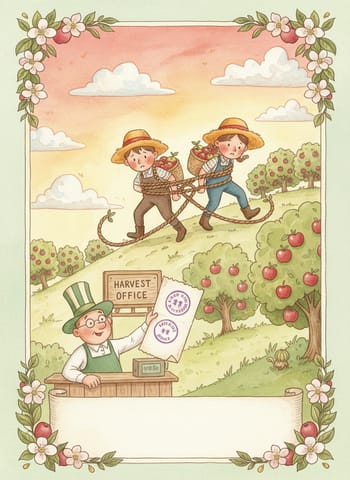
At half past five, with one hour left, Zuri brings her next crate to the weigh shed. The clerk is a quiet man with a rubber stamp and a very tired wrist. He weighs the crate and takes her ticket.
Às cinco e meia, faltando uma hora, Zuri leva a caixa seguinte ao galpão de pesagem. O funcionário é um homem quieto, com um carimbo de borracha e um pulso muito cansado. Ele pesa a caixa e pega o bilhete dela.
Thunk, goes the stamp. Then, without thinking, he does it again.
Tum, faz o carimbo. Então, sem pensar, ele o faz de novo.
A second blue circle lands on the first.
Um segundo círculo azul cai sobre o primeiro.
Zuri looks at the ticket. The two circles sit almost on top of each other.
Zuri olha o bilhete. Os dois círculos estão quase um em cima do outro.
"You stamped it twice," she says.
"O senhor carimbou duas vezes", diz ela.
"Did I?" The clerk looks at the paper. "Oh no. I am so sorry. My hand is on automatic."
"Carimbei?" O funcionário olha o papel. "Ah, não. Sinto muitíssimo. Minha mão está no automático."
"So, does it count as two crates?"
"Então, conta como duas caixas?"
"No." The clerk shakes his head firmly. "Absolutely not. The rule says a double stamp makes the ticket void. It is nothing. It does not count at all."
"Não." O funcionário balança a cabeça com firmeza. "De jeito nenhum. A regra diz que carimbo duplo anula o bilhete. Não vale nada. Não conta de modo algum."
"That is not fair," says a voice behind her.
"Isso não é justo", diz uma voz atrás dela.
It is Yaw. He has just arrived with his own crate, and he heard everything. He takes the ticket from the clerk's hand and holds it up to the light.
É Yaw. Ele acabou de chegar com a própria caixa e ouviu tudo. Pega o bilhete da mão do funcionário e o ergue contra a luz.
"She picked that crate fairly," he says. "I watched her pick it. Look at the weight on the card. It is the biggest crate of the day."
"Ela colheu essa caixa de forma justa", diz ele. "Eu a vi colher. Olhe o peso no cartão. É a maior caixa do dia."
Zuri stares at him. She does not expect this from her biggest rival.
Zuri o encara. Não espera isso do seu maior rival.
"I know it does not help me," Yaw says. "But the clerk made the mistake. She should not lose for it."
"Eu sei que isso não me ajuda", diz Yaw. "Mas o erro foi do funcionário. Ela não deveria perder por causa dele."
"Thank you," Zuri says slowly. "That is very decent of you."
"Obrigada", diz Zuri devagar. "Isso é muito decente da sua parte."
"Do not get used to it," says Yaw.
"Não se acostume", diz Yaw.
They both look at the clerk. He looks at his stamp, and then at the two pickers, and he sighs.
Os dois olham para o funcionário. Ele olha o carimbo, depois os dois colhedores, e suspira.
"I cannot change the rules," he says. "But I can ask the owner."
"Não posso mudar as regras", diz ele. "Mas posso perguntar à dona."
The owner of Hollow Farm arrives five minutes later. She is a big woman in muddy boots, with a pencil behind her ear. She looks at the ticket for a long time. Then she looks at the tally board, where the two names stand side by side.
A dona da Fazenda Hollow chega cinco minutos depois. É uma mulher grande de botas enlameadas, com um lápis atrás da orelha. Ela olha o bilhete por um bom tempo. Depois olha o quadro de pontuação, onde os dois nomes estão lado a lado.
"Forty for Zuri and forty-one for Yaw," she says. "Interesting."
"Quarenta para Zuri e quarenta e um para Yaw", diz ela. "Interessante."
"With the double ticket, I would have forty-one," Zuri says.
"Com o bilhete duplo, eu teria quarenta e um", diz Zuri.
"Then it is a tie. Without it, Yaw wins by one." The owner scratches her chin. "A tie is boring, and a void is unfair. I have an idea."
"Então é empate. Sem ele, Yaw vence por um." A dona coça o queixo. "Empate é chato, e anular é injusto. Tenho uma ideia."
She points up the hill with her pencil. At the very top of the orchard, a single row of old, tall trees stands against the sky. They are the Winter Queens, the oldest trees on the farm. Their apples are the best of the harvest, pale and golden and heavy with juice. But the branches grow almost eight metres above the ground.
Ela aponta colina acima com o lápis. No ponto mais alto do pomar, uma única fileira de árvores velhas e altas se destaca contra o céu. São as Rainhas do Inverno, as árvores mais antigas da fazenda. As maçãs delas são as melhores da colheita, pálidas, douradas e pesadas de suco. Mas os galhos crescem a quase oito metros do chão.
"Nobody picks the Winter Queens," the owner says. "My best ladder is too short, and the ground up there is stony. The apples are going to waste. Pick one full crate from those trees before the horn, and I will honour this ticket."
"Ninguém colhe as Rainhas do Inverno", diz a dona. "Minha melhor escada é curta demais, e o chão lá em cima é pedregoso. As maçãs estão se perdendo. Colham uma caixa cheia dessas árvores antes da buzina, e eu valido este bilhete."
"By myself?" Zuri asks.
"Sozinha?", Zuri pergunta.
"One of you on the ladder, and one of you holding it steady," the owner says. "Because nobody climbs those trees alone. If the ladder moves, the person on top falls."
"Um de vocês na escada e o outro segurando firme", diz a dona. "Porque ninguém sobe naquelas árvores sozinho. Se a escada se mexer, quem está em cima cai."
Zuri and Yaw look at each other. Neither of them speaks.
Zuri e Yaw se olham. Nenhum dos dois fala.
"We have fifty minutes," Yaw says at last.
"Temos cinquenta minutos", diz Yaw por fim.
"I am lighter," Zuri says. "I should climb."
"Eu sou mais leve", diz Zuri. "Eu devia subir."
"I am stronger," says Yaw. "I should hold."
"Eu sou mais forte", diz Yaw. "Eu devia segurar."
"If you let go, I will never forgive you."
"Se você soltar, eu nunca vou perdoar."
"If you drop the apples, I will never forgive you," Yaw says.
"Se você derrubar as maçãs, eu nunca vou perdoar", diz Yaw.
They race up the hill together, carrying the empty crate between them. It is the first time all day that they have walked side by side.
Eles correm colina acima juntos, carregando a caixa vazia entre os dois. É a primeira vez no dia todo que caminham lado a lado.
The ground under the Winter Queens is stony and uneven, just as the owner said. Yaw plants the ladder carefully and pushes the legs into the earth. He puts his shoulder against it and plants his feet.
O chão sob as Rainhas do Inverno é pedregoso e irregular, exatamente como a dona disse. Yaw firma a escada com cuidado e enterra os pés dela na terra. Apoia o ombro nela e finca os pés.
"Ready," he says.
"Pronto", diz ele.
Zuri climbs. Each step makes the ladder shiver, and Yaw leans in harder. Higher and higher she goes, until she is among the branches. The fruit hangs round her like lamps.
Zuri sobe. Cada degrau faz a escada tremer, e Yaw se inclina com mais força. Mais e mais alto ela vai, até ficar entre os galhos. As frutas pendem em volta dela como lâmpadas.
"Left a little," she calls down. "No, your left. Good. Hold it there."
"Um pouco para a esquerda", ela chama lá de cima. "Não, a sua esquerda. Bom. Segure aí."
"I am holding it. I am holding it. Are you picking or talking?"
"Estou segurando. Estou segurando. Você está colhendo ou conversando?"
"Both. Catch."
"Os dois. Pegue."
She drops the first apple. He catches it neatly in the crate. Then comes the second, and the third. They find a rhythm that neither of them has used before. She picks, he catches, and the crate fills.
Ela solta a primeira maçã. Ele a pega com precisão na caixa. Depois vem a segunda, e a terceira. Eles encontram um ritmo que nenhum dos dois havia usado antes. Ela colhe, ele pega, e a caixa se enche.
Every few minutes, Yaw moves the ladder to a new branch. Each time, Zuri waits patiently, her feet steady, and each time he says, "Ready." The word starts to sound like a friend's name.
A cada poucos minutos, Yaw muda a escada para um novo galho. Cada vez, Zuri espera com paciência, os pés firmes, e cada vez ele diz: "Pronto." A palavra começa a soar como o nome de um amigo.
When the light turns orange, they have one crate. When the horn sounds in the valley, they have three.
Quando a luz fica laranja, eles têm uma caixa. Quando a buzina soa no vale, têm três.
They carry the crates down the hill, one handle each, in two trips. The clerk is waiting at the door of the weigh shed. When he sees the pale golden fruit, he lets out a low whistle. He takes the old ticket and presses the stamp down once, with great care.
Eles carregam as caixas colina abaixo, uma alça cada um, em duas viagens. O funcionário está esperando na porta do galpão de pesagem. Ao ver a fruta pálida e dourada, solta um assobio baixo. Pega o bilhete antigo e pressiona o carimbo uma única vez, com muito cuidado.
A last, careful stamp falls.
Cai um último carimbo, cuidadoso.
"Forty-one for Zuri," he says. Then he stamps two new tickets, one for each of them. "Forty-two for Zuri. Forty-two for Yaw."
"Quarenta e um para Zuri", diz ele. Depois carimba dois bilhetes novos, um para cada um. "Quarenta e dois para Zuri. Quarenta e dois para Yaw."
The owner steps out of the shed with the Golden Ladder under one arm. It is smaller than Zuri remembers. It has a tiny silver ladder on top. Below it is a plate with room for exactly one name.
A dona sai do galpão com a Escada Dourada debaixo do braço. É menor do que Zuri lembrava. Tem uma minúscula escada de prata no alto. Embaixo dela há uma placa com espaço para exatamente um nome.
"The farm has a problem," she says. "I only have one trophy."
"A fazenda tem um problema", diz ela. "Eu só tenho um troféu."
Yaw looks at Zuri. Zuri looks at Yaw. A slow smile spreads across her face.
Yaw olha para Zuri. Zuri olha para Yaw. Um sorriso lento se espalha pelo rosto dela.
"So," she says, "who gets to carry it home?"
"Então", diz ela, "quem leva para casa?"