The Ball on the Roof
Una historia gratuita en inglés de nivel B1 para estudiantes, para leer en línea en 7 idiomas, con opción de escucharla en la app gratuita Storyteller.
A luggage clerk who always helps others lets a nervous English learner climb onto a roof to fetch a child's lost ball.
¡Ese fue el avance! Escucha la historia completa en la app gratuita Storyteller. Descargar la app
El audio no está disponible en este momento.
The left-luggage room at Gate Street is a long, narrow room with a counter at one end. Behind the counter stand rows of metal shelves, and every shelf is full of other people's lives. There are suitcases, guitar cases, boxes tied with string and one stuffed rabbit. Lorna has worked here for three years.
La sala de equipajes de la calle Gate es una sala larga y estrecha con un mostrador en un extremo. Detrás del mostrador hay hileras de estantes metálicos, y cada estante está lleno de las vidas de otras personas. Hay maletas, estuches de guitarra, cajas atadas con cordel y un conejo de peluche. Lorna lleva tres años trabajando aquí.
At the back of the room, high on the wall, there is a small window. It looks out onto the flat roof of the ticket office next door. For one month, a blue-and-white ball has sat on that roof. It leans against a metal vent, and Lorna looks at it every morning.
Al fondo de la sala, en lo alto de la pared, hay una pequeña ventana. Da al techo plano de la boletería de al lado. Desde hace un mes, una pelota azul y blanca descansa en ese techo. Está apoyada contra un respiradero metálico, y Lorna la mira todas las mañanas.
She knows exactly how it got there. A little girl was waiting for a bus with her father. She kicked the ball too hard, and it flew over the wall and rolled onto the roof. The girl did not cry. She stood still and looked up, as if the ball might change its mind.
Sabe exactamente cómo llegó allí. Una niñita esperaba el autobús con su padre. Pateó la pelota demasiado fuerte, y salió volando por encima del muro y rodó hasta el techo. La niña no lloró. Se quedó quieta y miró hacia arriba, como si la pelota pudiera cambiar de opinión.
"I'll get it down for you," Lorna told her father. "Come back tomorrow."
«Yo se la bajo», le dijo Lorna al padre. «Vuelva mañana».
He has come back every day since. He never asks about the ball. He simply stands at the counter, and Lorna says, "Not yet," and he nods and leaves.
Él ha vuelto todos los días desde entonces. Nunca pregunta por la pelota. Simplemente se queda ante el mostrador, y Lorna dice: «Todavía no», y él asiente y se va.
The roof is the problem. The only way up is a hatch behind the tallest shelf, and nobody has opened it for years. Lorna does not have the key. She also has no ladder and no permission, and the manager is away until next week. So the ball waits, and so does Lorna.
El problema es el techo. La única forma de subir es una trampilla detrás del estante más alto, y nadie la ha abierto en años. Lorna no tiene la llave. Tampoco tiene escalera ni permiso, y el gerente está fuera hasta la próxima semana. Así que la pelota espera, y Lorna también.
On a quiet afternoon a man walks in, carrying a heavy blue bag. He is perhaps thirty, with a dark beard and a careful way of standing. He puts a small book on the counter and opens it to a page with a pencil mark.
En una tarde tranquila entra un hombre cargando un pesado bolso azul. Tendrá unos treinta años, con barba oscura y una manera cuidadosa de estar de pie. Pone un librito sobre el mostrador y lo abre en una página con una marca de lápiz.
"Good afternoon," he reads. "I would like to leave my bag. It is for six hours. Is it possible?"
«Buenas tardes», lee. «Quisiera dejar mi bolso. Son seis horas. ¿Es posible?».
"Of course," says Lorna. "Name, please?"
«Por supuesto», dice Lorna. «¿Su nombre, por favor?».
"Fabrice." He smiles with relief. "Your English is very fast. My English is slow, but I am learning."
«Fabrice». Sonríe aliviado. «Usted habla inglés muy rápido. Mi inglés es lento, pero estoy aprendiendo».
"Your English is fine," says Lorna. "You've said it better than most people I know."
«Su inglés está bien», dice Lorna. «Lo ha dicho mejor que la mayoría de la gente que conozco».
She writes a ticket and takes the bag. Fabrice has a bus to catch at nine, and he has six hours to fill before it leaves. He does not seem to know what to do with them. He walks to the end of the room and back. Then he stops by the little window at the back, and he stays there.
Escribe un ticket y recibe el bolso. Fabrice tiene un autobús a las nueve, y tiene seis horas que llenar antes de que salga. No parece saber qué hacer con ellas. Camina hasta el fondo de la sala y vuelve. Luego se detiene junto a la ventanita del fondo, y se queda allí.
"Excuse me," he says. "What is this? On the roof?"
«Disculpe», dice. «¿Qué es esto? ¿En el techo?».
"A ball," Lorna says.
«Una pelota», dice Lorna.
"I see that it is a ball. But why is it there?"
«Veo que es una pelota. ¿Pero por qué está ahí?».
So she tells him. She does it slowly, with simple words. She does the same with every visitor who carries a phrase book. Fabrice listens with his head on one side. When she says "kicked," he repeats it quietly. When she says "hatch," he asks her to draw one.
Así que se lo cuenta. Lo hace despacio, con palabras sencillas. Hace lo mismo con todos los visitantes que llevan un libro de frases. Fabrice escucha con la cabeza ladeada. Cuando ella dice «pateó», él lo repite en voz baja. Cuando dice «trampilla», le pide que dibuje una.
She draws a square on the back of a ticket. He studies it as if it is a map.
Ella dibuja un cuadrado en el reverso de un ticket. Él lo estudia como si fuera un mapa.
"I know this," he says. "In my country, I am a roofer. For eleven years I climb roofs. This hatch is easy."
«Esto lo conozco», dice. «En mi país, soy techador. Once años subo a techos. Esta trampilla es fácil».
"It is locked," says Lorna. "And there's no ladder."
«Está cerrada con llave», dice Lorna. «Y no hay escalera».
"Is there a… " He searches for the word and makes a shape in the air with his hands.
«¿Hay un…?». Busca la palabra y hace una forma en el aire con las manos.
"A trolley?" asks Lorna. "A big one for the bags?"
«¿Un carrito?», pregunta Lorna. «¿Uno grande para las maletas?».
"Yes! A trolley. And a long stick?"
«¡Sí! Un carrito. ¿Y un palo largo?».
Lorna looks at him. For three years she has been the person who helps. She gives directions, finds lost tickets and teaches people to say "platform." Nobody has ever offered to climb a roof for her. She feels something unfamiliar, and it takes her a moment to name it. It is the feeling of being helped.
Lorna lo mira. Durante tres años ha sido la persona que ayuda. Da indicaciones, encuentra boletos perdidos y enseña a la gente a decir «andén». Nadie le ha ofrecido nunca subir a un techo por ella. Siente algo desconocido, y le toma un momento ponerle nombre. Es la sensación de ser ayudada.
"I have a broom," she says. "And there's a screwdriver in the drawer."
«Tengo una escoba», dice. «Y hay un destornillador en el cajón».
The hatch is old and stiff. Fabrice pulls the tallest shelf away from the wall with a loud squeal. A cloud of dust rises. Lorna holds her hand over her mouth. He does not mind the dust. He takes the screwdriver and starts on the lock. He hums a tune that sounds very old.
La trampilla es vieja y está dura. Fabrice aparta el estante más alto de la pared con un chirrido fuerte. Se levanta una nube de polvo. Lorna se tapa la boca con la mano. A él no le molesta el polvo. Toma el destornillador y empieza con la cerradura. Tararea una melodía que suena muy antigua.
"Do you do this often?" she asks.
«¿Hace esto a menudo?», pregunta ella.
"Every day, at home. Here it is a holiday." He grins. "But my hands remember."
«Todos los días, en casa. Aquí es un día de fiesta». Sonríe de oreja a oreja. «Pero mis manos recuerdan».
It takes twenty minutes. At last the lock gives a small click, and the hatch swings open. A square of white sky appears above them. Fabrice puts one foot on the trolley, and it rolls. He says a word in his own language, and Lorna catches the trolley with both hands.
Tarda veinte minutos. Por fin la cerradura da un pequeño clic, y la trampilla se abre de par en par. Un cuadrado de cielo blanco aparece sobre ellos. Fabrice pone un pie en el carrito, y rueda. Dice una palabra en su propio idioma, y Lorna atrapa el carrito con ambas manos.
"Hold it," he says. "Please. Strongly."
«Sujete», dice. «Por favor. Fuerte».
"I'm holding!"
«¡Estoy sujetando!».
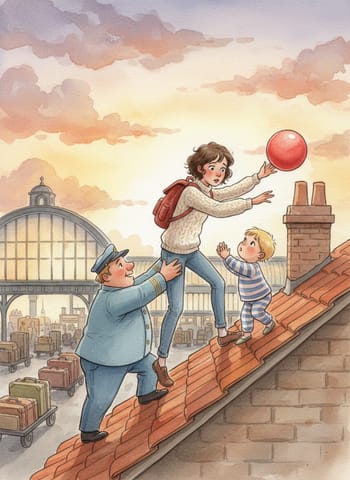
He climbs through the hatch, first his arms, then his shoulders, then his knees. For a moment only his boots hang in the air. Then they disappear too. Lorna stands alone in the left-luggage room. She holds the trolley with all her weight and listens to footsteps on the ceiling.
Trepa por la trampilla, primero los brazos, luego los hombros, luego las rodillas. Por un momento solo sus botas cuelgan en el aire. Luego también desaparecen. Lorna se queda sola en la sala de equipajes. Sujeta el carrito con todo su peso y escucha pasos en el techo.
"Can you see it?" she calls.
«¿Puede verla?», grita.
"I see it! It is behind the vent." The footsteps stop. "It is hard to reach. I must lie down."
«¡La veo! Está detrás del respiradero». Los pasos se detienen. «Es difícil de alcanzar. Tengo que acostarme».
Lorna waits. A bus engine starts outside, and then another. Customers come and go behind her, but today they find a closed counter with a note. She has written, "Back in ten minutes," and then crossed out ten, and written twenty.
Lorna espera. Un motor de autobús arranca afuera, y luego otro. Los clientes van y vienen detrás de ella, pero hoy encuentran un mostrador cerrado con una nota. Ha escrito «Vuelvo en diez minutos», y luego ha tachado diez y ha escrito veinte.
"Lorna!" The voice is high above her. "I have it!"
«¡Lorna!». La voz suena muy arriba. «¡La tengo!».
A moment later the ball drops through the hatch and bounces twice on the floor. She picks it up. It is dusty and a little soft, but whole. A thin line of grey marker runs round its middle, as if someone wrote on it long ago.
Un momento después la pelota cae por la trampilla y rebota dos veces en el suelo. Ella la recoge. Está polvorienta y un poco blanda, pero entera. Una delgada línea de marcador gris le rodea el medio, como si alguien hubiera escrito en ella hace mucho.
Fabrice comes down the same way he went up, backwards and slowly. His shirt is black with dirt, and he is smiling like a boy. He sits on the trolley and shakes the dust out of his beard.
Fabrice baja por donde subió, de espaldas y despacio. Su camisa está negra de suciedad, y sonríe como un niño. Se sienta en el carrito y se sacude el polvo de la barba.
"Thank you," Lorna says. The words feel too small. "I mean it. Thank you."
«Gracias», dice Lorna. Las palabras le parecen demasiado pequeñas. «De verdad. Gracias».
"No, no," says Fabrice. "Thank you. You speak with me for one hour. I speak English more than in one month."
«No, no», dice Fabrice. «Gracias a usted. Usted habla conmigo una hora. Yo hablo inglés más que en un mes».
The girl's father arrives at four, as he does every day. He stands at the counter and looks at Lorna, and she says nothing at all. She just puts the ball in his hands. He looks at it for a long time. Then he laughs and says a few words in an unsteady voice. He hurries out to find his daughter.
El padre de la niña llega a las cuatro, como todos los días. Se para ante el mostrador y mira a Lorna, y ella no dice nada. Solo le pone la pelota en las manos. Él la mira durante largo rato. Luego se ríe y dice unas pocas palabras con voz temblorosa. Sale a toda prisa a buscar a su hija.
Lorna wipes the counter and turns back to the room. Fabrice is washing his hands at the small sink. Beside him lies his phrase book, still open, and she sees a new pencil mark on the page. It is next to the word "hatch."
Lorna limpia el mostrador y se vuelve hacia la sala. Fabrice se lava las manos en el pequeño lavabo. A su lado está su libro de frases, todavía abierto, y ella ve una nueva marca de lápiz en la página. Está junto a la palabra «trampilla».
When she dusts the shelves that evening, she notices something else. The ball has left a faint ring of dust on the floor where she put it down. In the middle of the ring lies a small bit of paper, that came off the ball. It has a few letters in grey marker, and a place name she does not know.
Cuando limpia los estantes esa tarde, nota algo más. La pelota ha dejado un tenue anillo de polvo en el suelo donde la puso. En medio del anillo hay un pequeño trozo de papel, que se desprendió de la pelota. Tiene unas pocas letras en marcador gris, y el nombre de un lugar que ella no conoce.
Fabrice walks over to look. He reads it once, and then again. His mouth opens, and then it closes.
Fabrice se acerca a mirar. Lo lee una vez, y luego otra. Abre la boca, y luego la cierra.
"What does it say?" Lorna asks.
«¿Qué dice?», pregunta Lorna.
Outside, the loudspeaker crackles into life. A voice announces the nine o'clock bus. Fabrice folds the paper twice and puts it in his pocket.
Afuera, el altavoz cobra vida con un crepitar. Una voz anuncia el autobús de las nueve. Fabrice dobla el papel dos veces y se lo guarda en el bolsillo.