Two Hands on the Price Board
Una historia gratuita en inglés de nivel B1 para estudiantes, para leer en línea en 7 idiomas, con opción de escucharla en la app gratuita Storyteller.
Two rival teenage sellers at a salt flat stop must share one price board when a coach arrives.
¡Ese fue el avance! Escucha la historia completa en la app gratuita Storyteller. Descargar la app
El audio no está disponible en este momento.
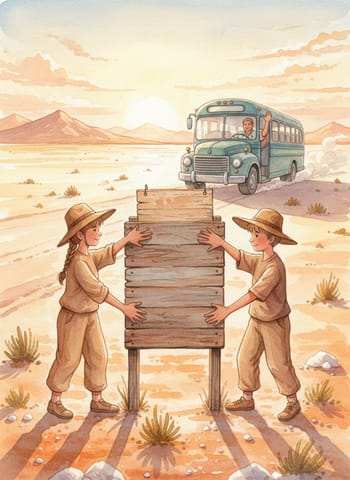
The price board at the Saltwater Stop was older than Lior and Dalila put together.
El tablero de precios de la Parada Agua Salada era más viejo que Lior y Dalila juntos.
It stood on two crooked posts at the edge of the car park, between their two stalls. Someone had painted it black long ago. The paint had cracked like dry mud. The stop sat on a salt flat so wide that the horizon looked like a drawn line. Coaches came across it twice a day, and the board was the first thing the passengers read.
Se alzaba sobre dos postes torcidos al borde del estacionamiento, entre sus dos puestos. Alguien lo había pintado de negro hacía mucho. La pintura se había agrietado como barro seco. La parada estaba sobre un salar tan ancho que el horizonte parecía una línea dibujada. Los autobuses de larga distancia lo cruzaban dos veces al día, y el tablero era lo primero que leían los pasajeros.
Lior sold cold lemon water from a blue cool box. Dalila sold small salt crystals, polished and strung on leather cords. Both of them worked at the stop every summer. Both of them thought the best corner belonged to them.
Lior vendía agua de limón fría de una hielera azul. Dalila vendía pequeños cristales de sal, pulidos y ensartados en cordones de cuero. Los dos trabajaban en la parada todos los veranos. Los dos pensaban que la mejor esquina era suya.
The trouble began with the board.
El problema empezó con el tablero.
On Monday, Lior wrote his price in the first row of the board. He wrote "Cold lemon water, three coins" in tall, square letters, like a man signing a letter. On Tuesday, Dalila wiped it with her sleeve. She wrote "Lemon water, three coins, crystals, five coins" in round, curling letters across the whole top half.
El lunes, Lior escribió su precio en la primera fila del tablero. Escribió «Agua de limón fría, tres monedas» con letras altas y cuadradas, como un hombre que firma una carta. El martes, Dalila lo borró con la manga. Escribió «Agua de limón, tres monedas, cristales, cinco monedas» con letras redondas y rizadas por toda la mitad superior.
On Wednesday, Lior rubbed out her curls. He drew a line down the middle of the board and wrote his name above the left side. He did not write hers on the right.
El miércoles, Lior borró sus rizos. Trazó una línea por el centro del tablero y escribió su nombre sobre el lado izquierdo. No escribió el de ella en el derecho.
"You cannot split a board that belongs to the stop," Dalila said.
«No puedes dividir un tablero que pertenece a la parada», dijo Dalila.
"I am not splitting it. I am organising it."
«No lo estoy dividiendo. Lo estoy organizando».
"You are taking it."
«Te lo estás quedando».
"You are writing too big."
«Tú escribes demasiado grande».
They did not speak for the rest of the afternoon. Each of them watched the other from behind a stall. Each pretended to be busy. In the evening the light turned the flat pink. They both walked past the board without looking at it.
No se hablaron el resto de la tarde. Cada uno vigilaba al otro desde detrás de su puesto. Cada uno fingía estar ocupado. Al anochecer, la luz volvió rosa la llanura. Los dos pasaron junto al tablero sin mirarlo.
By Friday the board was a mess. There were crossed-out numbers, smudged names, and a line down the middle that went crooked halfway. A man who stopped for a drink read it for a long time. Then he walked on without buying anything.
Para el viernes, el tablero era un desastre. Había números tachados, nombres manchados y una línea por el medio que se torcía a la mitad. Un hombre que se detuvo a tomar algo lo leyó durante mucho rato. Luego siguió su camino sin comprar nada.
"See what you did," said Dalila.
«Mira lo que hiciste», dijo Dalila.
"Me?" Lior said. "You started it."
«¿Yo?», dijo Lior. «Tú empezaste».
At noon on Saturday, a big white coach rolled across the flat. It stopped in a cloud of fine salt dust. The door opened with a sigh. A woman in a bright scarf stepped out and clapped her hands.
Al mediodía del sábado, un gran autobús blanco cruzó la llanura. Se detuvo en una nube de fino polvo de sal. La puerta se abrió con un suspiro. Una mujer con un pañuelo brillante bajó y dio una palmada.
"Fifteen minutes, everyone," she called. "Then we leave. The next town is far."
«Quince minutos, todos», llamó. «Luego nos vamos. El próximo pueblo está lejos».
Forty passengers poured out. They were tired and thirsty, and they carried cameras and empty water bottles. They went straight to the board. For a moment, there was a quiet murmur as they tried to read it.
Cuarenta pasajeros salieron en tropel. Estaban cansados y sedientos, y llevaban cámaras y botellas de agua vacías. Fueron directo al tablero. Por un momento, hubo un murmullo bajo mientras intentaban leerlo.
"What does that say?" a man asked.
«¿Qué dice ahí?», preguntó un hombre.
"I think it says three coins for lemon," said a girl. "Or thirty."
«Creo que dice tres monedas el limón», dijo una chica. «O treinta».
"Is the crystal five, or fifty?"
«¿El cristal es cinco, o cincuenta?».
"Where do I pay?"
«¿Dónde se paga?».
Nobody could tell which price belonged to which stall. Some of the passengers tried Lior's cool box and some tried Dalila's table. Nobody was sure of the numbers, and nobody wanted to argue. A few of them looked at their watches. One man took out his phone and began taking a photograph of the board, shaking his head.
Nadie podía saber qué precio era de qué puesto. Algunos pasajeros probaron la hielera de Lior y otros la mesa de Dalila. Nadie estaba seguro de los números, y nadie quería discutir. Algunos miraron sus relojes. Un hombre sacó su teléfono y empezó a fotografiar el tablero, negando con la cabeza.
The woman in the scarf walked over to the stalls. She had kind eyes, but she looked worried.
La mujer del pañuelo caminó hacia los puestos. Tenía ojos amables, pero parecía preocupada.
"I need to know," she said, "if my passengers can buy things here, and quickly. If they can't read your board, they will go back to the coach and wait. I have done this journey many times. The stop with a clear board gets the money."
«Necesito saber», dijo, «si mis pasajeros pueden comprar cosas aquí, y rápido. Si no pueden leer su tablero, volverán al autobús y esperarán. He hecho este viaje muchas veces. La parada con un tablero claro se queda con el dinero».
Lior opened his mouth. Dalila opened hers. Neither of them said a word.
Lior abrió la boca. Dalila abrió la suya. Ninguno dijo una palabra.
The woman waited. "I will say it plainly," she said. "You have thirteen minutes. If you cannot give me one clear price list, I will drive away. The next coach will see the same mess."
La mujer esperó. «Se lo diré claramente», dijo. «Tienen trece minutos. Si no me dan una lista de precios clara, me iré. El próximo autobús verá el mismo desorden».
She walked back to the coach. The passengers stood in the sun and waited.
Volvió caminando al autobús. Los pasajeros se quedaron bajo el sol, esperando.
Lior looked at Dalila. Dalila looked at the board. For a long moment, the only sound was the hum of the cool box.
Lior miró a Dalila. Dalila miró el tablero. Durante un largo momento, el único sonido fue el zumbido de la hielera.
"I have a rag," Lior said at last.
«Tengo un trapo», dijo Lior por fin.
"I have a bucket," said Dalila, and her voice was small.
«Tengo un cubo», dijo Dalila, y su voz era pequeña.
They worked quickly. Lior wet the rag in the bucket and wiped the board clean. Dalila fetched a thick white marker from her stall and shook it hard. The surface shone dark and wet for a few seconds. Then it began to dry in the sun.
Trabajaron rápido. Lior mojó el trapo en el cubo y limpió el tablero. Dalila sacó de su puesto un grueso marcador blanco y lo sacudió con fuerza. La superficie brilló oscura y mojada unos segundos. Luego empezó a secarse al sol.
"You do the numbers," she said. "Your numbers are clear."
«Tú haz los números», dijo ella. «Tus números son claros».
"You do the words. Yours are pretty."
«Tú haz las palabras. Las tuyas son bonitas».
"Pretty words do not help anyone who is thirsty."
«Las palabras bonitas no ayudan a nadie que tiene sed».
"They help if people can read them."
«Ayudan si la gente las puede leer».
Dalila almost smiled. She took the marker and wrote the first line in her round hand: "Lemon water, with ice." Lior took a marker from the cool box lid. Beside it he added the price in his tall, square figures: "3." Then she wrote "Salt crystal on a cord," and he wrote "5."
Dalila casi sonrió. Tomó el marcador y escribió la primera línea con su letra redonda: «Agua de limón, con hielo». Lior tomó un marcador de la tapa de la hielera. Junto a ella añadió el precio con sus cifras altas y cuadradas: «3». Luego ella escribió «Cristal de sal en cordón», y él escribió «5».
The letters were different, but they sat side by side, and the board looked better at once.
Las letras eran diferentes, pero estaban lado a lado, y el tablero se veía mejor de inmediato.
"We could do one more thing," Dalila said. She was talking fast now. "If someone buys both, they pay seven coins and not eight."
«Podríamos hacer una cosa más», dijo Dalila. Hablaba rápido ahora. «Si alguien compra ambos, paga siete monedas y no ocho».
"Seven," said Lior. "That is fair." He wrote it at the bottom and drew a neat line beneath it.
«Siete», dijo Lior. «Es justo». Lo escribió abajo y trazó una línea limpia debajo.
They stepped back. In the middle of the board, the two kinds of handwriting leaned together like two people talking quietly.
Dieron un paso atrás. En medio del tablero, los dos tipos de letra se inclinaban juntos como dos personas conversando en voz baja.
"Ready?" he said.
«¿Lista?», dijo él.
"Ready."
«Lista».
The woman in the scarf blew a whistle, and the forty passengers came back. This time nobody asked what the numbers meant. A girl took three coins out of her pocket and bought a lemon water. A man with a camera bought a crystal for his daughter. Then they started buying both, and the line grew so long that Lior ran out of cups. Dalila ran to a crate behind the stall to fetch more. Lior counted the coins into a tin and called out the prices. Together they served the whole coach in eleven minutes.
La mujer del pañuelo tocó un silbato, y los cuarenta pasajeros volvieron. Esta vez nadie preguntó qué significaban los números. Una chica sacó tres monedas del bolsillo y compró un agua de limón. Un hombre con cámara compró un cristal para su hija. Luego empezaron a comprar ambos, y la fila creció tanto que a Lior se le acabaron los vasos. Dalila corrió a una caja detrás del puesto a traer más. Lior contó las monedas en una lata y cantó los precios. Juntos atendieron a todo el autobús en once minutos.
When the woman in the scarf climbed the steps, she looked down at them from the door.
Cuando la mujer del pañuelo subió los escalones, los miró desde la puerta.
"That," she said, "is a good board."
«Eso», dijo, «es un buen tablero».
The coach rolled away across the flat, and the dust settled slowly behind it.
El autobús se alejó rodando por la llanura, y el polvo se asentó lentamente tras él.
For a while they sat on the cool box and counted the coins. The tin was almost full. Neither of them said who had earned more. Lior pushed the tin across the lid, and Dalila took half. Then she pushed one extra coin back to him, because he had run out of cups so fast.
Durante un rato se sentaron en la hielera y contaron las monedas. La lata estaba casi llena. Ninguno dijo quién había ganado más. Lior empujó la lata por la tapa, y Dalila tomó la mitad. Luego le devolvió una moneda extra, porque a él se le habían acabado los vasos tan rápido.
"The line under the seven is crooked," she said.
«La línea bajo el siete está torcida», dijo ella.
"I know. I will fix it tomorrow."
«Lo sé. La arreglaré mañana».
"Do not," said Dalila. "Leave it."
«No lo hagas», dijo Dalila. «Déjala».
By evening the sun sank low, and the flat turned from white to pale gold. The shadows of the crooked posts stretched away across the salt. The board stood between the two stalls, and the last light touched the writing on it. There were tall, square numbers and round, curling words. In the stillness, it looked as if the two hands had been working there together for years.
Al atardecer el sol se hundió, y la llanura pasó de blanca a dorado pálido. Las sombras de los postes torcidos se alargaron sobre la sal. El tablero se alzaba entre los dos puestos, y la última luz tocaba lo escrito en él. Había números altos y cuadrados y palabras redondas y rizadas. En la quietud, parecía como si las dos manos llevaran años trabajando allí juntas.