The Slowest Chairlift in the Valley
Una historia gratuita en inglés de nivel B1 para estudiantes, para leer en línea en 7 idiomas, con opción de escucharla en la app gratuita Storyteller.
An engineer comes to speed up a mountain lift in summer and finally asks its operator why it crawls.
¡Ese fue el avance! Escucha la historia completa en la app gratuita Storyteller. Descargar la app
El audio no está disponible en este momento.
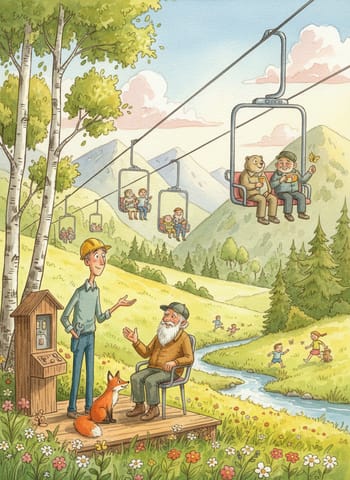
In winter, the chairlift at Kessel Mountain carried skiers to the top in six minutes. In summer, it carried hikers in forty.
En invierno, el telesilla del monte Kessel llevaba a los esquiadores a la cima en seis minutos. En verano, llevaba a los excursionistas en cuarenta.
Takeshi had run the lift station for seven summers. The snow melted every May, and the green grass came back to the slopes. The big machines that made snow stood silent in the fields like sleeping animals. Only one old chairlift kept moving, and it moved at the speed of a walking cow.
Takeshi había manejado la estación del telesilla durante siete veranos. La nieve se derretía cada mayo y el pasto verde volvía a las laderas. Las grandes máquinas que hacían la nieve estaban quietas en los campos como animales dormidos. Solo un viejo telesilla seguía moviéndose, y lo hacía a la velocidad de una vaca que camina.
On a bright Tuesday in July, a visitor arrived at the bottom station. He carried a heavy bag of tools. He was a tall man with a clipboard and a company badge. His name was Raj.
Un martes brillante de julio, llegó un visitante a la estación de abajo. Traía una pesada bolsa de herramientas. Era un hombre alto, con una tablilla de notas y una credencial de empresa. Se llamaba Raj.
"I am here for the yearly check," he said. "The owners want a report on the motor. They are thinking about an upgrade."
«Vengo a la revisión anual», dijo. «Los dueños quieren un informe sobre el motor. Están pensando en una mejora».
"An upgrade?" said Takeshi.
«¿Una mejora?», dijo Takeshi.
"A faster lift for summer. Ten minutes instead of forty. More riders, more money." Raj shrugged, as if he did not care much either way. "That is what they told me."
«Un telesilla más rápido para el verano. Diez minutos en vez de cuarenta. Más pasajeros, más dinero». Raj se encogió de hombros, como si no le importara mucho de una forma u otra. «Eso fue lo que me dijeron».
Takeshi said nothing. He poured water into a plastic cup and handed it over. Then he went back to his stool. The first chair of the day swung out of the station.
Takeshi no dijo nada. Sirvió agua en un vasito de plástico y se lo entregó. Luego volvió a su taburete. La primera silla del día salió balanceándose de la estación.
Raj spent the morning inside the motor room. Takeshi could hear him working through the thin wall. There was the sound of a spanner, a long silence, and then a low whistle. At noon, Raj came out with oil on his hands.
Raj pasó la mañana dentro de la sala del motor. Takeshi lo oía trabajar a través de la delgada pared. Se oía el ruido de una llave inglesa, un largo silencio y luego un silbido grave. Al mediodía, Raj salió con las manos llenas de aceite.
"The motor is strong," he said. "It can run three times faster than this. Why does it crawl?"
«El motor es fuerte», dijo. «Puede andar tres veces más rápido que esto. ¿Por qué se arrastra?».
"The owner set it that way many years ago," said Takeshi. "Safer for old knees."
«El dueño lo dejó así hace muchos años», dijo Takeshi. «Es más seguro para las rodillas viejas».
"Safer," Raj repeated. He did not sound convinced.
«Más seguro», repitió Raj. No sonaba convencido.
In the afternoon, Raj decided to watch the passengers. He sat on a bench near the entrance with his clipboard on his lap. Takeshi did his usual work. He helped a mother lift a pushchair onto a chair, and he gave a young man a map. He stopped the lift for a moment so an older hiker could sit down safely.
Por la tarde, Raj decidió observar a los pasajeros. Se sentó en una banca cerca de la entrada con la tablilla sobre las rodillas. Takeshi hizo su trabajo de siempre. Ayudó a una madre a subir un cochecito a una silla y le dio un mapa a un joven. Detuvo el telesilla un momento para que un excursionista mayor pudiera sentarse con seguridad.
People came in different moods. Some were cheerful, and some looked impatient already. A teenage boy checked his phone twice before he even sat down.
La gente llegaba con ánimos diferentes. Algunos estaban contentos y otros ya parecían impacientes. Un adolescente miró su teléfono dos veces antes de siquiera sentarse.
"Forty minutes!" one man said, with a laugh that was not friendly. "My legs are faster than this."
«¡Cuarenta minutos!», dijo un hombre, con una risa que no era amistosa. «Mis piernas son más rápidas que esto».
"Then walk," said Takeshi, and he smiled. The man did not walk. He climbed onto the chair and grumbled until it disappeared into the trees.
«Entonces camine», dijo Takeshi, y sonrió. El hombre no caminó. Se subió a la silla y siguió quejándose hasta que desapareció entre los árboles.
Raj wrote something on his clipboard. "You hear this complaint all day?"
Raj anotó algo en su tablilla. «¿Oyes esta queja todo el día?».
"Every day," said Takeshi. "It is part of the job."
«Todos los días», dijo Takeshi. «Es parte del trabajo».
"And it does not bother you?"
«¿Y no te molesta?».
"No." Takeshi looked up the hill, where the cables shone in the sun. "Wait until they come down."
«No». Takeshi miró hacia lo alto de la colina, donde los cables brillaban al sol. «Espere a que bajen».
Raj frowned, but he stayed. At five o'clock, the first riders returned from the top. A couple stepped off the chair, and they were holding hands. A man in a blue shirt was smiling at nobody in particular. Two sisters were laughing so hard that one of them had to sit down on the grass.
Raj frunció el ceño, pero se quedó. A las cinco de la tarde, los primeros pasajeros regresaron de la cima. Una pareja bajó de la silla tomada de la mano. Un hombre de camisa azul sonreía sin mirar a nadie en particular. Dos hermanas se reían tanto que una de ellas tuvo que sentarse en el pasto.
"They look happy," Raj said slowly.
«Parecen felices», dijo Raj despacio.
"Mostly," said Takeshi. "Not always at the start. But when they come back, yes."
«La mayoría», dijo Takeshi. «No siempre al principio. Pero cuando regresan, sí».
That evening, they ate dinner together in the small kitchen behind the station. Takeshi cooked rice and vegetables on a camping burner. They talked about the mountain, and about the old machines Raj had repaired in other valleys. The conversation was easy.
Esa noche cenaron juntos en la pequeña cocina detrás de la estación. Takeshi cocinó arroz y verduras en un quemador de camping. Hablaron de la montaña y de las viejas máquinas que Raj había reparado en otros valles. La conversación fluía con facilidad.
Raj put his fork down.
Raj dejó el tenedor.
"May I ask you something? It has been in my head all day."
«¿Puedo preguntarte algo? Lo llevo en la cabeza todo el día».
"Please," said Takeshi.
«Por favor», dijo Takeshi.
"Why did you never ask the owners to make the lift faster? Seven summers. You hear the complaints. You could have a busier station, a better salary. Yet you keep it slow."
«¿Por qué nunca les pediste a los dueños que hicieran más rápido el telesilla? Siete veranos. Oyes las quejas. Podrías tener una estación más concurrida, un mejor sueldo. Y aun así lo mantienes lento».
For a long time, Takeshi did not answer. Outside, a bird sang a short, simple song.
Durante un largo rato, Takeshi no respondió. Afuera, un pájaro cantó una canción corta y sencilla.
"Nobody has asked me that before," he said at last. "In seven years, they only asked how many riders we had."
«Nadie me lo había preguntado antes», dijo al fin. «En siete años, solo me preguntaron cuántos pasajeros teníamos».
"I am asking now."
«Te lo pregunto ahora».
Takeshi turned his cup in his hands. "The first summer, I thought the same as you. I thought the lift was a problem. Then one afternoon, I rode up to fix a broken light. It took forty minutes, and I had nothing to do. No phone signal. No one to talk to except a silent hill."
Takeshi giró su taza entre las manos. «El primer verano pensaba lo mismo que usted. Pensaba que el telesilla era un problema. Entonces, una tarde, subí a arreglar una luz rota. Tardó cuarenta minutos y no tenía nada que hacer. Sin señal de teléfono. Nadie con quien hablar, salvo una colina silenciosa».
"And?"
«¿Y?».
"I thought about my brother. We had not spoken for three years, since an argument about our parents' house. I had not planned to think about him. It simply happened somewhere around the twentieth minute." He smiled a little. "At the top, I sent him a message. It was only two words."
«Pensé en mi hermano. Llevábamos tres años sin hablarnos, desde una discusión por la casa de nuestros padres. No había planeado pensar en él. Simplemente ocurrió por ahí del minuto veinte». Sonrió un poco. «Arriba, le mandé un mensaje. Eran solo dos palabras».
"What did he answer?"
«¿Qué respondió?».
"He answered in ten seconds." Takeshi laughed quietly. "He had been waiting longer than I realised."
«Respondió en diez segundos». Takeshi rio en voz baja. «Llevaba esperando más tiempo de lo que yo creía».
Raj looked at the floor.
Raj miró al suelo.
"After that, I started to listen to the riders," Takeshi continued. "On the way down, people tell me things. A woman once told me she had finally decided to leave her job. A father said he had never spent a whole hour with his daughter without screens. A young man had a question to ask. He found the courage only when the chair reached the high pines."
«Después de eso, empecé a escuchar a los pasajeros», continuó Takeshi. «En el camino de bajada, la gente me cuenta cosas. Una mujer me dijo una vez que por fin había decidido dejar su trabajo. Un padre dijo que nunca había pasado una hora entera con su hija sin pantallas. Un joven tenía una pregunta que hacer. Encontró el valor solo cuando la silla llegó a los pinos altos».
"And a fast lift?"
«¿Y un telesilla rápido?».
"In ten minutes, nobody gets lonely enough to think. They look at the view, and they take a photograph." Takeshi opened his hands. "I am not saying slowness is always good. I only say it gives people something. Nobody ever asks what."
«En diez minutos, nadie se siente lo bastante solo como para pensar. Miran el paisaje y sacan una fotografía». Takeshi abrió las manos. «No digo que la lentitud siempre sea buena. Solo digo que le da algo a la gente. Nadie pregunta nunca qué».
The kitchen was quiet. The only sound was the old clock above the sink.
La cocina quedó en silencio. El único sonido era el viejo reloj sobre el fregadero.
"I came here to measure a motor," Raj said finally.
«Vine aquí a medir un motor», dijo Raj por fin.
"And now?"
«¿Y ahora?».
"Now I think I should measure something else."
«Ahora creo que debería medir otra cosa».
The next morning, Raj rode the lift to the top by himself. His tool bag sat on his knees. He did not hurry. He watched the grass pass under his feet, and then the trees. The long grey cable ran ahead of him. Somewhere above the halfway point, he put his clipboard away.
A la mañana siguiente, Raj subió solo en el telesilla hasta la cima. Su bolsa de herramientas descansaba sobre sus rodillas. No tenía prisa. Vio pasar el pasto bajo sus pies, y luego los árboles. El largo cable gris corría delante de él. En algún punto pasada la mitad del recorrido, guardó la tablilla.
At the summit station, he stayed for an hour. He sat on a rock and looked at the valley. A little before noon, he took out his phone and wrote a message to someone. He did not tell Takeshi who.
En la estación de la cima se quedó una hora. Se sentó en una roca y miró el valle. Poco antes del mediodía, sacó su teléfono y escribió un mensaje a alguien. No le dijo a Takeshi a quién.
When he returned to the bottom, Takeshi was waiting with a cup of water.
Cuando regresó abajo, Takeshi lo esperaba con un vaso de agua.
"Did you finish your report?"
«¿Terminaste tu informe?».
"Not yet." Raj took out his pen and sat down at the small desk in the office. The form was waiting for him with its empty boxes. He read the line that asked about recommended changes.
«Todavía no». Raj sacó su pluma y se sentó en el pequeño escritorio de la oficina. El formulario lo esperaba con sus casillas vacías. Leyó la línea que preguntaba por los cambios recomendados.
Then he wrote, in clear capital letters, "Speed correct. Do not change," and signed his name at the bottom.
Luego escribió, con claras letras mayúsculas: «Velocidad correcta. No cambiar», y firmó con su nombre al pie.