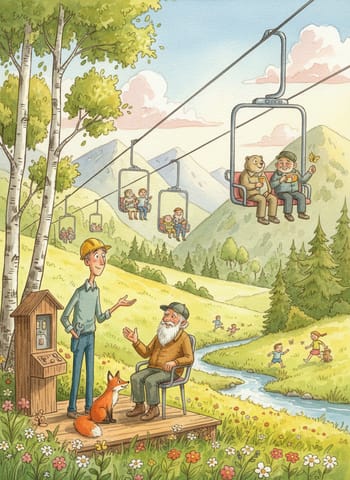
The Slowest Chairlift in the Valley
A free B1-level English story for language learners, readable online in 7 languages, with an option to listen via the free Storyteller app.
An engineer comes to speed up a mountain lift in summer and finally asks its operator why it crawls.
That was the preview! Hear the full story in the free Storyteller app. Get the app
Audio isn't available right now.
In winter, the chairlift at Kessel Mountain carried skiers to the top in six minutes. In summer, it carried hikers in forty.
Takeshi had run the lift station for seven summers. The snow melted every May, and the green grass came back to the slopes. The big machines that made snow stood silent in the fields like sleeping animals. Only one old chairlift kept moving, and it moved at the speed of a walking cow.
On a bright Tuesday in July, a visitor arrived at the bottom station. He carried a heavy bag of tools. He was a tall man with a clipboard and a company badge. His name was Raj.
"I am here for the yearly check," he said. "The owners want a report on the motor. They are thinking about an upgrade."
"An upgrade?" said Takeshi.
"A faster lift for summer. Ten minutes instead of forty. More riders, more money." Raj shrugged, as if he did not care much either way. "That is what they told me."
Takeshi said nothing. He poured water into a plastic cup and handed it over. Then he went back to his stool. The first chair of the day swung out of the station.
Raj spent the morning inside the motor room. Takeshi could hear him working through the thin wall. There was the sound of a spanner, a long silence, and then a low whistle. At noon, Raj came out with oil on his hands.
"The motor is strong," he said. "It can run three times faster than this. Why does it crawl?"
"The owner set it that way many years ago," said Takeshi. "Safer for old knees."
"Safer," Raj repeated. He did not sound convinced.
In the afternoon, Raj decided to watch the passengers. He sat on a bench near the entrance with his clipboard on his lap. Takeshi did his usual work. He helped a mother lift a pushchair onto a chair, and he gave a young man a map. He stopped the lift for a moment so an older hiker could sit down safely.
People came in different moods. Some were cheerful, and some looked impatient already. A teenage boy checked his phone twice before he even sat down.
"Forty minutes!" one man said, with a laugh that was not friendly. "My legs are faster than this."
"Then walk," said Takeshi, and he smiled. The man did not walk. He climbed onto the chair and grumbled until it disappeared into the trees.
Raj wrote something on his clipboard. "You hear this complaint all day?"
"Every day," said Takeshi. "It is part of the job."
"And it does not bother you?"
"No." Takeshi looked up the hill, where the cables shone in the sun. "Wait until they come down."
Raj frowned, but he stayed. At five o'clock, the first riders returned from the top. A couple stepped off the chair, and they were holding hands. A man in a blue shirt was smiling at nobody in particular. Two sisters were laughing so hard that one of them had to sit down on the grass.
"They look happy," Raj said slowly.
"Mostly," said Takeshi. "Not always at the start. But when they come back, yes."
That evening, they ate dinner together in the small kitchen behind the station. Takeshi cooked rice and vegetables on a camping burner. They talked about the mountain, and about the old machines Raj had repaired in other valleys. The conversation was easy.
Raj put his fork down.
"May I ask you something? It has been in my head all day."
"Please," said Takeshi.
"Why did you never ask the owners to make the lift faster? Seven summers. You hear the complaints. You could have a busier station, a better salary. Yet you keep it slow."
For a long time, Takeshi did not answer. Outside, a bird sang a short, simple song.
"Nobody has asked me that before," he said at last. "In seven years, they only asked how many riders we had."
"I am asking now."
Takeshi turned his cup in his hands. "The first summer, I thought the same as you. I thought the lift was a problem. Then one afternoon, I rode up to fix a broken light. It took forty minutes, and I had nothing to do. No phone signal. No one to talk to except a silent hill."
"And?"
"I thought about my brother. We had not spoken for three years, since an argument about our parents' house. I had not planned to think about him. It simply happened somewhere around the twentieth minute." He smiled a little. "At the top, I sent him a message. It was only two words."
"What did he answer?"
"He answered in ten seconds." Takeshi laughed quietly. "He had been waiting longer than I realised."
Raj looked at the floor.
"After that, I started to listen to the riders," Takeshi continued. "On the way down, people tell me things. A woman once told me she had finally decided to leave her job. A father said he had never spent a whole hour with his daughter without screens. A young man had a question to ask. He found the courage only when the chair reached the high pines."
"And a fast lift?"
"In ten minutes, nobody gets lonely enough to think. They look at the view, and they take a photograph." Takeshi opened his hands. "I am not saying slowness is always good. I only say it gives people something. Nobody ever asks what."
The kitchen was quiet. The only sound was the old clock above the sink.
"I came here to measure a motor," Raj said finally.
"And now?"
"Now I think I should measure something else."
The next morning, Raj rode the lift to the top by himself. His tool bag sat on his knees. He did not hurry. He watched the grass pass under his feet, and then the trees. The long grey cable ran ahead of him. Somewhere above the halfway point, he put his clipboard away.
At the summit station, he stayed for an hour. He sat on a rock and looked at the valley. A little before noon, he took out his phone and wrote a message to someone. He did not tell Takeshi who.
When he returned to the bottom, Takeshi was waiting with a cup of water.
"Did you finish your report?"
"Not yet." Raj took out his pen and sat down at the small desk in the office. The form was waiting for him with its empty boxes. He read the line that asked about recommended changes.
Then he wrote, in clear capital letters, "Speed correct. Do not change," and signed his name at the bottom.