Two Hands on the Price Board
Cerita bahasa Inggris gratis level B1 untuk pelajar, bisa dibaca online dalam 7 bahasa, dengan pilihan untuk mendengarkannya di aplikasi Storyteller gratis.
Two rival teenage sellers at a salt flat stop must share one price board when a coach arrives.
Itu cuplikannya! Dengarkan cerita lengkapnya di aplikasi Storyteller gratis. Unduh aplikasi
Audio belum tersedia saat ini.
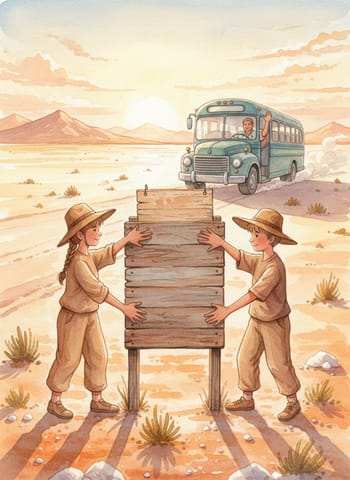
The price board at the Saltwater Stop was older than Lior and Dalila put together.
Papan harga di Saltwater Stop lebih tua daripada umur Lior dan Dalila dijumlahkan.
It stood on two crooked posts at the edge of the car park, between their two stalls. Someone had painted it black long ago. The paint had cracked like dry mud. The stop sat on a salt flat so wide that the horizon looked like a drawn line. Coaches came across it twice a day, and the board was the first thing the passengers read.
Papan itu berdiri di atas dua tiang miring di tepi tempat parkir, di antara kedua lapak mereka. Seseorang telah mengecatnya hitam sejak lama. Catnya retak seperti lumpur kering. Perhentian itu berdiri di hamparan garam yang begitu luas sehingga cakrawalanya tampak seperti garis gambar. Bus-bus melintasinya dua kali sehari, dan papan itu adalah hal pertama yang dibaca para penumpang.
Lior sold cold lemon water from a blue cool box. Dalila sold small salt crystals, polished and strung on leather cords. Both of them worked at the stop every summer. Both of them thought the best corner belonged to them.
Lior menjual air lemon dingin dari kotak pendingin biru. Dalila menjual kristal garam kecil, yang dipoles dan dirangkai pada tali kulit. Keduanya berjualan di perhentian itu setiap musim panas. Keduanya merasa sudut terbaik adalah milik mereka.
The trouble began with the board.
Masalahnya bermula dari papan itu.
On Monday, Lior wrote his price in the first row of the board. He wrote "Cold lemon water, three coins" in tall, square letters, like a man signing a letter. On Tuesday, Dalila wiped it with her sleeve. She wrote "Lemon water, three coins, crystals, five coins" in round, curling letters across the whole top half.
Pada hari Senin, Lior menulis harganya di baris pertama papan. Ia menulis "Air lemon dingin, tiga koin" dengan huruf tinggi dan kotak-kotak, seperti orang menandatangani surat. Pada hari Selasa, Dalila menghapusnya dengan lengan bajunya. Ia menulis "Air lemon, tiga koin, kristal, lima koin" dengan huruf bulat melengkung di seluruh bagian atas.
On Wednesday, Lior rubbed out her curls. He drew a line down the middle of the board and wrote his name above the left side. He did not write hers on the right.
Pada hari Rabu, Lior menghapus lengkungan-lengkungannya. Ia menarik garis di tengah papan dan menulis namanya di atas sisi kiri. Ia tidak menulis nama Dalila di sisi kanan.
"You cannot split a board that belongs to the stop," Dalila said.
"Kamu tidak boleh membagi papan milik perhentian ini," kata Dalila.
"I am not splitting it. I am organising it."
"Aku tidak membaginya. Aku menatanya."
"You are taking it."
"Kamu merebutnya."
"You are writing too big."
"Tulisanmu terlalu besar."
They did not speak for the rest of the afternoon. Each of them watched the other from behind a stall. Each pretended to be busy. In the evening the light turned the flat pink. They both walked past the board without looking at it.
Mereka tidak bicara lagi sepanjang sore itu. Masing-masing mengawasi yang lain dari balik lapaknya. Masing-masing berpura-pura sibuk. Menjelang malam, cahaya mengubah hamparan itu menjadi merah muda. Mereka berdua berjalan melewati papan tanpa melihatnya.
By Friday the board was a mess. There were crossed-out numbers, smudged names, and a line down the middle that went crooked halfway. A man who stopped for a drink read it for a long time. Then he walked on without buying anything.
Pada hari Jumat papan itu berantakan. Ada angka-angka yang dicoret, nama-nama yang kabur, dan garis di tengah yang membelok di pertengahan. Seorang lelaki yang berhenti untuk minum membacanya lama sekali. Lalu ia berjalan pergi tanpa membeli apa pun.
"See what you did," said Dalila.
"Lihat akibat perbuatanmu," kata Dalila.
"Me?" Lior said. "You started it."
"Aku?" kata Lior. "Kamu yang mulai."
At noon on Saturday, a big white coach rolled across the flat. It stopped in a cloud of fine salt dust. The door opened with a sigh. A woman in a bright scarf stepped out and clapped her hands.
Pada tengah hari Sabtu, sebuah bus putih besar bergulir melintasi hamparan itu. Bus berhenti dalam awan debu garam yang halus. Pintunya terbuka dengan embusan napas. Seorang perempuan berselendang cerah turun dan bertepuk tangan.
"Fifteen minutes, everyone," she called. "Then we leave. The next town is far."
"Lima belas menit, semuanya," serunya. "Lalu kita berangkat. Kota berikutnya jauh."
Forty passengers poured out. They were tired and thirsty, and they carried cameras and empty water bottles. They went straight to the board. For a moment, there was a quiet murmur as they tried to read it.
Empat puluh penumpang berhamburan keluar. Mereka lelah dan haus, membawa kamera dan botol air kosong. Mereka langsung menuju papan. Sejenak terdengar gumaman pelan saat mereka mencoba membacanya.
"What does that say?" a man asked.
"Itu tulisannya apa?" tanya seorang lelaki.
"I think it says three coins for lemon," said a girl. "Or thirty."
"Kurasa tiga koin untuk lemon," kata seorang gadis. "Atau tiga puluh."
"Is the crystal five, or fifty?"
"Kristalnya lima, atau lima puluh?"
"Where do I pay?"
"Bayarnya di mana?"
Nobody could tell which price belonged to which stall. Some of the passengers tried Lior's cool box and some tried Dalila's table. Nobody was sure of the numbers, and nobody wanted to argue. A few of them looked at their watches. One man took out his phone and began taking a photograph of the board, shaking his head.
Tak ada yang bisa membedakan harga mana milik lapak mana. Sebagian penumpang mencoba kotak pendingin Lior dan sebagian mencoba meja Dalila. Tak ada yang yakin dengan angkanya, dan tak ada yang mau berdebat. Beberapa melirik jam tangan. Seorang lelaki mengeluarkan ponsel dan mulai memotret papan itu sambil menggelengkan kepala.
The woman in the scarf walked over to the stalls. She had kind eyes, but she looked worried.
Perempuan berselendang itu berjalan menghampiri kedua lapak. Matanya ramah, tetapi ia tampak cemas.
"I need to know," she said, "if my passengers can buy things here, and quickly. If they can't read your board, they will go back to the coach and wait. I have done this journey many times. The stop with a clear board gets the money."
"Saya perlu tahu," katanya, "apakah penumpang saya bisa membeli sesuatu di sini, dan dengan cepat. Kalau mereka tidak bisa membaca papan Anda, mereka akan kembali ke bus dan menunggu. Saya sudah sering melakukan perjalanan ini. Perhentian dengan papan yang jelas yang mendapat uangnya."
Lior opened his mouth. Dalila opened hers. Neither of them said a word.
Lior membuka mulut. Dalila membuka mulutnya. Tak satu pun dari mereka berkata sepatah kata.
The woman waited. "I will say it plainly," she said. "You have thirteen minutes. If you cannot give me one clear price list, I will drive away. The next coach will see the same mess."
Perempuan itu menunggu. "Saya katakan terus terang," katanya. "Anda punya tiga belas menit. Kalau Anda tidak bisa memberi saya satu daftar harga yang jelas, saya akan pergi. Bus berikutnya akan melihat kekacauan yang sama."
She walked back to the coach. The passengers stood in the sun and waited.
Ia berjalan kembali ke bus. Para penumpang berdiri di bawah terik matahari dan menunggu.
Lior looked at Dalila. Dalila looked at the board. For a long moment, the only sound was the hum of the cool box.
Lior memandang Dalila. Dalila memandang papan. Untuk waktu yang lama, satu-satunya suara adalah dengung kotak pendingin.
"I have a rag," Lior said at last.
"Aku punya lap," kata Lior akhirnya.
"I have a bucket," said Dalila, and her voice was small.
"Aku punya ember," kata Dalila, dan suaranya pelan.
They worked quickly. Lior wet the rag in the bucket and wiped the board clean. Dalila fetched a thick white marker from her stall and shook it hard. The surface shone dark and wet for a few seconds. Then it began to dry in the sun.
Mereka bekerja cepat. Lior membasahi lap di ember dan menyeka papan hingga bersih. Dalila mengambil spidol putih tebal dari lapaknya dan mengocoknya kuat-kuat. Permukaan papan tampak gelap dan basah berkilau selama beberapa detik. Lalu mulai mengering di bawah matahari.
"You do the numbers," she said. "Your numbers are clear."
"Kamu yang menulis angka," katanya. "Angkamu jelas."
"You do the words. Yours are pretty."
"Kamu yang menulis kata-kata. Tulisanmu cantik."
"Pretty words do not help anyone who is thirsty."
"Kata-kata cantik tidak menolong orang yang haus."
"They help if people can read them."
"Menolong kalau orang bisa membacanya."
Dalila almost smiled. She took the marker and wrote the first line in her round hand: "Lemon water, with ice." Lior took a marker from the cool box lid. Beside it he added the price in his tall, square figures: "3." Then she wrote "Salt crystal on a cord," and he wrote "5."
Dalila nyaris tersenyum. Ia mengambil spidol itu dan menulis baris pertama dengan tulisan bulatnya: "Air lemon, dengan es." Lior mengambil spidol dari tutup kotak pendingin. Di sebelahnya ia menambahkan harga dengan angka-angkanya yang tinggi dan kotak-kotak: "3." Lalu Dalila menulis "Kristal garam pada tali," dan Lior menulis "5."
The letters were different, but they sat side by side, and the board looked better at once.
Hurufnya berbeda, tetapi keduanya berdampingan, dan papan itu langsung tampak lebih baik.
"We could do one more thing," Dalila said. She was talking fast now. "If someone buys both, they pay seven coins and not eight."
"Kita bisa melakukan satu hal lagi," kata Dalila. Kini ia bicara cepat. "Kalau seseorang membeli keduanya, ia membayar tujuh koin, bukan delapan."
"Seven," said Lior. "That is fair." He wrote it at the bottom and drew a neat line beneath it.
"Tujuh," kata Lior. "Itu adil." Ia menuliskannya di bagian bawah dan menarik garis rapi di bawahnya.
They stepped back. In the middle of the board, the two kinds of handwriting leaned together like two people talking quietly.
Mereka mundur selangkah. Di tengah papan, kedua jenis tulisan tangan itu saling condong seperti dua orang yang berbincang pelan.
"Ready?" he said.
"Siap?" katanya.
"Ready."
"Siap."
The woman in the scarf blew a whistle, and the forty passengers came back. This time nobody asked what the numbers meant. A girl took three coins out of her pocket and bought a lemon water. A man with a camera bought a crystal for his daughter. Then they started buying both, and the line grew so long that Lior ran out of cups. Dalila ran to a crate behind the stall to fetch more. Lior counted the coins into a tin and called out the prices. Together they served the whole coach in eleven minutes.
Perempuan berselendang itu meniup peluit, dan empat puluh penumpang kembali. Kali ini tak ada yang bertanya apa arti angka-angka itu. Seorang gadis mengeluarkan tiga koin dari sakunya dan membeli air lemon. Seorang lelaki dengan kamera membeli kristal untuk putrinya. Lalu mereka mulai membeli keduanya, dan antrean menjadi begitu panjang sampai Lior kehabisan gelas. Dalila berlari ke peti di belakang lapak untuk mengambil lagi. Lior menghitung koin ke dalam kaleng dan menyebutkan harga. Bersama-sama mereka melayani seluruh bus dalam sebelas menit.
When the woman in the scarf climbed the steps, she looked down at them from the door.
Ketika perempuan berselendang itu menaiki tangga, ia memandang mereka dari pintu.
"That," she said, "is a good board."
"Itu," katanya, "papan yang bagus."
The coach rolled away across the flat, and the dust settled slowly behind it.
Bus itu bergulir pergi melintasi hamparan, dan debu perlahan mengendap di belakangnya.
For a while they sat on the cool box and counted the coins. The tin was almost full. Neither of them said who had earned more. Lior pushed the tin across the lid, and Dalila took half. Then she pushed one extra coin back to him, because he had run out of cups so fast.
Beberapa saat mereka duduk di atas kotak pendingin dan menghitung koin. Kalengnya hampir penuh. Tak seorang pun mengatakan siapa yang mendapat lebih banyak. Lior mendorong kaleng itu melintasi tutup kotak, dan Dalila mengambil separuhnya. Lalu ia mendorong satu koin tambahan kembali kepadanya, karena Lior kehabisan gelas begitu cepat.
"The line under the seven is crooked," she said.
"Garis di bawah angka tujuh itu miring," katanya.
"I know. I will fix it tomorrow."
"Aku tahu. Besok akan kuperbaiki."
"Do not," said Dalila. "Leave it."
"Jangan," kata Dalila. "Biarkan saja."
By evening the sun sank low, and the flat turned from white to pale gold. The shadows of the crooked posts stretched away across the salt. The board stood between the two stalls, and the last light touched the writing on it. There were tall, square numbers and round, curling words. In the stillness, it looked as if the two hands had been working there together for years.
Menjelang malam matahari tenggelam rendah, dan hamparan itu berubah dari putih menjadi keemasan pucat. Bayangan kedua tiang miring itu memanjang melintasi garam. Papan itu berdiri di antara kedua lapak, dan cahaya terakhir menyentuh tulisan di atasnya. Ada angka-angka tinggi dan kotak-kotak serta kata-kata bulat melengkung. Dalam keheningan itu, tampak seakan kedua tangan itu telah bekerja di sana bersama-sama selama bertahun-tahun.