The Jar of Nameless Seeds
Cerita bahasa Inggris gratis level B1 untuk pelajar, bisa dibaca online dalam 7 bahasa, dengan pilihan untuk mendengarkannya di aplikasi Storyteller gratis.
A young diner worker learns patience when a lorry driver leaves her seeds that refuse to grow the easy way.
Itu cuplikannya! Dengarkan cerita lengkapnya di aplikasi Storyteller gratis. Unduh aplikasi
Audio belum tersedia saat ini.
Aiko has worked at the Sundown Diner for four months. She came for one week, only to earn enough money for a bus ticket. Then the week became a month, and the month became a habit. Now she knows the sound of every lorry that turns off the long desert road.
Aiko sudah bekerja di Sundown Diner selama empat bulan. Ia datang untuk satu minggu saja, hanya untuk mengumpulkan uang membeli tiket bus. Lalu seminggu menjadi sebulan, dan sebulan menjadi kebiasaan. Kini ia mengenali suara setiap truk yang berbelok dari jalan gurun yang panjang.
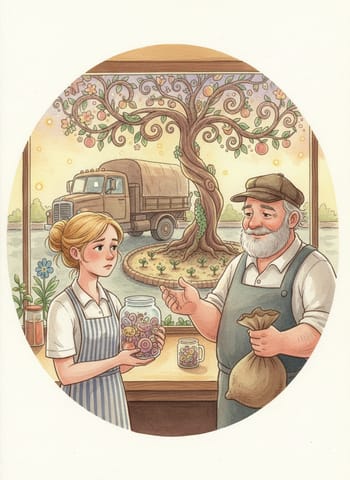
Today, a heavy lorry with a dented door stops outside at noon. The driver, a man with a grey beard, eats a plate of eggs and says almost nothing. When he finishes, he puts a glass jar on the counter.
Hari ini, sebuah truk besar dengan pintu penyok berhenti di luar pada tengah hari. Sopirnya, seorang pria berjenggot abu-abu, makan sepiring telur dan hampir tidak bicara. Setelah selesai, ia meletakkan sebuah toples kaca di meja kasir.
"These are for you," he says. "A woman gave them to me at a petrol station a thousand miles back. She had no label, no name, nothing."
"Ini untukmu," katanya. "Seorang perempuan memberikannya padaku di pom bensin seribu mil di belakang sana. Tanpa label, tanpa nama, tanpa apa-apa."
Aiko lifts the jar. It is full of tiny brown seeds, each one hard and shiny like a grain of black pepper. "What do they grow into?" she asks.
Aiko mengangkat toples itu. Isinya penuh biji-biji cokelat mungil, masing-masing keras dan mengilap seperti butir lada hitam. "Biji ini tumbuh jadi apa?" tanyanya.
"I have no idea. I live in a lorry. Plant them and find out." He pays for his meal, tips his cap, and drives away.
"Aku tidak tahu. Aku tinggal di truk. Tanam saja dan cari tahu." Ia membayar makanannya, menyentuh topinya sebagai salam, lalu pergi.
Safiya, who owns the diner, looks up from the grill. She is a calm woman who has cooked here for fifteen years. "Don't get excited," she says. "Nothing grows out here except weeds and bad ideas."
Safiya, pemilik kedai itu, mendongak dari panggangan. Ia perempuan yang tenang dan sudah memasak di sini selama lima belas tahun. "Jangan terlalu bersemangat," katanya. "Di sini tidak ada yang tumbuh kecuali rumput liar dan ide buruk."
But Aiko is already excited. For four months she has watched the same flat horizon. Now she holds something that might become alive. That evening, she finds an empty coffee can behind the kitchen. She fills it with soil from the car park and pushes thirty seeds into it. Then she puts it on the windowsill.
Tetapi Aiko sudah bersemangat. Selama empat bulan ia memandangi cakrawala datar yang sama. Kini ia memegang sesuatu yang mungkin akan hidup. Malam itu, ia menemukan kaleng kopi kosong di belakang dapur. Ia mengisinya dengan tanah dari tempat parkir dan menancapkan tiga puluh biji ke dalamnya. Lalu ia meletakkannya di ambang jendela.
She waters the can twice a day, once before the lunch crowd and once after. She talks to it a little, which she would never admit to anyone. On the fifth day, nothing has changed, so she gives it a double dose of water.
Ia menyiram kaleng itu dua kali sehari, sekali sebelum keramaian makan siang dan sekali sesudahnya. Ia berbicara sedikit padanya, hal yang tak akan pernah ia akui kepada siapa pun. Pada hari kelima, belum ada yang berubah, jadi ia memberinya air dua kali lipat.
"You are going to drown it," Safiya says, passing with a tray of plates.
"Kamu akan menenggelamkannya," kata Safiya sambil lewat membawa nampan piring.
"I'm helping it," Aiko answers. "Plants need water."
"Aku membantunya," jawab Aiko. "Tanaman butuh air."
On the ninth morning, a sour smell comes from the can. Aiko lifts it to the light. A grey fuzz covers the soil, and the seeds underneath have turned soft and dark. She stares at the mess, and her stomach drops.
Pada pagi kesembilan, bau asam tercium dari kaleng itu. Aiko mengangkatnya ke arah cahaya. Bulu halus abu-abu menutupi tanah, dan biji-biji di bawahnya sudah menjadi lunak dan gelap. Ia menatap kekacauan itu, dan perutnya serasa jatuh.
This feeling is not new to her. She quit her first course at university after one hard exam. She quit her second job after one bad week. Every time something fails on the first try, she decides that she was wrong to want it. She almost throws the can into the bin.
Perasaan ini bukan hal baru baginya. Ia berhenti dari kuliah pertamanya setelah satu ujian yang berat. Ia berhenti dari pekerjaan keduanya setelah satu minggu yang buruk. Setiap kali sesuatu gagal pada percobaan pertama, ia memutuskan bahwa ia salah karena menginginkannya. Ia nyaris membuang kaleng itu ke tempat sampah.
"Wait." Safiya takes the jar from the shelf and pours a few seeds into her palm. She rolls one between her fingers, and then she bites it gently. "Hard as a pebble," she says. "These are desert seeds. They don't wake up because you water them. They wake up when something breaks the shell."
"Tunggu." Safiya mengambil toples dari rak dan menuangkan beberapa biji ke telapak tangannya. Ia menggulirkan satu di antara jari-jarinya, lalu menggigitnya pelan. "Keras seperti kerikil," katanya. "Ini biji-biji gurun. Mereka tidak bangun hanya karena disiram. Mereka bangun ketika ada sesuatu yang memecahkan cangkangnya."
"How do you know that?" Aiko asks.
"Bagaimana Ibu tahu?" tanya Aiko.
"Fifteen years of watching what survives behind this building." Safiya nods toward the back lot, where a few stubborn flowers grow through cracks in the concrete. "Everything that lives there had a rough start. Nobody hands it an easy one."
"Lima belas tahun mengamati apa yang bertahan hidup di belakang bangunan ini." Safiya mengangguk ke arah lahan belakang, tempat beberapa bunga yang keras kepala tumbuh menembus retakan beton. "Semua yang hidup di sana awalnya mengalami masa sulit. Tidak ada yang diberi awal yang mudah."
Aiko looks at the jar. Thirty seeds are gone, but about seventy remain. "So I get another try," she says.
Aiko memandang toples itu. Tiga puluh biji sudah hilang, tetapi masih tersisa sekitar tujuh puluh. "Jadi aku dapat kesempatan lagi," katanya.
"You get a better try," Safiya says. "If you listen to the seed this time and not to yourself."
"Kamu dapat kesempatan yang lebih baik," kata Safiya. "Kalau kali ini kamu mendengarkan bijinya, bukan dirimu sendiri."
That night, after closing, Aiko tries a different plan. She finds a sheet of sandpaper in the storeroom. One by one, she rubs ten seeds on the paper. A pale spot shows on each shell. It is slow work, and her fingers ache, but she does not hurry. Then she drops them in a cup of warm water from the coffee machine. They soak overnight.
Malam itu, setelah kedai tutup, Aiko mencoba rencana yang berbeda. Ia menemukan selembar amplas di gudang. Satu per satu, ia menggosokkan sepuluh biji pada kertas itu. Sebuah bercak pucat muncul di setiap cangkang. Pekerjaannya lambat, dan jari-jarinya pegal, tetapi ia tidak terburu-buru. Lalu ia menjatuhkannya ke dalam cangkir berisi air hangat dari mesin kopi. Biji-biji itu direndam semalaman.
The next morning, she carries the cup to the back lot. Behind the building, an old ice machine drips slowly onto a strip of gravel. The drops fall one at a time, with a small, steady sound. Aiko digs ten shallow holes along the edge of the wet patch. She drops one seed into each hole and covers it with a thin layer of sand. At the last moment, she places a flat stone on the west side. Now the afternoon sun cannot hit the ground so hard.
Keesokan paginya, ia membawa cangkir itu ke lahan belakang. Di belakang bangunan, sebuah mesin es tua menetes pelan ke sepetak kerikil. Tetesannya jatuh satu per satu, dengan bunyi kecil yang tetap. Aiko menggali sepuluh lubang dangkal di sepanjang tepi tanah yang basah itu. Ia menjatuhkan satu biji ke setiap lubang dan menutupnya dengan selapis tipis pasir. Pada saat terakhir, ia meletakkan sebuah batu pipih di sisi barat. Kini sinar matahari sore tidak bisa menghantam tanah sekeras itu.
"That's all?" Safiya asks from the back door. She holds a cup of coffee.
"Hanya itu?" tanya Safiya dari pintu belakang. Ia memegang secangkir kopi.
"That's all. No extra water, and no talking to it." Aiko wipes her hands on her apron. "I will just check every morning before work."
"Hanya itu. Tanpa air tambahan, dan tanpa mengajaknya bicara." Aiko mengusap tangannya pada celemek. "Aku akan memeriksanya saja setiap pagi sebelum bekerja."
For eight days, she checks and sees only gravel. Each time, she wants to dig, to water, to do something. Each time, she makes herself stand still for one minute and then walk away. By the sixth day, the minute has become a habit too. She notices small things instead. There is a lizard on the wall, and the light turns gold on the stone.
Selama delapan hari, ia memeriksa dan hanya melihat kerikil. Setiap kali, ia ingin menggali, menyiram, melakukan sesuatu. Setiap kali, ia memaksa dirinya berdiri diam semenit lalu pergi. Pada hari keenam, semenit itu pun sudah menjadi kebiasaan. Ia malah memperhatikan hal-hal kecil. Ada seekor kadal di dinding, dan cahaya berubah keemasan di atas batu.
On the ninth day, she kneels down and holds her breath. A tiny green hook is pushing out of the sand. It is bent like a question mark and no bigger than a grain of rice. Beside it, a second one is beginning to lift.
Pada hari kesembilan, ia berlutut dan menahan napas. Sebuah kait hijau mungil sedang mendorong keluar dari pasir. Bentuknya melengkung seperti tanda tanya dan tidak lebih besar dari sebutir beras. Di sebelahnya, yang kedua mulai terangkat.
She runs inside with sandy knees. "Safiya! Come and look!"
Ia berlari ke dalam dengan lutut berpasir. "Safiya! Ayo lihat!"
Safiya follows her out, drying her hands on a towel. She crouches and looks for a long time. "Well," she says at last. "Look at that. Out here, of all places."
Safiya mengikutinya keluar sambil mengeringkan tangan dengan handuk. Ia berjongkok dan menatapnya lama sekali. "Wah," katanya akhirnya. "Lihat itu. Di tempat seperti ini, dari semua tempat."
"Seven," Aiko whispers, after she counts. "Seven came up."
"Tujuh," bisik Aiko setelah menghitung. "Tujuh yang muncul."
"Seven out of ten is a very good year." Safiya stands and smiles, which she does only rarely. "Tomorrow I'll cut you a piece of metal for shade. Don't touch the roots."
"Tujuh dari sepuluh itu tahun yang sangat baik." Safiya berdiri dan tersenyum, sesuatu yang jarang sekali ia lakukan. "Besok aku potongkan sepotong logam untuk peneduh. Jangan sentuh akarnya."
By the end of the month, the seedlings are as tall as a pencil. Lorry drivers who stop for pie begin to walk around the back with their coffee. They ask what the plants are. Aiko tells them the same answer every time: "Nobody knows." Some of them laugh, and a few of them take photographs.
Menjelang akhir bulan, bibit-bibit itu sudah setinggi pensil. Para sopir truk yang berhenti untuk makan pai mulai berjalan ke belakang dengan membawa kopi mereka. Mereka bertanya tanaman apa itu. Aiko memberi jawaban yang sama setiap kali: "Tidak ada yang tahu." Beberapa dari mereka tertawa, dan beberapa mengambil foto.
One morning, a thin stem of the tallest plant forms a hard little knot near the top. It is tight and silver, like a closed fist. Aiko does not recognise it from any garden she has ever seen. She checks the other six plants, but only this one has made a knot.
Suatu pagi, batang tipis dari tanaman tertinggi membentuk simpul kecil yang keras di dekat puncaknya. Simpul itu rapat dan keperakan, seperti kepalan tangan yang tertutup. Aiko tidak mengenalinya dari taman mana pun yang pernah ia lihat. Ia memeriksa keenam tanaman lainnya, tetapi hanya yang satu ini yang membentuk simpul.
She finds a paper card in her apron. She writes "Name:" at the top and then stops with the pen above the line. After a moment, she leans the card against the flat stone and leaves the line empty. Then she goes back inside to refill the coffee.
Ia menemukan selembar kartu kertas di celemeknya. Ia menulis "Nama:" di bagian atas lalu berhenti dengan pena di atas garis itu. Setelah beberapa saat, ia menyandarkan kartu itu pada batu pipih dan membiarkan garisnya kosong. Lalu ia kembali ke dalam untuk mengisi ulang kopi.