Aiko has worked at the Sundown Diner for four months. She came for one week, only to earn enough money for a bus ticket. Then the week became a month, and the month became a habit. Now she knows the sound of every lorry that turns off the long desert road.
爱子在日落餐馆工作四个月了。她本来只打算干一个星期,挣够一张车票的钱就走。后来一个星期变成了一个月,一个月又变成了习惯。现在,每一辆从漫长的沙漠公路上拐下来的卡车,她都听得出声音。
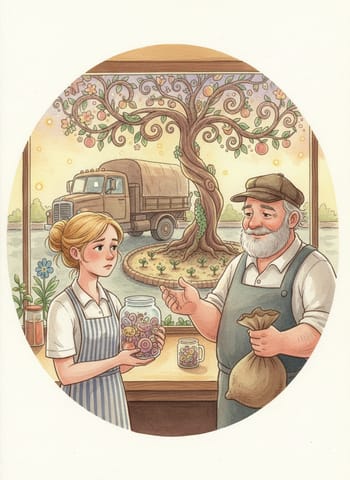
Today, a heavy lorry with a dented door stops outside at noon. The driver, a man with a grey beard, eats a plate of eggs and says almost nothing. When he finishes, he puts a glass jar on the counter.
今天中午,一辆车门瘪了的重型卡车停在了外面。司机是个留着灰胡子的男人,他吃了一盘鸡蛋,几乎一句话也没说。吃完后,他把一个玻璃罐放在柜台上。
"These are for you," he says. "A woman gave them to me at a petrol station a thousand miles back. She had no label, no name, nothing."
“这个送给你,”他说,“一千英里以外的一个加油站,有个女人给了我。没有标签,没有名字,什么都没有。”
Aiko lifts the jar. It is full of tiny brown seeds, each one hard and shiny like a grain of black pepper. "What do they grow into?" she asks.
爱子拿起罐子。里面装满了细小的棕色种子,每一颗都又硬又亮,像黑胡椒粒。“它们会长成什么?”她问。
"I have no idea. I live in a lorry. Plant them and find out." He pays for his meal, tips his cap, and drives away.
“我不知道。我住在卡车上。种下去,你就知道了。”他付了饭钱,抬了抬帽檐,开着车走了。
Safiya, who owns the diner, looks up from the grill. She is a calm woman who has cooked here for fifteen years. "Don't get excited," she says. "Nothing grows out here except weeds and bad ideas."
萨菲娅是这家餐馆的老板,她正在烤架前忙活,抬起头来。她是个沉静的女人,已经在这里做了十五年饭。“别激动,”她说,“这里除了杂草和坏主意,什么都长不出来。”
But Aiko is already excited. For four months she has watched the same flat horizon. Now she holds something that might become alive. That evening, she finds an empty coffee can behind the kitchen. She fills it with soil from the car park and pushes thirty seeds into it. Then she puts it on the windowsill.
可爱子已经激动起来了。四个月来,她看的一直是同一道平坦的地平线。现在,她手里有了可能变成生命的东西。那天傍晚,她在厨房后面找到一个空咖啡罐,用停车场的土把它装满,把三十粒种子按进土里,然后放在窗台上。
She waters the can twice a day, once before the lunch crowd and once after. She talks to it a little, which she would never admit to anyone. On the fifth day, nothing has changed, so she gives it a double dose of water.
她每天给罐子浇两次水,一次在午餐高峰之前,一次在之后。她还会对它说一点话,这件事她绝不会向任何人承认。到第五天,什么变化也没有,于是她把水加了一倍。
"You are going to drown it," Safiya says, passing with a tray of plates.
“你会把它淹死的。”萨菲娅端着一托盘盘子经过,说道。
"I'm helping it," Aiko answers. "Plants need water."
“我在帮它,”爱子回答,“植物需要水。”
On the ninth morning, a sour smell comes from the can. Aiko lifts it to the light. A grey fuzz covers the soil, and the seeds underneath have turned soft and dark. She stares at the mess, and her stomach drops.
第九天早上,罐子里飘出一股酸味。爱子把它举到光线下。土面上盖着一层灰色的霉毛,下面的种子已经变得软软的、黑黑的。她盯着这一团糟,心猛地一沉。
This feeling is not new to her. She quit her first course at university after one hard exam. She quit her second job after one bad week. Every time something fails on the first try, she decides that she was wrong to want it. She almost throws the can into the bin.
这种感觉对她并不陌生。她在大学里上的第一门课,一场难考的考试之后就退掉了。她的第二份工作,干了一个糟糕的星期就辞了。每次事情第一次尝试就失败,她就认定是自己想要它想错了。她差点把罐子扔进垃圾桶。
"Wait." Safiya takes the jar from the shelf and pours a few seeds into her palm. She rolls one between her fingers, and then she bites it gently. "Hard as a pebble," she says. "These are desert seeds. They don't wake up because you water them. They wake up when something breaks the shell."
“等等。”萨菲娅从架子上拿下玻璃罐,倒了几粒种子在手心里。她在指间捻着一粒,又轻轻咬了一下。“硬得像卵石,”她说,“这是沙漠里的种子。你给它浇水,它不会醒。有东西把壳弄破了,它才会醒。”
"How do you know that?" Aiko asks.
“你怎么知道的?”爱子问。
"Fifteen years of watching what survives behind this building." Safiya nods toward the back lot, where a few stubborn flowers grow through cracks in the concrete. "Everything that lives there had a rough start. Nobody hands it an easy one."
“在这栋楼后面看了十五年什么能活下来。”萨菲娅朝后面的空地点点头,那里有几株倔强的小花,从水泥的裂缝里钻出来。“在那儿活下来的东西,开头都不容易。没有谁会给它们一个轻松的开始。”
Aiko looks at the jar. Thirty seeds are gone, but about seventy remain. "So I get another try," she says.
爱子看着罐子。三十粒种子没有了,但还剩大约七十粒。“这么说我还能再试一次。”她说。
"You get a better try," Safiya says. "If you listen to the seed this time and not to yourself."
“你能试得更好,”萨菲娅说,“只要这次你听种子的,不听你自己的。”
That night, after closing, Aiko tries a different plan. She finds a sheet of sandpaper in the storeroom. One by one, she rubs ten seeds on the paper. A pale spot shows on each shell. It is slow work, and her fingers ache, but she does not hurry. Then she drops them in a cup of warm water from the coffee machine. They soak overnight.
那天夜里打烊后,爱子换了个办法。她在储藏室找到一张砂纸,一粒一粒地把十颗种子在砂纸上磨。每颗种子的壳上都露出一小块浅色的斑。这活儿很慢,她的手指都酸了,但她不着急。然后她把种子放进一杯咖啡机里接的温水里,泡了一整夜。
The next morning, she carries the cup to the back lot. Behind the building, an old ice machine drips slowly onto a strip of gravel. The drops fall one at a time, with a small, steady sound. Aiko digs ten shallow holes along the edge of the wet patch. She drops one seed into each hole and covers it with a thin layer of sand. At the last moment, she places a flat stone on the west side. Now the afternoon sun cannot hit the ground so hard.
第二天早上,她端着杯子来到后面的空地。楼房后面,有一台旧制冰机正慢慢往一条碎石带上滴水。水滴一滴一滴落下来,发出小小的、稳稳的声音。爱子在湿地边缘挖了十个浅坑,每个坑里放一粒种子,盖上薄薄一层沙子。最后,她又在西边放了一块平石头,这样下午的太阳就不会把地面晒得那么狠了。
"That's all?" Safiya asks from the back door. She holds a cup of coffee.
“就这样?”萨菲娅站在后门问,手里端着一杯咖啡。
"That's all. No extra water, and no talking to it." Aiko wipes her hands on her apron. "I will just check every morning before work."
“就这样。不多浇水,也不跟它说话。”爱子在围裙上擦了擦手。“上班前我每天早上去看一看就行。”
For eight days, she checks and sees only gravel. Each time, she wants to dig, to water, to do something. Each time, she makes herself stand still for one minute and then walk away. By the sixth day, the minute has become a habit too. She notices small things instead. There is a lizard on the wall, and the light turns gold on the stone.
八天里,她每天去看,看到的只有碎石。每一次她都想去挖一挖,浇一浇,做点什么。每一次她都逼自己站着不动一分钟,然后走开。到第六天,那一分钟也变成了习惯。她开始注意到一些小东西:墙上有一只蜥蜴,石头上的光变成了金色。
On the ninth day, she kneels down and holds her breath. A tiny green hook is pushing out of the sand. It is bent like a question mark and no bigger than a grain of rice. Beside it, a second one is beginning to lift.
第九天,她跪下来,屏住了呼吸。一个绿色的小钩子正从沙里顶出来,弯得像个问号,还没有一粒米大。在它旁边,第二个也开始抬头了。
She runs inside with sandy knees. "Safiya! Come and look!"
她沾着一膝盖的沙子跑进屋里。“萨菲娅!快来看!”
Safiya follows her out, drying her hands on a towel. She crouches and looks for a long time. "Well," she says at last. "Look at that. Out here, of all places."
萨菲娅跟着她出来,用毛巾擦着手。她蹲下身,看了很久。“嗯,”她终于说,“瞧瞧,居然就在这种地方。”
"Seven," Aiko whispers, after she counts. "Seven came up."
“七棵,”爱子数完,低声说,“长出来七棵。”
"Seven out of ten is a very good year." Safiya stands and smiles, which she does only rarely. "Tomorrow I'll cut you a piece of metal for shade. Don't touch the roots."
“十颗里长出七棵,是个很好的年景。”萨菲娅站起身,笑了,她很少笑。“明天我给你裁一块金属片遮阴。别碰根。”
By the end of the month, the seedlings are as tall as a pencil. Lorry drivers who stop for pie begin to walk around the back with their coffee. They ask what the plants are. Aiko tells them the same answer every time: "Nobody knows." Some of them laugh, and a few of them take photographs.
月底的时候,幼苗已经有铅笔那么高了。停下来吃馅饼的卡车司机们开始端着咖啡绕到后面去。他们问这些是什么植物。爱子每次都给同一个回答:“没人知道。”有的人笑了,也有几个人拍了照。
One morning, a thin stem of the tallest plant forms a hard little knot near the top. It is tight and silver, like a closed fist. Aiko does not recognise it from any garden she has ever seen. She checks the other six plants, but only this one has made a knot.
一天早上,最高的那株植物的细茎顶端附近,结出了一个硬硬的小疙瘩。它紧紧的,银色的,像握紧的拳头。爱子在她见过的任何花园里都没见过这样的东西。她查看了另外六株,只有这一株结了疙瘩。
She finds a paper card in her apron. She writes "Name:" at the top and then stops with the pen above the line. After a moment, she leans the card against the flat stone and leaves the line empty. Then she goes back inside to refill the coffee.
她从围裙里找出一张纸卡,在最上面写下“名字:”,然后笔悬在横线上方停住了。过了一会儿,她把卡片靠在那块平石头上,让那条线空着。然后她回到屋里,去添咖啡了。