The Jar of Nameless Seeds
A free B1-level English story for language learners, readable online in 7 languages, with an option to listen via the free Storyteller app.
A young diner worker learns patience when a lorry driver leaves her seeds that refuse to grow the easy way.
That was the preview! Hear the full story in the free Storyteller app. Get the app
Audio isn't available right now.
Aiko has worked at the Sundown Diner for four months. She came for one week, only to earn enough money for a bus ticket. Then the week became a month, and the month became a habit. Now she knows the sound of every lorry that turns off the long desert road.
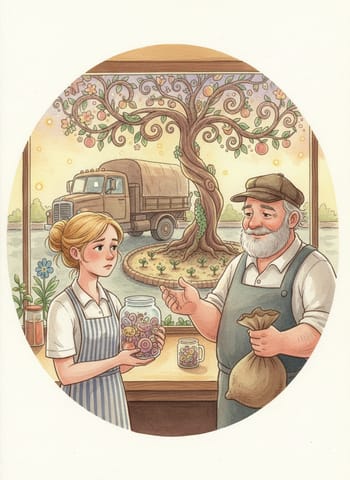
Today, a heavy lorry with a dented door stops outside at noon. The driver, a man with a grey beard, eats a plate of eggs and says almost nothing. When he finishes, he puts a glass jar on the counter.
"These are for you," he says. "A woman gave them to me at a petrol station a thousand miles back. She had no label, no name, nothing."
Aiko lifts the jar. It is full of tiny brown seeds, each one hard and shiny like a grain of black pepper. "What do they grow into?" she asks.
"I have no idea. I live in a lorry. Plant them and find out." He pays for his meal, tips his cap, and drives away.
Safiya, who owns the diner, looks up from the grill. She is a calm woman who has cooked here for fifteen years. "Don't get excited," she says. "Nothing grows out here except weeds and bad ideas."
But Aiko is already excited. For four months she has watched the same flat horizon. Now she holds something that might become alive. That evening, she finds an empty coffee can behind the kitchen. She fills it with soil from the car park and pushes thirty seeds into it. Then she puts it on the windowsill.
She waters the can twice a day, once before the lunch crowd and once after. She talks to it a little, which she would never admit to anyone. On the fifth day, nothing has changed, so she gives it a double dose of water.
"You are going to drown it," Safiya says, passing with a tray of plates.
"I'm helping it," Aiko answers. "Plants need water."
On the ninth morning, a sour smell comes from the can. Aiko lifts it to the light. A grey fuzz covers the soil, and the seeds underneath have turned soft and dark. She stares at the mess, and her stomach drops.
This feeling is not new to her. She quit her first course at university after one hard exam. She quit her second job after one bad week. Every time something fails on the first try, she decides that she was wrong to want it. She almost throws the can into the bin.
"Wait." Safiya takes the jar from the shelf and pours a few seeds into her palm. She rolls one between her fingers, and then she bites it gently. "Hard as a pebble," she says. "These are desert seeds. They don't wake up because you water them. They wake up when something breaks the shell."
"How do you know that?" Aiko asks.
"Fifteen years of watching what survives behind this building." Safiya nods toward the back lot, where a few stubborn flowers grow through cracks in the concrete. "Everything that lives there had a rough start. Nobody hands it an easy one."
Aiko looks at the jar. Thirty seeds are gone, but about seventy remain. "So I get another try," she says.
"You get a better try," Safiya says. "If you listen to the seed this time and not to yourself."
That night, after closing, Aiko tries a different plan. She finds a sheet of sandpaper in the storeroom. One by one, she rubs ten seeds on the paper. A pale spot shows on each shell. It is slow work, and her fingers ache, but she does not hurry. Then she drops them in a cup of warm water from the coffee machine. They soak overnight.
The next morning, she carries the cup to the back lot. Behind the building, an old ice machine drips slowly onto a strip of gravel. The drops fall one at a time, with a small, steady sound. Aiko digs ten shallow holes along the edge of the wet patch. She drops one seed into each hole and covers it with a thin layer of sand. At the last moment, she places a flat stone on the west side. Now the afternoon sun cannot hit the ground so hard.
"That's all?" Safiya asks from the back door. She holds a cup of coffee.
"That's all. No extra water, and no talking to it." Aiko wipes her hands on her apron. "I will just check every morning before work."
For eight days, she checks and sees only gravel. Each time, she wants to dig, to water, to do something. Each time, she makes herself stand still for one minute and then walk away. By the sixth day, the minute has become a habit too. She notices small things instead. There is a lizard on the wall, and the light turns gold on the stone.
On the ninth day, she kneels down and holds her breath. A tiny green hook is pushing out of the sand. It is bent like a question mark and no bigger than a grain of rice. Beside it, a second one is beginning to lift.
She runs inside with sandy knees. "Safiya! Come and look!"
Safiya follows her out, drying her hands on a towel. She crouches and looks for a long time. "Well," she says at last. "Look at that. Out here, of all places."
"Seven," Aiko whispers, after she counts. "Seven came up."
"Seven out of ten is a very good year." Safiya stands and smiles, which she does only rarely. "Tomorrow I'll cut you a piece of metal for shade. Don't touch the roots."
By the end of the month, the seedlings are as tall as a pencil. Lorry drivers who stop for pie begin to walk around the back with their coffee. They ask what the plants are. Aiko tells them the same answer every time: "Nobody knows." Some of them laugh, and a few of them take photographs.
One morning, a thin stem of the tallest plant forms a hard little knot near the top. It is tight and silver, like a closed fist. Aiko does not recognise it from any garden she has ever seen. She checks the other six plants, but only this one has made a knot.
She finds a paper card in her apron. She writes "Name:" at the top and then stops with the pen above the line. After a moment, she leans the card against the flat stone and leaves the line empty. Then she goes back inside to refill the coffee.