The Jar of Nameless Seeds
Uma história gratuita em inglês de nível B1 para estudantes, para ler online em 7 idiomas, com opção de ouvir no app gratuito Storyteller.
A young diner worker learns patience when a lorry driver leaves her seeds that refuse to grow the easy way.
Essa foi a prévia! Ouça a história completa no app gratuito Storyteller. Baixar o app
O áudio não está disponível no momento.
Aiko has worked at the Sundown Diner for four months. She came for one week, only to earn enough money for a bus ticket. Then the week became a month, and the month became a habit. Now she knows the sound of every lorry that turns off the long desert road.
Aiko trabalha na lanchonete Sundown há quatro meses. Ela veio por uma semana, só para ganhar o suficiente para uma passagem de ônibus. Depois a semana virou um mês, e o mês virou um hábito. Agora ela conhece o som de cada caminhão que sai da longa estrada do deserto.
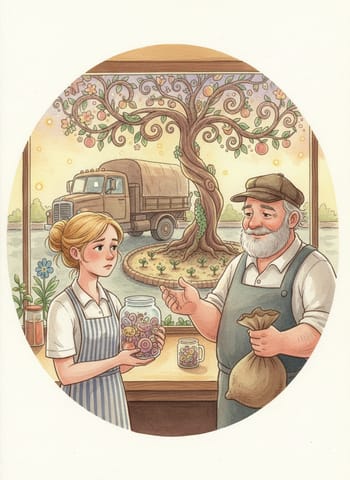
Today, a heavy lorry with a dented door stops outside at noon. The driver, a man with a grey beard, eats a plate of eggs and says almost nothing. When he finishes, he puts a glass jar on the counter.
Hoje, um caminhão pesado com a porta amassada para lá fora ao meio-dia. O motorista, um homem de barba grisalha, come um prato de ovos e quase não diz nada. Quando termina, coloca um pote de vidro no balcão.
"These are for you," he says. "A woman gave them to me at a petrol station a thousand miles back. She had no label, no name, nothing."
"Isto é para você", diz. "Uma mulher me deu num posto de gasolina, a mil milhas daqui. Não tinha rótulo, nem nome, nada."
Aiko lifts the jar. It is full of tiny brown seeds, each one hard and shiny like a grain of black pepper. "What do they grow into?" she asks.
Aiko levanta o pote. Está cheio de sementes marrons minúsculas, cada uma dura e brilhante como um grão de pimenta-do-reino. "Elas viram o quê?", ela pergunta.
"I have no idea. I live in a lorry. Plant them and find out." He pays for his meal, tips his cap, and drives away.
"Não faço ideia. Eu moro num caminhão. Plante e descubra." Ele paga a refeição, toca o boné e vai embora.
Safiya, who owns the diner, looks up from the grill. She is a calm woman who has cooked here for fifteen years. "Don't get excited," she says. "Nothing grows out here except weeds and bad ideas."
Safiya, a dona da lanchonete, levanta os olhos da chapa. É uma mulher calma que cozinha ali há quinze anos. "Não se empolgue", diz. "Aqui não nasce nada além de mato e más ideias."
But Aiko is already excited. For four months she has watched the same flat horizon. Now she holds something that might become alive. That evening, she finds an empty coffee can behind the kitchen. She fills it with soil from the car park and pushes thirty seeds into it. Then she puts it on the windowsill.
Mas Aiko já está empolgada. Há quatro meses ela vê o mesmo horizonte plano. Agora tem nas mãos algo que pode ganhar vida. Naquela noite, ela encontra uma lata de café vazia atrás da cozinha. Enche-a com terra do estacionamento e enfia trinta sementes dentro. Depois a coloca no parapeito da janela.
She waters the can twice a day, once before the lunch crowd and once after. She talks to it a little, which she would never admit to anyone. On the fifth day, nothing has changed, so she gives it a double dose of water.
Ela rega a lata duas vezes por dia, uma antes do movimento do almoço e outra depois. Conversa um pouco com ela, o que jamais admitiria a ninguém. No quinto dia, nada mudou, então ela lhe dá uma dose dupla de água.
"You are going to drown it," Safiya says, passing with a tray of plates.
"Você vai afogar", diz Safiya, passando com uma bandeja de pratos.
"I'm helping it," Aiko answers. "Plants need water."
"Estou ajudando", Aiko responde. "Planta precisa de água."
On the ninth morning, a sour smell comes from the can. Aiko lifts it to the light. A grey fuzz covers the soil, and the seeds underneath have turned soft and dark. She stares at the mess, and her stomach drops.
Na nona manhã, um cheiro azedo sai da lata. Aiko a ergue contra a luz. Um mofo cinza cobre a terra, e as sementes por baixo ficaram moles e escuras. Ela encara a bagunça, e o estômago despenca.
This feeling is not new to her. She quit her first course at university after one hard exam. She quit her second job after one bad week. Every time something fails on the first try, she decides that she was wrong to want it. She almost throws the can into the bin.
Esse sentimento não é novo para ela. Largou o primeiro curso na universidade depois de uma prova difícil. Largou o segundo emprego depois de uma semana ruim. Toda vez que algo falha na primeira tentativa, ela decide que errou ao querer aquilo. Ela quase joga a lata no lixo.
"Wait." Safiya takes the jar from the shelf and pours a few seeds into her palm. She rolls one between her fingers, and then she bites it gently. "Hard as a pebble," she says. "These are desert seeds. They don't wake up because you water them. They wake up when something breaks the shell."
"Espere." Safiya pega o pote da prateleira e despeja algumas sementes na palma da mão. Rola uma entre os dedos e depois a morde de leve. "Dura como pedrinha", diz. "São sementes do deserto. Elas não acordam porque você as rega. Acordam quando algo quebra a casca."
"How do you know that?" Aiko asks.
"Como você sabe disso?", Aiko pergunta.
"Fifteen years of watching what survives behind this building." Safiya nods toward the back lot, where a few stubborn flowers grow through cracks in the concrete. "Everything that lives there had a rough start. Nobody hands it an easy one."
"Quinze anos vendo o que sobrevive atrás deste prédio." Safiya acena com a cabeça para o terreno dos fundos, onde algumas flores teimosas crescem por rachaduras no concreto. "Tudo que vive ali teve um começo duro. Ninguém lhe dá um começo fácil."
Aiko looks at the jar. Thirty seeds are gone, but about seventy remain. "So I get another try," she says.
Aiko olha para o pote. Trinta sementes se foram, mas sobraram umas setenta. "Então eu ganho outra chance", diz.
"You get a better try," Safiya says. "If you listen to the seed this time and not to yourself."
"Você ganha uma chance melhor", diz Safiya. "Se desta vez escutar a semente, e não a si mesma."
That night, after closing, Aiko tries a different plan. She finds a sheet of sandpaper in the storeroom. One by one, she rubs ten seeds on the paper. A pale spot shows on each shell. It is slow work, and her fingers ache, but she does not hurry. Then she drops them in a cup of warm water from the coffee machine. They soak overnight.
Naquela noite, depois de fechar, Aiko tenta um plano diferente. Encontra uma folha de lixa no depósito. Uma por uma, esfrega dez sementes no papel. Um ponto claro aparece em cada casca. É um trabalho lento, e os dedos dela doem, mas ela não se apressa. Depois as joga num copo de água morna da máquina de café. Elas ficam de molho a noite toda.
The next morning, she carries the cup to the back lot. Behind the building, an old ice machine drips slowly onto a strip of gravel. The drops fall one at a time, with a small, steady sound. Aiko digs ten shallow holes along the edge of the wet patch. She drops one seed into each hole and covers it with a thin layer of sand. At the last moment, she places a flat stone on the west side. Now the afternoon sun cannot hit the ground so hard.
Na manhã seguinte, ela leva o copo para o terreno dos fundos. Atrás do prédio, uma velha máquina de gelo pinga devagar sobre uma faixa de cascalho. As gotas caem uma de cada vez, com um som pequeno e constante. Aiko cava dez buracos rasos ao longo da borda do trecho molhado. Põe uma semente em cada buraco e cobre com uma camada fina de areia. No último instante, coloca uma pedra chata do lado oeste. Agora o sol da tarde não pode bater tão forte no chão.
"That's all?" Safiya asks from the back door. She holds a cup of coffee.
"É só isso?", Safiya pergunta da porta dos fundos. Ela segura uma xícara de café.
"That's all. No extra water, and no talking to it." Aiko wipes her hands on her apron. "I will just check every morning before work."
"É só isso. Nada de água extra, e nada de conversar com elas." Aiko limpa as mãos no avental. "Vou só olhar todas as manhãs antes do trabalho."
For eight days, she checks and sees only gravel. Each time, she wants to dig, to water, to do something. Each time, she makes herself stand still for one minute and then walk away. By the sixth day, the minute has become a habit too. She notices small things instead. There is a lizard on the wall, and the light turns gold on the stone.
Por oito dias, ela olha e vê só cascalho. Cada vez, quer cavar, regar, fazer alguma coisa. Cada vez, obriga-se a ficar parada por um minuto e depois ir embora. No sexto dia, o minuto também já virou um hábito. Em vez disso, ela repara em coisas pequenas. Há uma lagartixa no muro, e a luz fica dourada na pedra.
On the ninth day, she kneels down and holds her breath. A tiny green hook is pushing out of the sand. It is bent like a question mark and no bigger than a grain of rice. Beside it, a second one is beginning to lift.
No nono dia, ela se ajoelha e prende a respiração. Um minúsculo gancho verde está empurrando a areia para sair. Está curvado como um ponto de interrogação e não é maior que um grão de arroz. Ao lado, um segundo começa a se levantar.
She runs inside with sandy knees. "Safiya! Come and look!"
Ela corre para dentro com os joelhos cheios de areia. "Safiya! Venha ver!"
Safiya follows her out, drying her hands on a towel. She crouches and looks for a long time. "Well," she says at last. "Look at that. Out here, of all places."
Safiya a segue para fora, secando as mãos numa toalha. Agacha-se e olha por um bom tempo. "Bem", diz por fim. "Veja só isso. Logo aqui, de todos os lugares."
"Seven," Aiko whispers, after she counts. "Seven came up."
"Sete", sussurra Aiko, depois de contar. "Sete nasceram."
"Seven out of ten is a very good year." Safiya stands and smiles, which she does only rarely. "Tomorrow I'll cut you a piece of metal for shade. Don't touch the roots."
"Sete de dez é um ótimo ano." Safiya se levanta e sorri, o que raramente faz. "Amanhã eu corto um pedaço de metal para dar sombra. Não toque nas raízes."
By the end of the month, the seedlings are as tall as a pencil. Lorry drivers who stop for pie begin to walk around the back with their coffee. They ask what the plants are. Aiko tells them the same answer every time: "Nobody knows." Some of them laugh, and a few of them take photographs.
No fim do mês, as mudas estão da altura de um lápis. Os caminhoneiros que param para comer torta começam a dar a volta pelos fundos com o café na mão. Perguntam que plantas são essas. Aiko dá a mesma resposta todas as vezes: "Ninguém sabe." Alguns riem, e uns poucos tiram fotos.
One morning, a thin stem of the tallest plant forms a hard little knot near the top. It is tight and silver, like a closed fist. Aiko does not recognise it from any garden she has ever seen. She checks the other six plants, but only this one has made a knot.
Certa manhã, um caule fino da planta mais alta forma um pequeno nó duro perto do topo. É apertado e prateado, como um punho fechado. Aiko não o reconhece de nenhum jardim que já tenha visto. Ela confere as outras seis plantas, mas só esta formou um nó.
She finds a paper card in her apron. She writes "Name:" at the top and then stops with the pen above the line. After a moment, she leans the card against the flat stone and leaves the line empty. Then she goes back inside to refill the coffee.
Encontra um cartão de papel no avental. Escreve "Nome:" no alto e para, com a caneta acima da linha. Depois de um momento, apoia o cartão na pedra chata e deixa a linha vazia. Então volta para dentro para reabastecer o café.