The Tin of Buttons at the Coin Shop
Uma história gratuita em inglês de nível B1 para estudantes, para ler online em 7 idiomas, com opção de ouvir no app gratuito Storyteller.
A teenager who works in a small shop must decide what to do with a tin of old buttons that carry a tailor's notes.
Essa foi a prévia! Ouça a história completa no app gratuito Storyteller. Baixar o app
O áudio não está disponível no momento.
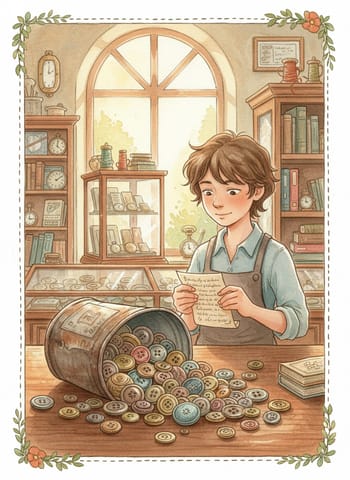
The shop was called Hendrik's Stamps and Coins, and it was smaller than most people's kitchens. Glass cases ran along both walls. Behind the counter, a hundred tiny drawers held paper squares, silver rounds and little magnifying glasses. Salma had worked there on Saturdays since the start of the school year.
A loja se chamava Selos e Moedas do Hendrik, e era menor que a cozinha da maioria das pessoas. Vitrines de vidro corriam ao longo das duas paredes. Atrás do balcão, cem gavetinhas guardavam quadradinhos de papel, discos de prata e pequenas lupas. Salma trabalhava ali aos sábados desde o início do ano letivo.
She liked the quiet. She liked the way Hendrik talked to customers as if each one had come from a faraway country. Most of all, she liked that nobody in the shop ever asked her what she wanted to be.
Ela gostava da quietude. Gostava do jeito como Hendrik falava com os clientes, como se cada um tivesse vindo de um país distante. Mais que tudo, gostava de que ninguém na loja jamais lhe perguntasse o que ela queria ser.
On the last Saturday of spring, a woman in a green coat pushed open the door. She carried a round biscuit tin with a faded picture of a lighthouse on the lid.
No último sábado da primavera, uma mulher de casaco verde empurrou a porta. Ela carregava uma lata redonda de biscoitos, com a imagem desbotada de um farol na tampa.
"I am clearing a cupboard," the woman said. "These were my neighbour's. She asked me to sell them to someone who will care."
"Estou esvaziando um armário", disse a mulher. "Isto era da minha vizinha. Ela me pediu para vender a alguém que dê valor."
"What are they?" Hendrik asked.
"O que são?", Hendrik perguntou.
"Buttons. Hundreds of them."
"Botões. Centenas deles."
She set the tin on the counter and opened it. Salma leaned forward. The buttons lay in the tin like a small, loud crowd. Some were glass, some were wood, and some were dull metal with tiny anchors on them. A few were as big as coins, and a few were smaller than her fingernail.
Ela pôs a lata no balcão e a abriu. Salma se inclinou para a frente. Os botões jaziam na lata como uma pequena multidão barulhenta. Alguns eram de vidro, alguns de madeira, e alguns de metal fosco com minúsculas âncoras. Alguns eram do tamanho de moedas, e alguns menores que a unha dela.
Hendrik picked one up with tweezers and turned it under the lamp. "I am not an expert in buttons," he said. "But I know someone who is. May I keep the tin for the afternoon?"
Hendrik pegou um com uma pinça e o virou sob a lâmpada. "Não sou especialista em botões", disse. "Mas conheço alguém que é. Posso ficar com a lata durante a tarde?"
"Of course," the woman said. "I will come back on Monday."
"Claro", disse a mulher. "Volto na segunda-feira."
When she left, Hendrik pushed the tin across the counter. "Salma, I have a job for you. Sort these, and tell me what you think we should do with them."
Quando ela saiu, Hendrik empurrou a lata pelo balcão. "Salma, tenho uma tarefa para você. Separe estes botões e me diga o que acha que devemos fazer com eles."
"What do you mean, what we should do?"
"Como assim, o que devemos fazer?"
"We have two good choices. I will explain after you look." He smiled. "I want to hear what you notice before I tell you what I think."
"Temos duas boas opções. Explico depois que você olhar." Ele sorriu. "Quero ouvir o que você percebe antes de dizer o que eu penso."
Salma spread a white cloth on the table in the back. She tipped the buttons out and began to sort them into piles by material. Glass, wood, shell, metal. It was slow work, but she found it calming.
Salma estendeu um pano branco na mesa dos fundos. Despejou os botões e começou a separá-los em pilhas por material. Vidro, madeira, concha, metal. Era um trabalho lento, mas ela o achava calmante.
At the bottom of the tin, she found something else. It was a roll of tiny paper tags, each one tied to a button with a thread. She counted nine. On each tag, someone had written a date and a short note in careful ink.
No fundo da lata, encontrou outra coisa. Era um rolinho de pequenas etiquetas de papel, cada uma amarrada a um botão com uma linha. Ela contou nove. Em cada etiqueta, alguém tinha escrito uma data e uma curta anotação com tinta caprichada.
She read the first. "March 4. Coat for the ferryman's son. Brass, four holes." She smiled. People wrote the most ordinary things.
Leu a primeira. "4 de março. Casaco para o filho do barqueiro. Latão, quatro furos." Sorriu. As pessoas escreviam as coisas mais comuns.
She read the second. "June 19. Wedding jacket, mother-of-pearl." She read the third. "October 2. School blazer, the button that fell in the soup."
Leu a segunda. "19 de junho. Paletó de casamento, madrepérola." Leu a terceira. "2 de outubro. Blazer da escola, o botão que caiu na sopa."
She laughed out loud. Hendrik looked up from his catalogue.
Riu alto. Hendrik levantou os olhos do catálogo.
"What is funny?"
"O que tem de engraçado?"
"These buttons have stories," Salma said. "The tags say whose coat each button came from. It looks like a tailor kept them."
"Estes botões têm histórias", disse Salma. "As etiquetas dizem de qual casaco cada botão veio. Parece que um alfaiate os guardou."
Hendrik came over and bent to read. For a long moment, he said nothing. Then he whistled softly.
Hendrik se aproximou e se curvou para ler. Por um longo momento, não disse nada. Então assobiou baixinho.
"A tailor's record," he said. "That is something."
"O registro de um alfaiate", disse. "Isso é algo."
He went to the phone and made two calls. When he came back, he sat on the stool opposite her and counted on his fingers.
Ele foi até o telefone e fez duas ligações. Quando voltou, sentou-se no banco em frente a ela e contou nos dedos.
"Here are the two choices," he said. "The first is a collector I know. He loves old buttons, and he pays well for glass and brass. If you sort the best forty into a case, he will pay five times the tin price. The money would help the shop through the summer."
"Aqui estão as duas opções", disse. "A primeira é um colecionador que conheço. Ele adora botões antigos e paga bem por vidro e latão. Se você separar os quarenta melhores numa caixa, ele pagará cinco vezes o preço da lata. O dinheiro ajudaria a loja a passar o verão."
"And the second choice?" Salma asked.
"E a segunda opção?", Salma perguntou.
"The second is a woman who runs an art class at the primary school down the road. She wants buttons for a big picture on the hall wall. She can pay only a little, but she would use every button in the tin."
"A segunda é uma mulher que dá aula de artes na escola primária aqui perto. Ela quer botões para um grande quadro na parede do salão. Só pode pagar um pouco, mas usaria todos os botões da lata."
Salma looked at the piles on the cloth. Both choices sounded fair. Hendrik was a good man, and the shop needed money. But the school picture sounded fun, and it would be seen by hundreds of children.
Salma olhou as pilhas no pano. As duas opções pareciam justas. Hendrik era um bom homem, e a loja precisava de dinheiro. Mas o quadro da escola parecia divertido, e seria visto por centenas de crianças.
"Which one would you pick?" she asked.
"Qual o senhor escolheria?", perguntou.
"That is exactly why I asked you," Hendrik said. "You found the tags. You have looked at them longer than I have. So you decide, and I will back you."
"É exatamente por isso que perguntei a você", disse Hendrik. "Você achou as etiquetas. Olhou para elas por mais tempo do que eu. Então você decide, e eu apoio."
The words made her stomach flutter. In her life, someone had always decided things for her. Her parents decided which school she attended. Her friends decided which cafe they visited. Nobody had ever said "you decide" and then waited.
As palavras deram um frio na barriga dela. Em sua vida, alguém sempre tinha decidido as coisas por ela. Os pais decidiam em que escola ela estudava. As amigas decidiam que café frequentavam. Ninguém jamais tinha dito "você decide" e então esperado.
She spent another hour with the buttons. She read all nine tags again. She looked at the glass ones in the light, and she weighed the brass ones in her hand. At four o'clock, she knew what she wanted to do.
Ela passou mais uma hora com os botões. Leu as nove etiquetas de novo. Olhou os de vidro contra a luz e pesou os de latão na mão. Às quatro horas, sabia o que queria fazer.
"I choose the school," she said.
"Escolho a escola", disse.
Hendrik leaned back. "Tell me why."
Hendrik se recostou. "Diga-me por quê."
"If we sell forty good buttons to the collector, we lose the rest. The tags would go to one case, and the plain buttons would go back into a drawer. Nobody would see the whole tin."
"Se vendermos quarenta botões bons ao colecionador, perdemos o resto. As etiquetas iriam para uma caixa, e os botões simples voltariam para uma gaveta. Ninguém veria a lata inteira."
"True."
"É verdade."
"But the school will use all of them. Each child will touch a button that was once on a real coat." She took a breath. "And the tags are like a little book. If the picture tells the stories, then the tin stays together. I think the tailor would have liked that."
"Mas a escola vai usar todos eles. Cada criança vai tocar num botão que já esteve num casaco de verdade." Ela respirou fundo. "E as etiquetas são como um livrinho. Se o quadro contar as histórias, a lata continua junta. Acho que o alfaiate teria gostado."
Hendrik was quiet for a few seconds. Then he nodded slowly.
Hendrik ficou quieto por alguns segundos. Então assentiu devagar.
"The money matters, you know," he said. "We will have a thin summer."
"O dinheiro importa, você sabe", disse. "Teremos um verão magro."
"I know," Salma said. "But I can work extra days. Not because I must, but because I want to."
"Eu sei", disse Salma. "Mas posso trabalhar dias extras. Não porque preciso, mas porque quero."
"You have thought about it carefully." He held out his hand, as if she were another dealer. "Then it is decided. I will call the school."
"Você pensou com cuidado." Ele estendeu a mão, como se ela fosse outra negociante. "Então está decidido. Vou ligar para a escola."
On Monday, the woman in the green coat came back. Salma explained the choice. The woman laughed, then asked if she could visit the picture when it was finished.
Na segunda-feira, a mulher de casaco verde voltou. Salma explicou a escolha. A mulher riu, depois perguntou se poderia visitar o quadro quando estivesse pronto.
"Yes," Salma said. "I will make sure there is a sign."
"Sim", disse Salma. "Vou providenciar uma placa."
Three weeks later, Hendrik closed the shop for an hour. The two of them walked down the road to the primary school. The hall smelled of floor wax and crayons. At the far end, high on the wall, a long mural climbed toward the ceiling. It showed a tailor's window, a lighthouse and a street full of people in coats. Every coat had real buttons stitched onto it.
Três semanas depois, Hendrik fechou a loja por uma hora. Os dois desceram a rua até a escola primária. O salão cheirava a cera de piso e giz de cera. No fundo, no alto da parede, um longo mural subia em direção ao teto. Mostrava a vitrine de um alfaiate, um farol e uma rua cheia de gente de casaco. Cada casaco tinha botões de verdade costurados.
The children had not left a single button out. Brass anchors shone on a sailor's jacket. A tiny glass one sat at the centre of a bride's sleeve. At the bottom of the mural, paper tags hung on threads. Each tag had a short note in a child's careful handwriting.
As crianças não tinham deixado nenhum botão de fora. Âncoras de latão brilhavam na jaqueta de um marinheiro. Um minúsculo de vidro estava no centro da manga de uma noiva. Na parte de baixo do mural, etiquetas de papel pendiam de linhas. Cada etiqueta trazia uma curta anotação em letra cuidadosa de criança.
Salma stood with her hands behind her back. The art class had gone home, and the hall was empty. Sun came through the tall windows and lay across the buttons like water. For a long moment, the whole wall seemed to glow. Beneath it, on a low shelf, the tin with the lighthouse on its lid sat open and empty.
Salma ficou de mãos atrás das costas. A aula de artes tinha acabado, e o salão estava vazio. O sol entrava pelas janelas altas e se estendia sobre os botões como água. Por um longo momento, a parede inteira pareceu brilhar. Embaixo dela, numa prateleira baixa, a lata com o farol na tampa estava aberta e vazia.