The Tin of Buttons at the Coin Shop
Una historia gratuita en inglés de nivel B1 para estudiantes, para leer en línea en 7 idiomas, con opción de escucharla en la app gratuita Storyteller.
A teenager who works in a small shop must decide what to do with a tin of old buttons that carry a tailor's notes.
¡Ese fue el avance! Escucha la historia completa en la app gratuita Storyteller. Descargar la app
El audio no está disponible en este momento.
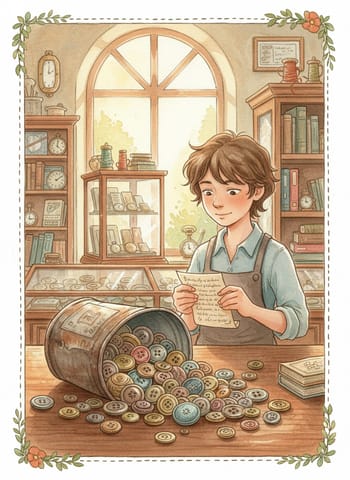
The shop was called Hendrik's Stamps and Coins, and it was smaller than most people's kitchens. Glass cases ran along both walls. Behind the counter, a hundred tiny drawers held paper squares, silver rounds and little magnifying glasses. Salma had worked there on Saturdays since the start of the school year.
La tienda se llamaba Sellos y Monedas de Hendrik, y era más pequeña que la cocina de la mayoría de la gente. Vitrinas de vidrio recorrían ambas paredes. Detrás del mostrador, cien cajoncitos guardaban cuadrados de papel, discos de plata y pequeñas lupas. Salma trabajaba allí los sábados desde el comienzo del curso escolar.
She liked the quiet. She liked the way Hendrik talked to customers as if each one had come from a faraway country. Most of all, she liked that nobody in the shop ever asked her what she wanted to be.
Le gustaba la tranquilidad. Le gustaba la manera en que Hendrik hablaba con los clientes, como si cada uno viniera de un país lejano. Sobre todo, le gustaba que nadie en la tienda le preguntara nunca qué quería ser.
On the last Saturday of spring, a woman in a green coat pushed open the door. She carried a round biscuit tin with a faded picture of a lighthouse on the lid.
El último sábado de primavera, una mujer con un abrigo verde empujó la puerta. Llevaba una lata redonda de galletas con un dibujo desteñido de un faro en la tapa.
"I am clearing a cupboard," the woman said. "These were my neighbour's. She asked me to sell them to someone who will care."
«Estoy vaciando un armario», dijo la mujer. «Estos eran de mi vecina. Me pidió que se los vendiera a alguien que los cuidara».
"What are they?" Hendrik asked.
«¿Qué son?», preguntó Hendrik.
"Buttons. Hundreds of them."
«Botones. Cientos de ellos».
She set the tin on the counter and opened it. Salma leaned forward. The buttons lay in the tin like a small, loud crowd. Some were glass, some were wood, and some were dull metal with tiny anchors on them. A few were as big as coins, and a few were smaller than her fingernail.
Dejó la lata sobre el mostrador y la abrió. Salma se inclinó hacia adelante. Los botones yacían en la lata como una pequeña multitud ruidosa. Algunos eran de vidrio, otros de madera, y otros de metal opaco con diminutas anclas. Unos pocos eran grandes como monedas, y otros más pequeños que su uña.
Hendrik picked one up with tweezers and turned it under the lamp. "I am not an expert in buttons," he said. "But I know someone who is. May I keep the tin for the afternoon?"
Hendrik tomó uno con unas pinzas y lo giró bajo la lámpara. «No soy un experto en botones», dijo. «Pero conozco a alguien que lo es. ¿Puedo quedarme con la lata esta tarde?».
"Of course," the woman said. "I will come back on Monday."
«Claro», dijo la mujer. «Volveré el lunes».
When she left, Hendrik pushed the tin across the counter. "Salma, I have a job for you. Sort these, and tell me what you think we should do with them."
Cuando se fue, Hendrik empujó la lata por el mostrador. «Salma, tengo un trabajo para ti. Clasifícalos y dime qué crees que deberíamos hacer con ellos».
"What do you mean, what we should do?"
«¿Qué quiere decir con qué deberíamos hacer?».
"We have two good choices. I will explain after you look." He smiled. "I want to hear what you notice before I tell you what I think."
«Tenemos dos buenas opciones. Te las explicaré después de que mires». Sonrió. «Quiero oír lo que notas antes de decirte lo que pienso».
Salma spread a white cloth on the table in the back. She tipped the buttons out and began to sort them into piles by material. Glass, wood, shell, metal. It was slow work, but she found it calming.
Salma extendió un paño blanco sobre la mesa de la trastienda. Vació los botones y empezó a clasificarlos en montones por material. Vidrio, madera, concha, metal. Era un trabajo lento, pero lo encontraba relajante.
At the bottom of the tin, she found something else. It was a roll of tiny paper tags, each one tied to a button with a thread. She counted nine. On each tag, someone had written a date and a short note in careful ink.
En el fondo de la lata, encontró algo más. Era un rollo de etiquetas de papel diminutas, cada una atada a un botón con un hilo. Contó nueve. En cada etiqueta, alguien había escrito una fecha y una nota breve con tinta cuidadosa.
She read the first. "March 4. Coat for the ferryman's son. Brass, four holes." She smiled. People wrote the most ordinary things.
Leyó la primera. «4 de marzo. Abrigo para el hijo del barquero. Latón, cuatro agujeros». Sonrió. La gente escribía las cosas más ordinarias.
She read the second. "June 19. Wedding jacket, mother-of-pearl." She read the third. "October 2. School blazer, the button that fell in the soup."
Leyó la segunda. «19 de junio. Chaqueta de boda, madreperla». Leyó la tercera. «2 de octubre. Blazer escolar, el botón que cayó en la sopa».
She laughed out loud. Hendrik looked up from his catalogue.
Se rio en voz alta. Hendrik levantó la vista de su catálogo.
"What is funny?"
«¿Qué es tan gracioso?».
"These buttons have stories," Salma said. "The tags say whose coat each button came from. It looks like a tailor kept them."
«Estos botones tienen historias», dijo Salma. «Las etiquetas dicen de qué abrigo salió cada botón. Parece que un sastre los guardó».
Hendrik came over and bent to read. For a long moment, he said nothing. Then he whistled softly.
Hendrik se acercó y se inclinó a leer. Durante un largo momento, no dijo nada. Luego silbó suavemente.
"A tailor's record," he said. "That is something."
«El registro de un sastre», dijo. «Eso es algo».
He went to the phone and made two calls. When he came back, he sat on the stool opposite her and counted on his fingers.
Fue al teléfono e hizo dos llamadas. Cuando volvió, se sentó en el taburete frente a ella y contó con los dedos.
"Here are the two choices," he said. "The first is a collector I know. He loves old buttons, and he pays well for glass and brass. If you sort the best forty into a case, he will pay five times the tin price. The money would help the shop through the summer."
«Estas son las dos opciones», dijo. «La primera es un coleccionista que conozco. Le encantan los botones antiguos y paga bien por el vidrio y el latón. Si clasificas los mejores cuarenta en una vitrina, pagará cinco veces el precio de la lata. El dinero ayudaría a la tienda a pasar el verano».
"And the second choice?" Salma asked.
«¿Y la segunda opción?», preguntó Salma.
"The second is a woman who runs an art class at the primary school down the road. She wants buttons for a big picture on the hall wall. She can pay only a little, but she would use every button in the tin."
«La segunda es una mujer que da una clase de arte en la escuela primaria de la calle de abajo. Quiere botones para un gran cuadro en la pared del salón. Solo puede pagar un poco, pero usaría todos los botones de la lata».
Salma looked at the piles on the cloth. Both choices sounded fair. Hendrik was a good man, and the shop needed money. But the school picture sounded fun, and it would be seen by hundreds of children.
Salma miró los montones sobre el paño. Las dos opciones parecían justas. Hendrik era un buen hombre, y la tienda necesitaba dinero. Pero el cuadro de la escuela sonaba divertido, y lo verían cientos de niños.
"Which one would you pick?" she asked.
«¿Cuál elegiría usted?», preguntó.
"That is exactly why I asked you," Hendrik said. "You found the tags. You have looked at them longer than I have. So you decide, and I will back you."
«Justamente por eso te lo pregunto», dijo Hendrik. «Tú encontraste las etiquetas. Las has mirado más tiempo que yo. Así que decide tú, y yo te respaldaré».
The words made her stomach flutter. In her life, someone had always decided things for her. Her parents decided which school she attended. Her friends decided which cafe they visited. Nobody had ever said "you decide" and then waited.
Las palabras le hicieron cosquillas en el estómago. En su vida, siempre había alguien que decidía las cosas por ella. Sus padres decidían a qué escuela iba. Sus amigos decidían qué café visitaban. Nadie le había dicho nunca «decide tú» y luego había esperado.
She spent another hour with the buttons. She read all nine tags again. She looked at the glass ones in the light, and she weighed the brass ones in her hand. At four o'clock, she knew what she wanted to do.
Pasó otra hora con los botones. Leyó otra vez las nueve etiquetas. Miró los de vidrio a la luz y sopesó los de latón en la mano. A las cuatro, sabía lo que quería hacer.
"I choose the school," she said.
«Elijo la escuela», dijo.
Hendrik leaned back. "Tell me why."
Hendrik se recostó. «Dime por qué».
"If we sell forty good buttons to the collector, we lose the rest. The tags would go to one case, and the plain buttons would go back into a drawer. Nobody would see the whole tin."
«Si vendemos cuarenta botones buenos al coleccionista, perdemos el resto. Las etiquetas irían a una sola vitrina, y los botones sencillos volverían a un cajón. Nadie vería la lata entera».
"True."
«Cierto».
"But the school will use all of them. Each child will touch a button that was once on a real coat." She took a breath. "And the tags are like a little book. If the picture tells the stories, then the tin stays together. I think the tailor would have liked that."
«Pero la escuela los usará todos. Cada niño tocará un botón que una vez estuvo en un abrigo de verdad». Tomó aire. «Y las etiquetas son como un librito. Si el cuadro cuenta las historias, la lata se queda unida. Creo que al sastre le habría gustado».
Hendrik was quiet for a few seconds. Then he nodded slowly.
Hendrik guardó silencio unos segundos. Luego asintió despacio.
"The money matters, you know," he said. "We will have a thin summer."
«El dinero importa, ¿sabes?», dijo. «Tendremos un verano flojo».
"I know," Salma said. "But I can work extra days. Not because I must, but because I want to."
«Lo sé», dijo Salma. «Pero puedo trabajar días extra. No porque deba, sino porque quiero».
"You have thought about it carefully." He held out his hand, as if she were another dealer. "Then it is decided. I will call the school."
«Lo has pensado con cuidado». Extendió la mano, como si ella fuera otra comerciante. «Entonces está decidido. Llamaré a la escuela».
On Monday, the woman in the green coat came back. Salma explained the choice. The woman laughed, then asked if she could visit the picture when it was finished.
El lunes, la mujer del abrigo verde volvió. Salma le explicó la decisión. La mujer se rio, y luego preguntó si podía visitar el cuadro cuando estuviera terminado.
"Yes," Salma said. "I will make sure there is a sign."
«Sí», dijo Salma. «Me aseguraré de que haya un letrero».
Three weeks later, Hendrik closed the shop for an hour. The two of them walked down the road to the primary school. The hall smelled of floor wax and crayons. At the far end, high on the wall, a long mural climbed toward the ceiling. It showed a tailor's window, a lighthouse and a street full of people in coats. Every coat had real buttons stitched onto it.
Tres semanas después, Hendrik cerró la tienda por una hora. Los dos caminaron por la calle hasta la escuela primaria. El salón olía a cera de piso y a crayones. Al fondo, en lo alto de la pared, un largo mural trepaba hacia el techo. Mostraba la vitrina de un sastre, un faro y una calle llena de gente con abrigos. Cada abrigo tenía botones de verdad cosidos.
The children had not left a single button out. Brass anchors shone on a sailor's jacket. A tiny glass one sat at the centre of a bride's sleeve. At the bottom of the mural, paper tags hung on threads. Each tag had a short note in a child's careful handwriting.
Los niños no habían dejado fuera ni un solo botón. Anclas de latón brillaban en la chaqueta de un marinero. Uno pequeño de vidrio estaba en el centro de la manga de una novia. En la parte inferior del mural, colgaban etiquetas de papel de hilos. Cada etiqueta tenía una nota breve con la letra cuidadosa de un niño.
Salma stood with her hands behind her back. The art class had gone home, and the hall was empty. Sun came through the tall windows and lay across the buttons like water. For a long moment, the whole wall seemed to glow. Beneath it, on a low shelf, the tin with the lighthouse on its lid sat open and empty.
Salma estaba de pie con las manos a la espalda. La clase de arte se había ido a casa y el salón estaba vacío. El sol entraba por las altas ventanas y yacía sobre los botones como agua. Durante un largo momento, toda la pared pareció resplandecer. Debajo, en un estante bajo, la lata con el faro en la tapa estaba abierta y vacía.