The Name Under the Sandpaper
Una historia gratuita en inglés de nivel B1 para estudiantes, para leer en línea en 7 idiomas, con opción de escucharla en la app gratuita Storyteller.
Teo wants to return a borrowed guitar looking new, but his careful polishing erases the one thing that made it his friend's.
¡Ese fue el avance! Escucha la historia completa en la app gratuita Storyteller. Descargar la app
El audio no está disponible en este momento.
Teo sits on an upturned crate at the far end of the fishing pier. The light is low, and the water under the boards looks like melted copper. Across his knees lies a battered guitar.
Teo está sentado en un cajón puesto boca abajo, en el extremo del muelle de pesca. La luz es baja, y el agua bajo las tablas parece cobre derretido. Sobre sus rodillas descansa una guitarra maltrecha.
The guitar has seen better years. A long scratch runs across the front. There is a dent near the neck, and one tuning peg is newer than the others. Teo loves every mark on it, but tonight he wants it to shine.
La guitarra ha visto mejores años. Un largo rayón cruza el frente. Hay una abolladura cerca del mástil, y una clavija de afinación es más nueva que las demás. Teo ama cada marca que tiene, pero esta noche quiere que brille.
The guitar belongs to Gaspar. Three months ago, Gaspar put it into Teo's hands. "Keep it until you can buy your own," he said. Tomorrow Teo gets his first pay from the fish market. On Saturday he plans to buy a guitar and give this one back.
La guitarra es de Gaspar. Hace tres meses, Gaspar se la puso en las manos a Teo. «Quédatela hasta que puedas comprarte la tuya», dijo. Mañana Teo recibe su primer pago del mercado de pescado. El sábado piensa comprarse una guitarra y devolver esta.
A friend like that deserves a guitar that looks new. That is what Teo tells himself, anyway.
Un amigo así merece una guitarra que parezca nueva. Eso es, al menos, lo que Teo se dice a sí mismo.
The woman from the bait shop leans over the rail beside him. She has a folded sheet of sandpaper in one hand and a tin of wax in the other.
La mujer de la tienda de carnada se apoya en la baranda a su lado. Tiene una hoja de papel de lija doblada en una mano y una lata de cera en la otra.
"Your back is a mess," she says, looking at the guitar. "The old varnish is cracked. Take these. Go slowly, and your friend will never know."
«La parte de atrás está hecha un desastre», dice, mirando la guitarra. «El barniz viejo está agrietado. Toma esto. Ve despacio, y tu amigo nunca se enterará».
"Thank you," Teo says. "I will bring them back tomorrow."
«Gracias», dice Teo. «Mañana se los devuelvo».
"Keep them," she says, and walks away with her bucket.
«Quédatelos», dice ella, y se aleja con su balde.
Along the pier, the lamps click on one by one. Men and women sit in a long row with their fishing lines hanging into the dark. The air smells of salt and bait and cold metal. Somewhere behind Teo, a radio plays very quietly.
A lo largo del muelle, las lámparas se encienden una por una. Hombres y mujeres están sentados en una larga fila con sus líneas de pesca colgando en la oscuridad. El aire huele a sal, a carnada y a metal frío. En algún lugar detrás de Teo, una radio suena muy bajito.
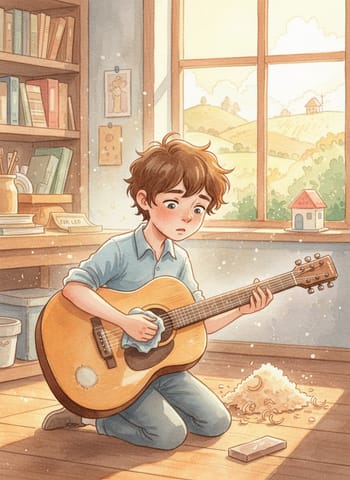
He turns the guitar over and starts on the back. The old varnish comes off in a fine, pale dust. Under it the wood is warm and yellow, like the inside of a lemon. Teo sands in long strokes, as the woman showed him, and blows the dust away every minute.
Da vuelta a la guitarra y empieza por la parte de atrás. El barniz viejo se desprende en un polvo fino y pálido. Debajo, la madera es cálida y amarilla, como el interior de un limón. Teo lija con trazos largos, como ella le enseñó, y sopla el polvo cada minuto.
The deepest scratches take the longest. They run across the middle of the back in a rough, wobbly line. Teo does not think about them much. They look like damage to him, so he sands them until they disappear.
Los rayones más profundos son los que más tardan. Cruzan el centro de la parte de atrás en una línea áspera y ondulante. Teo no piensa mucho en ellos. Le parecen un daño, así que los lija hasta que desaparecen.
When he finishes, the back is as smooth as a plate. He rubs in the wax with his thumb and holds the guitar up to the lamp. It shines. He feels proud for the first time all week.
Cuando termina, la parte de atrás está lisa como un plato. Frota la cera con el pulgar y levanta la guitarra hacia la lámpara. Brilla. Se siente orgulloso por primera vez en toda la semana.
He plays a chord. It sounds exactly the same as before, with a little buzz on the lowest string. Teo frowns. A new back does not change a sound, he realises. Only practice does that.
Toca un acorde. Suena exactamente igual que antes, con un pequeño zumbido en la cuerda más grave. Teo frunce el ceño. Una parte trasera nueva no cambia un sonido, comprende. Eso solo lo cambia la práctica.
"Hey, look at you," says a voice behind him. "A man at work."
«Eh, mírate», dice una voz detrás de él. «Todo un hombre trabajando».
Gaspar walks out of the half dark with two fishing rods over his shoulder. He carries a paper bag of hot chips. He is grinning, and the smell of vinegar follows him along the boards.
Gaspar sale de la semioscuridad con dos cañas de pescar al hombro. Lleva una bolsa de papel con papas fritas calientes. Sonríe, y el olor a vinagre lo sigue por las tablas.
"I wanted to surprise you," Teo says. "Look. I fixed it up. No more scratches."
«Quería darte una sorpresa», dice Teo. «Mira. La arreglé. Ya no hay rayones».
Gaspar puts down the rods. He takes the guitar and turns it over to admire the back. Then he stops smiling.
Gaspar deja las cañas. Toma la guitarra y le da vuelta para admirar la parte de atrás. Entonces deja de sonreír.
He runs his thumb slowly over the smooth wood, from one end to the other. He does it a second time, more slowly. Teo watches his friend's hand and feels something cold begin in his stomach.
Pasa el pulgar despacio por la madera lisa, de un extremo al otro. Lo hace una segunda vez, más despacio. Teo mira la mano de su amigo y siente que algo frío empieza en su estómago.
"What is wrong?" Teo asks.
«¿Qué pasa?», pregunta Teo.
"My name was here," Gaspar says quietly.
«Mi nombre estaba aquí», dice Gaspar en voz baja.
"Your name?"
«¿Tu nombre?»
"I carved it when I was eight, with a bent nail." Gaspar's voice is flat. "My dad had just let me hold the guitar for the first time. I was so excited that I scratched my name on the back. He was angry for about a minute."
«Lo grabé cuando tenía ocho años, con un clavo torcido». La voz de Gaspar es plana. «Mi papá acababa de dejarme sostener la guitarra por primera vez. Estaba tan emocionado que rayé mi nombre en la parte de atrás. Él estuvo enojado como un minuto».
He gives a short laugh with no happiness in it. "Then he said, if you put your name on it, you have to learn to play it. I never did. I just kept the guitar in the cupboard for six years."
Suelta una risa corta sin alegría. «Luego dijo: si pones tu nombre en ella, tienes que aprender a tocarla. Nunca aprendí. Solo guardé la guitarra en el armario durante seis años».
Teo cannot speak. He remembers the rough wobbly line across the middle of the back. He remembers a crooked letter at one end, shaped like a fishing hook. He did not read it as a letter. He read it as damage.
Teo no puede hablar. Recuerda la línea áspera y ondulante en el centro de la parte de atrás. Recuerda una letra torcida en un extremo, con forma de anzuelo. No la leyó como una letra. La leyó como un daño.
"Gaspar, I am so sorry," he says at last. "I thought it was only scratches. I thought I was helping."
«Gaspar, lo siento muchísimo», dice por fin. «Pensé que solo eran rayones. Pensé que te estaba ayudando».
"I know you did." Gaspar sits down on the boards with his back against the rail. He holds the guitar on his knees and says nothing for a long time.
«Lo sé». Gaspar se sienta en las tablas con la espalda contra la baranda. Sostiene la guitarra sobre las rodillas y no dice nada durante mucho rato.
The radio behind them goes on playing. A fisherman at the next post reels in his line and puts it out again. The lamp above them hums.
La radio detrás de ellos sigue sonando. Un pescador del siguiente puesto recoge su línea y la lanza de nuevo. La lámpara sobre ellos zumba.
"I should have told you what the marks were," Gaspar says. "It was never your fault. It is just that I did not know I cared until it was gone."
«Debí decirte qué eran esas marcas», dice Gaspar. «Nunca fue tu culpa. Es que no sabía que me importaba hasta que desapareció».
Teo kneels in front of him. His hands are still covered in pale dust. "Tell me how to fix it," he says. "Please. I will do anything."
Teo se arrodilla frente a él. Sus manos todavía están cubiertas de polvo pálido. «Dime cómo arreglarlo», dice. «Por favor. Haré lo que sea».
"You cannot put wood back." Gaspar rubs his eyes with the heel of his hand. "It is gone."
«No se puede devolver la madera». Gaspar se frota los ojos con la base de la mano. «Se fue».
"I cannot put it back," Teo agrees. "But I can carve it again. Deeper this time, so nobody can sand it away by accident."
«No puedo devolverla», concuerda Teo. «Pero puedo grabarlo otra vez. Más profundo esta vez, para que nadie pueda lijarlo por accidente».
Gaspar looks at him for a long moment. Then, to Teo's surprise, he pulls a small tin from his jacket. It is full of hooks and weights and bits of line. At the bottom lies a bent nail, black with age.
Gaspar lo mira un largo momento. Entonces, para sorpresa de Teo, saca una lata pequeña de su chaqueta. Está llena de anzuelos, plomos y pedazos de línea. En el fondo hay un clavo torcido, negro de viejo.
"This is the same nail," Gaspar says. "I kept it. Silly, right?"
«Este es el mismo clavo», dice Gaspar. «Lo guardé. Qué tontería, ¿no?»
"Not silly," says Teo.
«No es una tontería», dice Teo.
They move under the nearest lamp. Gaspar takes a pencil from behind his ear, which makes Teo laugh in spite of everything. He draws the six letters on the smooth wood. They are large and a little crooked, the way he remembers them. The G has its hooked tail.
Se mueven bajo la lámpara más cercana. Gaspar toma un lápiz de detrás de la oreja, lo que hace reír a Teo a pesar de todo. Dibuja las seis letras sobre la madera lisa. Son grandes y un poco torcidas, como las recuerda. La G tiene su cola de anzuelo.
"Now you," he says, and hands Teo the nail.
«Ahora tú», dice, y le da el clavo a Teo.
Teo takes a deep breath. He presses the point into the wood on the first line of the G. It is harder than it looks. The nail slips, and Gaspar puts his hand over Teo's to hold it steady.
Teo respira hondo. Presiona la punta contra la madera en la primera línea de la G. Es más difícil de lo que parece. El clavo resbala, y Gaspar pone su mano sobre la de Teo para mantenerla firme.
"Slowly," Gaspar says. "Let the nail do the work."
«Despacio», dice Gaspar. «Deja que el clavo haga el trabajo».
They go from letter to letter, one stroke at a time. The pier grows quieter around them. A few of the fishermen glance over, then look back at their lines. When Teo reaches the last R, his arm aches, but the letters are clean and deep.
Van de letra en letra, un trazo a la vez. El muelle se vuelve más silencioso a su alrededor. Unos cuantos pescadores echan un vistazo y luego vuelven a mirar sus líneas. Cuando Teo llega a la última R, le duele el brazo, pero las letras son limpias y profundas.
"One more thing," Gaspar says. He takes the nail and holds it out. "Underneath, a little smaller. Put your name."
«Una cosa más», dice Gaspar. Toma el clavo y se lo extiende. «Debajo, un poco más pequeño. Pon tu nombre».
"It is your guitar."
«Es tu guitarra».
"Not any more," Gaspar says. "Rule number one in my house. If your name is on it, you play it. So play it, Teo. You do not need to buy another one."
«Ya no», dice Gaspar. «Regla número uno en mi casa. Si tu nombre está en ella, la tocas. Así que tócala, Teo. No necesitas comprar otra».
Teo cannot say anything. He carves three small letters under the big ones, slowly and carefully. Then he blows the dust from the wood and turns the guitar over. He places his fingers on the strings.
Teo no puede decir nada. Graba tres letras pequeñas debajo de las grandes, despacio y con cuidado. Luego sopla el polvo de la madera y da vuelta a la guitarra. Coloca los dedos sobre las cuerdas.
He plays the first chord, and the sound runs out across the dark water.
Toca el primer acorde, y el sonido corre por el agua oscura.