The Name Under the Sandpaper
A free B1-level English story for language learners, readable online in 7 languages, with an option to listen via the free Storyteller app.
Teo wants to return a borrowed guitar looking new, but his careful polishing erases the one thing that made it his friend's.
That was the preview! Hear the full story in the free Storyteller app. Get the app
Audio isn't available right now.
Teo sits on an upturned crate at the far end of the fishing pier. The light is low, and the water under the boards looks like melted copper. Across his knees lies a battered guitar.
The guitar has seen better years. A long scratch runs across the front. There is a dent near the neck, and one tuning peg is newer than the others. Teo loves every mark on it, but tonight he wants it to shine.
The guitar belongs to Gaspar. Three months ago, Gaspar put it into Teo's hands. "Keep it until you can buy your own," he said. Tomorrow Teo gets his first pay from the fish market. On Saturday he plans to buy a guitar and give this one back.
A friend like that deserves a guitar that looks new. That is what Teo tells himself, anyway.
The woman from the bait shop leans over the rail beside him. She has a folded sheet of sandpaper in one hand and a tin of wax in the other.
"Your back is a mess," she says, looking at the guitar. "The old varnish is cracked. Take these. Go slowly, and your friend will never know."
"Thank you," Teo says. "I will bring them back tomorrow."
"Keep them," she says, and walks away with her bucket.
Along the pier, the lamps click on one by one. Men and women sit in a long row with their fishing lines hanging into the dark. The air smells of salt and bait and cold metal. Somewhere behind Teo, a radio plays very quietly.
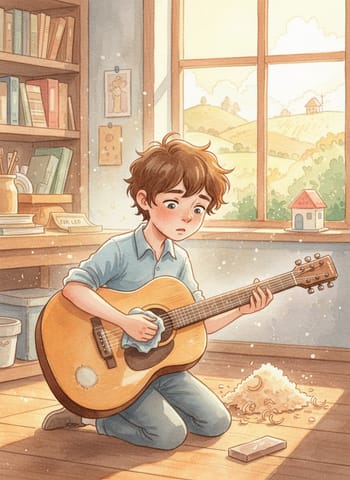
He turns the guitar over and starts on the back. The old varnish comes off in a fine, pale dust. Under it the wood is warm and yellow, like the inside of a lemon. Teo sands in long strokes, as the woman showed him, and blows the dust away every minute.
The deepest scratches take the longest. They run across the middle of the back in a rough, wobbly line. Teo does not think about them much. They look like damage to him, so he sands them until they disappear.
When he finishes, the back is as smooth as a plate. He rubs in the wax with his thumb and holds the guitar up to the lamp. It shines. He feels proud for the first time all week.
He plays a chord. It sounds exactly the same as before, with a little buzz on the lowest string. Teo frowns. A new back does not change a sound, he realises. Only practice does that.
"Hey, look at you," says a voice behind him. "A man at work."
Gaspar walks out of the half dark with two fishing rods over his shoulder. He carries a paper bag of hot chips. He is grinning, and the smell of vinegar follows him along the boards.
"I wanted to surprise you," Teo says. "Look. I fixed it up. No more scratches."
Gaspar puts down the rods. He takes the guitar and turns it over to admire the back. Then he stops smiling.
He runs his thumb slowly over the smooth wood, from one end to the other. He does it a second time, more slowly. Teo watches his friend's hand and feels something cold begin in his stomach.
"What is wrong?" Teo asks.
"My name was here," Gaspar says quietly.
"Your name?"
"I carved it when I was eight, with a bent nail." Gaspar's voice is flat. "My dad had just let me hold the guitar for the first time. I was so excited that I scratched my name on the back. He was angry for about a minute."
He gives a short laugh with no happiness in it. "Then he said, if you put your name on it, you have to learn to play it. I never did. I just kept the guitar in the cupboard for six years."
Teo cannot speak. He remembers the rough wobbly line across the middle of the back. He remembers a crooked letter at one end, shaped like a fishing hook. He did not read it as a letter. He read it as damage.
"Gaspar, I am so sorry," he says at last. "I thought it was only scratches. I thought I was helping."
"I know you did." Gaspar sits down on the boards with his back against the rail. He holds the guitar on his knees and says nothing for a long time.
The radio behind them goes on playing. A fisherman at the next post reels in his line and puts it out again. The lamp above them hums.
"I should have told you what the marks were," Gaspar says. "It was never your fault. It is just that I did not know I cared until it was gone."
Teo kneels in front of him. His hands are still covered in pale dust. "Tell me how to fix it," he says. "Please. I will do anything."
"You cannot put wood back." Gaspar rubs his eyes with the heel of his hand. "It is gone."
"I cannot put it back," Teo agrees. "But I can carve it again. Deeper this time, so nobody can sand it away by accident."
Gaspar looks at him for a long moment. Then, to Teo's surprise, he pulls a small tin from his jacket. It is full of hooks and weights and bits of line. At the bottom lies a bent nail, black with age.
"This is the same nail," Gaspar says. "I kept it. Silly, right?"
"Not silly," says Teo.
They move under the nearest lamp. Gaspar takes a pencil from behind his ear, which makes Teo laugh in spite of everything. He draws the six letters on the smooth wood. They are large and a little crooked, the way he remembers them. The G has its hooked tail.
"Now you," he says, and hands Teo the nail.
Teo takes a deep breath. He presses the point into the wood on the first line of the G. It is harder than it looks. The nail slips, and Gaspar puts his hand over Teo's to hold it steady.
"Slowly," Gaspar says. "Let the nail do the work."
They go from letter to letter, one stroke at a time. The pier grows quieter around them. A few of the fishermen glance over, then look back at their lines. When Teo reaches the last R, his arm aches, but the letters are clean and deep.
"One more thing," Gaspar says. He takes the nail and holds it out. "Underneath, a little smaller. Put your name."
"It is your guitar."
"Not any more," Gaspar says. "Rule number one in my house. If your name is on it, you play it. So play it, Teo. You do not need to buy another one."
Teo cannot say anything. He carves three small letters under the big ones, slowly and carefully. Then he blows the dust from the wood and turns the guitar over. He places his fingers on the strings.
He plays the first chord, and the sound runs out across the dark water.