The Misprint in the Paper Boat
Uma história gratuita em inglês de nível B1 para estudantes, para ler online em 7 idiomas, com opção de ouvir no app gratuito Storyteller.
In a busy print shop, a folded paper boat helps a new assistant spot an error that its owner can no longer see.
Essa foi a prévia! Ouça a história completa no app gratuito Storyteller. Baixar o app
O áudio não está disponível no momento.
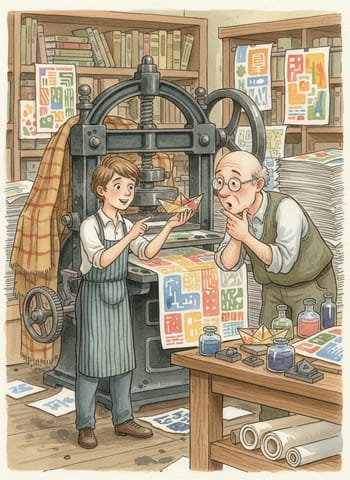
The print shop opens at seven, but Jabu is always there by six. He likes the hour when the machines are cold and the floor still smells of last night's ink. He walks between the tables, touches the stacks of paper and listens to the building wake up.
A gráfica abre às sete, mas Jabu sempre está lá às seis. Ele gosta da hora em que as máquinas estão frias e o chão ainda cheira à tinta da noite anterior. Anda entre as mesas, toca as pilhas de papel e escuta o prédio acordar.
Today, the first job on the board is a big one. A river club has ordered three hundred posters for its annual boat parade. The club's organiser is coming for them at five o'clock. She has already asked about them twice.
Hoje, o primeiro trabalho do quadro é grande. Um clube do rio encomendou trezentos cartazes para o desfile anual de barcos. A organizadora do clube virá buscá-los às cinco da tarde. Ela já perguntou deles duas vezes.
Nils arrives at half past seven with two coffees and a paper bag. He is new, and he has worked at the shop for only three weeks. Before that, he spent ten years behind a desk at an insurance office. He says he left because he was tired of reading things nobody wanted to read.
Nils chega às sete e meia com dois cafés e um saco de papel. Ele é novo e trabalha na gráfica há apenas três semanas. Antes disso, passou dez anos atrás de uma mesa numa seguradora. Diz que saiu porque estava cansado de ler coisas que ninguém queria ler.
"What are we printing?" he asks.
"O que vamos imprimir?", pergunta ele.
"A poster with a big blue boat and a lot of words," Jabu says. "It has to be perfect. The club pays well, and they send us work every year."
"Um cartaz com um grande barco azul e muitas palavras", diz Jabu. "Tem que ficar perfeito. O clube paga bem, e eles nos mandam serviço todo ano."
Jabu has already prepared the proof on his screen. He shows it to Nils, who reads it slowly, from top to bottom. The headline says River Boat Parade in tall yellow letters. Below it come the street, the name of the club and a small map. At the bottom are the date and the time.
Jabu já preparou a prova na tela. Mostra a Nils, que a lê devagar, de cima a baixo. O título diz Desfile de Barcos do Rio em letras amarelas altas. Abaixo vêm a rua, o nome do clube e um pequeno mapa. Na parte de baixo estão a data e a hora.
"It looks good," Nils says.
"Está bonito", diz Nils.
"It looks good because I have read it fifty times," Jabu says. He smiles. "Come, I will show you how to load the paper."
"Está bonito porque eu li cinquenta vezes", diz Jabu. Ele sorri. "Venha, vou mostrar como carregar o papel."
All morning, the press runs with a steady, heavy rhythm. Jabu teaches Nils to fan the sheets so they do not stick together. He shows him how to check the ink. He explains how to feel a dry roller and how to hear a change in the sound. Nils learns fast. He asks questions and writes the answers in a small notebook.
A manhã toda, a prensa funciona num ritmo constante e pesado. Jabu ensina Nils a folhear as folhas para que não grudem. Mostra como conferir a tinta. Explica como sentir um rolo seco e como ouvir uma mudança no som. Nils aprende rápido. Faz perguntas e anota as respostas num caderninho.
By noon, the first hundred and twenty posters lie in neat piles on the drying rack. The blue boat shines in the light from the window. Jabu picks one up, nods, and puts it down again.
Ao meio-dia, os primeiros cento e vinte cartazes estão em pilhas arrumadas no secador. O barco azul brilha na luz da janela. Jabu pega um, assente e o coloca de volta.
"Lunch," he says. "Then we finish the rest."
"Almoço", diz ele. "Depois terminamos o resto."
They eat standing up, at the counter by the front door. Afterwards, Nils goes back to the press room alone. He finds a spoiled sheet in the waste box. It has a long grey streak across the corner. He smooths it on the table and begins to fold.
Comem em pé, no balcão perto da porta da frente. Depois, Nils volta sozinho à sala da prensa. Encontra uma folha estragada na caixa de descarte. Tem uma longa faixa cinza no canto. Ele a alisa sobre a mesa e começa a dobrar.
He does it without thinking. His fingers know the steps from childhood. Fold in half, fold the corners, fold up the edges, pull the sides apart. A small boat comes out of the paper, with a flat bottom and a sharp front. He has made hundreds of them in his life, usually in meetings that were too long.
Faz isso sem pensar. Os dedos conhecem os passos desde a infância. Dobrar ao meio, dobrar os cantos, dobrar as bordas para cima, puxar os lados. Um barquinho sai do papel, com fundo chato e proa pontuda. Ele já fez centenas na vida, em geral em reuniões longas demais.
He sets the boat on the table and looks at it. Something about it feels odd.
Põe o barco sobre a mesa e olha para ele. Algo nele parece estranho.
The folds have hidden the big blue picture and the headline. He sees only the bottom strip of the poster, folded into the hull. It shows two short lines in plain black letters. Saturday, the twenty-first of June. Parade starts at nine in the evening.
As dobras esconderam o grande desenho azul e o título. Ele vê só a faixa inferior do cartaz, dobrada no casco. Nela estão duas linhas curtas em letras pretas simples. Sábado, 21 de junho. O desfile começa às nove da noite.
Nils reads it twice. Then he takes out his phone and finds the club's email, which Jabu forwarded on his first morning. He scrolls down to the third paragraph.
Nils lê duas vezes. Depois pega o celular e encontra o e-mail do clube, que Jabu encaminhou na primeira manhã dele. Rola até o terceiro parágrafo.
Please note that the parade begins at nine o'clock in the morning, before the sun is high.
Observem que o desfile começa às nove da manhã, antes de o sol ficar alto.
He walks quickly into the office. Jabu is on the phone, but he hangs up when he sees Nils's face.
Ele vai depressa até o escritório. Jabu está ao telefone, mas desliga ao ver o rosto de Nils.
"What is wrong?" Jabu asks.
"O que foi?", pergunta Jabu.
"I may be wrong," Nils says. "But I think the time is wrong on the posters."
"Posso estar errado", diz Nils. "Mas acho que a hora está errada nos cartazes."
Jabu frowns. He takes the paper boat from Nils's hand and holds it up. For a moment, he says nothing at all. Then he sits down heavily in his chair.
Jabu franze a testa. Pega o barco de papel da mão de Nils e o ergue. Por um momento, não diz nada. Então se deixa cair pesadamente na cadeira.
"Nine in the evening," he reads aloud. "Nine in the evening. How can that be?"
"Nove da noite", lê em voz alta. "Nove da noite. Como pode ser?"
"It says nine in the morning in the email."
"No e-mail diz nove da manhã."
"I know what the email says. I typed it myself." Jabu rubs his forehead. "I must have changed it when I fixed the spacing, and I never saw it. I read that poster so many times that my eyes only saw what I expected."
"Sei o que diz o e-mail. Fui eu que digitei." Jabu esfrega a testa. "Devo ter mudado quando ajustei o espaçamento e nunca vi. Li aquele cartaz tantas vezes que meus olhos só viam o que eu esperava."
"The boat showed it to me because it hid everything else," Nils says quietly.
"O barco me mostrou porque escondeu todo o resto", diz Nils baixinho.
Jabu laughs, but it is not a happy sound. He looks at the clock above the door. It is ten past one.
Jabu ri, mas não é um som alegre. Olha o relógio sobre a porta. É uma e dez.
"A hundred and twenty are printed," he says. "One hundred and eighty are still to go. And they are all wrong."
"Cento e vinte estão impressos", diz ele. "Faltam cento e oitenta. E estão todos errados."
"Could we stop the press?"
"Podemos parar a prensa?"
"I stopped it for lunch an hour ago. That is the only good news." Jabu stands up. His shoulders are straight again, and his voice is calm. He has been in the business for thirty years, and he knows that panic costs more than paper. "Come with me."
"Eu parei para o almoço há uma hora. Essa é a única boa notícia." Jabu se levanta. Os ombros estão firmes de novo, e a voz, calma. Está no ramo há trinta anos e sabe que o pânico custa mais que o papel. "Venha comigo."
In the press room, he walks to the machine and runs his finger over the plate. The error is small, a single word on a metal sheet. He takes the plate out and carries it to the computer.
Na sala da prensa, ele vai até a máquina e passa o dedo na chapa. O erro é pequeno, uma única palavra numa folha de metal. Tira a chapa e a leva ao computador.
"First, we fix the file," he says. "Not just the time. I want you to read the whole poster aloud, line by line, from the bottom. Slowly."
"Primeiro, corrigimos o arquivo", diz ele. "Não só a hora. Quero que você leia o cartaz inteiro em voz alta, linha por linha, de baixo para cima. Devagar."
"From the bottom?"
"De baixo para cima?"
"A page looks different from the bottom. Your eyes cannot jump ahead because you have to read every word alone." Jabu lifts his eyebrows. "Your boat is a clever way to do the same thing."
"Uma página parece diferente de baixo para cima. Os olhos não conseguem pular adiante, porque você precisa ler cada palavra sozinha." Jabu ergue as sobrancelhas. "O seu barco é um jeito inteligente de fazer a mesma coisa."
Nils reads. Jabu listens. They find the correct time, and they find nothing else. Jabu makes a new plate, and Nils helps him lock it into the machine.
Nils lê. Jabu escuta. Encontram a hora certa e não encontram mais nada. Jabu faz uma chapa nova, e Nils o ajuda a prendê-la na máquina.
At two o'clock, the press starts again. This time, Jabu does not leave the room. Every ten minutes, he pulls a sheet from the tray and passes it to Nils. Nils reads it from the bottom up and nods.
Às duas horas, a prensa volta a funcionar. Desta vez, Jabu não sai da sala. A cada dez minutos, tira uma folha da bandeja e a passa a Nils. Nils a lê de baixo para cima e assente.
When the three hundred copies are finished, Jabu looks at the old posters. A hundred and twenty beautiful sheets, with a blue boat and the wrong hour, wait on the rack.
Quando as trezentas cópias ficam prontas, Jabu olha os cartazes antigos. Cento e vinte folhas lindas, com um barco azul e a hora errada, esperam no secador.
"We cannot give them away," Nils says. "People will come at night."
"Não podemos dá-los", diz Nils. "As pessoas vão aparecer à noite."
"We cannot sell them either. But we can use them." Jabu pulls out a pencil and writes a short note on a card. "I will give them to the school next door, with the back side blank. The children can draw on the empty paper."
"Também não podemos vendê-los. Mas podemos aproveitá-los." Jabu pega um lápis e escreve um bilhete curto num cartão. "Vou dá-los à escola aqui do lado, com o verso em branco. As crianças podem desenhar no papel vazio."
At twenty to five, the organiser arrives. She is a quick, energetic woman with sunglasses on her head, and she walks straight to the counter. Jabu has the new posters ready, wrapped in brown paper.
Vinte para as cinco, a organizadora chega. É uma mulher rápida e cheia de energia, com óculos escuros na cabeça, e vai direto ao balcão. Jabu tem os cartazes novos prontos, embrulhados em papel pardo.
"Everything correct?" she asks.
"Tudo certo?", pergunta ela.
"Everything correct," Jabu says. "We checked it twice. The second time, someone read it to me from the bottom."
"Tudo certo", diz Jabu. "Conferimos duas vezes. Na segunda, alguém leu para mim de baixo para cima."
She laughs, though she does not understand the joke. She pays, takes the posters and leaves with the bell ringing above the door.
Ela ri, embora não entenda a piada. Paga, pega os cartazes e sai com a sineta tocando acima da porta.
The shop is quiet again. Jabu walks back to the press room. Nils is already there, sweeping paper dust from the floor. On the table, the little paper boat still sits where he left it.
A gráfica fica quieta de novo. Jabu volta à sala da prensa. Nils já está lá, varrendo o pó de papel do chão. Sobre a mesa, o barquinho de papel continua onde ele o deixou.
Jabu picks it up and turns it in his hand. Then he walks to the shelf above the press, where he keeps his coffee cup. He places the boat in the centre of the shelf, with the mistake showing. Then he presses the green button and starts the next job.
Jabu o pega e o vira na mão. Depois vai até a prateleira acima da prensa, onde guarda a xícara de café. Coloca o barco no centro da prateleira, com o erro à mostra. Então aperta o botão verde e começa o próximo trabalho.