The Misprint in the Paper Boat
Cerita bahasa Inggris gratis level B1 untuk pelajar, bisa dibaca online dalam 7 bahasa, dengan pilihan untuk mendengarkannya di aplikasi Storyteller gratis.
In a busy print shop, a folded paper boat helps a new assistant spot an error that its owner can no longer see.
Itu cuplikannya! Dengarkan cerita lengkapnya di aplikasi Storyteller gratis. Unduh aplikasi
Audio belum tersedia saat ini.
The print shop opens at seven, but Jabu is always there by six. He likes the hour when the machines are cold and the floor still smells of last night's ink. He walks between the tables, touches the stacks of paper and listens to the building wake up.
Percetakan itu buka pukul tujuh, tetapi Jabu selalu sudah ada di sana pukul enam. Ia menyukai jam ketika mesin-mesin masih dingin dan lantai masih berbau tinta semalam. Ia berjalan di antara meja-meja, menyentuh tumpukan kertas, dan mendengarkan gedung itu terbangun.
Today, the first job on the board is a big one. A river club has ordered three hundred posters for its annual boat parade. The club's organiser is coming for them at five o'clock. She has already asked about them twice.
Hari ini, pekerjaan pertama di papan adalah pekerjaan besar. Sebuah klub sungai memesan tiga ratus poster untuk pawai perahu tahunannya. Penyelenggara klub itu akan datang mengambilnya pukul lima. Ia sudah dua kali menanyakannya.
Nils arrives at half past seven with two coffees and a paper bag. He is new, and he has worked at the shop for only three weeks. Before that, he spent ten years behind a desk at an insurance office. He says he left because he was tired of reading things nobody wanted to read.
Nils tiba pukul setengah delapan membawa dua cangkir kopi dan sebuah kantong kertas. Ia orang baru, dan baru tiga minggu bekerja di toko itu. Sebelumnya, ia menghabiskan sepuluh tahun di balik meja di kantor asuransi. Ia bilang keluar karena lelah membaca hal-hal yang tidak ingin dibaca siapa pun.
"What are we printing?" he asks.
"Kita mencetak apa?" tanyanya.
"A poster with a big blue boat and a lot of words," Jabu says. "It has to be perfect. The club pays well, and they send us work every year."
"Poster dengan perahu biru besar dan banyak tulisan," kata Jabu. "Harus sempurna. Klub itu membayar dengan baik, dan mereka mengirimi kita pekerjaan setiap tahun."
Jabu has already prepared the proof on his screen. He shows it to Nils, who reads it slowly, from top to bottom. The headline says River Boat Parade in tall yellow letters. Below it come the street, the name of the club and a small map. At the bottom are the date and the time.
Jabu sudah menyiapkan contoh cetaknya di layar. Ia menunjukkannya kepada Nils, yang membacanya pelan-pelan, dari atas ke bawah. Judulnya berbunyi Pawai Perahu Sungai dengan huruf kuning yang tinggi. Di bawahnya ada nama jalan, nama klub, dan sebuah peta kecil. Di bagian paling bawah ada tanggal dan jam.
"It looks good," Nils says.
"Kelihatannya bagus," kata Nils.
"It looks good because I have read it fifty times," Jabu says. He smiles. "Come, I will show you how to load the paper."
"Kelihatannya bagus karena aku sudah membacanya lima puluh kali," kata Jabu. Ia tersenyum. "Ayo, kutunjukkan cara memasukkan kertas."
All morning, the press runs with a steady, heavy rhythm. Jabu teaches Nils to fan the sheets so they do not stick together. He shows him how to check the ink. He explains how to feel a dry roller and how to hear a change in the sound. Nils learns fast. He asks questions and writes the answers in a small notebook.
Sepanjang pagi, mesin cetak berjalan dengan irama yang mantap dan berat. Jabu mengajari Nils mengipasi lembaran-lembaran agar tidak lengket. Ia menunjukkan cara memeriksa tinta. Ia menjelaskan cara merasakan rol yang kering dan cara mendengar perubahan bunyi. Nils belajar dengan cepat. Ia bertanya dan menuliskan jawabannya di buku catatan kecil.
By noon, the first hundred and twenty posters lie in neat piles on the drying rack. The blue boat shines in the light from the window. Jabu picks one up, nods, and puts it down again.
Menjelang siang, seratus dua puluh poster pertama tersusun rapi di rak pengering. Perahu biru itu berkilau dalam cahaya dari jendela. Jabu mengambil satu, mengangguk, lalu meletakkannya kembali.
"Lunch," he says. "Then we finish the rest."
"Makan siang," katanya. "Lalu kita selesaikan sisanya."
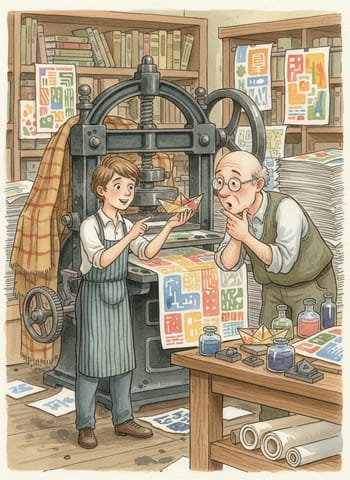
They eat standing up, at the counter by the front door. Afterwards, Nils goes back to the press room alone. He finds a spoiled sheet in the waste box. It has a long grey streak across the corner. He smooths it on the table and begins to fold.
Mereka makan sambil berdiri, di konter dekat pintu depan. Sesudahnya, Nils kembali ke ruang mesin sendirian. Ia menemukan selembar kertas rusak di kotak sampah. Ada goresan abu-abu panjang melintang di sudutnya. Ia meratakannya di meja dan mulai melipat.
He does it without thinking. His fingers know the steps from childhood. Fold in half, fold the corners, fold up the edges, pull the sides apart. A small boat comes out of the paper, with a flat bottom and a sharp front. He has made hundreds of them in his life, usually in meetings that were too long.
Ia melakukannya tanpa berpikir. Jari-jarinya mengenal langkah-langkahnya sejak kecil. Lipat dua, lipat sudut-sudutnya, lipat tepi-tepinya ke atas, tarik kedua sisinya. Sebuah perahu kecil muncul dari kertas itu, dengan dasar datar dan ujung depan yang tajam. Seumur hidupnya ia sudah membuat ratusan perahu seperti itu, biasanya dalam rapat yang terlalu panjang.
He sets the boat on the table and looks at it. Something about it feels odd.
Ia meletakkan perahu itu di meja dan memandanginya. Ada sesuatu yang terasa janggal.
The folds have hidden the big blue picture and the headline. He sees only the bottom strip of the poster, folded into the hull. It shows two short lines in plain black letters. Saturday, the twenty-first of June. Parade starts at nine in the evening.
Lipatan-lipatan itu telah menyembunyikan gambar biru besar dan judulnya. Ia hanya melihat lajur paling bawah poster itu, terlipat menjadi lambung perahu. Di situ ada dua baris pendek dengan huruf hitam polos. Sabtu, dua puluh satu Juni. Pawai dimulai pukul sembilan malam.
Nils reads it twice. Then he takes out his phone and finds the club's email, which Jabu forwarded on his first morning. He scrolls down to the third paragraph.
Nils membacanya dua kali. Lalu ia mengeluarkan ponselnya dan mencari surel dari klub itu, yang diteruskan Jabu pada hari pertamanya. Ia menggulir ke paragraf ketiga.
Please note that the parade begins at nine o'clock in the morning, before the sun is high.
Harap diperhatikan bahwa pawai dimulai pukul sembilan pagi, sebelum matahari tinggi.
He walks quickly into the office. Jabu is on the phone, but he hangs up when he sees Nils's face.
Ia berjalan cepat ke kantor. Jabu sedang menelepon, tetapi ia menutupnya begitu melihat wajah Nils.
"What is wrong?" Jabu asks.
"Ada apa?" tanya Jabu.
"I may be wrong," Nils says. "But I think the time is wrong on the posters."
"Mungkin saya salah," kata Nils. "Tapi saya rasa jamnya salah di poster-poster itu."
Jabu frowns. He takes the paper boat from Nils's hand and holds it up. For a moment, he says nothing at all. Then he sits down heavily in his chair.
Jabu mengerutkan kening. Ia mengambil perahu kertas itu dari tangan Nils dan mengangkatnya. Sesaat, ia tidak mengatakan apa pun. Lalu ia duduk berat di kursinya.
"Nine in the evening," he reads aloud. "Nine in the evening. How can that be?"
"Pukul sembilan malam," bacanya keras-keras. "Pukul sembilan malam. Bagaimana bisa?"
"It says nine in the morning in the email."
"Di surelnya tertulis pukul sembilan pagi."
"I know what the email says. I typed it myself." Jabu rubs his forehead. "I must have changed it when I fixed the spacing, and I never saw it. I read that poster so many times that my eyes only saw what I expected."
"Aku tahu apa isi surelnya. Aku sendiri yang mengetiknya." Jabu mengusap dahinya. "Pasti aku mengubahnya waktu membetulkan spasi, dan aku tidak pernah melihatnya. Aku membaca poster itu begitu sering sampai mataku hanya melihat apa yang kuharapkan."
"The boat showed it to me because it hid everything else," Nils says quietly.
"Perahu itu menunjukkannya kepada saya karena ia menyembunyikan yang lainnya," kata Nils pelan.
Jabu laughs, but it is not a happy sound. He looks at the clock above the door. It is ten past one.
Jabu tertawa, tetapi bukan tawa yang gembira. Ia melihat jam di atas pintu. Pukul satu lewat sepuluh.
"A hundred and twenty are printed," he says. "One hundred and eighty are still to go. And they are all wrong."
"Seratus dua puluh sudah tercetak," katanya. "Seratus delapan puluh belum. Dan semuanya salah."
"Could we stop the press?"
"Bisakah kita menghentikan mesinnya?"
"I stopped it for lunch an hour ago. That is the only good news." Jabu stands up. His shoulders are straight again, and his voice is calm. He has been in the business for thirty years, and he knows that panic costs more than paper. "Come with me."
"Aku sudah menghentikannya untuk makan siang sejam yang lalu. Itu satu-satunya kabar baik." Jabu berdiri. Bahunya kembali tegak, dan suaranya tenang. Ia sudah tiga puluh tahun berkecimpung di bisnis ini, dan ia tahu bahwa panik lebih mahal daripada kertas. "Ikut aku."
In the press room, he walks to the machine and runs his finger over the plate. The error is small, a single word on a metal sheet. He takes the plate out and carries it to the computer.
Di ruang mesin, ia berjalan ke mesin itu dan menyusurkan jarinya di atas pelat. Kesalahannya kecil, satu kata pada lempeng logam. Ia melepaskan pelat itu dan membawanya ke komputer.
"First, we fix the file," he says. "Not just the time. I want you to read the whole poster aloud, line by line, from the bottom. Slowly."
"Pertama, kita perbaiki berkasnya," katanya. "Bukan hanya jamnya. Aku ingin kamu membaca seluruh poster dengan suara keras, baris demi baris, dari bawah. Pelan-pelan."
"From the bottom?"
"Dari bawah?"
"A page looks different from the bottom. Your eyes cannot jump ahead because you have to read every word alone." Jabu lifts his eyebrows. "Your boat is a clever way to do the same thing."
"Halaman terlihat berbeda dari bawah. Matamu tidak bisa melompat ke depan karena kamu harus membaca setiap kata satu per satu." Jabu mengangkat alisnya. "Perahumu itu cara cerdas untuk melakukan hal yang sama."
Nils reads. Jabu listens. They find the correct time, and they find nothing else. Jabu makes a new plate, and Nils helps him lock it into the machine.
Nils membaca. Jabu mendengarkan. Mereka menemukan jam yang benar, dan tidak menemukan apa pun lagi. Jabu membuat pelat baru, dan Nils membantunya memasangnya ke mesin.
At two o'clock, the press starts again. This time, Jabu does not leave the room. Every ten minutes, he pulls a sheet from the tray and passes it to Nils. Nils reads it from the bottom up and nods.
Pukul dua, mesin cetak mulai lagi. Kali ini, Jabu tidak meninggalkan ruangan. Setiap sepuluh menit, ia mengambil selembar dari baki dan menyerahkannya kepada Nils. Nils membacanya dari bawah ke atas dan mengangguk.
When the three hundred copies are finished, Jabu looks at the old posters. A hundred and twenty beautiful sheets, with a blue boat and the wrong hour, wait on the rack.
Ketika ketiga ratus lembar selesai, Jabu memandang poster-poster lama. Seratus dua puluh lembar yang indah, dengan perahu biru dan jam yang salah, menunggu di rak.
"We cannot give them away," Nils says. "People will come at night."
"Kita tidak bisa membagikannya," kata Nils. "Orang-orang akan datang pada malam hari."
"We cannot sell them either. But we can use them." Jabu pulls out a pencil and writes a short note on a card. "I will give them to the school next door, with the back side blank. The children can draw on the empty paper."
"Kita juga tidak bisa menjualnya. Tapi kita bisa memanfaatkannya." Jabu mengambil pensil dan menulis catatan singkat pada sebuah kartu. "Akan kuberikan ke sekolah sebelah, dengan sisi belakang yang kosong. Anak-anak bisa menggambar di kertas kosong itu."
At twenty to five, the organiser arrives. She is a quick, energetic woman with sunglasses on her head, and she walks straight to the counter. Jabu has the new posters ready, wrapped in brown paper.
Pukul lima kurang dua puluh, sang penyelenggara tiba. Ia perempuan yang gesit dan bersemangat dengan kacamata hitam di atas kepalanya, dan ia langsung berjalan ke konter. Jabu sudah menyiapkan poster-poster baru, terbungkus kertas cokelat.
"Everything correct?" she asks.
"Semuanya benar?" tanyanya.
"Everything correct," Jabu says. "We checked it twice. The second time, someone read it to me from the bottom."
"Semuanya benar," kata Jabu. "Kami memeriksanya dua kali. Kali kedua, seseorang membacakannya untuk saya dari bawah."
She laughs, though she does not understand the joke. She pays, takes the posters and leaves with the bell ringing above the door.
Ia tertawa, meski tidak mengerti leluconnya. Ia membayar, membawa poster-poster itu, lalu pergi dengan lonceng berdenting di atas pintu.
The shop is quiet again. Jabu walks back to the press room. Nils is already there, sweeping paper dust from the floor. On the table, the little paper boat still sits where he left it.
Toko itu kembali sunyi. Jabu berjalan kembali ke ruang mesin. Nils sudah ada di sana, menyapu debu kertas dari lantai. Di atas meja, perahu kertas kecil itu masih berada di tempat ia meninggalkannya.
Jabu picks it up and turns it in his hand. Then he walks to the shelf above the press, where he keeps his coffee cup. He places the boat in the centre of the shelf, with the mistake showing. Then he presses the green button and starts the next job.
Jabu mengambilnya dan memutarnya di tangan. Lalu ia berjalan ke rak di atas mesin cetak, tempat ia menyimpan cangkir kopinya. Ia menaruh perahu itu di tengah rak, dengan kesalahannya terlihat. Lalu ia menekan tombol hijau dan memulai pekerjaan berikutnya.