Your Move on the Ice
A free B1-level English story for language learners, readable online in 7 languages, with an option to listen via the free Storyteller app.
Two early-morning skaters share rehearsal time with a chess clock, until one of them is caught pressing the buttons unfairly.
That was the preview! Hear the full story in the free Storyteller app. Get the app
Audio isn't available right now.
Mirza arrives at the skating rink at six in the morning, before the first visitors. The ice is empty and shining, and the air smells of cold metal. Gus is already sitting on the bench by the barrier, tying his skates with great care.
"You are late," he says.
"I am four minutes early," Mirza says. "Your watch is wrong."
"My watch is never wrong. That is why I brought the clock."
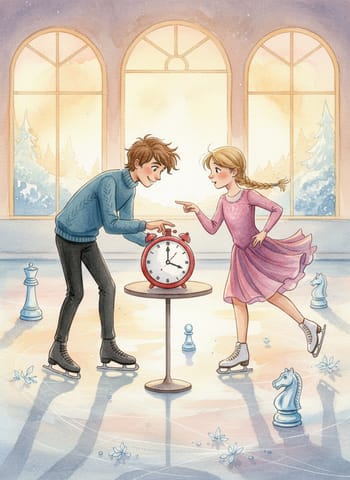
On the bench between them sits an old wooden chess clock. Gus bought it at a market stall last month. It has two white faces, two brass buttons, and a loud tick that echoes across the empty ice.
The rink is celebrating its fiftieth year, and the manager has asked for a show. Mirza skated every winter as a girl. Now she wants a routine with fast spins and long, sharp lines. Gus is a carpenter who learned to skate in the autumn. He wants something slow and funny, with a bow at the end.
They could not agree. So they made a rule, and the clock is the judge. Each of them gets twenty minutes of every morning. While your side of the clock runs, you choose what the pair practises. When your time ends, you press your button, and the other person takes over.
"Ladies first," Gus says.
Gus presses his button, and Mirza's side begins to tick. For twenty minutes, she leads. They skate fast circles. They practise her spin, with Gus holding her hand and trying not to fall. He falls twice. She does not mind. Her plan is good, and she can feel it.
Then she slaps the button. The ticking changes sides.
"Finally," Gus says, and he stands up. "My turn."
He wants to try a slow turn he has invented. It is a wide, gentle curve with a bow in the middle. It looks like a boat on a quiet lake. Mirza follows him, and she has to admit that it is pretty. They have skated for perhaps ten minutes when the clock gives a loud click.
"Time," Mirza calls from the barrier. She is holding the clock in her hands. "Your twenty minutes are over."
Gus stops in the middle of the ice. "That was fast."
"The clock does not lie."
He skates over, slowly, and looks at his watch. He does not say anything. He only puts his chin in his hand, the way he does when he checks a measurement.
The next morning is the same. Mirza leads for twenty minutes, and her plan grows. She adds a jump. She adds a lift that scares both of them. When it is Gus's turn, he has a new idea, a small dance step with the feet together. He barely finishes the first try before the clock clicks again.
"Time," she says.
"Already?" Gus asks. "It feels like five minutes."
Mirza does not look at the clock twice. She is thinking about the lift.
On the third morning, Gus arrives before her. When Mirza walks in, he is sitting on the bench with the clock open on his knees. A small screwdriver lies beside him, and so does his phone.
"What are you doing to my judge?" she asks.
"I am making sure the judge is honest." He holds up the phone. "I timed us yesterday. You skated for twenty-four minutes. I skated for eleven."
Mirza stares at him. "That cannot be right."
"The clock is fine. I checked every part." He closes the back and puts the screwdriver away. "It is not the clock that is wrong. It is the hand that presses the button."
For a moment she wants to argue. She has a long speech ready, about her experience and her years on the ice. Instead she sits down next to him on the bench, and the speech goes quiet.
"I did not know," she says at last.
"I think you did a little."
She looks at her gloves. It is true, and it is easy to see once he says it. Each morning she has pressed her button late and his button early. She has told herself that she was only being careful. But the real reason is smaller and harder. The show is in two weeks. After that, there is no reason for them to meet at six in the morning.
"I wanted our routine to be perfect," she says. "If it is perfect, then maybe we will keep skating together."
"That is a strange way to ask," Gus says.
"I know. I am sorry. It was a mistake, and a silly one."
He nods. He does not look angry. He looks like a man who has solved a puzzle and wishes the answer were kinder. "Thank you for telling me," he says. "I mean it."
"What do we do now?"
Gus gets up and walks to the edge of the ice. "We do the morning again, and this time we do it properly. I press your button, and you press mine. Then neither of us can cheat."
"That is the most sensible thing anyone has said to me this month," Mirza says.
They skate. Gus presses her button, and she stands at the barrier with her arms crossed, watching his boat-curve again. It is even prettier than she remembered. When her own twenty minutes begin, he presses his button with one finger. Her side starts to tick.
She leads him into the spin, and for once she explains it slowly. She shows him where to put his foot and when to let go. Gus follows, and he does not fall. On the third try, the spin is so smooth that they both laugh out loud. A cleaner polishing the barrier looks up in surprise.
They test the lift next. It frightens Mirza more than it frightens Gus. A carpenter, she finds, knows exactly how much weight a good pair of arms can hold. He checks her grip twice and tells her to count to three. On three, she goes up into the cold air. For a second she can see the whole empty rink, white and bright.
When Gus puts her down, she is smiling so widely that her cheeks hurt.
"That was not in the plan," he says.
"It was always in the plan."
"Then why did you take it out?"
She does not answer. The clock ticks, and the two of them stand on the ice and listen to it.
In the second week, the routine changes shape. The fast spins stay, but they come after the slow curve instead of before it. The jump disappears, and the bow in the middle grows bigger. Neither of them would have made it alone. Mirza begins to like it more than her first plan.
On the morning of the show, the rink is full of lights and folding chairs. Mirza stands at the barrier in a plain blue dress. Gus stands beside her in a jacket with new, shorter sleeves. In his pocket, he carries the clock. He says it brings luck.
"Are you nervous?" she asks.
"Terrified. I have a hammer in my bag in case the ice breaks."
"The ice will not break."
"Then I have a hammer for no reason, which is how I like to live." He takes out the clock and sets it on the barrier. For a moment they both look at the two brass buttons, one for each of them.
The music starts, softly, from the speakers. Mirza reaches out and presses his button. Gus smiles and presses hers.
"Your move," she says.