Your Move on the Ice
Uma história gratuita em inglês de nível B1 para estudantes, para ler online em 7 idiomas, com opção de ouvir no app gratuito Storyteller.
Two early-morning skaters share rehearsal time with a chess clock, until one of them is caught pressing the buttons unfairly.
Essa foi a prévia! Ouça a história completa no app gratuito Storyteller. Baixar o app
O áudio não está disponível no momento.
Mirza arrives at the skating rink at six in the morning, before the first visitors. The ice is empty and shining, and the air smells of cold metal. Gus is already sitting on the bench by the barrier, tying his skates with great care.
Mirza chega à pista de patinação às seis da manhã, antes dos primeiros visitantes. O gelo está vazio e reluzente, e o ar cheira a metal frio. Gus já está sentado no banco junto à grade, amarrando os patins com muito cuidado.
"You are late," he says.
"Você está atrasada", diz ele.
"I am four minutes early," Mirza says. "Your watch is wrong."
"Estou quatro minutos adiantada", diz Mirza. "O seu relógio está errado."
"My watch is never wrong. That is why I brought the clock."
"O meu relógio nunca erra. Por isso eu trouxe o cronômetro."
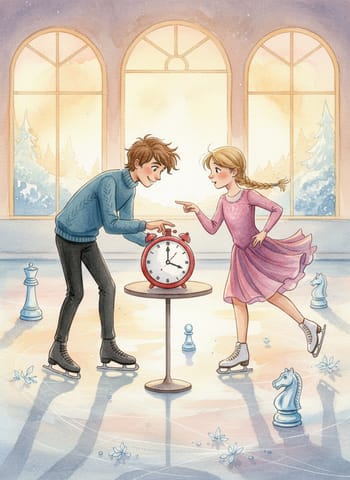
On the bench between them sits an old wooden chess clock. Gus bought it at a market stall last month. It has two white faces, two brass buttons, and a loud tick that echoes across the empty ice.
No banco, entre os dois, há um velho relógio de xadrez de madeira. Gus o comprou numa barraca de feira no mês passado. Tem dois mostradores brancos, dois botões de latão e um tique-taque alto que ecoa pelo gelo vazio.
The rink is celebrating its fiftieth year, and the manager has asked for a show. Mirza skated every winter as a girl. Now she wants a routine with fast spins and long, sharp lines. Gus is a carpenter who learned to skate in the autumn. He wants something slow and funny, with a bow at the end.
A pista está comemorando cinquenta anos, e o gerente pediu uma apresentação. Mirza patinava todo inverno quando era menina. Agora quer uma coreografia com piruetas rápidas e linhas longas e precisas. Gus é carpinteiro e aprendeu a patinar no outono. Quer algo lento e divertido, com uma reverência no final.
They could not agree. So they made a rule, and the clock is the judge. Each of them gets twenty minutes of every morning. While your side of the clock runs, you choose what the pair practises. When your time ends, you press your button, and the other person takes over.
Não conseguiram chegar a um acordo. Então criaram uma regra, e o relógio é o juiz. Cada um tem vinte minutos de cada manhã. Enquanto o seu lado do relógio corre, você escolhe o que a dupla pratica. Quando o seu tempo acaba, você aperta o seu botão, e a outra pessoa assume.
"Ladies first," Gus says.
"As damas primeiro", diz Gus.
Gus presses his button, and Mirza's side begins to tick. For twenty minutes, she leads. They skate fast circles. They practise her spin, with Gus holding her hand and trying not to fall. He falls twice. She does not mind. Her plan is good, and she can feel it.
Gus aperta o botão, e o lado de Mirza começa a tiquetaquear. Por vinte minutos, ela conduz. Patinam círculos rápidos. Praticam a pirueta dela, com Gus segurando sua mão e tentando não cair. Ele cai duas vezes. Ela não se importa. O plano dela é bom, e ela sente isso.
Then she slaps the button. The ticking changes sides.
Então ela dá um tapa no botão. O tique-taque muda de lado.
"Finally," Gus says, and he stands up. "My turn."
"Finalmente", diz Gus, e se levanta. "Minha vez."
He wants to try a slow turn he has invented. It is a wide, gentle curve with a bow in the middle. It looks like a boat on a quiet lake. Mirza follows him, and she has to admit that it is pretty. They have skated for perhaps ten minutes when the clock gives a loud click.
Ele quer experimentar uma curva lenta que inventou. É uma curva ampla e suave, com uma reverência no meio. Parece um barco num lago tranquilo. Mirza o segue e tem de admitir que é bonito. Patinaram talvez dez minutos quando o relógio dá um clique alto.
"Time," Mirza calls from the barrier. She is holding the clock in her hands. "Your twenty minutes are over."
"Tempo", chama Mirza da grade. Ela está com o relógio nas mãos. "Seus vinte minutos acabaram."
Gus stops in the middle of the ice. "That was fast."
Gus para no meio do gelo. "Passou rápido."
"The clock does not lie."
"O relógio não mente."
He skates over, slowly, and looks at his watch. He does not say anything. He only puts his chin in his hand, the way he does when he checks a measurement.
Ele se aproxima, devagar, e olha o próprio relógio de pulso. Não diz nada. Só apoia o queixo na mão, como faz quando confere uma medida.
The next morning is the same. Mirza leads for twenty minutes, and her plan grows. She adds a jump. She adds a lift that scares both of them. When it is Gus's turn, he has a new idea, a small dance step with the feet together. He barely finishes the first try before the clock clicks again.
A manhã seguinte é igual. Mirza conduz por vinte minutos, e o plano dela cresce. Ela acrescenta um salto. Acrescenta um levantamento que assusta os dois. Quando é a vez de Gus, ele tem uma ideia nova, um pequeno passo de dança com os pés juntos. Mal termina a primeira tentativa e o relógio faz clique de novo.
"Time," she says.
"Tempo", diz ela.
"Already?" Gus asks. "It feels like five minutes."
"Já?", pergunta Gus. "Parece que foram cinco minutos."
Mirza does not look at the clock twice. She is thinking about the lift.
Mirza não olha o relógio duas vezes. Está pensando no levantamento.
On the third morning, Gus arrives before her. When Mirza walks in, he is sitting on the bench with the clock open on his knees. A small screwdriver lies beside him, and so does his phone.
Na terceira manhã, Gus chega antes dela. Quando Mirza entra, ele está sentado no banco com o relógio aberto nos joelhos. Uma chave de fenda pequena está ao lado dele, e também o celular.
"What are you doing to my judge?" she asks.
"O que você está fazendo com o meu juiz?", pergunta ela.
"I am making sure the judge is honest." He holds up the phone. "I timed us yesterday. You skated for twenty-four minutes. I skated for eleven."
"Estou garantindo que o juiz seja honesto." Ele ergue o celular. "Cronometrei a gente ontem. Você patinou vinte e quatro minutos. Eu patinei onze."
Mirza stares at him. "That cannot be right."
Mirza o encara. "Isso não pode estar certo."
"The clock is fine. I checked every part." He closes the back and puts the screwdriver away. "It is not the clock that is wrong. It is the hand that presses the button."
"O relógio está bom. Conferi cada peça." Ele fecha a tampa de trás e guarda a chave de fenda. "O errado não é o relógio. É a mão que aperta o botão."
For a moment she wants to argue. She has a long speech ready, about her experience and her years on the ice. Instead she sits down next to him on the bench, and the speech goes quiet.
Por um momento, ela quer discutir. Tem um longo discurso pronto, sobre sua experiência e seus anos no gelo. Em vez disso, senta-se ao lado dele no banco, e o discurso se cala.
"I did not know," she says at last.
"Eu não sabia", diz ela por fim.
"I think you did a little."
"Acho que um pouco você sabia."
She looks at her gloves. It is true, and it is easy to see once he says it. Each morning she has pressed her button late and his button early. She has told herself that she was only being careful. But the real reason is smaller and harder. The show is in two weeks. After that, there is no reason for them to meet at six in the morning.
Ela olha para as luvas. É verdade, e é fácil ver agora que ele disse. Toda manhã ela apertou o seu botão tarde e o dele cedo. Disse a si mesma que estava só sendo cuidadosa. Mas o motivo real é menor e mais difícil. A apresentação é em duas semanas. Depois disso, não haverá razão para os dois se encontrarem às seis da manhã.
"I wanted our routine to be perfect," she says. "If it is perfect, then maybe we will keep skating together."
"Eu queria que a nossa coreografia fosse perfeita", diz ela. "Se for perfeita, talvez a gente continue patinando juntos."
"That is a strange way to ask," Gus says.
"É um jeito estranho de pedir", diz Gus.
"I know. I am sorry. It was a mistake, and a silly one."
"Eu sei. Desculpe. Foi um erro, e um erro bobo."
He nods. He does not look angry. He looks like a man who has solved a puzzle and wishes the answer were kinder. "Thank you for telling me," he says. "I mean it."
Ele assente. Não parece zangado. Parece um homem que resolveu um enigma e gostaria que a resposta fosse mais gentil. "Obrigado por me contar", diz. "Estou falando sério."
"What do we do now?"
"O que fazemos agora?"
Gus gets up and walks to the edge of the ice. "We do the morning again, and this time we do it properly. I press your button, and you press mine. Then neither of us can cheat."
Gus se levanta e caminha até a beira do gelo. "Refazemos a manhã, e desta vez direito. Eu aperto o seu botão, e você aperta o meu. Assim nenhum dos dois pode trapacear."
"That is the most sensible thing anyone has said to me this month," Mirza says.
"É a coisa mais sensata que alguém me disse este mês", diz Mirza.
They skate. Gus presses her button, and she stands at the barrier with her arms crossed, watching his boat-curve again. It is even prettier than she remembered. When her own twenty minutes begin, he presses his button with one finger. Her side starts to tick.
Eles patinam. Gus aperta o botão dela, e ela fica junto à grade, de braços cruzados, vendo a curva-barco dele de novo. É ainda mais bonita do que ela lembrava. Quando começam os vinte minutos dela, ele aperta o seu botão com um dedo. O lado dela começa a tiquetaquear.
She leads him into the spin, and for once she explains it slowly. She shows him where to put his foot and when to let go. Gus follows, and he does not fall. On the third try, the spin is so smooth that they both laugh out loud. A cleaner polishing the barrier looks up in surprise.
Ela o conduz à pirueta e, pela primeira vez, explica devagar. Mostra onde pôr o pé e quando soltar. Gus acompanha e não cai. Na terceira tentativa, a pirueta sai tão suave que os dois riem alto. Um faxineiro que polia a grade levanta os olhos, surpreso.
They test the lift next. It frightens Mirza more than it frightens Gus. A carpenter, she finds, knows exactly how much weight a good pair of arms can hold. He checks her grip twice and tells her to count to three. On three, she goes up into the cold air. For a second she can see the whole empty rink, white and bright.
Depois testam o levantamento. Ele assusta Mirza mais do que Gus. Um carpinteiro, ela descobre, sabe exatamente quanto peso um bom par de braços aguenta. Ele confere a pegada dela duas vezes e manda contar até três. No três, ela sobe ao ar frio. Por um segundo, vê a pista inteira vazia, branca e brilhante.
When Gus puts her down, she is smiling so widely that her cheeks hurt.
Quando Gus a põe no chão, ela sorri tanto que as bochechas doem.
"That was not in the plan," he says.
"Isso não estava no plano", diz ele.
"It was always in the plan."
"Sempre esteve no plano."
"Then why did you take it out?"
"Então por que você o tirou?"
She does not answer. The clock ticks, and the two of them stand on the ice and listen to it.
Ela não responde. O relógio tiquetaqueia, e os dois ficam no gelo, escutando.
In the second week, the routine changes shape. The fast spins stay, but they come after the slow curve instead of before it. The jump disappears, and the bow in the middle grows bigger. Neither of them would have made it alone. Mirza begins to like it more than her first plan.
Na segunda semana, a coreografia muda de forma. As piruetas rápidas continuam, mas vêm depois da curva lenta, e não antes. O salto desaparece, e a reverência no meio fica maior. Nenhum dos dois a teria feito sozinho. Mirza começa a gostar dela mais do que do primeiro plano.
On the morning of the show, the rink is full of lights and folding chairs. Mirza stands at the barrier in a plain blue dress. Gus stands beside her in a jacket with new, shorter sleeves. In his pocket, he carries the clock. He says it brings luck.
Na manhã da apresentação, a pista está cheia de luzes e cadeiras dobráveis. Mirza está junto à grade, num vestido azul simples. Gus está ao lado dela, com um paletó de mangas novas, mais curtas. No bolso, leva o relógio. Diz que dá sorte.
"Are you nervous?" she asks.
"Está nervoso?", pergunta ela.
"Terrified. I have a hammer in my bag in case the ice breaks."
"Apavorado. Tenho um martelo na bolsa, caso o gelo quebre."
"The ice will not break."
"O gelo não vai quebrar."
"Then I have a hammer for no reason, which is how I like to live." He takes out the clock and sets it on the barrier. For a moment they both look at the two brass buttons, one for each of them.
"Então tenho um martelo sem motivo, que é como eu gosto de viver." Ele tira o relógio e o coloca sobre a grade. Por um momento, os dois olham para os dois botões de latão, um para cada um.
The music starts, softly, from the speakers. Mirza reaches out and presses his button. Gus smiles and presses hers.
A música começa, baixinho, nos alto-falantes. Mirza estende a mão e aperta o botão dele. Gus sorri e aperta o do dela.
"Your move," she says.
"Sua vez", diz ela.