The Oar Pin and the Island Box
Uma história gratuita em inglês de nível B1 para estudantes, para ler online em 7 idiomas, com opção de ouvir no app gratuito Storyteller.
A boat-hut worker fixes a broken oar so a newcomer can leave a postcard for a stranger on the island.
Essa foi a prévia! Ouça a história completa no app gratuito Storyteller. Baixar o app
O áudio não está disponível no momento.
The boat hut on Lake Verne had only one rule that Emre cared about. Every boat had to be back before six o'clock. After that, he locked the door, counted the money and cycled home along the shore.
O galpão de barcos do Lago Verne tinha apenas uma regra que importava para Emre. Todo barco tinha de estar de volta antes das seis horas. Depois disso, ele trancava a porta, contava o dinheiro e voltava de bicicleta pela margem.
It was twenty past five when the boy walked in. He was about Emre's age, thin and tall, with a backpack on one shoulder. In his hand, he held a postcard against his chest as if it might fly away.
Eram cinco e vinte quando o garoto entrou. Tinha mais ou menos a idade de Emre, magro e alto, com uma mochila pendurada em um ombro. Na mão, segurava um cartão-postal contra o peito, como se ele pudesse sair voando.
"Are you still renting boats?" he asked.
"Vocês ainda estão alugando barcos?", perguntou ele.
"For forty more minutes," Emre said. "Then I lock up. Where do you want to go?"
"Por mais quarenta minutos", disse Emre. "Depois eu tranco tudo. Aonde você quer ir?"
"To the island." The boy pointed through the window at the small green shape in the middle of the lake. "My name is Osei. I only need ten minutes there."
"À ilha." O garoto apontou pela janela para a pequena forma verde no meio do lago. "Meu nome é Osei. Só preciso de dez minutos lá."
Emre looked at the clock above the door. Then he looked at the water. The surface was smooth and gold, and the lake was almost empty. It was the best hour of the day, and he had never once taken it for himself.
Emre olhou para o relógio acima da porta. Depois olhou para a água. A superfície estava lisa e dourada, e o lago estava quase vazio. Era a melhor hora do dia, e ele nunca tinha ficado com ela para si.
"The trip takes twenty minutes each way," he said. "If you row well."
"A viagem leva vinte minutos para ir", disse ele. "Se você remar bem."
"I row very well," Osei said.
"Eu remo muito bem", disse Osei.
That turned out to be false. Emre understood it ten seconds later. Osei tried to sit in the first boat and nearly fell into the water. He caught the boy by the sleeve and pulled him back onto the dock.
Isso se revelou falso. Emre entendeu dez segundos depois. Osei tentou sentar no primeiro barco e quase caiu na água. Emre o segurou pela manga e o puxou de volta para o cais.
"Maybe I row a little," Osei admitted.
"Talvez eu reme um pouquinho", admitiu Osei.
"Then I will come with you," Emre said. "The rule says beginners must have a guide, and I would like my boats to return."
"Então vou com você", disse Emre. "A regra diz que iniciantes precisam de um guia, e eu gostaria que meus barcos voltassem."
They chose the only boat left on the rack. It was a blue wooden rowboat with the number six painted on the side. Emre slid it into the water, and Osei climbed in carefully. When Emre fitted the first oar into its holder, the oar slipped out and splashed into the lake.
Escolheram o único barco que restava no suporte. Era um barco a remo de madeira azul, com o número seis pintado na lateral. Emre o deslizou para a água, e Osei subiu com cuidado. Quando Emre encaixou o primeiro remo no suporte, o remo escapou e caiu no lago com um splash.
"That is strange," Emre said.
"Que estranho", disse Emre.
He pulled the oar back in and checked the metal holder. A small pin was missing from the top, the one that keeps the oar in place. Without it, every stroke would throw the oar out sideways.
Ele puxou o remo de volta e examinou o suporte de metal. Faltava um pino pequeno na parte de cima, aquele que mantém o remo no lugar. Sem ele, cada remada jogaria o remo para o lado.
"Is it broken?" Osei asked.
"Quebrou?", perguntou Osei.
"It is missing. Someone probably lost it last week." Emre sighed. He glanced at the clock inside the hut. It was now twenty-five past five. "I have more pins in the shed, but the shed key is in my other jacket at home."
"Está faltando. Alguém provavelmente perdeu semana passada." Emre suspirou. Olhou o relógio dentro do galpão. Já eram cinco e vinte e cinco. "Tenho mais pinos no depósito, mas a chave do depósito está na minha outra jaqueta, em casa."
"Then we cannot go."
"Então não podemos ir."
"I did not say that."
"Eu não disse isso."
Emre stood on the dock with his hands on his hips. He thought about the toolbox in the hut. He remembered a drawer full of old bolts, nails and zip ties. Then he ran inside and came back with a handful of long plastic ties.
Emre ficou no cais com as mãos na cintura. Pensou na caixa de ferramentas do galpão. Lembrou de uma gaveta cheia de parafusos velhos, pregos e abraçadeiras. Então correu para dentro e voltou com um punhado de abraçadeiras plásticas compridas.
"What are those for?" Osei asked.
"Para que servem?", perguntou Osei.
"For a lesson in boat repair," Emre said. "Hold the oar."
"Para uma aula de conserto de barcos", disse Emre. "Segure o remo."
He pushed a tie through the hole where the pin had been and pulled it round the oar. He added a second tie, and then a third. Soon the oar sat firmly in its holder. He tested it with a hard pull. The oar did not move.
Passou uma abraçadeira pelo furo onde estava o pino e a puxou em volta do remo. Acrescentou uma segunda, e depois uma terceira. Logo o remo estava firme no suporte. Ele testou com um puxão forte. O remo não se mexeu.
"It is not beautiful," he said, "but it is safe. Let's go."
"Não é bonito", disse ele, "mas é seguro. Vamos."
They left the dock at half past five. Emre rowed, and Osei sat in the back with the postcard on his knees. Behind them, the town got smaller. Ahead, the island grew.
Saíram do cais às cinco e meia. Emre remava, e Osei se sentou atrás, com o cartão-postal nos joelhos. Atrás deles, a cidade ia ficando menor. À frente, a ilha crescia.
"You never told me why you must go there," Emre said.
"Você ainda não me disse por que precisa ir lá", disse Emre.
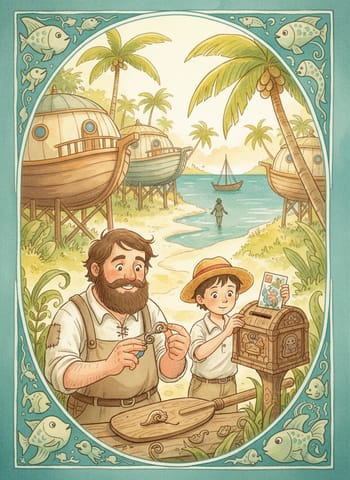
"There is a box," Osei said. "A wooden box on a post, on the north side. People leave things inside it. Letters, drawings, little stones."
"Tem uma caixa", disse Osei. "Uma caixa de madeira sobre um poste, no lado norte. As pessoas deixam coisas dentro dela. Cartas, desenhos, pedrinhas."
"I know the box. Tourists leave it full of rubbish."
"Conheço a caixa. Os turistas deixam ela cheia de lixo."
"I want to leave this." Osei held up the postcard. On the front, there was a picture of a mountain. "But I have a problem. Look at the back."
"Quero deixar isto." Osei ergueu o cartão-postal. Na frente, havia uma foto de uma montanha. "Mas tenho um problema. Olhe o verso."
Emre leaned in while the boat drifted. The card was filled with neat handwriting. At the top, where the address should have been, there was only a blank space.
Emre se inclinou enquanto o barco flutuava. O cartão estava cheio de uma letra caprichada. No alto, onde deveria estar o endereço, havia apenas um espaço em branco.
"You forgot to write the address," Emre said.
"Você esqueceu de escrever o endereço", disse Emre.
"No. There is none." Osei smiled for the first time. "It is a card for nobody. For whoever opens the box."
"Não. Não tem endereço." Osei sorriu pela primeira vez. "É um cartão para ninguém. Para quem abrir a caixa."
"That is a strange thing to do."
"Isso é uma coisa estranha de se fazer."
"I moved to this town three weeks ago," Osei said. "I do not know anybody here. My parents are busy, and my old friends are very far away. So I started to write cards to strangers. I leave one in each place I like."
"Eu me mudei para esta cidade três semanas atrás", disse Osei. "Não conheço ninguém aqui. Meus pais vivem ocupados, e meus amigos de antes estão muito longe. Então comecei a escrever cartões para desconhecidos. Deixo um em cada lugar de que gosto."
Emre said nothing for a while. He just rowed.
Emre não disse nada por um tempo. Só remou.
"How many have you left?" he asked.
"Quantos você já deixou?", perguntou.
"Four. A park bench, a library, a fence and a bridge. I never know if anyone reads them." Osei looked at the island. "That is why I chose the box. People open it on purpose."
"Quatro. Um banco de parque, uma biblioteca, uma cerca e uma ponte. Nunca sei se alguém lê." Osei olhou para a ilha. "Por isso escolhi a caixa. As pessoas abrem de propósito."
They reached the island at ten to six. Emre jumped out and pulled the boat onto the sand. The place was quiet, with tall reeds and one narrow path. At the end of the path stood a post with a small wooden box on top.
Chegaram à ilha às cinco e cinquenta. Emre pulou para fora e puxou o barco para a areia. O lugar era silencioso, com juncos altos e uma trilha estreita. No fim da trilha havia um poste com uma pequena caixa de madeira no alto.
Osei walked up to it and tried to open the lid. It did not move.
Osei foi até ela e tentou abrir a tampa. Não se mexeu.
"It is stuck," he said.
"Está emperrada", disse ele.
"The wood gets swollen in summer," Emre said. "Let me try."
"A madeira incha no verão", disse Emre. "Deixe-me tentar."
He pulled, and he pushed, and he knocked on the sides with his fist. Nothing happened. The time was going, and he could feel it in his chest. At last he took a key from his pocket. He slid it into the crack under the lid and pressed down.
Ele puxou, empurrou e bateu nas laterais com o punho. Nada aconteceu. O tempo estava passando, e ele sentia isso no peito. Por fim, tirou uma chave do bolso. Enfiou-a na fresta embaixo da tampa e fez pressão.
The lid opened with a loud crack.
A tampa se abriu com um estalo alto.
Inside, the box was full of folded paper, shells and a single faded ribbon. Osei looked at the contents for a long time. Then he laid his postcard on top, with the words facing up.
Dentro, a caixa estava cheia de papéis dobrados, conchas e uma única fita desbotada. Osei olhou o conteúdo por um longo tempo. Depois colocou o cartão-postal por cima, com as palavras viradas para cima.
"Will you read it first?" he asked.
"Você vai ler primeiro?", perguntou.
"It is not addressed to me," Emre said.
"Não é endereçado a mim", disse Emre.
"It is not addressed to anyone."
"Não é endereçado a ninguém."
Emre took the card and read it quickly, standing in the low gold light. It was short. It said that the writer was new here. It said the lake was the first thing he had loved in this town. It said that if the reader was also a stranger, they were not alone.
Emre pegou o cartão e o leu depressa, em pé na luz dourada e baixa. Era curto. Dizia que quem escreveu era novo ali. Dizia que o lago foi a primeira coisa de que ele gostou naquela cidade. Dizia que, se quem lesse também fosse um desconhecido, não estava sozinho.
He read it twice. When he looked up, Osei was watching the water.
Ele leu duas vezes. Quando levantou os olhos, Osei olhava a água.
"I wrote it this morning," Osei said. "When I first saw the lake."
"Escrevi hoje de manhã", disse Osei. "Quando vi o lago pela primeira vez."
"You did not know who would read it."
"Você não sabia quem iria ler."
"No," Osei said. "That is why I left the address empty."
"Não", disse Osei. "Por isso deixei o endereço em branco."
Emre looked at the box again. He was glad that he was the first reader.
Emre olhou a caixa de novo. Estava feliz por ser o primeiro leitor.
Emre put the card back in the box, and he closed the lid carefully. They walked down to the boat without speaking. The sun was almost on the water by then, and the lake was the colour of copper.
Emre colocou o cartão de volta na caixa e fechou a tampa com cuidado. Desceram até o barco sem falar. O sol já estava quase na água, e o lago tinha a cor do cobre.
On the way back, Emre rowed harder than he had ever rowed before. The plastic ties held. They reached the dock at four minutes past six. A cyclist on the shore waved, as if they had returned from a long journey.
Na volta, Emre remou com mais força do que nunca. As abraçadeiras aguentaram. Chegaram ao cais às seis e quatro. Um ciclista na margem acenou, como se tivessem voltado de uma longa viagem.
Emre tied the boat to its post and locked the hut. Osei waited next to him with his backpack in both hands.
Emre amarrou o barco ao poste e trancou o galpão. Osei esperou ao lado dele, com a mochila nas duas mãos.
"I broke your rule," Emre said. "I was late by four minutes."
"Quebrei sua regra", disse Emre. "Atrasei quatro minutos."
"I am sorry."
"Desculpe."
"Don't be. I never take the best hour for myself." Emre looked at the lake, then at the boy. "Do you have another card in that bag?"
"Não precisa. Eu nunca fico com a melhor hora para mim." Emre olhou para o lago, depois para o garoto. "Você tem outro cartão nessa mochila?"
"I have six," Osei said.
"Tenho seis", disse Osei.
Emre held out his hand. "Can I borrow a pen? I want to know what you write when you are not a stranger any more."
Emre estendeu a mão. "Posso pegar uma caneta emprestada? Quero saber o que você escreve quando não é mais um desconhecido."
Osei took out a pen. "I do not know yet," he said. "What would you write?"
Osei tirou uma caneta. "Ainda não sei", disse. "O que você escreveria?"