The Oar Pin and the Island Box
Một truyện tiếng Anh miễn phí trình độ B1 cho người học, đọc trực tuyến bằng 7 ngôn ngữ, có thể nghe qua ứng dụng Storyteller miễn phí.
A boat-hut worker fixes a broken oar so a newcomer can leave a postcard for a stranger on the island.
Hết phần nghe thử! Nghe trọn truyện trong ứng dụng Storyteller miễn phí. Tải app
Hiện chưa thể phát audio.
The boat hut on Lake Verne had only one rule that Emre cared about. Every boat had to be back before six o'clock. After that, he locked the door, counted the money and cycled home along the shore.
Nhà thuyền ở hồ Verne chỉ có một quy tắc mà Emre quan tâm. Mọi chiếc thuyền phải về trước sáu giờ. Sau đó, anh khóa cửa, đếm tiền và đạp xe về nhà dọc bờ hồ.
It was twenty past five when the boy walked in. He was about Emre's age, thin and tall, with a backpack on one shoulder. In his hand, he held a postcard against his chest as if it might fly away.
Lúc đó là năm giờ hai mươi khi cậu bé bước vào. Cậu trạc tuổi Emre, gầy và cao, đeo ba lô trên một vai. Trong tay, cậu ép một tấm bưu thiếp vào ngực như sợ nó sẽ bay mất.
"Are you still renting boats?" he asked.
"Anh vẫn còn cho thuê thuyền chứ?" cậu hỏi.
"For forty more minutes," Emre said. "Then I lock up. Where do you want to go?"
"Bốn mươi phút nữa," Emre nói. "Sau đó tôi khóa cửa. Cậu muốn đi đâu?"
"To the island." The boy pointed through the window at the small green shape in the middle of the lake. "My name is Osei. I only need ten minutes there."
"Ra đảo." Cậu bé chỉ qua cửa sổ về cái bóng xanh nhỏ giữa hồ. "Tôi tên là Osei. Tôi chỉ cần mười phút ở đó."
Emre looked at the clock above the door. Then he looked at the water. The surface was smooth and gold, and the lake was almost empty. It was the best hour of the day, and he had never once taken it for himself.
Emre nhìn đồng hồ phía trên cửa. Rồi anh nhìn mặt nước. Mặt hồ phẳng lặng và vàng óng, và gần như không có ai. Đó là giờ đẹp nhất trong ngày, và anh chưa bao giờ giữ nó cho riêng mình.
"The trip takes twenty minutes each way," he said. "If you row well."
"Mỗi chiều đi mất hai mươi phút," anh nói. "Nếu cậu chèo giỏi."
"I row very well," Osei said.
"Tôi chèo rất giỏi," Osei nói.
That turned out to be false. Emre understood it ten seconds later. Osei tried to sit in the first boat and nearly fell into the water. He caught the boy by the sleeve and pulled him back onto the dock.
Hóa ra điều đó không đúng. Emre hiểu ra mười giây sau. Osei định ngồi vào chiếc thuyền đầu tiên và suýt ngã xuống nước. Anh nắm tay áo cậu và kéo cậu lên lại bến.
"Maybe I row a little," Osei admitted.
"Có lẽ tôi chèo được chút ít," Osei thừa nhận.
"Then I will come with you," Emre said. "The rule says beginners must have a guide, and I would like my boats to return."
"Vậy tôi sẽ đi cùng cậu," Emre nói. "Quy tắc bảo người mới phải có người hướng dẫn, và tôi muốn thuyền của mình trở về."
They chose the only boat left on the rack. It was a blue wooden rowboat with the number six painted on the side. Emre slid it into the water, and Osei climbed in carefully. When Emre fitted the first oar into its holder, the oar slipped out and splashed into the lake.
Họ chọn chiếc thuyền duy nhất còn lại trên giá. Đó là một chiếc thuyền chèo gỗ màu xanh, bên hông sơn số sáu. Emre đẩy nó xuống nước, và Osei cẩn thận trèo vào. Khi Emre lắp chiếc mái chèo đầu tiên vào giá, mái chèo tuột ra và rơi tõm xuống hồ.
"That is strange," Emre said.
"Lạ thật," Emre nói.
He pulled the oar back in and checked the metal holder. A small pin was missing from the top, the one that keeps the oar in place. Without it, every stroke would throw the oar out sideways.
Anh kéo mái chèo lên và kiểm tra giá kim loại. Một chiếc chốt nhỏ ở phía trên bị mất, cái chốt giữ mái chèo tại chỗ. Thiếu nó, mỗi nhịp chèo sẽ làm mái chèo văng sang một bên.
"Is it broken?" Osei asked.
"Nó hỏng à?" Osei hỏi.
"It is missing. Someone probably lost it last week." Emre sighed. He glanced at the clock inside the hut. It was now twenty-five past five. "I have more pins in the shed, but the shed key is in my other jacket at home."
"Nó bị mất. Chắc tuần trước có ai làm rơi." Emre thở dài. Anh liếc đồng hồ trong nhà thuyền. Giờ đã là năm giờ hai mươi lăm. "Tôi có thêm chốt trong kho, nhưng chìa khóa kho nằm trong áo khoác kia ở nhà."
"Then we cannot go."
"Vậy chúng ta không đi được rồi."
"I did not say that."
"Tôi đâu có nói thế."
Emre stood on the dock with his hands on his hips. He thought about the toolbox in the hut. He remembered a drawer full of old bolts, nails and zip ties. Then he ran inside and came back with a handful of long plastic ties.
Emre đứng trên bến, hai tay chống hông. Anh nghĩ đến hộp dụng cụ trong nhà thuyền. Anh nhớ ra một ngăn kéo đầy bu lông, đinh và dây rút cũ. Rồi anh chạy vào trong và quay ra với một nắm dây rút nhựa dài.
"What are those for?" Osei asked.
"Mấy cái đó để làm gì?" Osei hỏi.
"For a lesson in boat repair," Emre said. "Hold the oar."
"Cho một bài học sửa thuyền," Emre nói. "Giữ mái chèo nhé."
He pushed a tie through the hole where the pin had been and pulled it round the oar. He added a second tie, and then a third. Soon the oar sat firmly in its holder. He tested it with a hard pull. The oar did not move.
Anh luồn một sợi dây qua lỗ chỗ chiếc chốt từng nằm và kéo vòng quanh mái chèo. Anh thêm sợi thứ hai, rồi sợi thứ ba. Chẳng mấy chốc mái chèo nằm chắc trong giá. Anh thử bằng một cú kéo mạnh. Mái chèo không nhúc nhích.
"It is not beautiful," he said, "but it is safe. Let's go."
"Không đẹp," anh nói, "nhưng an toàn. Đi thôi."
They left the dock at half past five. Emre rowed, and Osei sat in the back with the postcard on his knees. Behind them, the town got smaller. Ahead, the island grew.
Họ rời bến lúc năm rưỡi. Emre chèo, còn Osei ngồi phía sau với tấm bưu thiếp trên đầu gối. Phía sau họ, thị trấn nhỏ dần. Phía trước, hòn đảo lớn lên.
"You never told me why you must go there," Emre said.
"Cậu chưa nói cho tôi biết vì sao cậu phải ra đó," Emre nói.
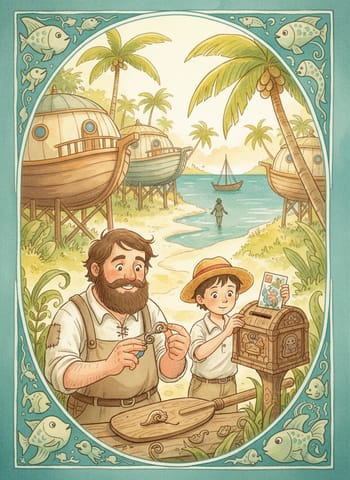
"There is a box," Osei said. "A wooden box on a post, on the north side. People leave things inside it. Letters, drawings, little stones."
"Có một cái hộp," Osei nói. "Một cái hộp gỗ trên cột, ở phía bắc. Người ta để đồ vào trong đó. Thư, tranh vẽ, những viên đá nhỏ."
"I know the box. Tourists leave it full of rubbish."
"Tôi biết cái hộp đó. Khách du lịch hay nhét đầy rác vào."
"I want to leave this." Osei held up the postcard. On the front, there was a picture of a mountain. "But I have a problem. Look at the back."
"Tôi muốn để cái này vào." Osei giơ tấm bưu thiếp lên. Mặt trước có hình một ngọn núi. "Nhưng tôi có một vấn đề. Anh nhìn mặt sau đi."
Emre leaned in while the boat drifted. The card was filled with neat handwriting. At the top, where the address should have been, there was only a blank space.
Emre nghiêng người trong khi thuyền trôi. Tấm thiếp kín những nét chữ ngay ngắn. Ở phía trên, chỗ lẽ ra phải ghi địa chỉ, chỉ có một khoảng trống.
"You forgot to write the address," Emre said.
"Cậu quên viết địa chỉ rồi," Emre nói.
"No. There is none." Osei smiled for the first time. "It is a card for nobody. For whoever opens the box."
"Không. Không có địa chỉ nào cả." Osei lần đầu mỉm cười. "Đó là tấm thiếp gửi cho không ai cả. Cho bất cứ ai mở cái hộp."
"That is a strange thing to do."
"Làm vậy lạ thật."
"I moved to this town three weeks ago," Osei said. "I do not know anybody here. My parents are busy, and my old friends are very far away. So I started to write cards to strangers. I leave one in each place I like."
"Tôi chuyển đến thị trấn này ba tuần trước," Osei nói. "Tôi không quen ai ở đây. Bố mẹ tôi bận, còn bạn cũ của tôi thì ở rất xa. Nên tôi bắt đầu viết thiếp cho người lạ. Tôi để lại một tấm ở mỗi nơi tôi thích."
Emre said nothing for a while. He just rowed.
Emre không nói gì một lúc. Anh chỉ chèo.
"How many have you left?" he asked.
"Cậu đã để lại bao nhiêu tấm rồi?" anh hỏi.
"Four. A park bench, a library, a fence and a bridge. I never know if anyone reads them." Osei looked at the island. "That is why I chose the box. People open it on purpose."
"Bốn. Một chiếc ghế công viên, một thư viện, một hàng rào và một cây cầu. Tôi chẳng bao giờ biết có ai đọc không." Osei nhìn hòn đảo. "Vì thế tôi chọn cái hộp. Người ta mở nó có chủ đích."
They reached the island at ten to six. Emre jumped out and pulled the boat onto the sand. The place was quiet, with tall reeds and one narrow path. At the end of the path stood a post with a small wooden box on top.
Họ đến đảo lúc sáu giờ kém mười. Emre nhảy xuống và kéo thuyền lên bãi cát. Nơi này yên tĩnh, với những đám lau sậy cao và một con đường mòn hẹp. Ở cuối đường có một cây cột với một chiếc hộp gỗ nhỏ đặt trên đỉnh.
Osei walked up to it and tried to open the lid. It did not move.
Osei bước đến và thử mở nắp. Nó không nhúc nhích.
"It is stuck," he said.
"Nó bị kẹt," cậu nói.
"The wood gets swollen in summer," Emre said. "Let me try."
"Gỗ phồng lên vào mùa hè," Emre nói. "Để tôi thử."
He pulled, and he pushed, and he knocked on the sides with his fist. Nothing happened. The time was going, and he could feel it in his chest. At last he took a key from his pocket. He slid it into the crack under the lid and pressed down.
Anh kéo, anh đẩy, anh gõ vào hai bên hộp bằng nắm tay. Chẳng có gì xảy ra. Thời gian đang trôi, và anh cảm thấy nó trong lồng ngực. Cuối cùng anh lấy một chiếc chìa khóa trong túi. Anh luồn nó vào khe dưới nắp và ấn xuống.
The lid opened with a loud crack.
Nắp hộp bật mở với một tiếng rắc lớn.
Inside, the box was full of folded paper, shells and a single faded ribbon. Osei looked at the contents for a long time. Then he laid his postcard on top, with the words facing up.
Bên trong, chiếc hộp đầy giấy gấp, vỏ sò và một dải ruy băng bạc màu. Osei nhìn những thứ bên trong thật lâu. Rồi cậu đặt tấm bưu thiếp lên trên cùng, mặt chữ hướng lên.
"Will you read it first?" he asked.
"Anh đọc nó trước nhé?" cậu hỏi.
"It is not addressed to me," Emre said.
"Nó không gửi cho tôi," Emre nói.
"It is not addressed to anyone."
"Nó không gửi cho ai cả."
Emre took the card and read it quickly, standing in the low gold light. It was short. It said that the writer was new here. It said the lake was the first thing he had loved in this town. It said that if the reader was also a stranger, they were not alone.
Emre cầm tấm thiếp và đọc nhanh, đứng trong ánh nắng vàng thấp. Nó ngắn. Nó nói rằng người viết là người mới đến đây. Nó nói rằng hồ là điều đầu tiên cậu yêu ở thị trấn này. Nó nói rằng nếu người đọc cũng là một người lạ, thì họ không đơn độc.
He read it twice. When he looked up, Osei was watching the water.
Anh đọc hai lần. Khi ngẩng lên, Osei đang nhìn mặt nước.
"I wrote it this morning," Osei said. "When I first saw the lake."
"Tôi viết nó sáng nay," Osei nói. "Khi tôi lần đầu thấy cái hồ."
"You did not know who would read it."
"Cậu không biết ai sẽ đọc."
"No," Osei said. "That is why I left the address empty."
"Không," Osei nói. "Vì thế tôi để trống địa chỉ."
Emre looked at the box again. He was glad that he was the first reader.
Emre nhìn cái hộp thêm lần nữa. Anh vui vì mình là người đọc đầu tiên.
Emre put the card back in the box, and he closed the lid carefully. They walked down to the boat without speaking. The sun was almost on the water by then, and the lake was the colour of copper.
Emre đặt tấm thiếp lại vào hộp và cẩn thận đóng nắp. Họ đi xuống chỗ thuyền mà không nói gì. Lúc đó mặt trời gần chạm mặt nước, và hồ có màu đồng.
On the way back, Emre rowed harder than he had ever rowed before. The plastic ties held. They reached the dock at four minutes past six. A cyclist on the shore waved, as if they had returned from a long journey.
Trên đường về, Emre chèo mạnh hơn bao giờ hết. Những sợi dây nhựa vẫn giữ chắc. Họ đến bến lúc sáu giờ bốn phút. Một người đi xe đạp trên bờ vẫy tay, như thể họ vừa trở về sau một chuyến đi dài.
Emre tied the boat to its post and locked the hut. Osei waited next to him with his backpack in both hands.
Emre buộc thuyền vào cột và khóa nhà thuyền. Osei đứng chờ bên cạnh với chiếc ba lô trong hai tay.
"I broke your rule," Emre said. "I was late by four minutes."
"Tôi đã phá quy tắc của mình," Emre nói. "Tôi trễ bốn phút."
"I am sorry."
"Tôi xin lỗi."
"Don't be. I never take the best hour for myself." Emre looked at the lake, then at the boy. "Do you have another card in that bag?"
"Đừng. Tôi chưa bao giờ giữ giờ đẹp nhất cho riêng mình." Emre nhìn hồ, rồi nhìn cậu bé. "Cậu còn tấm thiếp nào trong túi không?"
"I have six," Osei said.
"Tôi còn sáu tấm," Osei nói.
Emre held out his hand. "Can I borrow a pen? I want to know what you write when you are not a stranger any more."
Emre chìa tay ra. "Cho tôi mượn một cây bút được không? Tôi muốn biết cậu sẽ viết gì khi cậu không còn là người lạ nữa."
Osei took out a pen. "I do not know yet," he said. "What would you write?"
Osei lấy ra một cây bút. "Tôi chưa biết," cậu nói. "Còn anh sẽ viết gì?"