The Oar Pin and the Island Box
Una historia gratuita en inglés de nivel B1 para estudiantes, para leer en línea en 7 idiomas, con opción de escucharla en la app gratuita Storyteller.
A boat-hut worker fixes a broken oar so a newcomer can leave a postcard for a stranger on the island.
¡Ese fue el avance! Escucha la historia completa en la app gratuita Storyteller. Descargar la app
El audio no está disponible en este momento.
The boat hut on Lake Verne had only one rule that Emre cared about. Every boat had to be back before six o'clock. After that, he locked the door, counted the money and cycled home along the shore.
La caseta de botes del lago Verne tenía una sola regla que a Emre le importaba. Todos los botes debían estar de vuelta antes de las seis. Después, cerraba la puerta, contaba el dinero y regresaba a casa en bicicleta por la orilla.
It was twenty past five when the boy walked in. He was about Emre's age, thin and tall, with a backpack on one shoulder. In his hand, he held a postcard against his chest as if it might fly away.
Eran las cinco y veinte cuando el chico entró. Tenía más o menos la edad de Emre, flaco y alto, con una mochila en un hombro. En la mano sostenía una postal contra el pecho como si pudiera salir volando.
"Are you still renting boats?" he asked.
«¿Todavía alquilan botes?», preguntó.
"For forty more minutes," Emre said. "Then I lock up. Where do you want to go?"
«Cuarenta minutos más», dijo Emre. «Luego cierro. ¿A dónde quieres ir?»
"To the island." The boy pointed through the window at the small green shape in the middle of the lake. "My name is Osei. I only need ten minutes there."
«A la isla». El chico señaló por la ventana la pequeña silueta verde en medio del lago. «Me llamo Osei. Solo necesito diez minutos allí».
Emre looked at the clock above the door. Then he looked at the water. The surface was smooth and gold, and the lake was almost empty. It was the best hour of the day, and he had never once taken it for himself.
Emre miró el reloj sobre la puerta. Luego miró el agua. La superficie estaba lisa y dorada, y el lago casi vacío. Era la mejor hora del día, y nunca la había tomado para sí ni una sola vez.
"The trip takes twenty minutes each way," he said. "If you row well."
«El viaje toma veinte minutos de ida», dijo. «Si remas bien».
"I row very well," Osei said.
«Remo muy bien», dijo Osei.
That turned out to be false. Emre understood it ten seconds later. Osei tried to sit in the first boat and nearly fell into the water. He caught the boy by the sleeve and pulled him back onto the dock.
Resultó que eso era falso. Emre lo entendió diez segundos después. Osei intentó sentarse en el primer bote y casi cayó al agua. Emre lo atrapó de la manga y lo jaló de vuelta al muelle.
"Maybe I row a little," Osei admitted.
«Quizá remo un poco», admitió Osei.
"Then I will come with you," Emre said. "The rule says beginners must have a guide, and I would like my boats to return."
«Entonces iré contigo», dijo Emre. «La regla dice que los principiantes deben llevar un guía, y me gustaría que mis botes regresaran».
They chose the only boat left on the rack. It was a blue wooden rowboat with the number six painted on the side. Emre slid it into the water, and Osei climbed in carefully. When Emre fitted the first oar into its holder, the oar slipped out and splashed into the lake.
Eligieron el único bote que quedaba en el soporte. Era un bote de remos de madera azul con el número seis pintado en el costado. Emre lo deslizó al agua, y Osei subió con cuidado. Cuando Emre colocó el primer remo en su soporte, el remo se salió y cayó chapoteando al lago.
"That is strange," Emre said.
«Qué raro», dijo Emre.
He pulled the oar back in and checked the metal holder. A small pin was missing from the top, the one that keeps the oar in place. Without it, every stroke would throw the oar out sideways.
Volvió a sacar el remo y revisó el soporte de metal. Faltaba un pequeño pasador en la parte de arriba, el que mantiene el remo en su lugar. Sin él, cada remada lanzaría el remo hacia un lado.
"Is it broken?" Osei asked.
«¿Está roto?», preguntó Osei.
"It is missing. Someone probably lost it last week." Emre sighed. He glanced at the clock inside the hut. It was now twenty-five past five. "I have more pins in the shed, but the shed key is in my other jacket at home."
«Falta. Seguramente alguien lo perdió la semana pasada». Emre suspiró. Miró de reojo el reloj dentro de la caseta. Ya eran las cinco y veinticinco. «Tengo más pasadores en el cobertizo, pero la llave del cobertizo está en mi otra chaqueta, en casa».
"Then we cannot go."
«Entonces no podemos ir».
"I did not say that."
«No dije eso».
Emre stood on the dock with his hands on his hips. He thought about the toolbox in the hut. He remembered a drawer full of old bolts, nails and zip ties. Then he ran inside and came back with a handful of long plastic ties.
Emre se paró en el muelle con las manos en la cintura. Pensó en la caja de herramientas de la caseta. Recordó un cajón lleno de pernos, clavos y bridas. Luego corrió adentro y volvió con un puñado de largas bridas de plástico.
"What are those for?" Osei asked.
«¿Para qué son?», preguntó Osei.
"For a lesson in boat repair," Emre said. "Hold the oar."
«Para una lección de reparación de botes», dijo Emre. «Sostén el remo».
He pushed a tie through the hole where the pin had been and pulled it round the oar. He added a second tie, and then a third. Soon the oar sat firmly in its holder. He tested it with a hard pull. The oar did not move.
Pasó una brida por el agujero donde había estado el pasador y la jaló alrededor del remo. Puso una segunda brida, y luego una tercera. Pronto el remo quedó firme en su soporte. Lo probó con un tirón fuerte. El remo no se movió.
"It is not beautiful," he said, "but it is safe. Let's go."
«No es bonito», dijo, «pero es seguro. Vamos».
They left the dock at half past five. Emre rowed, and Osei sat in the back with the postcard on his knees. Behind them, the town got smaller. Ahead, the island grew.
Dejaron el muelle a las cinco y media. Emre remaba, y Osei iba sentado atrás con la postal sobre las rodillas. Detrás de ellos, el pueblo se hacía más pequeño. Adelante, la isla crecía.
"You never told me why you must go there," Emre said.
«No me has dicho por qué debes ir allí», dijo Emre.
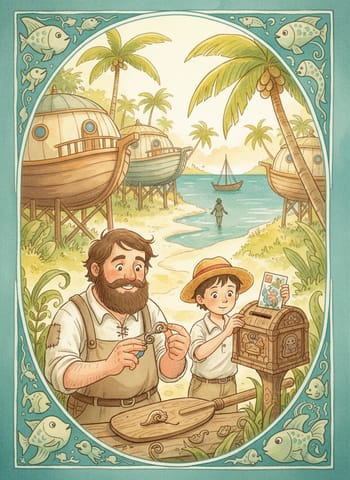
"There is a box," Osei said. "A wooden box on a post, on the north side. People leave things inside it. Letters, drawings, little stones."
«Hay una caja», dijo Osei. «Una caja de madera sobre un poste, en el lado norte. La gente deja cosas adentro. Cartas, dibujos, piedritas».
"I know the box. Tourists leave it full of rubbish."
«Conozco la caja. Los turistas la dejan llena de basura».
"I want to leave this." Osei held up the postcard. On the front, there was a picture of a mountain. "But I have a problem. Look at the back."
«Quiero dejar esto». Osei levantó la postal. Al frente había una imagen de una montaña. «Pero tengo un problema. Mira el reverso».
Emre leaned in while the boat drifted. The card was filled with neat handwriting. At the top, where the address should have been, there was only a blank space.
Emre se inclinó mientras el bote iba a la deriva. La tarjeta estaba llena de una letra prolija. Arriba, donde debía ir la dirección, solo había un espacio en blanco.
"You forgot to write the address," Emre said.
«Olvidaste escribir la dirección», dijo Emre.
"No. There is none." Osei smiled for the first time. "It is a card for nobody. For whoever opens the box."
«No. No hay ninguna». Osei sonrió por primera vez. «Es una tarjeta para nadie. Para quien abra la caja».
"That is a strange thing to do."
«Es una cosa extraña de hacer».
"I moved to this town three weeks ago," Osei said. "I do not know anybody here. My parents are busy, and my old friends are very far away. So I started to write cards to strangers. I leave one in each place I like."
«Me mudé a este pueblo hace tres semanas», dijo Osei. «No conozco a nadie aquí. Mis padres están ocupados, y mis viejos amigos están muy lejos. Así que empecé a escribir tarjetas a desconocidos. Dejo una en cada lugar que me gusta».
Emre said nothing for a while. He just rowed.
Emre no dijo nada por un rato. Solo remó.
"How many have you left?" he asked.
«¿Cuántas has dejado?», preguntó.
"Four. A park bench, a library, a fence and a bridge. I never know if anyone reads them." Osei looked at the island. "That is why I chose the box. People open it on purpose."
«Cuatro. Una banca de un parque, una biblioteca, una cerca y un puente. Nunca sé si alguien las lee». Osei miró la isla. «Por eso elegí la caja. La gente la abre a propósito».
They reached the island at ten to six. Emre jumped out and pulled the boat onto the sand. The place was quiet, with tall reeds and one narrow path. At the end of the path stood a post with a small wooden box on top.
Llegaron a la isla a las seis menos diez. Emre saltó y arrastró el bote sobre la arena. El lugar estaba tranquilo, con juncos altos y un solo sendero angosto. Al final del sendero había un poste con una cajita de madera encima.
Osei walked up to it and tried to open the lid. It did not move.
Osei caminó hasta ella y trató de abrir la tapa. No se movió.
"It is stuck," he said.
«Está atascada», dijo.
"The wood gets swollen in summer," Emre said. "Let me try."
«La madera se hincha en verano», dijo Emre. «Déjame probar».
He pulled, and he pushed, and he knocked on the sides with his fist. Nothing happened. The time was going, and he could feel it in his chest. At last he took a key from his pocket. He slid it into the crack under the lid and pressed down.
Jaló, empujó y golpeó los costados con el puño. No pasó nada. El tiempo se iba, y lo sentía en el pecho. Por fin sacó una llave de su bolsillo. La deslizó en la rendija bajo la tapa y presionó hacia abajo.
The lid opened with a loud crack.
La tapa se abrió con un fuerte crujido.
Inside, the box was full of folded paper, shells and a single faded ribbon. Osei looked at the contents for a long time. Then he laid his postcard on top, with the words facing up.
Adentro, la caja estaba llena de papeles doblados, conchas y una sola cinta desteñida. Osei miró el contenido durante mucho rato. Luego puso su postal encima, con las palabras hacia arriba.
"Will you read it first?" he asked.
«¿La leerás primero?», preguntó.
"It is not addressed to me," Emre said.
«No está dirigida a mí», dijo Emre.
"It is not addressed to anyone."
«No está dirigida a nadie».
Emre took the card and read it quickly, standing in the low gold light. It was short. It said that the writer was new here. It said the lake was the first thing he had loved in this town. It said that if the reader was also a stranger, they were not alone.
Emre tomó la tarjeta y la leyó rápido, de pie en la baja luz dorada. Era corta. Decía que quien la escribía era nuevo aquí. Decía que el lago era lo primero que había amado en este pueblo. Decía que si quien la leía también era un extraño, no estaba solo.
He read it twice. When he looked up, Osei was watching the water.
La leyó dos veces. Cuando levantó la vista, Osei miraba el agua.
"I wrote it this morning," Osei said. "When I first saw the lake."
«La escribí esta mañana», dijo Osei. «Cuando vi el lago por primera vez».
"You did not know who would read it."
«No sabías quién la leería».
"No," Osei said. "That is why I left the address empty."
«No», dijo Osei. «Por eso dejé vacía la dirección».
Emre looked at the box again. He was glad that he was the first reader.
Emre volvió a mirar la caja. Se alegró de ser el primer lector.
Emre put the card back in the box, and he closed the lid carefully. They walked down to the boat without speaking. The sun was almost on the water by then, and the lake was the colour of copper.
Emre puso la tarjeta de vuelta en la caja y cerró la tapa con cuidado. Bajaron al bote sin hablar. El sol estaba casi sobre el agua para entonces, y el lago tenía el color del cobre.
On the way back, Emre rowed harder than he had ever rowed before. The plastic ties held. They reached the dock at four minutes past six. A cyclist on the shore waved, as if they had returned from a long journey.
En el camino de regreso, Emre remó más fuerte de lo que había remado jamás. Las bridas de plástico aguantaron. Llegaron al muelle a las seis y cuatro. Un ciclista en la orilla los saludó, como si hubieran vuelto de un largo viaje.
Emre tied the boat to its post and locked the hut. Osei waited next to him with his backpack in both hands.
Emre amarró el bote a su poste y cerró la caseta. Osei esperaba a su lado con la mochila en ambas manos.
"I broke your rule," Emre said. "I was late by four minutes."
«Rompí tu regla», dijo Emre. «Me retrasé cuatro minutos».
"I am sorry."
«Lo siento».
"Don't be. I never take the best hour for myself." Emre looked at the lake, then at the boy. "Do you have another card in that bag?"
«No lo sientas. Yo nunca me quedo con la mejor hora para mí». Emre miró el lago, luego al chico. «¿Tienes otra tarjeta en esa mochila?»
"I have six," Osei said.
«Tengo seis», dijo Osei.
Emre held out his hand. "Can I borrow a pen? I want to know what you write when you are not a stranger any more."
Emre extendió la mano. «¿Puedo pedirte prestada una pluma? Quiero saber qué escribes cuando ya no eres un extraño».
Osei took out a pen. "I do not know yet," he said. "What would you write?"
Osei sacó una pluma. «Todavía no lo sé», dijo. «¿Tú qué escribirías?»