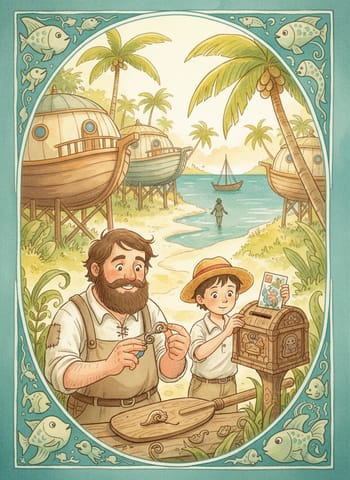
The Oar Pin and the Island Box
Cerita bahasa Inggris gratis level B1 untuk pelajar, bisa dibaca online dalam 7 bahasa, dengan pilihan untuk mendengarkannya di aplikasi Storyteller gratis.
A boat-hut worker fixes a broken oar so a newcomer can leave a postcard for a stranger on the island.
Itu cuplikannya! Dengarkan cerita lengkapnya di aplikasi Storyteller gratis. Unduh aplikasi
Audio belum tersedia saat ini.
The boat hut on Lake Verne had only one rule that Emre cared about. Every boat had to be back before six o'clock. After that, he locked the door, counted the money and cycled home along the shore.
Pondok perahu di Danau Verne hanya punya satu aturan yang dipedulikan Emre. Setiap perahu harus sudah kembali sebelum pukul enam. Setelah itu, ia mengunci pintu, menghitung uang, dan bersepeda pulang menyusuri tepi danau.
It was twenty past five when the boy walked in. He was about Emre's age, thin and tall, with a backpack on one shoulder. In his hand, he held a postcard against his chest as if it might fly away.
Saat itu pukul lima lewat dua puluh ketika anak laki-laki itu masuk. Usianya sebaya dengan Emre, kurus dan tinggi, dengan ransel di satu bahu. Di tangannya, ia memegang sebuah kartu pos di dadanya seolah-olah kartu itu bisa terbang.
"Are you still renting boats?" he asked.
"Apakah Anda masih menyewakan perahu?" tanyanya.
"For forty more minutes," Emre said. "Then I lock up. Where do you want to go?"
"Empat puluh menit lagi," kata Emre. "Setelah itu aku tutup. Kamu mau ke mana?"
"To the island." The boy pointed through the window at the small green shape in the middle of the lake. "My name is Osei. I only need ten minutes there."
"Ke pulau." Anak itu menunjuk lewat jendela ke bentuk hijau kecil di tengah danau. "Namaku Osei. Aku hanya butuh sepuluh menit di sana."
Emre looked at the clock above the door. Then he looked at the water. The surface was smooth and gold, and the lake was almost empty. It was the best hour of the day, and he had never once taken it for himself.
Emre melihat jam di atas pintu. Lalu ia melihat air. Permukaannya halus dan keemasan, dan danau hampir kosong. Itu jam terbaik dalam sehari, dan ia belum pernah sekali pun mengambilnya untuk dirinya sendiri.
"The trip takes twenty minutes each way," he said. "If you row well."
"Perjalanannya dua puluh menit sekali jalan," katanya. "Kalau kamu pandai mendayung."
"I row very well," Osei said.
"Aku sangat pandai mendayung," kata Osei.
That turned out to be false. Emre understood it ten seconds later. Osei tried to sit in the first boat and nearly fell into the water. He caught the boy by the sleeve and pulled him back onto the dock.
Ternyata itu tidak benar. Emre menyadarinya sepuluh detik kemudian. Osei mencoba duduk di perahu pertama dan hampir jatuh ke air. Emre menangkap lengan bajunya dan menariknya kembali ke dermaga.
"Maybe I row a little," Osei admitted.
"Mungkin aku bisa mendayung sedikit," Osei mengaku.
"Then I will come with you," Emre said. "The rule says beginners must have a guide, and I would like my boats to return."
"Kalau begitu aku ikut denganmu," kata Emre. "Aturannya, pemula harus ditemani pemandu, dan aku ingin perahuku kembali."
They chose the only boat left on the rack. It was a blue wooden rowboat with the number six painted on the side. Emre slid it into the water, and Osei climbed in carefully. When Emre fitted the first oar into its holder, the oar slipped out and splashed into the lake.
Mereka memilih satu-satunya perahu yang tersisa di rak. Perahu dayung kayu biru dengan angka enam dicat di sisinya. Emre mendorongnya ke air, dan Osei naik dengan hati-hati. Ketika Emre memasang dayung pertama ke dudukannya, dayung itu terlepas dan tercebur ke danau.
"That is strange," Emre said.
"Aneh," kata Emre.
He pulled the oar back in and checked the metal holder. A small pin was missing from the top, the one that keeps the oar in place. Without it, every stroke would throw the oar out sideways.
Ia menarik dayung itu kembali dan memeriksa dudukan logamnya. Sebuah pin kecil hilang dari bagian atas, pin yang menahan dayung di tempatnya. Tanpa itu, setiap kayuhan akan melempar dayung ke samping.
"Is it broken?" Osei asked.
"Rusak?" tanya Osei.
"It is missing. Someone probably lost it last week." Emre sighed. He glanced at the clock inside the hut. It was now twenty-five past five. "I have more pins in the shed, but the shed key is in my other jacket at home."
"Hilang. Mungkin seseorang menghilangkannya minggu lalu." Emre mendesah. Ia melirik jam di dalam pondok. Sekarang pukul lima lewat dua puluh lima. "Aku punya pin lain di gudang, tapi kunci gudangnya ada di jaketku yang satu lagi di rumah."
"Then we cannot go."
"Kalau begitu kita tidak bisa pergi."
"I did not say that."
"Aku tidak bilang begitu."
Emre stood on the dock with his hands on his hips. He thought about the toolbox in the hut. He remembered a drawer full of old bolts, nails and zip ties. Then he ran inside and came back with a handful of long plastic ties.
Emre berdiri di dermaga sambil bertolak pinggang. Ia memikirkan kotak perkakas di pondok. Ia ingat ada laci penuh baut, paku, dan kabel pengikat tua. Lalu ia berlari masuk dan kembali dengan segenggam kabel pengikat plastik yang panjang.
"What are those for?" Osei asked.
"Itu untuk apa?" tanya Osei.
"For a lesson in boat repair," Emre said. "Hold the oar."
"Untuk pelajaran memperbaiki perahu," kata Emre. "Pegang dayungnya."
He pushed a tie through the hole where the pin had been and pulled it round the oar. He added a second tie, and then a third. Soon the oar sat firmly in its holder. He tested it with a hard pull. The oar did not move.
Ia menyelipkan satu kabel pengikat melalui lubang tempat pin tadi berada dan menariknya melingkari dayung. Ia menambahkan yang kedua, lalu yang ketiga. Segera dayung itu duduk kokoh di dudukannya. Ia mengujinya dengan tarikan keras. Dayung itu tidak bergerak.
"It is not beautiful," he said, "but it is safe. Let's go."
"Memang tidak indah," katanya, "tapi aman. Ayo berangkat."
They left the dock at half past five. Emre rowed, and Osei sat in the back with the postcard on his knees. Behind them, the town got smaller. Ahead, the island grew.
Mereka meninggalkan dermaga pukul setengah enam. Emre mendayung, dan Osei duduk di belakang dengan kartu pos di lututnya. Di belakang mereka, kota semakin kecil. Di depan, pulau semakin besar.
"You never told me why you must go there," Emre said.
"Kamu belum cerita kenapa kamu harus ke sana," kata Emre.
"There is a box," Osei said. "A wooden box on a post, on the north side. People leave things inside it. Letters, drawings, little stones."
"Ada sebuah kotak," kata Osei. "Kotak kayu di atas tiang, di sisi utara. Orang-orang meninggalkan benda-benda di dalamnya. Surat, gambar, batu kecil."
"I know the box. Tourists leave it full of rubbish."
"Aku tahu kotak itu. Para turis membiarkannya penuh sampah."
"I want to leave this." Osei held up the postcard. On the front, there was a picture of a mountain. "But I have a problem. Look at the back."
"Aku ingin meninggalkan ini." Osei mengangkat kartu pos itu. Di depannya ada gambar sebuah gunung. "Tapi aku punya masalah. Lihat bagian belakangnya."
Emre leaned in while the boat drifted. The card was filled with neat handwriting. At the top, where the address should have been, there was only a blank space.
Emre mencondongkan badan sementara perahu hanyut pelan. Kartu itu penuh tulisan tangan yang rapi. Di bagian atas, tempat alamat seharusnya ditulis, hanya ada ruang kosong.
"You forgot to write the address," Emre said.
"Kamu lupa menulis alamatnya," kata Emre.
"No. There is none." Osei smiled for the first time. "It is a card for nobody. For whoever opens the box."
"Tidak. Memang tidak ada." Osei tersenyum untuk pertama kalinya. "Ini kartu untuk siapa saja. Untuk siapa pun yang membuka kotak itu."
"That is a strange thing to do."
"Aneh sekali."
"I moved to this town three weeks ago," Osei said. "I do not know anybody here. My parents are busy, and my old friends are very far away. So I started to write cards to strangers. I leave one in each place I like."
"Aku pindah ke kota ini tiga minggu lalu," kata Osei. "Aku tidak kenal siapa pun di sini. Orang tuaku sibuk, dan teman-teman lamaku sangat jauh. Jadi aku mulai menulis kartu untuk orang asing. Aku meninggalkan satu di setiap tempat yang kusukai."
Emre said nothing for a while. He just rowed.
Emre tidak berkata apa-apa beberapa saat. Ia hanya mendayung.
"How many have you left?" he asked.
"Sudah berapa yang kamu tinggalkan?" tanyanya.
"Four. A park bench, a library, a fence and a bridge. I never know if anyone reads them." Osei looked at the island. "That is why I chose the box. People open it on purpose."
"Empat. Bangku taman, perpustakaan, pagar, dan jembatan. Aku tak pernah tahu apakah ada yang membacanya." Osei menatap pulau. "Makanya aku memilih kotak itu. Orang membukanya dengan sengaja."
They reached the island at ten to six. Emre jumped out and pulled the boat onto the sand. The place was quiet, with tall reeds and one narrow path. At the end of the path stood a post with a small wooden box on top.
Mereka sampai di pulau pukul enam kurang sepuluh. Emre melompat turun dan menarik perahu ke pasir. Tempat itu sunyi, dengan alang-alang tinggi dan satu jalan setapak sempit. Di ujung jalan itu berdiri sebuah tiang dengan kotak kayu kecil di atasnya.
Osei walked up to it and tried to open the lid. It did not move.
Osei berjalan ke sana dan mencoba membuka tutupnya. Tutup itu tidak bergerak.
"It is stuck," he said.
"Macet," katanya.
"The wood gets swollen in summer," Emre said. "Let me try."
"Kayunya mengembang di musim panas," kata Emre. "Biar aku coba."
He pulled, and he pushed, and he knocked on the sides with his fist. Nothing happened. The time was going, and he could feel it in his chest. At last he took a key from his pocket. He slid it into the crack under the lid and pressed down.
Ia menarik, mendorong, dan mengetuk sisi-sisinya dengan kepalan tangan. Tidak terjadi apa-apa. Waktu terus berjalan, dan ia bisa merasakannya di dadanya. Akhirnya ia mengambil sebuah kunci dari sakunya. Ia menyelipkannya ke celah di bawah tutup dan menekan ke bawah.
The lid opened with a loud crack.
Tutup itu terbuka dengan bunyi berderak keras.
Inside, the box was full of folded paper, shells and a single faded ribbon. Osei looked at the contents for a long time. Then he laid his postcard on top, with the words facing up.
Di dalam, kotak itu penuh kertas terlipat, kerang, dan sehelai pita pudar. Osei memandangi isinya lama sekali. Lalu ia meletakkan kartu posnya di atas, dengan tulisan menghadap ke atas.
"Will you read it first?" he asked.
"Kamu mau membacanya dulu?" tanyanya.
"It is not addressed to me," Emre said.
"Kartu itu bukan ditujukan untukku," kata Emre.
"It is not addressed to anyone."
"Tidak ditujukan untuk siapa pun."
Emre took the card and read it quickly, standing in the low gold light. It was short. It said that the writer was new here. It said the lake was the first thing he had loved in this town. It said that if the reader was also a stranger, they were not alone.
Emre mengambil kartu itu dan membacanya cepat, berdiri dalam cahaya keemasan yang rendah. Isinya pendek. Penulisnya mengatakan bahwa ia baru di sini. Ia mengatakan danau adalah hal pertama yang ia cintai di kota ini. Ia mengatakan bahwa jika pembacanya juga orang asing, mereka tidak sendirian.
He read it twice. When he looked up, Osei was watching the water.
Ia membacanya dua kali. Ketika ia mengangkat wajah, Osei sedang memandangi air.
"I wrote it this morning," Osei said. "When I first saw the lake."
"Aku menulisnya pagi ini," kata Osei. "Saat pertama kali melihat danau."
"You did not know who would read it."
"Kamu tidak tahu siapa yang akan membacanya."
"No," Osei said. "That is why I left the address empty."
"Tidak," kata Osei. "Makanya aku mengosongkan alamatnya."
Emre looked at the box again. He was glad that he was the first reader.
Emre memandang kotak itu lagi. Ia senang dirinya menjadi pembaca pertama.
Emre put the card back in the box, and he closed the lid carefully. They walked down to the boat without speaking. The sun was almost on the water by then, and the lake was the colour of copper.
Emre menaruh kartu itu kembali ke dalam kotak, dan menutup tutupnya dengan hati-hati. Mereka berjalan turun ke perahu tanpa bicara. Matahari sudah hampir menyentuh air saat itu, dan danau berwarna tembaga.
On the way back, Emre rowed harder than he had ever rowed before. The plastic ties held. They reached the dock at four minutes past six. A cyclist on the shore waved, as if they had returned from a long journey.
Dalam perjalanan pulang, Emre mendayung lebih keras daripada yang pernah ia lakukan. Kabel pengikat plastik itu bertahan. Mereka sampai di dermaga pukul enam lewat empat menit. Seorang pesepeda di tepi danau melambai, seakan mereka baru kembali dari perjalanan panjang.
Emre tied the boat to its post and locked the hut. Osei waited next to him with his backpack in both hands.
Emre mengikat perahu ke tiangnya dan mengunci pondok. Osei menunggu di sampingnya dengan ransel di kedua tangan.
"I broke your rule," Emre said. "I was late by four minutes."
"Aku melanggar aturanku," kata Emre. "Aku terlambat empat menit."
"I am sorry."
"Maaf."
"Don't be. I never take the best hour for myself." Emre looked at the lake, then at the boy. "Do you have another card in that bag?"
"Tidak usah. Aku tak pernah mengambil jam terbaik untuk diriku sendiri." Emre memandang danau, lalu anak itu. "Kamu punya kartu lain di tas itu?"
"I have six," Osei said.
"Aku punya enam," kata Osei.
Emre held out his hand. "Can I borrow a pen? I want to know what you write when you are not a stranger any more."
Emre mengulurkan tangan. "Boleh aku pinjam pulpen? Aku ingin tahu apa yang kamu tulis saat kamu tidak lagi orang asing."
Osei took out a pen. "I do not know yet," he said. "What would you write?"
Osei mengeluarkan sebuah pulpen. "Aku belum tahu," katanya. "Kamu akan menulis apa?"