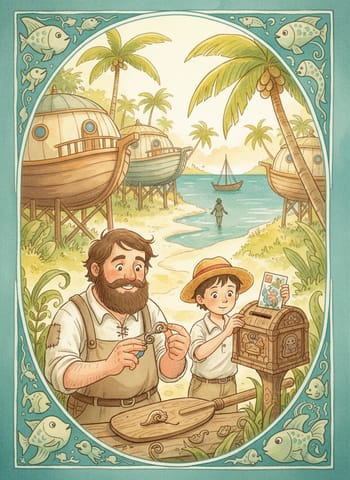
The Oar Pin and the Island Box
A free B1-level English story for language learners, readable online in 7 languages, with an option to listen via the free Storyteller app.
A boat-hut worker fixes a broken oar so a newcomer can leave a postcard for a stranger on the island.
That was the preview! Hear the full story in the free Storyteller app. Get the app
Audio isn't available right now.
The boat hut on Lake Verne had only one rule that Emre cared about. Every boat had to be back before six o'clock. After that, he locked the door, counted the money and cycled home along the shore.
It was twenty past five when the boy walked in. He was about Emre's age, thin and tall, with a backpack on one shoulder. In his hand, he held a postcard against his chest as if it might fly away.
"Are you still renting boats?" he asked.
"For forty more minutes," Emre said. "Then I lock up. Where do you want to go?"
"To the island." The boy pointed through the window at the small green shape in the middle of the lake. "My name is Osei. I only need ten minutes there."
Emre looked at the clock above the door. Then he looked at the water. The surface was smooth and gold, and the lake was almost empty. It was the best hour of the day, and he had never once taken it for himself.
"The trip takes twenty minutes each way," he said. "If you row well."
"I row very well," Osei said.
That turned out to be false. Emre understood it ten seconds later. Osei tried to sit in the first boat and nearly fell into the water. He caught the boy by the sleeve and pulled him back onto the dock.
"Maybe I row a little," Osei admitted.
"Then I will come with you," Emre said. "The rule says beginners must have a guide, and I would like my boats to return."
They chose the only boat left on the rack. It was a blue wooden rowboat with the number six painted on the side. Emre slid it into the water, and Osei climbed in carefully. When Emre fitted the first oar into its holder, the oar slipped out and splashed into the lake.
"That is strange," Emre said.
He pulled the oar back in and checked the metal holder. A small pin was missing from the top, the one that keeps the oar in place. Without it, every stroke would throw the oar out sideways.
"Is it broken?" Osei asked.
"It is missing. Someone probably lost it last week." Emre sighed. He glanced at the clock inside the hut. It was now twenty-five past five. "I have more pins in the shed, but the shed key is in my other jacket at home."
"Then we cannot go."
"I did not say that."
Emre stood on the dock with his hands on his hips. He thought about the toolbox in the hut. He remembered a drawer full of old bolts, nails and zip ties. Then he ran inside and came back with a handful of long plastic ties.
"What are those for?" Osei asked.
"For a lesson in boat repair," Emre said. "Hold the oar."
He pushed a tie through the hole where the pin had been and pulled it round the oar. He added a second tie, and then a third. Soon the oar sat firmly in its holder. He tested it with a hard pull. The oar did not move.
"It is not beautiful," he said, "but it is safe. Let's go."
They left the dock at half past five. Emre rowed, and Osei sat in the back with the postcard on his knees. Behind them, the town got smaller. Ahead, the island grew.
"You never told me why you must go there," Emre said.
"There is a box," Osei said. "A wooden box on a post, on the north side. People leave things inside it. Letters, drawings, little stones."
"I know the box. Tourists leave it full of rubbish."
"I want to leave this." Osei held up the postcard. On the front, there was a picture of a mountain. "But I have a problem. Look at the back."
Emre leaned in while the boat drifted. The card was filled with neat handwriting. At the top, where the address should have been, there was only a blank space.
"You forgot to write the address," Emre said.
"No. There is none." Osei smiled for the first time. "It is a card for nobody. For whoever opens the box."
"That is a strange thing to do."
"I moved to this town three weeks ago," Osei said. "I do not know anybody here. My parents are busy, and my old friends are very far away. So I started to write cards to strangers. I leave one in each place I like."
Emre said nothing for a while. He just rowed.
"How many have you left?" he asked.
"Four. A park bench, a library, a fence and a bridge. I never know if anyone reads them." Osei looked at the island. "That is why I chose the box. People open it on purpose."
They reached the island at ten to six. Emre jumped out and pulled the boat onto the sand. The place was quiet, with tall reeds and one narrow path. At the end of the path stood a post with a small wooden box on top.
Osei walked up to it and tried to open the lid. It did not move.
"It is stuck," he said.
"The wood gets swollen in summer," Emre said. "Let me try."
He pulled, and he pushed, and he knocked on the sides with his fist. Nothing happened. The time was going, and he could feel it in his chest. At last he took a key from his pocket. He slid it into the crack under the lid and pressed down.
The lid opened with a loud crack.
Inside, the box was full of folded paper, shells and a single faded ribbon. Osei looked at the contents for a long time. Then he laid his postcard on top, with the words facing up.
"Will you read it first?" he asked.
"It is not addressed to me," Emre said.
"It is not addressed to anyone."
Emre took the card and read it quickly, standing in the low gold light. It was short. It said that the writer was new here. It said the lake was the first thing he had loved in this town. It said that if the reader was also a stranger, they were not alone.
He read it twice. When he looked up, Osei was watching the water.
"I wrote it this morning," Osei said. "When I first saw the lake."
"You did not know who would read it."
"No," Osei said. "That is why I left the address empty."
Emre looked at the box again. He was glad that he was the first reader.
Emre put the card back in the box, and he closed the lid carefully. They walked down to the boat without speaking. The sun was almost on the water by then, and the lake was the colour of copper.
On the way back, Emre rowed harder than he had ever rowed before. The plastic ties held. They reached the dock at four minutes past six. A cyclist on the shore waved, as if they had returned from a long journey.
Emre tied the boat to its post and locked the hut. Osei waited next to him with his backpack in both hands.
"I broke your rule," Emre said. "I was late by four minutes."
"I am sorry."
"Don't be. I never take the best hour for myself." Emre looked at the lake, then at the boy. "Do you have another card in that bag?"
"I have six," Osei said.
Emre held out his hand. "Can I borrow a pen? I want to know what you write when you are not a stranger any more."
Osei took out a pen. "I do not know yet," he said. "What would you write?"