Twelve Doors and a Tin of Buttons
Uma história gratuita em inglês de nível B2 para estudantes, para ler online em 7 idiomas, com opção de ouvir no app gratuito Storyteller.
Two rival neighbours find a tin of numbered buttons that fit the locks of every door on their street, but the doors open fully only when they work as a pair.
Essa foi a prévia! Ouça a história completa no app gratuito Storyteller. Baixar o app
O áudio não está disponível no momento.
Counting Lane has twelve houses, and every house has a door with a brass number on it. The numbers run up one side from one to six and back down the other from seven to twelve. The street looks like a long, narrow clock. Nobody knows who built it. Nobody has ever seen the doors open from the outside, either, because every resident goes in through the back garden and out the same way.
A Rua da Contagem tem doze casas, e cada casa tem uma porta com um número de latão. Os números sobem de um lado, do um ao seis, e descem do outro, do sete ao doze. A rua parece um relógio comprido e estreito. Ninguém sabe quem a construiu. Ninguém jamais viu as portas se abrirem pelo lado de fora, aliás, porque todos os moradores entram pelo jardim dos fundos e saem pelo mesmo caminho.
Fergus lives behind door four. Saskia lives behind door nine. They have been rivals since the first day of school. Both of them tried to be first in line and ended up wedged together in the gate.
Fergus mora atrás da porta quatro. Saskia mora atrás da porta nove. Eles são rivais desde o primeiro dia de aula. Os dois tentaram ser o primeiro da fila e acabaram entalados juntos no portão.
Since then, the rivalry has grown a great deal. They race to the lamp post at the middle of the street every morning, and whoever touches it first earns a point. Fergus is ahead by seven, but Saskia insists that the points before March do not count because his shoelace was untied. They argue about this daily, loudly, and with real enjoyment.
Desde então, a rivalidade cresceu muito. Todas as manhãs eles correm até o poste de luz no meio da rua, e quem o tocar primeiro ganha um ponto. Fergus está à frente por sete, mas Saskia insiste que os pontos anteriores a março não valem, porque o cadarço dele estava desamarrado. Eles discutem isso todos os dias, em voz alta e com verdadeiro prazer.
On Saturday, the argument is interrupted by a clinking noise.
No sábado, a discussão é interrompida por um tilintar.
"Did you hear that?" Fergus asks.
"Você ouviu isso?", pergunta Fergus.
"I am not falling for it," says Saskia. "You always pretend to hear something when you are losing."
"Não vou cair nessa", diz Saskia. "Você sempre finge que ouve alguma coisa quando está perdendo."
"I am not losing. I am ahead by seven."
"Eu não estou perdendo. Estou na frente por sete."
"Ahead by seven minus the shoelace."
"Na frente por sete menos o cadarço."
The clink comes again, from the foot of the lamp post. A round tin sits there, dented and rusty, about the size of a loaf of cake. It was not there yesterday. Fergus is sure of it, because he walked past this exact spot with his eyes closed as a dare. He crouches and reaches for it. Saskia drops to her knees at the same moment and grabs the other side.
O tilintar vem de novo, da base do poste. Uma lata redonda está ali, amassada e enferrujada, do tamanho de um bolo de forma. Ela não estava ali ontem. Fergus tem certeza, porque passou exatamente por esse lugar de olhos fechados, por causa de um desafio. Ele se agacha e estica a mão para pegá-la. Saskia cai de joelhos no mesmo instante e agarra o outro lado.
"I saw it first," Fergus says.
"Eu vi primeiro", diz Fergus.
"You saw it second. I was already looking."
"Você viu em segundo. Eu já estava olhando."
"At what? At the clouds?"
"Para quê? Para as nuvens?"
"At the tin, with my mind."
"Para a lata, com a minha mente."
They tug. The lid, which has probably been loose for years, flies off, and a cascade of buttons spills across the cobbles in every direction. They are all shapes and colours: round brass ones, square wooden ones, a tiny glass one that glints like a drop of water. Each of them has a number stitched into its face in white thread.
Eles puxam. A tampa, que provavelmente estava frouxa havia anos, sai voando, e uma cascata de botões se espalha pelos paralelepípedos em todas as direções. Há botões de todos os formatos e cores: redondos de latão, quadrados de madeira, um minúsculo de vidro que brilha como uma gota d'água. Cada um tem um número bordado na face com linha branca.
For a moment, both of them stop pulling and simply look.
Por um momento, os dois param de puxar e simplesmente olham.
"Ten," Saskia whispers, picking one up. "This one says ten."
"Dez", sussurra Saskia, pegando um. "Este aqui diz dez."
"Mine says four." Fergus turns it over in his palm. It is a heavy brown button with two holes, and the stitched number shines as if it has just been sewn. "Four. Like my door."
"O meu diz quatro." Fergus vira o botão na palma da mão. É um botão marrom e pesado, com dois furos, e o número bordado brilha como se tivesse acabado de ser costurado. "Quatro. Como a minha porta."
They look at each other. Then they look at the street.
Eles se olham. Depois olham para a rua.
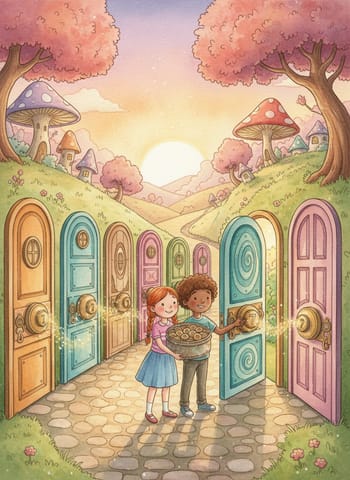
On door four, the brass plate suddenly seems to have a different shape. Where the keyhole should be, there is a round, shallow dip, no bigger than a coin. Fergus runs across the road and presses the button into it. It fits perfectly. The door swallows it with a quiet click, and a thin line of golden light appears around the frame.
Na porta quatro, a placa de latão de repente parece ter outro formato. No lugar onde deveria estar a fechadura, há uma cavidade redonda e rasa, não maior que uma moeda. Fergus atravessa a rua correndo e aperta o botão ali dentro. Encaixa perfeitamente. A porta o engole com um clique suave, e uma fina linha de luz dourada aparece em volta do batente.
"Don't," Saskia says, but he has already pulled the handle.
"Não faça isso", diz Saskia, mas ele já puxou a maçaneta.
The door opens a hand's width and stops. Behind it is not a hallway but a narrow staircase going down into the dark. A smell of warm dust and old paper comes up from the bottom. Fergus peers in and does not move.
A porta se abre a largura de uma mão e para. Atrás dela não há um corredor, mas uma escada estreita descendo para a escuridão. Um cheiro de poeira morna e papel velho sobe lá de baixo. Fergus espia para dentro e não se mexe.
"It is not working properly," he says. "It will only open a little."
"Não está funcionando direito", diz ele. "Só abre um pouquinho."
"Maybe it needs more than one button." Saskia is already at door nine, pressing a button into the dip at its centre. The door clicks, and golden light traces its edge. It opens exactly one hand's width, then sticks. "See? The same thing."
"Talvez precise de mais de um botão." Saskia já está na porta nove, apertando um botão na cavidade do centro. A porta faz clique, e uma luz dourada contorna a borda. Ela se abre exatamente a largura de uma mão e emperra. "Viu? A mesma coisa."
"So each door needs two buttons."
"Então cada porta precisa de dois botões."
"Or one button from each of us."
"Ou de um botão de cada um de nós."
They stare at each other across the street. Fergus opens his mouth to say that he has no interest in sharing. Then he notices the look on Saskia's face. It is stubborn and wary, as though they have both just discovered the same inconvenient fact.
Eles se encaram do outro lado da rua. Fergus abre a boca para dizer que não tem o menor interesse em dividir. Então ele repara na expressão de Saskia. É teimosa e desconfiada, como se os dois tivessem acabado de descobrir o mesmo fato inconveniente.
"I will not forget about the shoelace," Saskia says.
"Eu não vou esquecer o cadarço", diz Saskia.
"I would be disappointed if you did."
"Eu ficaria decepcionado se esquecesse."
It takes them an hour to sort the buttons. They lay them out in rows on the cobbles, from one to twelve. A pattern appears at once. Each number turns up exactly twice, but no two buttons of the same number look alike. The glass ten is clearly meant to be matched with the dull iron ten. Door four already holds the brown button, so it needs the pearl one.
Eles levam uma hora para separar os botões. Dispõem tudo em fileiras sobre os paralelepípedos, do um ao doze. Um padrão aparece de imediato. Cada número surge exatamente duas vezes, mas dois botões do mesmo número nunca são iguais. O dez de vidro claramente deve combinar com o dez de ferro fosco. A porta quatro já tem o botão marrom, então precisa do de madrepérola.
Fergus and Saskia take turns. He reads out a number; she finds the partner button; they press them into the plate together, one button each. At door one, the first pair makes a sound like a bell. At door two, the street gives a faint shiver. By door six, the golden light has spread from the frames to the cobbles. The lamp post in the middle of the lane is humming.
Fergus e Saskia se revezam. Ele lê um número em voz alta; ela encontra o botão par; eles apertam os dois na placa juntos, um botão cada. Na porta um, o primeiro par faz um som como o de um sino. Na porta dois, a rua dá um leve estremecimento. Na porta seis, a luz dourada já se espalhou dos batentes para os paralelepípedos. O poste no meio da rua está zumbindo.
"Is it supposed to do that?" Saskia asks.
"Isso devia acontecer?", pergunta Saskia.
"I have no idea. I did not even know the street had a hum."
"Não faço ideia. Eu nem sabia que a rua zumbia."
"It is probably friendly."
"Provavelmente é amigável."
"You have no evidence for that."
"Você não tem nenhuma prova disso."
"I have the evidence of my own good judgment," Saskia says.
"Tenho a prova do meu próprio bom senso", diz Saskia.
At door twelve, the final pair clicks home. For a moment, nothing happens. Then, all at once, every door on Counting Lane swings wide with a soft sound, like twelve people drawing a breath. Light pours out of the houses and meets in the middle of the street. The air fills with the smell of old books and warm bricks.
Na porta doze, o último par se encaixa com um clique. Por um momento, nada acontece. Então, de uma só vez, todas as portas da Rua da Contagem se escancaram com um som suave, como doze pessoas respirando fundo. A luz jorra das casas e se encontra no meio da rua. O ar se enche de cheiro de livros velhos e tijolos mornos.
Neighbours come hurrying out of their back gardens, blinking, holding spoons and watering cans and sleepy cats. Someone laughs. Someone else says that she has lived here for thirty years and never once seen the street from the front. A small girl runs through the open door of number seven and comes back with a glowing paper star in her hands.
Os vizinhos saem apressados de seus jardins dos fundos, piscando, segurando colheres, regadores e gatos sonolentos. Alguém ri. Outra pessoa diz que mora ali há trinta anos e nunca tinha visto a rua pela frente. Uma menininha corre pela porta aberta do número sete e volta com uma estrela de papel brilhante nas mãos.
Fergus and Saskia stand in the middle of it, still holding the empty tin between them. Neither of them seems to remember who picked it up first.
Fergus e Saskia ficam no meio de tudo aquilo, ainda segurando a lata vazia entre os dois. Nenhum dos dois parece lembrar quem a pegou primeiro.
"Seven," Fergus says at last.
"Sete", diz Fergus por fim.
"What?"
"O quê?"
"I said I was ahead by seven. I think we should stop counting."
"Eu disse que estava na frente por sete. Acho que a gente devia parar de contar."
Saskia looks at the doors, at the golden light, and at the tin in her hands. She is quiet for so long that he starts to worry she is composing a clever answer. When she finally speaks, her voice is almost shy.
Saskia olha para as portas, para a luz dourada e para a lata em suas mãos. Ela fica quieta por tanto tempo que ele começa a se preocupar que ela esteja elaborando uma resposta esperta. Quando finalmente fala, sua voz é quase tímida.
"If we stop counting," she says, "who is going to tell everyone how the doors got opened?"
"Se a gente parar de contar", diz ela, "quem vai contar para todo mundo como as portas foram abertas?"