Twelve Doors and a Tin of Buttons
Una historia gratuita en inglés de nivel B2 para estudiantes, para leer en línea en 7 idiomas, con opción de escucharla en la app gratuita Storyteller.
Two rival neighbours find a tin of numbered buttons that fit the locks of every door on their street, but the doors open fully only when they work as a pair.
¡Ese fue el avance! Escucha la historia completa en la app gratuita Storyteller. Descargar la app
El audio no está disponible en este momento.
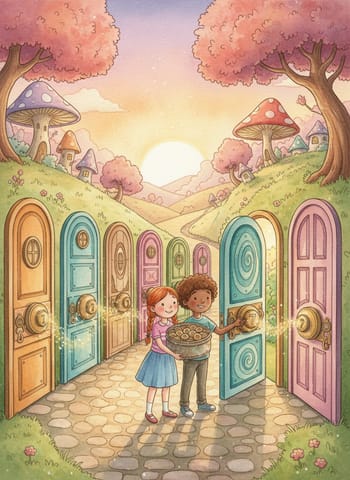
Counting Lane has twelve houses, and every house has a door with a brass number on it. The numbers run up one side from one to six and back down the other from seven to twelve. The street looks like a long, narrow clock. Nobody knows who built it. Nobody has ever seen the doors open from the outside, either, because every resident goes in through the back garden and out the same way.
La Calle del Conteo tiene doce casas, y cada casa tiene una puerta con un número de latón. Los números suben por un lado del uno al seis y bajan por el otro del siete al doce. La calle parece un reloj largo y angosto. Nadie sabe quién la construyó. Nadie ha visto tampoco abrirse las puertas desde afuera, porque cada vecino entra por el jardín trasero y sale por el mismo lugar.
Fergus lives behind door four. Saskia lives behind door nine. They have been rivals since the first day of school. Both of them tried to be first in line and ended up wedged together in the gate.
Fergus vive detrás de la puerta cuatro. Saskia vive detrás de la puerta nueve. Son rivales desde el primer día de escuela. Los dos intentaron ser los primeros de la fila y terminaron atorados juntos en el portón.
Since then, the rivalry has grown a great deal. They race to the lamp post at the middle of the street every morning, and whoever touches it first earns a point. Fergus is ahead by seven, but Saskia insists that the points before March do not count because his shoelace was untied. They argue about this daily, loudly, and with real enjoyment.
Desde entonces, la rivalidad ha crecido mucho. Todas las mañanas corren hasta el poste de luz en medio de la calle, y quien lo toque primero gana un punto. Fergus va adelante por siete, pero Saskia insiste en que los puntos anteriores a marzo no cuentan porque él traía el cordón desabrochado. Discuten esto a diario, en voz alta y con verdadero placer.
On Saturday, the argument is interrupted by a clinking noise.
El sábado, la discusión se ve interrumpida por un tintineo.
"Did you hear that?" Fergus asks.
«¿Oíste eso?», pregunta Fergus.
"I am not falling for it," says Saskia. "You always pretend to hear something when you are losing."
«No voy a caer», dice Saskia. «Siempre finges oír algo cuando vas perdiendo».
"I am not losing. I am ahead by seven."
«No voy perdiendo. Voy ganando por siete».
"Ahead by seven minus the shoelace."
«Ganando por siete menos el cordón».
The clink comes again, from the foot of the lamp post. A round tin sits there, dented and rusty, about the size of a loaf of cake. It was not there yesterday. Fergus is sure of it, because he walked past this exact spot with his eyes closed as a dare. He crouches and reaches for it. Saskia drops to her knees at the same moment and grabs the other side.
El tintineo suena otra vez, al pie del poste. Allí hay una lata redonda, abollada y oxidada, del tamaño de un panqué. Ayer no estaba. Fergus está seguro, porque pasó por este mismo lugar con los ojos cerrados como reto. Se agacha y la alcanza. Saskia cae de rodillas en el mismo momento y la agarra del otro lado.
"I saw it first," Fergus says.
«Yo la vi primero», dice Fergus.
"You saw it second. I was already looking."
«La viste segundo. Yo ya estaba mirando».
"At what? At the clouds?"
«¿A qué? ¿A las nubes?».
"At the tin, with my mind."
«A la lata, con la mente».
They tug. The lid, which has probably been loose for years, flies off, and a cascade of buttons spills across the cobbles in every direction. They are all shapes and colours: round brass ones, square wooden ones, a tiny glass one that glints like a drop of water. Each of them has a number stitched into its face in white thread.
Jalan. La tapa, que probablemente llevaba años floja, sale volando, y una cascada de botones se derrama por los adoquines en todas direcciones. Son de todas las formas y colores: redondos de latón, cuadrados de madera, uno diminuto de vidrio que reluce como una gota de agua. Cada uno tiene un número bordado en el frente con hilo blanco.
For a moment, both of them stop pulling and simply look.
Por un momento, ambos dejan de jalar y simplemente miran.
"Ten," Saskia whispers, picking one up. "This one says ten."
«Diez», susurra Saskia, levantando uno. «Este dice diez».
"Mine says four." Fergus turns it over in his palm. It is a heavy brown button with two holes, and the stitched number shines as if it has just been sewn. "Four. Like my door."
«El mío dice cuatro». Fergus lo da vuelta en la palma. Es un botón café pesado con dos agujeros, y el número bordado brilla como si lo acabaran de coser. «Cuatro. Como mi puerta».
They look at each other. Then they look at the street.
Se miran. Luego miran la calle.
On door four, the brass plate suddenly seems to have a different shape. Where the keyhole should be, there is a round, shallow dip, no bigger than a coin. Fergus runs across the road and presses the button into it. It fits perfectly. The door swallows it with a quiet click, and a thin line of golden light appears around the frame.
En la puerta cuatro, la placa de latón de pronto parece tener una forma distinta. Donde debería estar la cerradura, hay un hueco redondo y poco profundo, no más grande que una moneda. Fergus cruza corriendo la calle y presiona el botón en él. Encaja perfectamente. La puerta se lo traga con un clic callado, y una delgada línea de luz dorada aparece alrededor del marco.
"Don't," Saskia says, but he has already pulled the handle.
«No lo hagas», dice Saskia, pero él ya ha jalado la manija.
The door opens a hand's width and stops. Behind it is not a hallway but a narrow staircase going down into the dark. A smell of warm dust and old paper comes up from the bottom. Fergus peers in and does not move.
La puerta se abre el ancho de una mano y se detiene. Detrás no hay un pasillo sino una angosta escalera que baja hacia la oscuridad. Sube desde el fondo un olor a polvo tibio y papel viejo. Fergus se asoma y no se mueve.
"It is not working properly," he says. "It will only open a little."
«No funciona bien», dice. «Solo se abre un poco».
"Maybe it needs more than one button." Saskia is already at door nine, pressing a button into the dip at its centre. The door clicks, and golden light traces its edge. It opens exactly one hand's width, then sticks. "See? The same thing."
«Quizás necesita más de un botón». Saskia ya está en la puerta nueve, presionando un botón en el hueco del centro. La puerta hace clic, y una luz dorada recorre su borde. Se abre exactamente el ancho de una mano, y luego se atora. «¿Ves? Lo mismo».
"So each door needs two buttons."
«Así que cada puerta necesita dos botones».
"Or one button from each of us."
«O un botón de cada uno de nosotros».
They stare at each other across the street. Fergus opens his mouth to say that he has no interest in sharing. Then he notices the look on Saskia's face. It is stubborn and wary, as though they have both just discovered the same inconvenient fact.
Se miran fijamente al otro lado de la calle. Fergus abre la boca para decir que no tiene ningún interés en compartir. Luego nota la expresión de Saskia. Es terca y cautelosa, como si ambos acabaran de descubrir el mismo hecho incómodo.
"I will not forget about the shoelace," Saskia says.
«No me voy a olvidar del cordón», dice Saskia.
"I would be disappointed if you did."
«Me decepcionaría que lo hicieras».
It takes them an hour to sort the buttons. They lay them out in rows on the cobbles, from one to twelve. A pattern appears at once. Each number turns up exactly twice, but no two buttons of the same number look alike. The glass ten is clearly meant to be matched with the dull iron ten. Door four already holds the brown button, so it needs the pearl one.
Les toma una hora clasificar los botones. Los acomodan en hileras sobre los adoquines, del uno al doce. De inmediato aparece un patrón. Cada número aparece exactamente dos veces, pero no hay dos botones del mismo número que se parezcan. El diez de vidrio claramente debe emparejarse con el diez de hierro opaco. La puerta cuatro ya tiene el botón café, así que necesita el de nácar.
Fergus and Saskia take turns. He reads out a number; she finds the partner button; they press them into the plate together, one button each. At door one, the first pair makes a sound like a bell. At door two, the street gives a faint shiver. By door six, the golden light has spread from the frames to the cobbles. The lamp post in the middle of the lane is humming.
Fergus y Saskia se turnan. Él lee un número; ella encuentra el botón compañero; los presionan juntos en la placa, un botón cada uno. En la puerta uno, el primer par suena como una campana. En la puerta dos, la calle da un leve estremecimiento. Para la puerta seis, la luz dorada se ha extendido de los marcos a los adoquines. El poste en medio de la calle está zumbando.
"Is it supposed to do that?" Saskia asks.
«¿Se supone que haga eso?», pregunta Saskia.
"I have no idea. I did not even know the street had a hum."
«No tengo idea. Ni siquiera sabía que la calle tuviera un zumbido».
"It is probably friendly."
«Probablemente es amistoso».
"You have no evidence for that."
«No tienes evidencia de eso».
"I have the evidence of my own good judgment," Saskia says.
«Tengo la evidencia de mi buen juicio», dice Saskia.
At door twelve, the final pair clicks home. For a moment, nothing happens. Then, all at once, every door on Counting Lane swings wide with a soft sound, like twelve people drawing a breath. Light pours out of the houses and meets in the middle of the street. The air fills with the smell of old books and warm bricks.
En la puerta doce, el último par encaja con un clic. Por un momento, no pasa nada. Entonces, de golpe, todas las puertas de la Calle del Conteo se abren de par en par con un sonido suave, como doce personas tomando aire. La luz sale a chorros de las casas y se encuentra en medio de la calle. El aire se llena de olor a libros viejos y ladrillos tibios.
Neighbours come hurrying out of their back gardens, blinking, holding spoons and watering cans and sleepy cats. Someone laughs. Someone else says that she has lived here for thirty years and never once seen the street from the front. A small girl runs through the open door of number seven and comes back with a glowing paper star in her hands.
Los vecinos salen apresurados de sus jardines traseros, parpadeando, con cucharas, regaderas y gatos adormilados. Alguien ríe. Alguien más dice que ha vivido aquí treinta años y nunca ha visto la calle de frente. Una niña pequeña corre por la puerta abierta del número siete y regresa con una estrella de papel resplandeciente entre las manos.
Fergus and Saskia stand in the middle of it, still holding the empty tin between them. Neither of them seems to remember who picked it up first.
Fergus y Saskia están en medio de todo, todavía sosteniendo entre ambos la lata vacía. Ninguno parece recordar quién la levantó primero.
"Seven," Fergus says at last.
«Siete», dice Fergus por fin.
"What?"
«¿Qué?».
"I said I was ahead by seven. I think we should stop counting."
«Dije que iba ganando por siete. Creo que deberíamos dejar de contar».
Saskia looks at the doors, at the golden light, and at the tin in her hands. She is quiet for so long that he starts to worry she is composing a clever answer. When she finally speaks, her voice is almost shy.
Saskia mira las puertas, la luz dorada y la lata en sus manos. Está callada tanto tiempo que él empieza a preocuparse de que esté componiendo una respuesta ingeniosa. Cuando por fin habla, su voz es casi tímida.
"If we stop counting," she says, "who is going to tell everyone how the doors got opened?"
«Si dejamos de contar», dice, «¿quién le va a decir a todos cómo se abrieron las puertas?».