Page Forty-One Leaves the Van
Una historia gratuita en inglés de nivel B2 para estudiantes, para leer en línea en 7 idiomas, con opción de escucharla en la app gratuita Storyteller.
Two summer helpers on a travelling library van chase a runaway page from an old cookbook through three pairs of hands to find the person it belongs to.
¡Ese fue el avance! Escucha la historia completa en la app gratuita Storyteller. Descargar la app
El audio no está disponible en este momento.
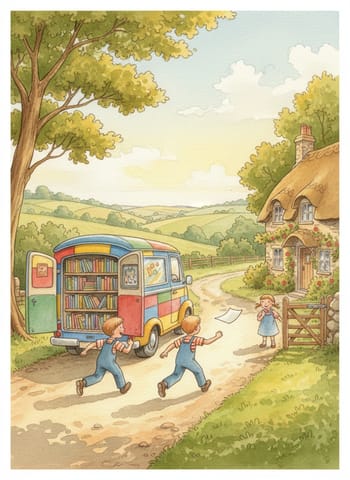
The mobile library van made its rounds of the valley every summer, and Elan and Ozan had been hired to help. Their jobs were small. They stamped the cards, stacked the returns and carried the heavy boxes of picture books up the steps.
La biblioteca móvil recorría el valle todos los veranos, y Elan y Ozan habían sido contratados para ayudar. Sus tareas eran pequeñas. Sellaban las fichas, apilaban las devoluciones y subían por los escalones las pesadas cajas de libros ilustrados.
On the second Friday, a book came back that Elan had never seen before. It was thick and brown, with a cracked spine and a title in faded gold: The Hearth Atlas of Salt and Smoke. The woman who returned it said she had borrowed it for a week and cooked from it twice.
El segundo viernes, devolvieron un libro que Elan nunca había visto. Era grueso y marrón, con el lomo agrietado y un título en dorado desvaído: El atlas del hogar de sal y humo. La mujer que lo devolvió dijo que lo había tomado prestado una semana y que había cocinado con él dos veces.
"Both meals were wonderful," she said. "But the last pages are a little loose, I am afraid."
«Las dos comidas estuvieron maravillosas», dijo. «Pero las últimas páginas están un poco sueltas, me temo».
Elan thanked her and set the book on the desk. After the van had pulled away from the stop, he opened it to check for damage, and he turned the pages one by one. Near the middle, he stopped.
Elan le dio las gracias y puso el libro sobre el escritorio. Cuando la camioneta se alejó de la parada, lo abrió para revisar si estaba dañado, y pasó las páginas una por una. Hacia la mitad, se detuvo.
"Ozan, come and look at this," he said.
«Ozan, ven a ver esto», dijo.
Ozan leaned over his shoulder. Between page forty and page forty-two there was a ragged stub of paper, as if a page had been torn out in a hurry. The edge was still slightly damp, and when Elan touched it, the stub gave off a faint smell of woodsmoke.
Ozan se asomó por encima de su hombro. Entre la página cuarenta y la cuarenta y dos había un resto irregular de papel, como si una página hubiera sido arrancada a toda prisa. El borde todavía estaba ligeramente húmedo, y cuando Elan lo tocó, el resto desprendió un leve olor a humo de leña.
"Nobody tore that," Ozan said. "Look at the stitching. The page just left."
«Nadie arrancó eso», dijo Ozan. «Mira la costura. La página simplemente se fue».
Elan laughed, and then he saw that Ozan was not joking. The librarian who drove the van had warned them on the first day that some of the old books on the shelf were unusual. She had said the Atlas was one of them, but she had not explained how.
Elan se rio, y luego vio que Ozan no bromeaba. La bibliotecaria que conducía la camioneta les había advertido el primer día que algunos de los libros viejos del estante eran inusuales. Había dicho que el Atlas era uno de ellos, pero no había explicado cómo.
They found out the rest from a note slipped inside the back cover. It was written in a neat hand: "The pages of this book are not content to stay bound. If one goes missing, follow the road it was carried along. It will always end up with the person it belongs to."
Lo demás lo averiguaron por una nota metida dentro de la contraportada. Estaba escrita con letra pulcra: «Las páginas de este libro no se resignan a quedarse encuadernadas. Si una desaparece, siga el camino por el que la llevaron. Siempre terminará con la persona a quien pertenece».
"That sounds like a joke," Elan said.
«Eso suena a broma», dijo Elan.
"Then it is a joke that smells of smoke," Ozan replied, and he reached for the route map.
«Entonces es una broma que huele a humo», respondió Ozan, y alcanzó el mapa de la ruta.
The woman had returned the book at the crossroads by the beekeeper's farm, the last stop before this one. The page could have slipped out there, and Ozan remembered seeing something pale flutter across the yard.
La mujer había devuelto el libro en el cruce junto a la granja del apicultor, la última parada antes de esta. La página podía haberse soltado allí, y Ozan recordó haber visto algo pálido revolotear por el patio.
They asked the librarian for ten minutes and ran the length of the lane. They found the beekeeper sitting on an upturned crate with a sheet of paper in her gloved hands.
Le pidieron diez minutos a la bibliotecaria y corrieron todo el largo del camino. Encontraron a la apicultora sentada en un cajón volcado con una hoja de papel en sus manos enguantadas.
"I found this on the gate," she said when they asked. "I read it twice. It is a recipe for a fish soup, which makes no sense, because I have never eaten fish in my life."
«La encontré en el portón», dijo cuando le preguntaron. «La leí dos veces. Es una receta de sopa de pescado, lo cual no tiene sentido, porque nunca en mi vida he comido pescado».
She frowned at the page. "Every time I try to read the ingredients, the words slide away. It is plainly meant for somebody else."
Frunció el ceño mirando la página. «Cada vez que intento leer los ingredientes, las palabras se escurren. Está claramente destinada a otra persona».
Elan thanked her and took the page. It felt warm, like a stone left in the sun. But as soon as he reached the road, it tugged gently against his fingers, and a gust of air lifted it out of his hand.
Elan le dio las gracias y tomó la página. Se sentía tibia, como una piedra dejada al sol. Pero en cuanto llegó al camino, tiró suavemente contra sus dedos, y una ráfaga de aire se la arrebató de la mano.
"It is leaving again!" Ozan shouted.
«¡Se va otra vez!», gritó Ozan.
They chased it down the hill, through a gap in a hedge and along the riverbank to the little ferry landing. The page skimmed across the water, and a mechanic wiping oil from his hands caught it neatly against his chest.
La persiguieron colina abajo, por un hueco de un seto y a lo largo de la orilla del río hasta el pequeño embarcadero del ferri. La página rozó el agua, y un mecánico que se limpiaba el aceite de las manos la atrapó con destreza contra el pecho.
"Is this yours?" the mechanic asked. He read the first line aloud, and then he frowned.
«¿Es suya?», preguntó el mecánico. Leyó la primera línea en voz alta, y luego frunció el ceño.
"I cannot make sense of it. It describes a kitchen, I think, but the roof is a ship's deck. Whoever wrote this was not from around here." He glanced at the sky. "The ferry leaves in five minutes. If I had the time, I would help you look. A girl was waiting at the school gate earlier, and she was staring at everything that flew by."
«No logro entenderla. Describe una cocina, creo, pero el techo es la cubierta de un barco. Quien escribió esto no era de por aquí». Echó un vistazo al cielo. «El ferri sale en cinco minutos. Si tuviera tiempo, los ayudaría a buscar. Antes había una niña esperando en la puerta de la escuela, y miraba fijamente todo lo que volaba».
He pressed the page into Ozan's hand. For a moment, it lay still, the ink glimmering as though it were wet. Then it slipped between his fingers, drifted up over the roof of the ferry house and went sailing away across the fields.
Le puso la página en la mano a Ozan. Por un momento, quedó quieta, con la tinta reluciendo como si estuviera mojada. Luego se deslizó entre sus dedos, se elevó sobre el techo de la caseta del ferri y se alejó planeando por los campos.
"We must have let go too early," Elan panted, as they ran. "That is the second time!"
«Debimos soltarla demasiado pronto», jadeó Elan mientras corrían. «¡Es la segunda vez!».
"Third time lucky," said Ozan, who had never run so fast in his life.
«A la tercera va la vencida», dijo Ozan, que nunca en su vida había corrido tan rápido.
The school gate stood at the end of the valley road, where the van was due to stop at four o'clock. It was a quarter to, and a thin line of children was already waiting. Some of them were reading and some were arguing. One was holding a sheet of paper over her head like a flag.
La puerta de la escuela estaba al final del camino del valle, donde la camioneta debía detenerse a las cuatro. Eran las cuatro menos cuarto, y una fila delgada de niños ya esperaba. Algunos leían y otros discutían. Una sostenía una hoja de papel sobre la cabeza como una bandera.
She was about ten years old. She was wearing a coat too big for her and a pair of shoes that had been polished for a different town. When she saw the two boys, she held the page out with both hands and looked up at them without speaking.
Tendría unos diez años. Llevaba un abrigo demasiado grande para ella y unos zapatos que habían sido lustrados para otro pueblo. Cuando vio a los dos chicos, extendió la página con ambas manos y los miró hacia arriba sin hablar.
"Is that yours?" Elan asked, as gently as he could.
«¿Es tuya?», preguntó Elan, con toda la suavidad que pudo.
The girl shook her head, and then she nodded, and then she said, in a very small voice, "I do not know. It showed me our kitchen."
La niña negó con la cabeza, y luego asintió, y luego dijo, con una vocecita: «No sé. Me mostró nuestra cocina».
"Your kitchen?" Ozan asked.
«¿Tu cocina?», preguntó Ozan.
"At the harbour. Before we moved."
«En el puerto. Antes de que nos mudáramos».
She turned the page toward them. The ink had rearranged itself into small handwriting that neither boy could read, but the picture beside it was clear enough. It showed a table by a window, a pan on a stove and a long grey ocean in the glass. "I have not eaten properly since we came here. Everything tastes of paper. But when I read this, I could smell the soup my mother makes, and I was not hungry any more. I was home."
Giró la página hacia ellos. La tinta se había reordenado en una letra pequeña que ninguno de los chicos podía leer, pero el dibujo junto a ella era bastante claro. Mostraba una mesa junto a una ventana, una sartén en una estufa y un largo océano gris en el vidrio. «No he comido bien desde que llegamos aquí. Todo me sabe a papel. Pero cuando leí esto, pude oler la sopa que hace mi mamá, y ya no tenía hambre. Estaba en casa».
For a minute, nobody said anything. The other children had gone quiet too. A bell rang inside the school, and the van rumbled around the corner and stopped with a sigh of brakes.
Durante un minuto, nadie dijo nada. Los demás niños también habían guardado silencio. Una campana sonó dentro de la escuela, y la camioneta dobló la esquina con un estruendo y se detuvo con un suspiro de frenos.
Elan took a breath. "The book belongs to the library," he said slowly. "But I think this page belongs to you. If the librarian agrees, you can keep it. We will tell her it found its owner."
Elan respiró hondo. «El libro pertenece a la biblioteca», dijo despacio. «Pero creo que esta página te pertenece a ti. Si la bibliotecaria está de acuerdo, puedes quedártela. Le diremos que encontró a su dueña».
The girl folded the page carefully, as if it might break, and tucked it inside her coat. Then she smiled for the first time, and it was a surprisingly wide smile. She said that she would come to the van every week, and that she would bring a bowl of the soup to share.
La niña dobló la página con cuidado, como si pudiera romperse, y se la guardó dentro del abrigo. Luego sonrió por primera vez, y fue una sonrisa sorprendentemente ancha. Dijo que vendría a la camioneta todas las semanas, y que traería un tazón de la sopa para compartir.
Ozan laughed. "I will hold you to that bowl," he said.
Ozan se rio. «Te tomaré la palabra con ese tazón», dijo.
That evening, after the last stop, the two boys sat in the back of the van. The Atlas lay open on the desk between them. The librarian had read the note and nodded, saying that it had happened before and that it always ended well. Elan held the book up to the lamp, and he looked once more at the stub where the missing page had been.
Esa tarde, después de la última parada, los dos chicos se sentaron en la parte de atrás de la camioneta. El Atlas yacía abierto sobre el escritorio entre ellos. La bibliotecaria había leído la nota y asentido, diciendo que ya había pasado antes y que siempre terminaba bien. Elan sostuvo el libro frente a la lámpara y miró una vez más el resto donde había estado la página que faltaba.
The stub was not empty. A line of fresh ink had appeared along the torn edge, written in the same neat hand as the note in the back cover. It was a short line.
El resto no estaba vacío. Una línea de tinta fresca había aparecido a lo largo del borde rasgado, escrita con la misma letra pulcra que la nota de la contraportada. Era una línea corta.
"The next page is already on its way," Ozan read aloud.
«La siguiente página ya va en camino», leyó Ozan en voz alta.
Elan closed the book and slid it carefully onto the highest shelf. Then he glanced at the window, which he was almost certain he had shut.
Elan cerró el libro y lo deslizó con cuidado en el estante más alto. Luego echó un vistazo a la ventana, que estaba casi seguro de haber cerrado.