The Sand Trail to Berth Four
Una historia gratuita en inglés de nivel B2 para estudiantes, para leer en línea en 7 idiomas, con opción de escucharla en la app gratuita Storyteller.
A ticket clerk and his colleague use a leaking bucket to find out who takes one ticket every night.
¡Ese fue el avance! Escucha la historia completa en la app gratuita Storyteller. Descargar la app
El audio no está disponible en este momento.
The ticket office at Harbour Point is a wooden hut with one window facing the quay and one facing the water. Aksel has run it for six years. He knows the timetable by heart, the price of every crossing and the exact sound the cash drawer makes when it is closed properly. That is why the numbers bother him so much.
La oficina de boletos de Harbour Point es una cabaña de madera con una ventana hacia el muelle y otra hacia el agua. Aksel la dirige desde hace seis años. Se sabe el horario de memoria, el precio de cada travesía y el sonido exacto que hace el cajón de dinero cuando está bien cerrado. Por eso los números lo inquietan tanto.
For three weeks, the last ferry of the evening, which leaves from berth four, has gone out with one more passenger than the tickets sold. The count at the gangway says thirty-seven. The till says thirty-six. And every morning, Aksel opens the cupboard where the spare ticket rolls are kept. One single ticket has been torn off the end of a roll, very cleanly, as if with a ruler.
Desde hace tres semanas, el último ferri de la tarde, que sale del atracadero cuatro, zarpa con un pasajero más que los boletos vendidos. El conteo en la pasarela dice treinta y siete. La caja dice treinta y seis. Y cada mañana, Aksel abre el armario donde se guardan los rollos de boletos de repuesto. Un solo boleto ha sido arrancado del final de un rollo, muy limpiamente, como con una regla.
"It is not much money," Marit says on Tuesday, as she hangs her coat on the hook. She works the afternoon shift and keeps the books. "Seven pounds a night. Maybe a hundred and fifty so far."
«No es mucho dinero», dice Marit el martes, mientras cuelga su abrigo en el gancho. Trabaja el turno de la tarde y lleva los libros. «Siete libras por noche. Quizá ciento cincuenta hasta ahora».
"It is not the money," Aksel says. "Only two people have keys to this hut. One of them is me. And I know I have not been selling tickets to myself."
«No es el dinero», dice Aksel. «Solo dos personas tienen llaves de esta cabaña. Una soy yo. Y sé que no me he estado vendiendo boletos a mí mismo».
"Then it is me?" Marit says, with a small laugh.
«¿Entonces soy yo?», dice Marit, con una risita.
"No. Which is exactly what bothers me." He rubs his forehead. "Somebody is getting in, taking one ticket and walking onto the ferry with a smile. And I cannot work out how."
«No. Que es justo lo que me inquieta». Se frota la frente. «Alguien entra, toma un boleto y sube al ferri con una sonrisa. Y no logro descubrir cómo».
Marit puts down her pen. She has a way of going very still when she is thinking, like a cat at a mouse hole.
Marit deja su pluma. Tiene una forma de quedarse muy quieta cuando piensa, como un gato frente a un agujero de ratón.
"Then we stop guessing and we catch the footprints," she says. "We do not need to sit up all night. We need to see who walks in."
«Entonces dejamos de adivinar y atrapamos las huellas», dice. «No necesitamos pasar la noche en vela. Necesitamos ver quién entra».
They make their first plan that afternoon, between the departures. It is a simple plan. Marit buys a bag of white chalk dust from the hardware shop across the road. After the last crossing, she will spread a thin layer of it over the floor between the back door and the ticket cupboard. In the morning, whoever has been creeping around will have left a clear print of every step.
Hacen su primer plan esa tarde, entre las salidas. Es un plan sencillo. Marit compra una bolsa de polvo de tiza blanca en la ferretería de enfrente. Después de la última travesía, esparcirá una capa fina sobre el piso entre la puerta trasera y el armario de los boletos. Por la mañana, quienquiera que haya estado merodeando habrá dejado una huella clara de cada paso.
At half past nine, with the quay empty and the boats rocking quietly at their ropes, Marit carries out the plan. She sprinkles the dust with a kitchen sieve, in a smooth, even carpet, from the back door to the cupboard and under the window. Aksel watches from the doorway with his arms folded.
A las nueve y media, con el muelle vacío y los botes meciéndose en silencio en sus amarras, Marit ejecuta el plan. Espolvorea el polvo con un colador de cocina, en una alfombra lisa y pareja, desde la puerta trasera hasta el armario y bajo la ventana. Aksel mira desde la puerta con los brazos cruzados.
"It looks like a freshly made bed," he says.
«Parece una cama recién hecha», dice.
"Do not step on it," Marit says. "Not even by accident."
«No pises», dice Marit. «Ni siquiera por accidente».
They lock up at ten, and they walk home in opposite directions, pleased with themselves.
Cierran a las diez, y caminan a casa en direcciones opuestas, satisfechos consigo mismos.
The plan collapses at seven the next morning. Aksel unlocks the hut, switches on the lamp and stops in the doorway. The floor is clean. It is not merely clean; it is shining. A faint smell of lemon hangs in the air, and in the corner, a mop is leaning against the wall with a bucket underneath it.
El plan se derrumba a las siete de la mañana siguiente. Aksel abre la cabaña, enciende la lámpara y se detiene en la puerta. El piso está limpio. No solo limpio; reluce. Un leve olor a limón flota en el aire, y en el rincón, un trapeador está apoyado en la pared con un balde debajo.
"No," he says out loud.
«No», dice en voz alta.
Marit arrives at eight. She takes one look at the floor and puts her hand over her eyes.
Marit llega a las ocho. Le basta una mirada al piso para taparse los ojos con la mano.
"The night cleaner," she says. "Nobody told her about the chalk. She comes at midnight, and she has done the whole building."
«La señora de la limpieza nocturna», dice. «Nadie le habló de la tiza. Viene a medianoche, y ha limpiado todo el edificio».
"So every footprint is gone," Aksel says. "And the ticket?"
«Así que todas las huellas se fueron», dice Aksel. «¿Y el boleto?».
He opens the cupboard. The roll has been torn again, as neatly as ever. Behind his back, Marit makes a small sound, somewhere between a groan and a laugh.
Abre el armario. El rollo ha sido arrancado otra vez, tan limpio como siempre. A espaldas de Aksel, Marit hace un sonidito, entre un gemido y una risa.
"Whoever it is," she says, "they have a better schedule than we do."
«Quienquiera que sea», dice, «tiene un horario mejor que el nuestro».
All morning they argue about what to do next. Aksel wants to fix a camera above the door. But the camera would cost more than the stolen tickets and would take a week to arrive. Marit wants to tell the harbour manager. But the manager will certainly say that it is nothing, and he will ask why two adults are losing sleep over a handful of paper.
Toda la mañana discuten qué hacer a continuación. Aksel quiere instalar una cámara sobre la puerta. Pero la cámara costaría más que los boletos robados y tardaría una semana en llegar. Marit quiere avisarle al gerente del puerto. Pero el gerente seguramente dirá que no es nada, y preguntará por qué dos adultos pierden el sueño por un puñado de papel.
It is late in the afternoon when Aksel sees the bucket.
Es avanzada la tarde cuando Aksel ve el balde.
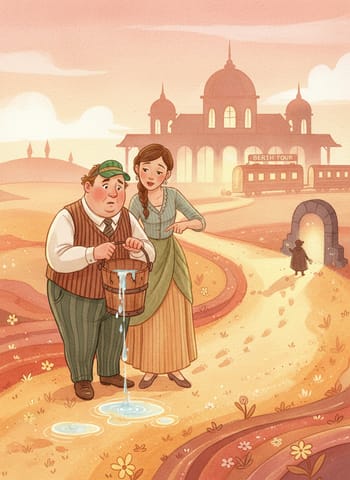
It hangs on a hook beside the back door, an old fire bucket, painted white and stamped with the word SAND. It was retired years ago because the bottom has rusted through. There is a hole in it about the size of a coin. Aksel takes it down and turns it over. A trickle of dust runs out through the hole, as thin and steady as water from a tap.
Cuelga de un gancho junto a la puerta trasera, un viejo balde contra incendios, pintado de blanco y marcado con la palabra ARENA. Lo retiraron hace años porque el fondo se oxidó y se perforó. Tiene un agujero del tamaño de una moneda. Aksel lo baja y lo da vuelta. Un hilo de polvo sale por el agujero, tan fino y constante como agua de una llave.
He stands there for a long time, watching the dust fall onto the floor, and an idea arrives in his head.
Se queda allí mucho tiempo, viendo caer el polvo al suelo, y una idea le llega a la cabeza.
"Marit," he says. "What would happen if we used this?"
«Marit», dice. «¿Qué pasaría si usáramos esto?».
"It has a hole in it," she says. "It is rubbish."
«Tiene un agujero», dice ella. «Es basura».
"Exactly. It is a hole that leaks slowly and evenly. I fill it and hang it on a string from the ceiling hook, right above the cupboard door. Then anyone who opens that door will knock it, and it will swing. A sand bucket that swings and leaks will draw a line on the floor." He draws an invisible circle in the air with his finger. "Not chalk. Real sand, heavy enough to hold a print. And this time nobody will be allowed to clean up after us."
«Exacto. Es un agujero que gotea lenta y parejamente. Lo lleno y lo cuelgo de una cuerda del gancho del techo, justo sobre la puerta del armario. Entonces quien abra esa puerta lo golpeará, y se balanceará. Un balde de arena que se balancea y gotea dibujará una línea en el piso». Dibuja un círculo invisible en el aire con el dedo. «No tiza. Arena de verdad, lo bastante pesada como para sostener una huella. Y esta vez a nadie se le permitirá limpiar después de nosotros».
"She will mop it at midnight," Marit says.
«Ella trapeará a medianoche», dice Marit.
"Not if we ask her to skip the hut tonight," Aksel says. "We tell her the floor is being treated."
«No si le pedimos que se salte la cabaña esta noche», dice Aksel. «Le decimos que el piso está en tratamiento».
Marit thinks about it. Then she smiles slowly.
Marit lo piensa. Luego sonríe lentamente.
"It is a terrible plan," she says. "Let us do it."
«Es un plan terrible», dice. «Hagámoslo».
That evening they fill the bucket to the brim with sand from the old bin on the quay. Aksel climbs onto a chair and ties the handle to the ceiling hook with a length of fishing line. Then he sets the bucket swaying, just enough to test it. Sand spills in a pale curve across the floorboards and stops when the swinging stops. Marit ties the other end of the line to the cupboard door, so that the first person to open it will set the bucket moving.
Esa tarde llenan el balde hasta el borde con arena del viejo contenedor del muelle. Aksel se sube a una silla y ata el asa al gancho del techo con un tramo de sedal. Luego pone el balde a balancearse, justo lo suficiente para probarlo. La arena se derrama en una curva pálida sobre las tablas del piso y se detiene cuando el balanceo se detiene. Marit ata el otro extremo del sedal a la puerta del armario, de modo que la primera persona que la abra ponga el balde en movimiento.
They lock up at ten again, and this time Marit has a word with the night cleaner, who agrees to skip the hut. Then they go home.
Cierran a las diez otra vez, y esta vez Marit habla con la señora de la limpieza nocturna, que acepta saltarse la cabaña. Luego se van a casa.
At seven the next morning, Aksel unlocks the door very slowly.
A las siete de la mañana siguiente, Aksel abre la puerta muy despacio.
The bucket hangs motionless from the ceiling, almost empty. A broad arc of sand lies on the floor beneath it. In the middle of the arc, as clear as a signature, there is a footprint.
El balde cuelga inmóvil del techo, casi vacío. Un amplio arco de arena yace en el suelo debajo. En medio del arco, tan claro como una firma, hay una huella.
Marit comes in behind him and kneels down.
Marit entra detrás de él y se arrodilla.
"It is bare," she says. "A bare foot. And it is wet."
«Está descalzo», dice. «Un pie descalzo. Y está mojado».
There is a second print beside it, and then a third. The line of prints leads across the floorboards, from the window that faces the water, to the cupboard, and back again. Aksel follows them with his eyes to the windowsill. The glass is shut and locked from the inside. Under it, on the wooden ledge, lies a thin trail of seaweed.
Hay una segunda huella a su lado, y luego una tercera. La línea de huellas cruza las tablas, desde la ventana que da al agua hasta el armario, y de vuelta. Aksel las sigue con la vista hasta el alféizar. El vidrio está cerrado con seguro desde adentro. Debajo, en el borde de madera, hay un fino rastro de algas.
"That window has not been opened for years," he says.
«Esa ventana no se ha abierto en años», dice.
"Then they did not need to open it," Marit says quietly.
«Entonces no necesitaron abrirla», dice Marit en voz baja.
She bends lower over the last print, the one nearest the sill, and she goes quiet. Beside the print of the large foot, half hidden under the edge of the sand, there is another. It is much smaller. It is the print of a child's foot, and it is pointing in the opposite direction, towards the sea.
Se inclina más sobre la última huella, la más cercana al alféizar, y se queda callada. Junto a la huella del pie grande, medio escondida bajo el borde de la arena, hay otra. Es mucho más pequeña. Es la huella del pie de un niño, y apunta en la dirección opuesta, hacia el mar.