The Sand Trail to Berth Four
Uma história gratuita em inglês de nível B2 para estudantes, para ler online em 7 idiomas, com opção de ouvir no app gratuito Storyteller.
A ticket clerk and his colleague use a leaking bucket to find out who takes one ticket every night.
Essa foi a prévia! Ouça a história completa no app gratuito Storyteller. Baixar o app
O áudio não está disponível no momento.
The ticket office at Harbour Point is a wooden hut with one window facing the quay and one facing the water. Aksel has run it for six years. He knows the timetable by heart, the price of every crossing and the exact sound the cash drawer makes when it is closed properly. That is why the numbers bother him so much.
A bilheteria de Harbour Point é uma cabana de madeira com uma janela voltada para o cais e outra voltada para a água. Aksel a administra há seis anos. Ele conhece a tabela de horários de cor, o preço de cada travessia e o som exato que a gaveta do caixa faz quando é fechada direito. Por isso os números o incomodam tanto.
For three weeks, the last ferry of the evening, which leaves from berth four, has gone out with one more passenger than the tickets sold. The count at the gangway says thirty-seven. The till says thirty-six. And every morning, Aksel opens the cupboard where the spare ticket rolls are kept. One single ticket has been torn off the end of a roll, very cleanly, as if with a ruler.
Há três semanas, a última balsa da noite, que sai do atracadouro quatro, tem partido com um passageiro a mais do que os bilhetes vendidos. A contagem na passarela diz trinta e sete. O caixa diz trinta e seis. E toda manhã, Aksel abre o armário onde ficam os rolos de bilhetes reserva. Um único bilhete foi destacado da ponta de um rolo, de forma muito limpa, como se com uma régua.
"It is not much money," Marit says on Tuesday, as she hangs her coat on the hook. She works the afternoon shift and keeps the books. "Seven pounds a night. Maybe a hundred and fifty so far."
"Não é muito dinheiro", diz Marit na terça-feira, enquanto pendura o casaco no gancho. Ela trabalha no turno da tarde e cuida da contabilidade. "Sete libras por noite. Talvez cento e cinquenta até agora."
"It is not the money," Aksel says. "Only two people have keys to this hut. One of them is me. And I know I have not been selling tickets to myself."
"Não é pelo dinheiro", diz Aksel. "Só duas pessoas têm chaves desta cabana. Uma sou eu. E eu sei que não tenho vendido bilhetes para mim mesmo."
"Then it is me?" Marit says, with a small laugh.
"Então sou eu?", diz Marit, com uma risadinha.
"No. Which is exactly what bothers me." He rubs his forehead. "Somebody is getting in, taking one ticket and walking onto the ferry with a smile. And I cannot work out how."
"Não. É exatamente isso que me incomoda." Ele esfrega a testa. "Alguém está entrando, pegando um bilhete e embarcando na balsa com um sorriso. E eu não consigo descobrir como."
Marit puts down her pen. She has a way of going very still when she is thinking, like a cat at a mouse hole.
Marit larga a caneta. Ela tem um jeito de ficar totalmente parada quando está pensando, como um gato diante de uma toca de rato.
"Then we stop guessing and we catch the footprints," she says. "We do not need to sit up all night. We need to see who walks in."
"Então paramos de adivinhar e pegamos as pegadas", diz ela. "Não precisamos ficar acordados a noite toda. Precisamos ver quem entra."
They make their first plan that afternoon, between the departures. It is a simple plan. Marit buys a bag of white chalk dust from the hardware shop across the road. After the last crossing, she will spread a thin layer of it over the floor between the back door and the ticket cupboard. In the morning, whoever has been creeping around will have left a clear print of every step.
Eles fazem o primeiro plano naquela tarde, entre as partidas. É um plano simples. Marit compra um saco de pó de giz branco na loja de ferragens do outro lado da rua. Depois da última travessia, ela vai espalhar uma camada fina dele no chão, entre a porta dos fundos e o armário de bilhetes. De manhã, quem quer que tenha andado furtivamente por ali terá deixado uma marca nítida de cada passo.
At half past nine, with the quay empty and the boats rocking quietly at their ropes, Marit carries out the plan. She sprinkles the dust with a kitchen sieve, in a smooth, even carpet, from the back door to the cupboard and under the window. Aksel watches from the doorway with his arms folded.
Às nove e meia, com o cais vazio e os barcos balançando em silêncio presos às cordas, Marit executa o plano. Ela espalha o pó com uma peneira de cozinha, num tapete liso e uniforme, da porta dos fundos até o armário e sob a janela. Aksel observa da porta, de braços cruzados.
"It looks like a freshly made bed," he says.
"Parece uma cama recém-arrumada", diz ele.
"Do not step on it," Marit says. "Not even by accident."
"Não pise nele", diz Marit. "Nem por acidente."
They lock up at ten, and they walk home in opposite directions, pleased with themselves.
Eles trancam tudo às dez e vão para casa em direções opostas, satisfeitos consigo mesmos.
The plan collapses at seven the next morning. Aksel unlocks the hut, switches on the lamp and stops in the doorway. The floor is clean. It is not merely clean; it is shining. A faint smell of lemon hangs in the air, and in the corner, a mop is leaning against the wall with a bucket underneath it.
O plano desmorona às sete da manhã seguinte. Aksel destranca a cabana, acende a lâmpada e para na porta. O chão está limpo. Não apenas limpo: está brilhando. Um leve cheiro de limão paira no ar e, no canto, um esfregão está encostado na parede com um balde embaixo.
"No," he says out loud.
"Não", diz ele em voz alta.
Marit arrives at eight. She takes one look at the floor and puts her hand over her eyes.
Marit chega às oito. Basta um olhar para o chão e ela cobre os olhos com a mão.
"The night cleaner," she says. "Nobody told her about the chalk. She comes at midnight, and she has done the whole building."
"A faxineira da noite", diz ela. "Ninguém contou a ela sobre o giz. Ela vem à meia-noite e limpou o prédio inteiro."
"So every footprint is gone," Aksel says. "And the ticket?"
"Então todas as pegadas sumiram", diz Aksel. "E o bilhete?"
He opens the cupboard. The roll has been torn again, as neatly as ever. Behind his back, Marit makes a small sound, somewhere between a groan and a laugh.
Ele abre o armário. O rolo foi destacado de novo, tão certinho quanto antes. Atrás dele, Marit solta um pequeno som, entre um gemido e uma risada.
"Whoever it is," she says, "they have a better schedule than we do."
"Quem quer que seja", diz ela, "tem uma agenda melhor que a nossa."
All morning they argue about what to do next. Aksel wants to fix a camera above the door. But the camera would cost more than the stolen tickets and would take a week to arrive. Marit wants to tell the harbour manager. But the manager will certainly say that it is nothing, and he will ask why two adults are losing sleep over a handful of paper.
A manhã inteira eles discutem o que fazer a seguir. Aksel quer instalar uma câmera acima da porta. Mas a câmera custaria mais que os bilhetes roubados e levaria uma semana para chegar. Marit quer contar ao gerente do porto. Mas o gerente com certeza dirá que não é nada, e perguntará por que dois adultos estão perdendo o sono por um punhado de papel.
It is late in the afternoon when Aksel sees the bucket.
É no fim da tarde que Aksel vê o balde.
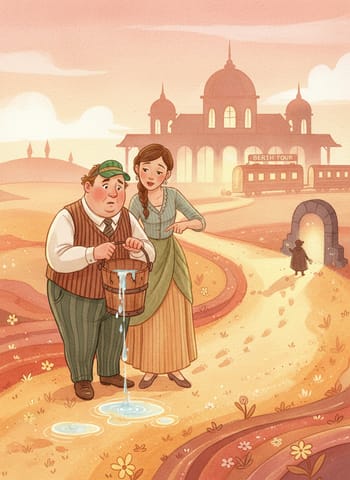
It hangs on a hook beside the back door, an old fire bucket, painted white and stamped with the word SAND. It was retired years ago because the bottom has rusted through. There is a hole in it about the size of a coin. Aksel takes it down and turns it over. A trickle of dust runs out through the hole, as thin and steady as water from a tap.
Está pendurado num gancho ao lado da porta dos fundos, um velho balde de incêndio, pintado de branco e marcado com a palavra AREIA. Foi aposentado anos atrás porque o fundo enferrujou e furou. Há um buraco nele do tamanho de uma moeda. Aksel o tira do gancho e o vira. Um fio de pó escorre pelo buraco, fino e constante como água de uma torneira.
He stands there for a long time, watching the dust fall onto the floor, and an idea arrives in his head.
Ele fica ali por muito tempo, olhando o pó cair no chão, e uma ideia surge em sua cabeça.
"Marit," he says. "What would happen if we used this?"
"Marit", diz ele. "O que aconteceria se usássemos isto?"
"It has a hole in it," she says. "It is rubbish."
"Está furado", diz ela. "É lixo."
"Exactly. It is a hole that leaks slowly and evenly. I fill it and hang it on a string from the ceiling hook, right above the cupboard door. Then anyone who opens that door will knock it, and it will swing. A sand bucket that swings and leaks will draw a line on the floor." He draws an invisible circle in the air with his finger. "Not chalk. Real sand, heavy enough to hold a print. And this time nobody will be allowed to clean up after us."
"Exatamente. É um buraco que vaza devagar e de maneira uniforme. Eu o encho e o penduro com um barbante no gancho do teto, bem acima da porta do armário. Aí qualquer um que abrir aquela porta vai esbarrar nele, e ele vai balançar. Um balde de areia que balança e vaza vai desenhar uma linha no chão." Ele desenha um círculo invisível no ar com o dedo. "Não giz. Areia de verdade, pesada o bastante para guardar uma pegada. E dessa vez ninguém vai poder limpar depois de nós."
"She will mop it at midnight," Marit says.
"Ela vai passar o esfregão à meia-noite", diz Marit.
"Not if we ask her to skip the hut tonight," Aksel says. "We tell her the floor is being treated."
"Não se pedirmos que pule a cabana esta noite", diz Aksel. "Dizemos a ela que o piso está sendo tratado."
Marit thinks about it. Then she smiles slowly.
Marit pensa a respeito. Então sorri devagar.
"It is a terrible plan," she says. "Let us do it."
"É um plano terrível", diz ela. "Vamos fazer."
That evening they fill the bucket to the brim with sand from the old bin on the quay. Aksel climbs onto a chair and ties the handle to the ceiling hook with a length of fishing line. Then he sets the bucket swaying, just enough to test it. Sand spills in a pale curve across the floorboards and stops when the swinging stops. Marit ties the other end of the line to the cupboard door, so that the first person to open it will set the bucket moving.
Naquela noite eles enchem o balde até a borda com areia da velha caixa no cais. Aksel sobe numa cadeira e amarra a alça no gancho do teto com um pedaço de linha de pesca. Depois põe o balde para balançar, só o suficiente para testar. A areia se derrama numa curva pálida sobre as tábuas do chão e para quando o balanço para. Marit amarra a outra ponta da linha na porta do armário, de modo que a primeira pessoa a abri-la ponha o balde em movimento.
They lock up at ten again, and this time Marit has a word with the night cleaner, who agrees to skip the hut. Then they go home.
Eles trancam tudo às dez de novo e, desta vez, Marit conversa com a faxineira da noite, que concorda em pular a cabana. Então vão para casa.
At seven the next morning, Aksel unlocks the door very slowly.
Às sete da manhã seguinte, Aksel destranca a porta bem devagar.
The bucket hangs motionless from the ceiling, almost empty. A broad arc of sand lies on the floor beneath it. In the middle of the arc, as clear as a signature, there is a footprint.
O balde pende imóvel do teto, quase vazio. Um amplo arco de areia cobre o chão embaixo dele. No meio do arco, nítida como uma assinatura, há uma pegada.
Marit comes in behind him and kneels down.
Marit entra atrás dele e se ajoelha.
"It is bare," she says. "A bare foot. And it is wet."
"É descalço", diz ela. "Um pé descalço. E está molhado."
There is a second print beside it, and then a third. The line of prints leads across the floorboards, from the window that faces the water, to the cupboard, and back again. Aksel follows them with his eyes to the windowsill. The glass is shut and locked from the inside. Under it, on the wooden ledge, lies a thin trail of seaweed.
Há uma segunda marca ao lado, e depois uma terceira. A fileira de pegadas atravessa o assoalho, da janela voltada para a água até o armário, e volta. Aksel as segue com os olhos até o parapeito. O vidro está fechado e trancado por dentro. Embaixo dele, na borda de madeira, há um fino rastro de alga marinha.
"That window has not been opened for years," he says.
"Aquela janela não é aberta há anos", diz ele.
"Then they did not need to open it," Marit says quietly.
"Então eles não precisaram abri-la", diz Marit em voz baixa.
She bends lower over the last print, the one nearest the sill, and she goes quiet. Beside the print of the large foot, half hidden under the edge of the sand, there is another. It is much smaller. It is the print of a child's foot, and it is pointing in the opposite direction, towards the sea.
Ela se curva mais sobre a última pegada, a mais próxima do parapeito, e fica em silêncio. Ao lado da marca do pé grande, meio escondida sob a borda da areia, há outra. É muito menor. É a marca do pé de uma criança, e aponta na direção oposta, para o mar.