The Wallet That Knew the Street
Uma história gratuita em inglês de nível B2 para estudantes, para ler online em 7 idiomas, com opção de ouvir no app gratuito Storyteller.
On the morning of a street party, a warm wallet holds a photograph of a party that has not happened yet.
Essa foi a prévia! Ouça a história completa no app gratuito Storyteller. Baixar o app
O áudio não está disponível no momento.
On the last Saturday of June, Fenwick Lane closed to traffic and turned into one long table. The tradition was older than anyone on the street could explain. Every shop carried its tables outside, every doorway wore a paper lantern, and by evening the whole lane smelled of grilled corn and warm sugar.
No último sábado de junho, a Fenwick Lane fechava para os carros e virava uma longa mesa. A tradição era mais antiga do que qualquer pessoa da rua conseguia explicar. Cada loja levava suas mesas para fora, cada soleira ganhava uma lanterna de papel, e ao entardecer a travessa inteira cheirava a milho assado e açúcar quente.
Corwin had been in charge of the decorations for fourteen years. He repaired clocks in a narrow shop at number nine. The other shopkeepers had decided long ago that a man who handled a hundred tiny springs could hang a few flags in a line. He did not argue with them. He liked the job.
Corwin cuidava das decorações havia catorze anos. Consertava relógios numa loja estreita no número nove. Os outros lojistas tinham decidido havia muito tempo que um homem que lidava com cem molinhas minúsculas podia pendurar algumas bandeirinhas em fila. Ele não discutia. Gostava do trabalho.
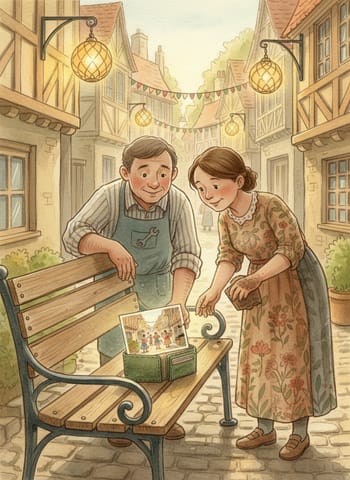
His routine never changed. At half past six he carried a stepladder and a crate of bunting down the lane. Then he bought a coffee from the kiosk at the corner and sat on the old iron bench outside the printer's to drink it. He always counted the flags on the crate before he started. There were always two hundred and twelve.
Sua rotina nunca mudava. Às seis e meia, levava uma escada e uma caixa de bandeirolas pela travessa. Depois comprava um café no quiosque da esquina e se sentava no velho banco de ferro diante da gráfica para tomá-lo. Sempre contava as bandeirinhas da caixa antes de começar. Eram sempre duzentas e doze.
That morning the bench was already occupied. A wallet lay on the seat, exactly where he usually put his cup.
Naquela manhã o banco já estava ocupado. Uma carteira estava sobre o assento, exatamente onde ele costumava pôr o copo.
It was an ordinary object at first glance: dark green leather, worn at the corners, closed with a small brass clasp. Corwin looked up and down the lane. The street was empty except for a man hosing the pavement outside the fish shop, and he was too far away to have noticed anything.
Era um objeto comum à primeira vista: couro verde-escuro, gasto nos cantos, fechado com um pequeno fecho de latão. Corwin olhou a travessa de ponta a ponta. A rua estava vazia, exceto por um homem que lavava a calçada com mangueira diante da peixaria, e ele estava longe demais para ter notado qualquer coisa.
He picked up the wallet, and it was warm. It was not the warmth of a pocket or of morning sunlight, but the slow, steady heat of something alive. He nearly dropped it.
Pegou a carteira, e ela estava quente. Não era o calor de um bolso nem da luz da manhã, mas o calor lento e constante de algo vivo. Quase a deixou cair.
"Do not be silly," he said aloud, and he opened the clasp.
"Não seja bobo", disse em voz alta, e abriu o fecho.
There was no money inside, and no cards, and no name. There was a single coin, thick and dull, stamped with the image of a lamp post that he did not recognise. There was a ticket stub printed with the words ADMIT ONE TO THE LANE. And there was a photograph.
Não havia dinheiro dentro, nem cartões, nem nome. Havia uma única moeda, grossa e opaca, estampada com a imagem de um poste de luz que ele não reconheceu. Havia um canhoto de ingresso impresso com as palavras ENTRADA PARA UMA PESSOA NA TRAVESSA. E havia uma fotografia.
The photograph showed Fenwick Lane at the height of a party. Paper lanterns were glowing in the dusk, tables ran the whole length of the street and hundreds of people were laughing at once. In the front, outside the clock shop, stood Corwin himself, holding a plate of corn and looking surprised. Next to him, with a lantern in her hands, stood Irene from the plant shop.
A fotografia mostrava a Fenwick Lane no auge de uma festa. Lanternas de papel brilhavam no crepúsculo, mesas se estendiam por toda a rua e centenas de pessoas riam ao mesmo tempo. Na frente, diante da relojoaria, estava o próprio Corwin, segurando um prato de milho e parecendo surpreso. Ao lado dele, com uma lanterna nas mãos, estava Irene, da loja de plantas.
Corwin turned the picture over. On the back, in small blue handwriting, someone had written the date. It was today's date.
Corwin virou a imagem. No verso, em letrinhas azuis, alguém havia escrito a data. Era a data de hoje.
"Interesting," he said, in the voice he used when a customer brought in a watch that ran backwards.
"Interessante", disse, na voz que usava quando um cliente trazia um relógio que andava para trás.
He was still staring at it when Irene arrived, pushing a trolley of potted ferns. She was a tall woman with soil under her fingernails, and she had never been known to walk past an interesting problem.
Ainda a encarava quando Irene chegou, empurrando um carrinho de samambaias em vasos. Era uma mulher alta, com terra debaixo das unhas, e nunca se soube que tivesse passado direto por um problema interessante.
"You look like you have seen a ghost," she said. "Have you?"
"Você parece ter visto um fantasma", disse ela. "Viu?"
"Not yet," Corwin said. He held out the photograph.
"Ainda não", disse Corwin. Estendeu a fotografia.
Irene studied it for a long time. Then she took a pair of reading glasses from her apron pocket, put them on and studied it again.
Irene a estudou por um bom tempo. Depois tirou um par de óculos de leitura do bolso do avental, colocou-os e a estudou de novo.
"That is my lantern," she said. "I only bought it on Thursday. It has never been outside the shop." She pointed at the edge of the picture. "And what is that?"
"Aquela é a minha lanterna", disse. "Só a comprei na quinta-feira. Nunca saiu da loja." Apontou para a beira da imagem. "E o que é aquilo?"
Corwin leaned closer. Between his clock shop and the plant shop, in the photograph, there was a third building. It was narrow, with a green door and a round window above it. The lantern light fell across its step as if it had always been there.
Corwin se inclinou. Entre a relojoaria e a loja de plantas, na fotografia, havia um terceiro prédio. Era estreito, com uma porta verde e uma janela redonda acima dela. A luz das lanternas caía sobre o degrau como se ele sempre tivesse estado ali.
"There is no building between us," Irene said slowly. "There is only the gap. I keep my bicycle in that gap."
"Não há prédio nenhum entre nós", disse Irene devagar. "Só o vão. Guardo minha bicicleta nesse vão."
"I know," Corwin said. "I have walked past it for fourteen years."
"Eu sei", disse Corwin. "Passo por ele há catorze anos."
They looked at each other. Then, without discussing it, they walked together to the narrow passage between their two shops. It was exactly as they remembered it: a strip of shadow, a drainpipe, a bicycle chained to a hook. The brick wall at the end of it was damp and plain.
Entreolharam-se. Então, sem combinar, foram juntos até a passagem estreita entre as duas lojas. Estava exatamente como lembravam: uma faixa de sombra, um cano de descida, uma bicicleta presa a um gancho. A parede de tijolos no fundo estava úmida e lisa.
"Perhaps the photograph was taken from a different street," Irene said. "Perhaps it is a trick."
"Talvez a fotografia tenha sido tirada de outra rua", disse Irene. "Talvez seja um truque."
"Perhaps," Corwin said. "But who would trick two shopkeepers with a warm wallet?"
"Talvez", disse Corwin. "Mas quem enganaria dois lojistas com uma carteira quente?"
They did what any sensible person would do. They carried the wallet down the lane and asked everyone. The fish seller said he had never seen it before. The printer said it was too clean to be lost by one of his customers. The woman who ran the kiosk held it for a moment, went very quiet and handed it straight back without a word.
Fizeram o que qualquer pessoa sensata faria. Levaram a carteira pela travessa e perguntaram a todos. O peixeiro disse que nunca a tinha visto. O gráfico disse que estava limpa demais para ter sido perdida por um de seus clientes. A mulher do quiosque a segurou por um instante, ficou muito quieta e a devolveu na hora, sem dizer uma palavra.
"She knows something," Irene whispered.
"Ela sabe de alguma coisa", sussurrou Irene.
"She knows she does not want it," Corwin said.
"Ela sabe que não a quer", disse Corwin.
By ten o'clock the tables were up, and the bunting hung in perfect lines from the lamp posts. The two hundred and twelfth flag was tied to the last post. For the first time in fourteen years, Corwin did not feel proud of it. He kept thinking about the coin. He had weighed it on the small scale in his shop. It had looked as light as a wedding ring, yet it had made the whole scale tilt as if it weighed a kilo.
Às dez horas as mesas estavam postas, e as bandeirinhas pendiam em linhas perfeitas dos postes. A bandeirinha duzentos e doze foi amarrada no último poste. Pela primeira vez em catorze anos, Corwin não sentiu orgulho disso. Não parava de pensar na moeda. Ele a pesara na balança pequena da loja. Parecia leve como uma aliança de casamento, mas tinha feito a balança inteira pender como se pesasse um quilo.
At noon, Irene brought him a sandwich and sat beside him on the iron bench.
Ao meio-dia, Irene lhe trouxe um sanduíche e sentou ao lado dele no banco de ferro.
"If it were my wallet," she said, "I would want someone to try the obvious thing."
"Se fosse a minha carteira", disse, "eu gostaria que alguém tentasse o óbvio."
"What is the obvious thing?"
"O que é o óbvio?"
"Show it the gap," she said.
"Mostrar a ela o vão", disse ela.
It sounded ridiculous, and they both knew it. But they walked back to the passage anyway, and Corwin held the wallet out in front of him like a man carrying a candle. The brass clasp began to tick softly, and the coin inside rang against the leather, a small clear note, like a spoon against a glass.
Parecia ridículo, e os dois sabiam. Mas voltaram à passagem mesmo assim, e Corwin estendeu a carteira à frente como um homem carregando uma vela. O fecho de latão começou a fazer tique-taque baixinho, e a moeda lá dentro tilintou contra o couro, uma notinha clara, como uma colher num copo.
Nothing else happened. The wall stayed a wall. The bicycle stayed on its hook. Yet for a moment, the shadow at the end of the passage seemed to deepen into the shape of a doorway. Corwin felt a faint cool breath on his face, the kind that comes from a cellar.
Nada mais aconteceu. A parede continuou sendo parede. A bicicleta continuou no gancho. Porém, por um momento, a sombra no fundo da passagem pareceu se aprofundar na forma de uma porta. Corwin sentiu um leve sopro frio no rosto, do tipo que vem de um porão.
Then the feeling stopped. The clasp fell silent, and the wallet went back to being merely warm.
Então a sensação passou. O fecho se calou, e a carteira voltou a ser apenas morna.
"Well," Irene said, a little hoarsely. "That was something."
"Bem", disse Irene, um pouco rouca. "Isso foi alguma coisa."
"It was," Corwin said. "I think it was a greeting."
"Foi", disse Corwin. "Acho que foi um cumprimento."
They said nothing more about it for the rest of the afternoon. The party began on time, as it always did. The lanterns were lit at dusk, and the lane filled with people carrying plates of food from table to table. Corwin stood outside his shop with a plate of grilled corn, and Irene stood next to him with her lantern. For a while they were simply two neighbours enjoying a party.
Não falaram mais nada sobre isso pelo resto da tarde. A festa começou na hora, como sempre. As lanternas foram acesas ao anoitecer, e a travessa se encheu de gente levando pratos de comida de mesa em mesa. Corwin ficou diante da loja com um prato de milho assado, e Irene ficou ao lado com sua lanterna. Por um tempo, eram apenas dois vizinhos aproveitando uma festa.
It was only when the first song started that Corwin put his hand in his pocket and felt the wallet again, warmer than ever. He drew out the photograph and held it up to the light of the nearest lantern.
Só quando a primeira música começou, Corwin pôs a mão no bolso e sentiu a carteira de novo, mais quente do que nunca. Tirou a fotografia e a ergueu à luz da lanterna mais próxima.
The picture had changed.
A imagem tinha mudado.
It still showed the lane, the tables and the crowd. But the two figures in front of the clock shop were no longer smiling. They were looking down at something small in their hands. Corwin was holding a photograph, and Irene was leaning over his shoulder to see it. The date on the back had changed too, and now the writing was fresh and wet.
Ainda mostrava a travessa, as mesas e a multidão. Mas as duas figuras diante da relojoaria já não sorriam. Olhavam para algo pequeno em suas mãos. Corwin segurava uma fotografia, e Irene se debruçava sobre o ombro dele para vê-la. A data no verso também tinha mudado, e agora a escrita estava fresca e molhada.
Irene saw it at the same moment. She did not scream, and she did not drop her lantern. She only took a slow breath and spoke very quietly, so that the singers would not hear.
Irene viu no mesmo instante. Não gritou, nem deixou a lanterna cair. Apenas respirou fundo, devagar, e falou muito baixo, para que os cantores não ouvissem.
"Corwin," she said, "if we are both standing here, then who is taking the picture?"
"Corwin", disse, "se nós dois estamos aqui, então quem está tirando a fotografia?"