The Wallet That Knew the Street
A free B2-level English story for language learners, readable online in 7 languages, with an option to listen via the free Storyteller app.
On the morning of a street party, a warm wallet holds a photograph of a party that has not happened yet.
That was the preview! Hear the full story in the free Storyteller app. Get the app
Audio isn't available right now.
On the last Saturday of June, Fenwick Lane closed to traffic and turned into one long table. The tradition was older than anyone on the street could explain. Every shop carried its tables outside, every doorway wore a paper lantern, and by evening the whole lane smelled of grilled corn and warm sugar.
Corwin had been in charge of the decorations for fourteen years. He repaired clocks in a narrow shop at number nine. The other shopkeepers had decided long ago that a man who handled a hundred tiny springs could hang a few flags in a line. He did not argue with them. He liked the job.
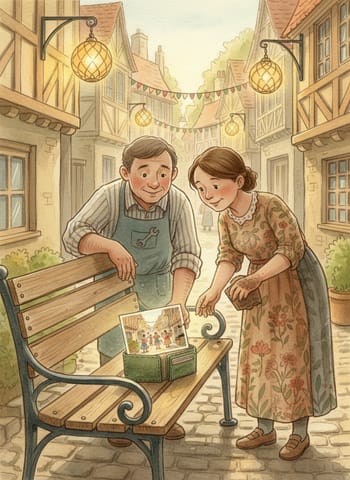
His routine never changed. At half past six he carried a stepladder and a crate of bunting down the lane. Then he bought a coffee from the kiosk at the corner and sat on the old iron bench outside the printer's to drink it. He always counted the flags on the crate before he started. There were always two hundred and twelve.
That morning the bench was already occupied. A wallet lay on the seat, exactly where he usually put his cup.
It was an ordinary object at first glance: dark green leather, worn at the corners, closed with a small brass clasp. Corwin looked up and down the lane. The street was empty except for a man hosing the pavement outside the fish shop, and he was too far away to have noticed anything.
He picked up the wallet, and it was warm. It was not the warmth of a pocket or of morning sunlight, but the slow, steady heat of something alive. He nearly dropped it.
"Do not be silly," he said aloud, and he opened the clasp.
There was no money inside, and no cards, and no name. There was a single coin, thick and dull, stamped with the image of a lamp post that he did not recognise. There was a ticket stub printed with the words ADMIT ONE TO THE LANE. And there was a photograph.
The photograph showed Fenwick Lane at the height of a party. Paper lanterns were glowing in the dusk, tables ran the whole length of the street and hundreds of people were laughing at once. In the front, outside the clock shop, stood Corwin himself, holding a plate of corn and looking surprised. Next to him, with a lantern in her hands, stood Irene from the plant shop.
Corwin turned the picture over. On the back, in small blue handwriting, someone had written the date. It was today's date.
"Interesting," he said, in the voice he used when a customer brought in a watch that ran backwards.
He was still staring at it when Irene arrived, pushing a trolley of potted ferns. She was a tall woman with soil under her fingernails, and she had never been known to walk past an interesting problem.
"You look like you have seen a ghost," she said. "Have you?"
"Not yet," Corwin said. He held out the photograph.
Irene studied it for a long time. Then she took a pair of reading glasses from her apron pocket, put them on and studied it again.
"That is my lantern," she said. "I only bought it on Thursday. It has never been outside the shop." She pointed at the edge of the picture. "And what is that?"
Corwin leaned closer. Between his clock shop and the plant shop, in the photograph, there was a third building. It was narrow, with a green door and a round window above it. The lantern light fell across its step as if it had always been there.
"There is no building between us," Irene said slowly. "There is only the gap. I keep my bicycle in that gap."
"I know," Corwin said. "I have walked past it for fourteen years."
They looked at each other. Then, without discussing it, they walked together to the narrow passage between their two shops. It was exactly as they remembered it: a strip of shadow, a drainpipe, a bicycle chained to a hook. The brick wall at the end of it was damp and plain.
"Perhaps the photograph was taken from a different street," Irene said. "Perhaps it is a trick."
"Perhaps," Corwin said. "But who would trick two shopkeepers with a warm wallet?"
They did what any sensible person would do. They carried the wallet down the lane and asked everyone. The fish seller said he had never seen it before. The printer said it was too clean to be lost by one of his customers. The woman who ran the kiosk held it for a moment, went very quiet and handed it straight back without a word.
"She knows something," Irene whispered.
"She knows she does not want it," Corwin said.
By ten o'clock the tables were up, and the bunting hung in perfect lines from the lamp posts. The two hundred and twelfth flag was tied to the last post. For the first time in fourteen years, Corwin did not feel proud of it. He kept thinking about the coin. He had weighed it on the small scale in his shop. It had looked as light as a wedding ring, yet it had made the whole scale tilt as if it weighed a kilo.
At noon, Irene brought him a sandwich and sat beside him on the iron bench.
"If it were my wallet," she said, "I would want someone to try the obvious thing."
"What is the obvious thing?"
"Show it the gap," she said.
It sounded ridiculous, and they both knew it. But they walked back to the passage anyway, and Corwin held the wallet out in front of him like a man carrying a candle. The brass clasp began to tick softly, and the coin inside rang against the leather, a small clear note, like a spoon against a glass.
Nothing else happened. The wall stayed a wall. The bicycle stayed on its hook. Yet for a moment, the shadow at the end of the passage seemed to deepen into the shape of a doorway. Corwin felt a faint cool breath on his face, the kind that comes from a cellar.
Then the feeling stopped. The clasp fell silent, and the wallet went back to being merely warm.
"Well," Irene said, a little hoarsely. "That was something."
"It was," Corwin said. "I think it was a greeting."
They said nothing more about it for the rest of the afternoon. The party began on time, as it always did. The lanterns were lit at dusk, and the lane filled with people carrying plates of food from table to table. Corwin stood outside his shop with a plate of grilled corn, and Irene stood next to him with her lantern. For a while they were simply two neighbours enjoying a party.
It was only when the first song started that Corwin put his hand in his pocket and felt the wallet again, warmer than ever. He drew out the photograph and held it up to the light of the nearest lantern.
The picture had changed.
It still showed the lane, the tables and the crowd. But the two figures in front of the clock shop were no longer smiling. They were looking down at something small in their hands. Corwin was holding a photograph, and Irene was leaning over his shoulder to see it. The date on the back had changed too, and now the writing was fresh and wet.
Irene saw it at the same moment. She did not scream, and she did not drop her lantern. She only took a slow breath and spoke very quietly, so that the singers would not hear.
"Corwin," she said, "if we are both standing here, then who is taking the picture?"