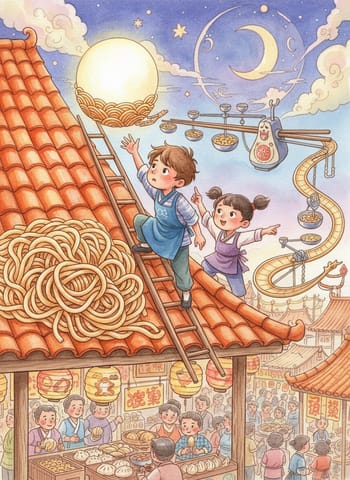
The Moon Ball on the Noodle Roof
A free B2-level English story for language learners, readable online in 7 languages, with an option to listen via the free Storyteller app.
Minutes before midnight, a young helper loses the glowing ball that lights his night market, and a friend spots an unlikely way to get it back in time.
That was the preview! Hear the full story in the free Storyteller app. Get the app
Audio isn't available right now.
Every night, the market on Lantern Row wakes up the same way. At the stroke of midnight, a glass ball the size of a melon is set into a stone cradle beside the fountain. Every lamp along the food row lights at once. The ball is called the Moon Ball. It has been carried from the lamp-keeper's house to the fountain by a young helper for as long as anyone can remember.
This month, the helper is Joost. He is fifteen, he is proud of the job, and he is also a little bored by it.
Tonight he walks down the row at a quarter to midnight with the ball cradled in both arms. It hums softly and gives off a pale glow, and it weighs almost nothing. The cooks greet him as he passes. Steam rises from dumpling baskets, oil spits in the woks, and the smell of grilled spice hangs in the air.
Lia, who runs messages for the stall owners, falls into step beside him. "You are early," she says. "Usually you arrive with two minutes to spare."
"I am a changed man," Joost says. Then he sees a group of children watching him from the steps of the noodle stall, and the old urge to show off takes over.
"Watch this," he whispers. He tosses the ball up and bounces it once off his knee.
"Joost, don't," Lia says.
It is too late. The ball spins higher than he intended, hits the edge of the noodle stall's tiled roof and rolls up the slope. It comes to rest behind the painted sign at the very top, where the roof tiles meet in a ridge. It sits there, glowing gently, as if it enjoys the view.
For a moment, neither of them speaks. The children on the steps go quiet.
"What time is it?" Joost asks at last.
Lia checks the clock above the spice seller's door. "Nine minutes to midnight," she says. "If the Moon Ball is not in the cradle when the bell rings, the lamps stay dark."
"For tonight?"
"For the whole month. That is the rule. The market would have to close until the next full moon." She stares at the roof. "Every cook on this street would lose a month of work because you wanted to look clever."
Joost does not argue. He is already counting. The fountain is at the far end of the row, and the row is two hundred paces long. On a quiet night, the walk takes five minutes. At midnight on a busy Saturday, with a crowd packed shoulder to shoulder between the stalls, it takes twice as long.
"We cannot carry it through that," he says. "If we ran, we would be stopped by the first big family with a pushchair."
"Then we have to be quicker than walking," Lia says.
First, though, they have to get the ball down. Joost climbs onto a stack of crates beside the noodle stall. The cook, a round woman with strong forearms, hands him a long wooden ladle without being asked. He stretches up and taps the ball with the end of it. It wobbles, but it does not come down. He taps again, a little harder.
"Gently," Lia calls. "It is not a drum."
The ball rolls two hand-widths along the ridge and tumbles off the back of the roof. Joost feels his stomach drop. Then he hears a rattling sound and a high, bright hum, and he realises that the ball has not fallen to the ground at all.
Behind the stalls, a long tin trough runs along the back wall of the whole food row. The cooks use it to carry wash water away from their pots. It is built to slope gently downhill, from the first stall to the last. The Moon Ball has landed in it and is rolling.
"Lia!" Joost shouts. "Look at it go!"
Lia looks. She watches the glow slide past the first stove, the second stove and the cluster of steaming barrels. Then she grins, and she grabs Joost by the sleeve.
"The trough ends at the fountain," she says. "I have seen the cooks tip their buckets into it a hundred times. Everything that goes in at this end comes out at the other."
"So we do not carry it," Joost says slowly. "We follow it."
They run. There is a narrow service lane behind the stalls, hardly wide enough for one person. It is full of crates and sleeping cats. Lia leads, because she knows every turn of it from her errands. Joost follows with his eyes fixed on the little light skimming along the tin beside them.
The ball is faster than they expected. It hums louder as it gains speed, and it throws a moving shadow across the wall. A cook hanging washing on a line looks up and drops a shirt. A boy carrying a tray of fruit sticks flattens himself against the wall to let them pass.
"Ten stalls," Lia gasps. "We are halfway."
"What time?" Joost asks.
"I cannot look at a clock and run at the same time!"
Then the trough bends. At the corner behind the pickle seller, the old tin has been patched with a pot lid. The join sticks up like a small step. The ball strikes it, jumps, and lands on the wrong side. It rolls off the trough and bounces across the cobbles of the lane.
Joost dives and misses. Lia steps over a basket, scoops the ball out of the air with both hands and stumbles into the wall, laughing and out of breath.
"Got it," she says. "Now we are carrying it, so we are slow again."
"Not necessarily." Joost points past her shoulder. Beyond the end of the lane, the food row meets the square, and the fountain is plainly visible. The cradle is a pale shape against the dark water. The crowd is thick around it, because everyone is waiting for the lamps.
"We cannot cross that," Lia says. "Nobody will move until the lamps are lit."
"Then we must reach it without pushing through everyone." Joost thinks for a second. "Who sets the lamps in the first place?"
"The lamp-keeper," Lia says. "He waits on the wall behind the cradle, with the long taper."
"And that wall has a stair at the back," Joost says. "I use it every night."
They go around behind the fountain, up the narrow stair and onto the low wall. From above, the whole square looks like a field of upturned faces. The lamp-keeper, a tall man with a taper in his hand, stares at them with his mouth open. Somewhere below, a bell begins to swing.
"Joost!" the lamp-keeper hisses. "The ball!"
Joost takes it from Lia, leans over the cradle and lowers it into the stone hollow with both hands. It settles with a deep, soft chime, like a note from a bowl. For one long heartbeat, nothing happens.
Then, all along the food row, two hundred lamps wake together. The street rises out of the darkness in gold and amber, and the crowd gasps and cheers. The first stroke of midnight is still ringing in the air.
The lamp-keeper lowers his taper and looks from one of them to the other. "You cut that very close," he says. "Do I want to know why?"
"No," Joost says at once.
"A bit," Lia says. She is still holding her side, and she is still laughing. She looks at Joost, who is staring at his own shaking hands, and she pats him on the shoulder.
"Next time you want to show off," she says, "try it with a dumpling."