The Moon Ball on the Noodle Roof
Cerita bahasa Inggris gratis level B2 untuk pelajar, bisa dibaca online dalam 7 bahasa, dengan pilihan untuk mendengarkannya di aplikasi Storyteller gratis.
Minutes before midnight, a young helper loses the glowing ball that lights his night market, and a friend spots an unlikely way to get it back in time.
Itu cuplikannya! Dengarkan cerita lengkapnya di aplikasi Storyteller gratis. Unduh aplikasi
Audio belum tersedia saat ini.
Every night, the market on Lantern Row wakes up the same way. At the stroke of midnight, a glass ball the size of a melon is set into a stone cradle beside the fountain. Every lamp along the food row lights at once. The ball is called the Moon Ball. It has been carried from the lamp-keeper's house to the fountain by a young helper for as long as anyone can remember.
Setiap malam, pasar di Lantern Row terbangun dengan cara yang sama. Tepat tengah malam, sebuah bola kaca sebesar melon diletakkan pada ayunan batu di samping air mancur. Setiap lampu di sepanjang deretan kedai makanan menyala serentak. Bola itu dinamai Bola Bulan. Selama yang bisa diingat siapa pun, bola itu selalu dibawa dari rumah penjaga lampu ke air mancur oleh seorang pembantu muda.
This month, the helper is Joost. He is fifteen, he is proud of the job, and he is also a little bored by it.
Bulan ini, pembantunya adalah Joost. Ia lima belas tahun, bangga dengan tugasnya, dan sekaligus agak bosan.
Tonight he walks down the row at a quarter to midnight with the ball cradled in both arms. It hums softly and gives off a pale glow, and it weighs almost nothing. The cooks greet him as he passes. Steam rises from dumpling baskets, oil spits in the woks, and the smell of grilled spice hangs in the air.
Malam ini ia berjalan menyusuri deretan itu pada pukul seperempat sebelum tengah malam sambil menimang bola itu dengan kedua lengan. Bola itu berdengung lembut dan memancarkan cahaya pucat, dan beratnya hampir tak ada. Para juru masak menyapanya ketika ia lewat. Uap naik dari keranjang-keranjang pangsit, minyak mendesis di wajan, dan bau rempah panggang menggantung di udara.
Lia, who runs messages for the stall owners, falls into step beside him. "You are early," she says. "Usually you arrive with two minutes to spare."
Lia, yang menjadi pengantar pesan bagi para pemilik kedai, berjalan menyejajarinya. "Kamu datang lebih awal," katanya. "Biasanya kamu tiba dengan sisa waktu dua menit."
"I am a changed man," Joost says. Then he sees a group of children watching him from the steps of the noodle stall, and the old urge to show off takes over.
"Aku sudah berubah," kata Joost. Lalu ia melihat sekelompok anak memperhatikannya dari tangga kedai mi, dan dorongan lama untuk pamer pun mengambil alih.
"Watch this," he whispers. He tosses the ball up and bounces it once off his knee.
"Lihat ini," bisiknya. Ia melempar bola itu ke atas dan memantulkannya sekali dari lututnya.
"Joost, don't," Lia says.
"Joost, jangan," kata Lia.
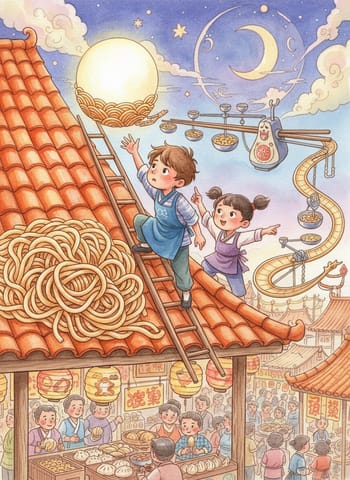
It is too late. The ball spins higher than he intended, hits the edge of the noodle stall's tiled roof and rolls up the slope. It comes to rest behind the painted sign at the very top, where the roof tiles meet in a ridge. It sits there, glowing gently, as if it enjoys the view.
Sudah terlambat. Bola itu berputar lebih tinggi daripada yang ia maksudkan, menghantam tepi atap genteng kedai mi dan menggelinding naik di lerengnya. Bola itu berhenti di balik papan nama bercat di puncak paling atas, tempat genteng-genteng bertemu membentuk bubungan. Bola itu duduk di sana, bersinar lembut, seolah menikmati pemandangan.
For a moment, neither of them speaks. The children on the steps go quiet.
Sesaat, tak seorang pun dari mereka berbicara. Anak-anak di tangga terdiam.
"What time is it?" Joost asks at last.
"Jam berapa sekarang?" tanya Joost akhirnya.
Lia checks the clock above the spice seller's door. "Nine minutes to midnight," she says. "If the Moon Ball is not in the cradle when the bell rings, the lamps stay dark."
Lia memeriksa jam di atas pintu penjual rempah. "Sembilan menit menjelang tengah malam," katanya. "Kalau Bola Bulan tidak ada di ayunannya saat lonceng berbunyi, lampu-lampu tetap padam."
"For tonight?"
"Untuk malam ini?"
"For the whole month. That is the rule. The market would have to close until the next full moon." She stares at the roof. "Every cook on this street would lose a month of work because you wanted to look clever."
"Untuk sebulan penuh. Itu aturannya. Pasar harus tutup sampai bulan purnama berikutnya." Ia menatap atap itu. "Setiap juru masak di jalan ini akan kehilangan pekerjaan sebulan penuh karena kamu ingin kelihatan hebat."
Joost does not argue. He is already counting. The fountain is at the far end of the row, and the row is two hundred paces long. On a quiet night, the walk takes five minutes. At midnight on a busy Saturday, with a crowd packed shoulder to shoulder between the stalls, it takes twice as long.
Joost tidak membantah. Ia sudah berhitung. Air mancur berada di ujung deretan, dan deretan itu sepanjang dua ratus langkah. Pada malam yang tenang, berjalan di sana butuh lima menit. Pada tengah malam Sabtu yang ramai, dengan kerumunan berdesakan bahu ke bahu di antara kedai-kedai, butuh dua kali lipatnya.
"We cannot carry it through that," he says. "If we ran, we would be stopped by the first big family with a pushchair."
"Kita tidak bisa membawanya lewat situ," katanya. "Kalau kita berlari, kita akan dihentikan oleh keluarga besar pertama yang mendorong kereta bayi."
"Then we have to be quicker than walking," Lia says.
"Kalau begitu kita harus lebih cepat daripada berjalan," kata Lia.
First, though, they have to get the ball down. Joost climbs onto a stack of crates beside the noodle stall. The cook, a round woman with strong forearms, hands him a long wooden ladle without being asked. He stretches up and taps the ball with the end of it. It wobbles, but it does not come down. He taps again, a little harder.
Namun pertama-tama, mereka harus menurunkan bola itu. Joost memanjat tumpukan peti di samping kedai mi. Sang juru masak, perempuan bertubuh bulat dengan lengan bawah kuat, menyodorkan sebuah sendok kayu panjang tanpa diminta. Ia menjangkau ke atas dan menyentuh bola itu dengan ujungnya. Bola itu bergoyang, tetapi tidak turun. Ia menyentuhnya lagi, sedikit lebih keras.
"Gently," Lia calls. "It is not a drum."
"Pelan-pelan," seru Lia. "Itu bukan gendang."
The ball rolls two hand-widths along the ridge and tumbles off the back of the roof. Joost feels his stomach drop. Then he hears a rattling sound and a high, bright hum, and he realises that the ball has not fallen to the ground at all.
Bola itu menggelinding sejauh dua lebar telapak tangan di sepanjang bubungan dan jatuh dari belakang atap. Perut Joost serasa merosot. Lalu ia mendengar suara bergemerincing dan dengung tinggi yang cerah, dan ia sadar bahwa bola itu sama sekali tidak jatuh ke tanah.
Behind the stalls, a long tin trough runs along the back wall of the whole food row. The cooks use it to carry wash water away from their pots. It is built to slope gently downhill, from the first stall to the last. The Moon Ball has landed in it and is rolling.
Di belakang kedai-kedai, sebuah talang seng panjang membentang di sepanjang dinding belakang seluruh deretan makanan. Para juru masak memakainya untuk mengalirkan air cucian dari panci-panci mereka. Talang itu dibuat melandai pelan ke bawah, dari kedai pertama sampai kedai terakhir. Bola Bulan mendarat di dalamnya dan menggelinding.
"Lia!" Joost shouts. "Look at it go!"
"Lia!" teriak Joost. "Lihat dia meluncur!"
Lia looks. She watches the glow slide past the first stove, the second stove and the cluster of steaming barrels. Then she grins, and she grabs Joost by the sleeve.
Lia melihat. Ia memperhatikan cahaya itu meluncur melewati tungku pertama, tungku kedua, dan kelompok tong yang mengepul. Lalu ia nyengir dan mencengkeram lengan baju Joost.
"The trough ends at the fountain," she says. "I have seen the cooks tip their buckets into it a hundred times. Everything that goes in at this end comes out at the other."
"Talang itu berakhir di air mancur," katanya. "Aku sudah seratus kali melihat para juru masak menuangkan ember mereka ke situ. Segala yang masuk di ujung ini keluar di ujung yang lain."
"So we do not carry it," Joost says slowly. "We follow it."
"Jadi kita tidak membawanya," kata Joost perlahan. "Kita mengikutinya."
They run. There is a narrow service lane behind the stalls, hardly wide enough for one person. It is full of crates and sleeping cats. Lia leads, because she knows every turn of it from her errands. Joost follows with his eyes fixed on the little light skimming along the tin beside them.
Mereka berlari. Ada lorong layanan sempit di belakang kedai-kedai, nyaris tak cukup lebar untuk satu orang. Lorong itu penuh peti dan kucing-kucing yang tidur. Lia memimpin, karena ia hafal setiap beloknya dari tugas-tugas antarnya. Joost mengikuti dengan mata terpaku pada cahaya kecil yang meluncur di atas seng di sebelah mereka.
The ball is faster than they expected. It hums louder as it gains speed, and it throws a moving shadow across the wall. A cook hanging washing on a line looks up and drops a shirt. A boy carrying a tray of fruit sticks flattens himself against the wall to let them pass.
Bola itu lebih cepat daripada dugaan mereka. Dengungnya makin keras seiring bertambahnya kecepatan, dan ia melemparkan bayangan yang bergerak ke dinding. Seorang juru masak yang sedang menjemur pakaian di tali menengadah dan menjatuhkan sehelai kemeja. Seorang anak laki-laki yang membawa nampan sate buah menempelkan diri ke dinding untuk memberi jalan.
"Ten stalls," Lia gasps. "We are halfway."
"Sepuluh kedai," Lia terengah. "Kita sudah separuh jalan."
"What time?" Joost asks.
"Jam berapa?" tanya Joost.
"I cannot look at a clock and run at the same time!"
"Aku tidak bisa melihat jam sambil berlari!"
Then the trough bends. At the corner behind the pickle seller, the old tin has been patched with a pot lid. The join sticks up like a small step. The ball strikes it, jumps, and lands on the wrong side. It rolls off the trough and bounces across the cobbles of the lane.
Lalu talang itu berbelok. Di tikungan di belakang penjual acar, seng tua itu telah ditambal dengan tutup panci. Sambungannya mencuat seperti anak tangga kecil. Bola itu menghantamnya, melompat, dan mendarat di sisi yang salah. Bola itu keluar dari talang dan memantul di atas batu-batu bulat lorong.
Joost dives and misses. Lia steps over a basket, scoops the ball out of the air with both hands and stumbles into the wall, laughing and out of breath.
Joost menyelam dan meleset. Lia melangkahi sebuah keranjang, menyambar bola itu dari udara dengan kedua tangan, dan terhuyung ke dinding, tertawa dan kehabisan napas.
"Got it," she says. "Now we are carrying it, so we are slow again."
"Dapat," katanya. "Sekarang kita yang membawanya, jadi kita lambat lagi."
"Not necessarily." Joost points past her shoulder. Beyond the end of the lane, the food row meets the square, and the fountain is plainly visible. The cradle is a pale shape against the dark water. The crowd is thick around it, because everyone is waiting for the lamps.
"Belum tentu." Joost menunjuk melewati bahunya. Di balik ujung lorong, deretan makanan bertemu alun-alun, dan air mancur terlihat jelas. Ayunan itu berupa bentuk pucat di hadapan air yang gelap. Kerumunan padat mengelilinginya, karena semua orang menunggu lampu-lampu.
"We cannot cross that," Lia says. "Nobody will move until the lamps are lit."
"Kita tidak bisa menyeberangi itu," kata Lia. "Tak seorang pun akan bergeser sampai lampu-lampu menyala."
"Then we must reach it without pushing through everyone." Joost thinks for a second. "Who sets the lamps in the first place?"
"Kalau begitu kita harus sampai ke sana tanpa mendesak semua orang." Joost berpikir sebentar. "Siapa yang menyalakan lampu-lampu itu sejak awal?"
"The lamp-keeper," Lia says. "He waits on the wall behind the cradle, with the long taper."
"Penjaga lampu," kata Lia. "Dia menunggu di atas tembok di belakang ayunan, dengan sumbu panjang."
"And that wall has a stair at the back," Joost says. "I use it every night."
"Dan tembok itu punya tangga di belakangnya," kata Joost. "Aku memakainya setiap malam."
They go around behind the fountain, up the narrow stair and onto the low wall. From above, the whole square looks like a field of upturned faces. The lamp-keeper, a tall man with a taper in his hand, stares at them with his mouth open. Somewhere below, a bell begins to swing.
Mereka berputar ke belakang air mancur, naik tangga sempit, lalu ke atas tembok rendah. Dari atas, seluruh alun-alun tampak seperti ladang wajah-wajah yang menengadah. Penjaga lampu, lelaki jangkung dengan sumbu di tangannya, menatap mereka dengan mulut ternganga. Di suatu tempat di bawah, sebuah lonceng mulai berayun.
"Joost!" the lamp-keeper hisses. "The ball!"
"Joost!" desis si penjaga lampu. "Bolanya!"
Joost takes it from Lia, leans over the cradle and lowers it into the stone hollow with both hands. It settles with a deep, soft chime, like a note from a bowl. For one long heartbeat, nothing happens.
Joost mengambilnya dari Lia, membungkuk di atas ayunan, dan menurunkannya ke cekungan batu dengan kedua tangan. Bola itu mendarat dengan denting lembut yang dalam, seperti nada dari sebuah mangkuk. Selama satu detak jantung yang panjang, tidak terjadi apa-apa.
Then, all along the food row, two hundred lamps wake together. The street rises out of the darkness in gold and amber, and the crowd gasps and cheers. The first stroke of midnight is still ringing in the air.
Lalu, di sepanjang deretan makanan, dua ratus lampu terbangun bersama-sama. Jalan itu muncul dari kegelapan dalam warna emas dan jingga, dan kerumunan terkesiap lalu bersorak. Dentang pertama tengah malam masih menggema di udara.
The lamp-keeper lowers his taper and looks from one of them to the other. "You cut that very close," he says. "Do I want to know why?"
Penjaga lampu menurunkan sumbunya dan memandang mereka bergantian. "Kalian nyaris terlambat," katanya. "Apa aku mau tahu alasannya?"
"No," Joost says at once.
"Tidak," kata Joost segera.
"A bit," Lia says. She is still holding her side, and she is still laughing. She looks at Joost, who is staring at his own shaking hands, and she pats him on the shoulder.
"Sedikit," kata Lia. Ia masih memegangi perutnya, dan masih tertawa. Ia memandang Joost, yang menatap tangannya sendiri yang gemetar, lalu menepuk bahunya.
"Next time you want to show off," she says, "try it with a dumpling."
"Lain kali kamu ingin pamer," katanya, "coba dengan pangsit."