The Moon Ball on the Noodle Roof
Uma história gratuita em inglês de nível B2 para estudantes, para ler online em 7 idiomas, com opção de ouvir no app gratuito Storyteller.
Minutes before midnight, a young helper loses the glowing ball that lights his night market, and a friend spots an unlikely way to get it back in time.
Essa foi a prévia! Ouça a história completa no app gratuito Storyteller. Baixar o app
O áudio não está disponível no momento.
Every night, the market on Lantern Row wakes up the same way. At the stroke of midnight, a glass ball the size of a melon is set into a stone cradle beside the fountain. Every lamp along the food row lights at once. The ball is called the Moon Ball. It has been carried from the lamp-keeper's house to the fountain by a young helper for as long as anyone can remember.
Toda noite, a feira da Lantern Row acorda do mesmo jeito. Ao soar da meia-noite, uma bola de vidro do tamanho de um melão é colocada num berço de pedra ao lado da fonte. Todos os lampiões ao longo da fileira de comidas acendem de uma vez. A bola se chama Bola da Lua. Desde que alguém se lembra, um jovem ajudante a leva da casa do acendedor de lampiões até a fonte.
This month, the helper is Joost. He is fifteen, he is proud of the job, and he is also a little bored by it.
Neste mês, o ajudante é Joost. Ele tem quinze anos, tem orgulho do trabalho e também está um pouco entediado com ele.
Tonight he walks down the row at a quarter to midnight with the ball cradled in both arms. It hums softly and gives off a pale glow, and it weighs almost nothing. The cooks greet him as he passes. Steam rises from dumpling baskets, oil spits in the woks, and the smell of grilled spice hangs in the air.
Esta noite, ele desce a fileira quinze para a meia-noite, com a bola nos dois braços. Ela zumbe baixinho, emite um brilho pálido e não pesa quase nada. Os cozinheiros o cumprimentam quando ele passa. O vapor sobe das cestas de bolinhos, o óleo chia nos woks e o cheiro de tempero grelhado paira no ar.
Lia, who runs messages for the stall owners, falls into step beside him. "You are early," she says. "Usually you arrive with two minutes to spare."
Lia, que leva recados para os donos das barracas, passa a andar ao lado dele. "Você está cedo", diz ela. "Normalmente chega com dois minutos de sobra."
"I am a changed man," Joost says. Then he sees a group of children watching him from the steps of the noodle stall, and the old urge to show off takes over.
"Sou um homem transformado", diz Joost. Então vê um grupo de crianças olhando para ele dos degraus da barraca de macarrão, e o velho impulso de se exibir toma conta.
"Watch this," he whispers. He tosses the ball up and bounces it once off his knee.
"Olhem só", sussurra ele. Joga a bola para o alto e a quica uma vez no joelho.
"Joost, don't," Lia says.
"Joost, não", diz Lia.
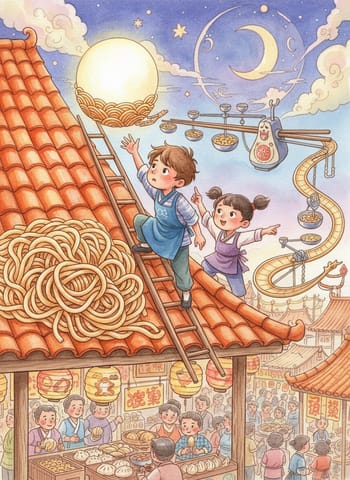
It is too late. The ball spins higher than he intended, hits the edge of the noodle stall's tiled roof and rolls up the slope. It comes to rest behind the painted sign at the very top, where the roof tiles meet in a ridge. It sits there, glowing gently, as if it enjoys the view.
É tarde demais. A bola gira mais alto do que ele pretendia, bate na beirada do telhado de telhas da barraca de macarrão e rola pela inclinação. Para atrás da placa pintada, bem no topo, onde as telhas se encontram na cumeeira. Fica ali, brilhando suavemente, como se gostasse da vista.
For a moment, neither of them speaks. The children on the steps go quiet.
Por um momento, nenhum dos dois fala. As crianças nos degraus ficam quietas.
"What time is it?" Joost asks at last.
"Que horas são?", pergunta Joost por fim.
Lia checks the clock above the spice seller's door. "Nine minutes to midnight," she says. "If the Moon Ball is not in the cradle when the bell rings, the lamps stay dark."
Lia confere o relógio acima da porta do vendedor de especiarias. "Faltam nove minutos para a meia-noite", diz ela. "Se a Bola da Lua não estiver no berço quando o sino tocar, os lampiões ficam apagados."
"For tonight?"
"Só esta noite?"
"For the whole month. That is the rule. The market would have to close until the next full moon." She stares at the roof. "Every cook on this street would lose a month of work because you wanted to look clever."
"O mês inteiro. Essa é a regra. A feira teria que fechar até a próxima lua cheia." Ela encara o telhado. "Todo cozinheiro desta rua perderia um mês de trabalho porque você quis parecer esperto."
Joost does not argue. He is already counting. The fountain is at the far end of the row, and the row is two hundred paces long. On a quiet night, the walk takes five minutes. At midnight on a busy Saturday, with a crowd packed shoulder to shoulder between the stalls, it takes twice as long.
Joost não discute. Já está contando. A fonte fica na outra ponta da fileira, e a fileira tem duzentos passos. Numa noite calma, a caminhada leva cinco minutos. À meia-noite de um sábado cheio, com a multidão apertada ombro a ombro entre as barracas, leva o dobro.
"We cannot carry it through that," he says. "If we ran, we would be stopped by the first big family with a pushchair."
"Não podemos carregá-la por aquilo", diz ele. "Se corrêssemos, a primeira família grande com um carrinho de bebê nos barraria."
"Then we have to be quicker than walking," Lia says.
"Então temos que ser mais rápidos que andando", diz Lia.
First, though, they have to get the ball down. Joost climbs onto a stack of crates beside the noodle stall. The cook, a round woman with strong forearms, hands him a long wooden ladle without being asked. He stretches up and taps the ball with the end of it. It wobbles, but it does not come down. He taps again, a little harder.
Primeiro, porém, precisam tirar a bola de lá. Joost sobe numa pilha de caixotes ao lado da barraca de macarrão. A cozinheira, uma mulher roliça de antebraços fortes, lhe entrega uma longa concha de madeira sem que ele peça. Ele se estica e cutuca a bola com a ponta dela. A bola balança, mas não desce. Ele cutuca de novo, um pouco mais forte.
"Gently," Lia calls. "It is not a drum."
"Com jeito", chama Lia. "Não é um tambor."
The ball rolls two hand-widths along the ridge and tumbles off the back of the roof. Joost feels his stomach drop. Then he hears a rattling sound and a high, bright hum, and he realises that the ball has not fallen to the ground at all.
A bola rola dois palmos pela cumeeira e despenca pelos fundos do telhado. Joost sente o estômago afundar. Então ouve um chocalhar e um zumbido agudo e brilhante, e percebe que a bola não caiu no chão.
Behind the stalls, a long tin trough runs along the back wall of the whole food row. The cooks use it to carry wash water away from their pots. It is built to slope gently downhill, from the first stall to the last. The Moon Ball has landed in it and is rolling.
Atrás das barracas, uma longa calha de zinco corre ao longo do muro dos fundos de toda a fileira de comidas. Os cozinheiros a usam para levar embora a água de lavar as panelas. Foi construída com uma leve descida, da primeira barraca à última. A Bola da Lua caiu nela e está rolando.
"Lia!" Joost shouts. "Look at it go!"
"Lia!", grita Joost. "Olha ela indo!"
Lia looks. She watches the glow slide past the first stove, the second stove and the cluster of steaming barrels. Then she grins, and she grabs Joost by the sleeve.
Lia olha. Vê o brilho deslizar além do primeiro fogão, do segundo e do grupo de barris fumegantes. Então sorri e agarra Joost pela manga.
"The trough ends at the fountain," she says. "I have seen the cooks tip their buckets into it a hundred times. Everything that goes in at this end comes out at the other."
"A calha termina na fonte", diz ela. "Já vi os cozinheiros despejarem baldes nela cem vezes. Tudo que entra por esta ponta sai pela outra."
"So we do not carry it," Joost says slowly. "We follow it."
"Então não a carregamos", diz Joost devagar. "Nós a seguimos."
They run. There is a narrow service lane behind the stalls, hardly wide enough for one person. It is full of crates and sleeping cats. Lia leads, because she knows every turn of it from her errands. Joost follows with his eyes fixed on the little light skimming along the tin beside them.
Correm. Há uma travessa de serviço estreita atrás das barracas, mal larga o bastante para uma pessoa. Está cheia de caixotes e gatos dormindo. Lia vai na frente, porque conhece cada curva por causa dos recados. Joost vai atrás, com os olhos fixos na lucezinha que desliza pelo zinco ao lado deles.
The ball is faster than they expected. It hums louder as it gains speed, and it throws a moving shadow across the wall. A cook hanging washing on a line looks up and drops a shirt. A boy carrying a tray of fruit sticks flattens himself against the wall to let them pass.
A bola é mais rápida do que esperavam. Zumbe mais alto à medida que ganha velocidade e lança uma sombra móvel no muro. Um cozinheiro pendurando roupa num varal levanta os olhos e deixa cair uma camisa. Um menino carregando uma bandeja de espetinhos de fruta se achata contra a parede para deixá-los passar.
"Ten stalls," Lia gasps. "We are halfway."
"Dez barracas", ofega Lia. "Estamos na metade."
"What time?" Joost asks.
"Que horas?", pergunta Joost.
"I cannot look at a clock and run at the same time!"
"Não consigo olhar um relógio e correr ao mesmo tempo!"
Then the trough bends. At the corner behind the pickle seller, the old tin has been patched with a pot lid. The join sticks up like a small step. The ball strikes it, jumps, and lands on the wrong side. It rolls off the trough and bounces across the cobbles of the lane.
Então a calha faz uma curva. Na esquina atrás do vendedor de picles, o zinco velho foi remendado com uma tampa de panela. A emenda sobressai como um pequeno degrau. A bola bate nela, pula e cai do lado errado. Sai rolando da calha e quica pelos paralelepípedos da travessa.
Joost dives and misses. Lia steps over a basket, scoops the ball out of the air with both hands and stumbles into the wall, laughing and out of breath.
Joost se joga e erra. Lia passa por cima de uma cesta, agarra a bola no ar com as duas mãos e tropeça na parede, rindo e sem fôlego.
"Got it," she says. "Now we are carrying it, so we are slow again."
"Peguei", diz ela. "Agora estamos carregando, então ficamos lentos de novo."
"Not necessarily." Joost points past her shoulder. Beyond the end of the lane, the food row meets the square, and the fountain is plainly visible. The cradle is a pale shape against the dark water. The crowd is thick around it, because everyone is waiting for the lamps.
"Não necessariamente." Joost aponta além do ombro dela. Depois do fim da travessa, a fileira de comidas encontra a praça, e a fonte está bem visível. O berço é uma forma pálida contra a água escura. A multidão está densa em volta dele, porque todos esperam pelos lampiões.
"We cannot cross that," Lia says. "Nobody will move until the lamps are lit."
"Não dá para atravessar aquilo", diz Lia. "Ninguém vai sair do lugar até os lampiões acenderem."
"Then we must reach it without pushing through everyone." Joost thinks for a second. "Who sets the lamps in the first place?"
"Então temos que chegar lá sem empurrar todo mundo." Joost pensa por um segundo. "Quem acende os lampiões, afinal?"
"The lamp-keeper," Lia says. "He waits on the wall behind the cradle, with the long taper."
"O acendedor", diz Lia. "Ele espera no muro atrás do berço, com o pavio comprido."
"And that wall has a stair at the back," Joost says. "I use it every night."
"E esse muro tem uma escada nos fundos", diz Joost. "Eu uso todas as noites."
They go around behind the fountain, up the narrow stair and onto the low wall. From above, the whole square looks like a field of upturned faces. The lamp-keeper, a tall man with a taper in his hand, stares at them with his mouth open. Somewhere below, a bell begins to swing.
Contornam a fonte por trás, sobem a escada estreita e chegam ao muro baixo. De cima, a praça inteira parece um campo de rostos voltados para o alto. O acendedor, um homem alto com um pavio na mão, olha para eles de boca aberta. Em algum lugar lá embaixo, um sino começa a balançar.
"Joost!" the lamp-keeper hisses. "The ball!"
"Joost!", sibila o acendedor. "A bola!"
Joost takes it from Lia, leans over the cradle and lowers it into the stone hollow with both hands. It settles with a deep, soft chime, like a note from a bowl. For one long heartbeat, nothing happens.
Joost a toma de Lia, se inclina sobre o berço e a baixa na cavidade de pedra com as duas mãos. Ela se acomoda com um carrilhão profundo e suave, como a nota de uma tigela. Por um longo batimento de coração, nada acontece.
Then, all along the food row, two hundred lamps wake together. The street rises out of the darkness in gold and amber, and the crowd gasps and cheers. The first stroke of midnight is still ringing in the air.
Então, ao longo da fileira de comidas, duzentos lampiões despertam juntos. A rua emerge da escuridão em dourado e âmbar, e a multidão arfa e aplaude. A primeira badalada da meia-noite ainda ressoa no ar.
The lamp-keeper lowers his taper and looks from one of them to the other. "You cut that very close," he says. "Do I want to know why?"
O acendedor baixa o pavio e olha de um para o outro. "Foi por muito pouco", diz ele. "Eu quero saber por quê?"
"No," Joost says at once.
"Não", diz Joost na hora.
"A bit," Lia says. She is still holding her side, and she is still laughing. She looks at Joost, who is staring at his own shaking hands, and she pats him on the shoulder.
"Um pouco", diz Lia. Ainda segura a lateral do corpo e ainda está rindo. Olha para Joost, que encara as próprias mãos trêmulas, e dá um tapinha no ombro dele.
"Next time you want to show off," she says, "try it with a dumpling."
"Da próxima vez que quiser se exibir", diz ela, "tente com um bolinho."