The Moon Ball on the Noodle Roof
Una historia gratuita en inglés de nivel B2 para estudiantes, para leer en línea en 7 idiomas, con opción de escucharla en la app gratuita Storyteller.
Minutes before midnight, a young helper loses the glowing ball that lights his night market, and a friend spots an unlikely way to get it back in time.
¡Ese fue el avance! Escucha la historia completa en la app gratuita Storyteller. Descargar la app
El audio no está disponible en este momento.
Every night, the market on Lantern Row wakes up the same way. At the stroke of midnight, a glass ball the size of a melon is set into a stone cradle beside the fountain. Every lamp along the food row lights at once. The ball is called the Moon Ball. It has been carried from the lamp-keeper's house to the fountain by a young helper for as long as anyone can remember.
Todas las noches, el mercado de Lantern Row despierta de la misma manera. Con la primera campanada de medianoche, una bola de cristal del tamaño de un melón se coloca en una cuna de piedra junto a la fuente. Todas las lámparas de la hilera de comida se encienden a la vez. La bola se llama la Bola de Luna. Un joven ayudante la ha llevado desde la casa del encargado de las lámparas hasta la fuente desde que nadie recuerda.
This month, the helper is Joost. He is fifteen, he is proud of the job, and he is also a little bored by it.
Este mes, el ayudante es Joost. Tiene quince años, está orgulloso del trabajo y también está un poco aburrido de él.
Tonight he walks down the row at a quarter to midnight with the ball cradled in both arms. It hums softly and gives off a pale glow, and it weighs almost nothing. The cooks greet him as he passes. Steam rises from dumpling baskets, oil spits in the woks, and the smell of grilled spice hangs in the air.
Esta noche camina por la hilera a un cuarto para la medianoche con la bola en ambos brazos. Zumba suavemente y desprende un brillo pálido, y casi no pesa nada. Los cocineros lo saludan cuando pasa. Sube vapor de las canastas de dumplings, el aceite salta en los woks y el olor a especias asadas flota en el aire.
Lia, who runs messages for the stall owners, falls into step beside him. "You are early," she says. "Usually you arrive with two minutes to spare."
Lia, que lleva recados para los dueños de los puestos, se pone a su paso. «Llegas temprano», dice. «Normalmente llegas con dos minutos de sobra».
"I am a changed man," Joost says. Then he sees a group of children watching him from the steps of the noodle stall, and the old urge to show off takes over.
«Soy un hombre cambiado», dice Joost. Entonces ve a un grupo de niños que lo miran desde los escalones del puesto de fideos, y el viejo impulso de lucirse se apodera de él.
"Watch this," he whispers. He tosses the ball up and bounces it once off his knee.
«Mira esto», susurra. Lanza la bola al aire y la hace rebotar una vez en su rodilla.
"Joost, don't," Lia says.
«Joost, no», dice Lia.
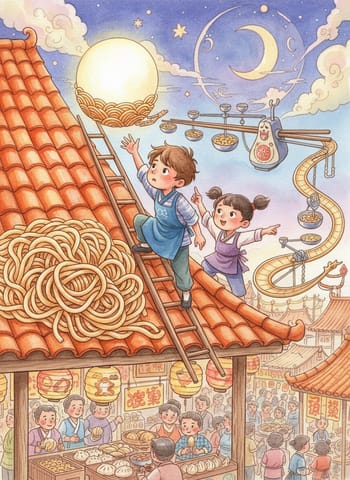
It is too late. The ball spins higher than he intended, hits the edge of the noodle stall's tiled roof and rolls up the slope. It comes to rest behind the painted sign at the very top, where the roof tiles meet in a ridge. It sits there, glowing gently, as if it enjoys the view.
Es demasiado tarde. La bola gira más alto de lo que él pretendía, golpea el borde del techo de tejas del puesto de fideos y rueda por la pendiente. Se detiene detrás del letrero pintado en lo más alto, donde las tejas se juntan en un caballete. Se queda allí, brillando suavemente, como si disfrutara de la vista.
For a moment, neither of them speaks. The children on the steps go quiet.
Por un momento, ninguno de los dos habla. Los niños de los escalones se quedan callados.
"What time is it?" Joost asks at last.
«¿Qué hora es?», pregunta Joost por fin.
Lia checks the clock above the spice seller's door. "Nine minutes to midnight," she says. "If the Moon Ball is not in the cradle when the bell rings, the lamps stay dark."
Lia mira el reloj sobre la puerta del vendedor de especias. «Faltan nueve minutos para la medianoche», dice. «Si la Bola de Luna no está en la cuna cuando suene la campana, las lámparas se quedan apagadas».
"For tonight?"
«¿Por esta noche?»
"For the whole month. That is the rule. The market would have to close until the next full moon." She stares at the roof. "Every cook on this street would lose a month of work because you wanted to look clever."
«Por todo el mes. Esa es la regla. El mercado tendría que cerrar hasta la próxima luna llena». Mira fijamente el techo. «Todos los cocineros de esta calle perderían un mes de trabajo porque tú quisiste parecer listo».
Joost does not argue. He is already counting. The fountain is at the far end of the row, and the row is two hundred paces long. On a quiet night, the walk takes five minutes. At midnight on a busy Saturday, with a crowd packed shoulder to shoulder between the stalls, it takes twice as long.
Joost no discute. Ya está contando. La fuente está en el extremo opuesto de la hilera, y la hilera mide doscientos pasos. En una noche tranquila, el trayecto lleva cinco minutos. A medianoche de un sábado concurrido, con una multitud apretada hombro con hombro entre los puestos, lleva el doble.
"We cannot carry it through that," he says. "If we ran, we would be stopped by the first big family with a pushchair."
«No podemos llevarla por ahí», dice. «Si corriéramos, nos detendría la primera familia grande con un cochecito».
"Then we have to be quicker than walking," Lia says.
«Entonces tenemos que ser más rápidos que caminando», dice Lia.
First, though, they have to get the ball down. Joost climbs onto a stack of crates beside the noodle stall. The cook, a round woman with strong forearms, hands him a long wooden ladle without being asked. He stretches up and taps the ball with the end of it. It wobbles, but it does not come down. He taps again, a little harder.
Primero, sin embargo, tienen que bajar la bola. Joost se sube a una pila de cajones junto al puesto de fideos. La cocinera, una mujer redonda de antebrazos fuertes, le alcanza un largo cucharón de madera sin que se lo pida. Él se estira hacia arriba y golpea la bola con el extremo. Se bambolea, pero no baja. Golpea otra vez, un poco más fuerte.
"Gently," Lia calls. "It is not a drum."
«Con suavidad», llama Lia. «No es un tambor».
The ball rolls two hand-widths along the ridge and tumbles off the back of the roof. Joost feels his stomach drop. Then he hears a rattling sound and a high, bright hum, and he realises that the ball has not fallen to the ground at all.
La bola rueda dos palmos a lo largo del caballete y cae por la parte de atrás del techo. A Joost se le encoge el estómago. Entonces oye un traqueteo y un zumbido agudo y brillante, y se da cuenta de que la bola no ha caído al suelo en absoluto.
Behind the stalls, a long tin trough runs along the back wall of the whole food row. The cooks use it to carry wash water away from their pots. It is built to slope gently downhill, from the first stall to the last. The Moon Ball has landed in it and is rolling.
Detrás de los puestos, un largo canal de hojalata recorre la pared trasera de toda la hilera de comida. Los cocineros lo usan para llevarse el agua sucia de sus ollas. Está construido con una suave pendiente, del primer puesto al último. La Bola de Luna ha caído en él y está rodando.
"Lia!" Joost shouts. "Look at it go!"
«¡Lia!», grita Joost. «¡Mira cómo va!»
Lia looks. She watches the glow slide past the first stove, the second stove and the cluster of steaming barrels. Then she grins, and she grabs Joost by the sleeve.
Lia mira. Ve el resplandor deslizarse junto a la primera estufa, la segunda estufa y el grupo de barriles humeantes. Entonces sonríe y agarra a Joost de la manga.
"The trough ends at the fountain," she says. "I have seen the cooks tip their buckets into it a hundred times. Everything that goes in at this end comes out at the other."
«El canal termina en la fuente», dice. «He visto a los cocineros vaciar sus baldes en él cien veces. Todo lo que entra por este extremo sale por el otro».
"So we do not carry it," Joost says slowly. "We follow it."
«O sea que no la llevamos», dice Joost despacio. «La seguimos».
They run. There is a narrow service lane behind the stalls, hardly wide enough for one person. It is full of crates and sleeping cats. Lia leads, because she knows every turn of it from her errands. Joost follows with his eyes fixed on the little light skimming along the tin beside them.
Corren. Hay un callejón de servicio angosto detrás de los puestos, apenas lo bastante ancho para una persona. Está lleno de cajones y gatos dormidos. Lia va adelante, porque conoce cada vuelta por sus recados. Joost la sigue con los ojos fijos en la lucecita que se desliza por la hojalata a su lado.
The ball is faster than they expected. It hums louder as it gains speed, and it throws a moving shadow across the wall. A cook hanging washing on a line looks up and drops a shirt. A boy carrying a tray of fruit sticks flattens himself against the wall to let them pass.
La bola es más rápida de lo que esperaban. Zumba más fuerte a medida que gana velocidad, y proyecta una sombra en movimiento sobre la pared. Un cocinero que cuelga ropa en un tendedero levanta la vista y deja caer una camisa. Un chico que lleva una bandeja de brochetas de fruta se pega a la pared para dejarlos pasar.
"Ten stalls," Lia gasps. "We are halfway."
«Diez puestos», jadea Lia. «Vamos por la mitad».
"What time?" Joost asks.
«¿Qué hora es?», pregunta Joost.
"I cannot look at a clock and run at the same time!"
«¡No puedo mirar un reloj y correr al mismo tiempo!»
Then the trough bends. At the corner behind the pickle seller, the old tin has been patched with a pot lid. The join sticks up like a small step. The ball strikes it, jumps, and lands on the wrong side. It rolls off the trough and bounces across the cobbles of the lane.
Entonces el canal da una vuelta. En la esquina detrás del vendedor de encurtidos, la vieja hojalata ha sido remendada con una tapa de olla. La unión sobresale como un pequeño escalón. La bola choca contra ella, salta y cae del lado equivocado. Rueda fuera del canal y rebota por los adoquines del callejón.
Joost dives and misses. Lia steps over a basket, scoops the ball out of the air with both hands and stumbles into the wall, laughing and out of breath.
Joost se lanza y falla. Lia pasa por encima de una canasta, atrapa la bola en el aire con las dos manos y tropieza contra la pared, riendo y sin aliento.
"Got it," she says. "Now we are carrying it, so we are slow again."
«La tengo», dice. «Ahora la llevamos nosotros, así que volvemos a ser lentos».
"Not necessarily." Joost points past her shoulder. Beyond the end of the lane, the food row meets the square, and the fountain is plainly visible. The cradle is a pale shape against the dark water. The crowd is thick around it, because everyone is waiting for the lamps.
«No necesariamente». Joost señala por encima de su hombro. Más allá del final del callejón, la hilera de comida se une con la plaza, y la fuente se ve con claridad. La cuna es una forma pálida contra el agua oscura. La multitud es densa a su alrededor, porque todos esperan las lámparas.
"We cannot cross that," Lia says. "Nobody will move until the lamps are lit."
«No podemos cruzar eso», dice Lia. «Nadie se moverá hasta que las lámparas estén encendidas».
"Then we must reach it without pushing through everyone." Joost thinks for a second. "Who sets the lamps in the first place?"
«Entonces tenemos que llegar sin empujar a todo el mundo». Joost piensa un segundo. «¿Quién enciende las lámparas, para empezar?»
"The lamp-keeper," Lia says. "He waits on the wall behind the cradle, with the long taper."
«El encargado», dice Lia. «Espera en el muro detrás de la cuna, con la vela larga».
"And that wall has a stair at the back," Joost says. "I use it every night."
«Y ese muro tiene una escalera por atrás», dice Joost. «La uso todas las noches».
They go around behind the fountain, up the narrow stair and onto the low wall. From above, the whole square looks like a field of upturned faces. The lamp-keeper, a tall man with a taper in his hand, stares at them with his mouth open. Somewhere below, a bell begins to swing.
Rodean por detrás de la fuente, suben por la estrecha escalera y llegan al muro bajo. Desde arriba, toda la plaza parece un campo de rostros alzados. El encargado de las lámparas, un hombre alto con una vela en la mano, los mira con la boca abierta. En algún lugar abajo, una campana empieza a balancearse.
"Joost!" the lamp-keeper hisses. "The ball!"
«¡Joost!», sisea el encargado. «¡La bola!»
Joost takes it from Lia, leans over the cradle and lowers it into the stone hollow with both hands. It settles with a deep, soft chime, like a note from a bowl. For one long heartbeat, nothing happens.
Joost se la quita a Lia, se inclina sobre la cuna y la baja al hueco de piedra con ambas manos. Se asienta con una campanada profunda y suave, como una nota de un cuenco. Durante un largo latido, no pasa nada.
Then, all along the food row, two hundred lamps wake together. The street rises out of the darkness in gold and amber, and the crowd gasps and cheers. The first stroke of midnight is still ringing in the air.
Entonces, a lo largo de toda la hilera de comida, doscientas lámparas despiertan a la vez. La calle emerge de la oscuridad en oro y ámbar, y la multitud ahoga un grito y vitorea. La primera campanada de la medianoche todavía resuena en el aire.
The lamp-keeper lowers his taper and looks from one of them to the other. "You cut that very close," he says. "Do I want to know why?"
El encargado baja la vela y los mira a uno y a otra. «Por poco», dice. «¿Quiero saber por qué?»
"No," Joost says at once.
«No», dice Joost enseguida.
"A bit," Lia says. She is still holding her side, and she is still laughing. She looks at Joost, who is staring at his own shaking hands, and she pats him on the shoulder.
«Un poquito», dice Lia. Todavía se sujeta el costado, y todavía se ríe. Mira a Joost, que contempla sus propias manos temblorosas, y le da una palmadita en el hombro.
"Next time you want to show off," she says, "try it with a dumpling."
«La próxima vez que quieras lucirte», dice, «inténtalo con un dumpling».