The Wallet That Knew the Street
Una historia gratuita en inglés de nivel B2 para estudiantes, para leer en línea en 7 idiomas, con opción de escucharla en la app gratuita Storyteller.
On the morning of a street party, a warm wallet holds a photograph of a party that has not happened yet.
¡Ese fue el avance! Escucha la historia completa en la app gratuita Storyteller. Descargar la app
El audio no está disponible en este momento.
On the last Saturday of June, Fenwick Lane closed to traffic and turned into one long table. The tradition was older than anyone on the street could explain. Every shop carried its tables outside, every doorway wore a paper lantern, and by evening the whole lane smelled of grilled corn and warm sugar.
El último sábado de junio, la calle Fenwick se cerraba al tráfico y se convertía en una larga mesa. La tradición era más antigua de lo que nadie en la calle podía explicar. Cada tienda sacaba sus mesas afuera, cada puerta lucía un farolillo de papel y, al anochecer, toda la calle olía a maíz asado y azúcar tibia.
Corwin had been in charge of the decorations for fourteen years. He repaired clocks in a narrow shop at number nine. The other shopkeepers had decided long ago that a man who handled a hundred tiny springs could hang a few flags in a line. He did not argue with them. He liked the job.
Corwin llevaba catorce años a cargo de la decoración. Arreglaba relojes en una tienda estrecha en el número nueve. Los demás comerciantes habían decidido hacía mucho que un hombre que manejaba cien resortes diminutos podía colgar unas cuantas banderas en fila. Él no discutía con ellos. Le gustaba el trabajo.
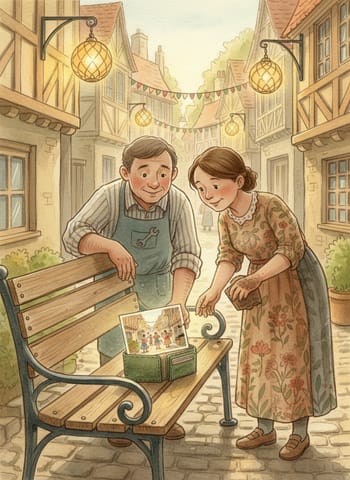
His routine never changed. At half past six he carried a stepladder and a crate of bunting down the lane. Then he bought a coffee from the kiosk at the corner and sat on the old iron bench outside the printer's to drink it. He always counted the flags on the crate before he started. There were always two hundred and twelve.
Su rutina nunca cambiaba. A las seis y media llevaba una escalera y un cajón de banderines calle abajo. Luego compraba un café en el quiosco de la esquina y se sentaba a bebérselo en la vieja banca de hierro frente a la imprenta. Siempre contaba las banderas del cajón antes de empezar. Siempre eran doscientas doce.
That morning the bench was already occupied. A wallet lay on the seat, exactly where he usually put his cup.
Esa mañana la banca ya estaba ocupada. Una cartera yacía en el asiento, exactamente donde él solía poner su taza.
It was an ordinary object at first glance: dark green leather, worn at the corners, closed with a small brass clasp. Corwin looked up and down the lane. The street was empty except for a man hosing the pavement outside the fish shop, and he was too far away to have noticed anything.
A primera vista era un objeto corriente: cuero verde oscuro, gastado en las esquinas, cerrado con un pequeño broche de latón. Corwin miró calle arriba y calle abajo. La calle estaba vacía, salvo por un hombre que mojaba con una manguera la acera frente a la pescadería, y estaba demasiado lejos para haber notado nada.
He picked up the wallet, and it was warm. It was not the warmth of a pocket or of morning sunlight, but the slow, steady heat of something alive. He nearly dropped it.
Recogió la cartera, y estaba tibia. No era la calidez de un bolsillo ni de la luz del sol de la mañana, sino el calor lento y constante de algo vivo. Casi se le cae.
"Do not be silly," he said aloud, and he opened the clasp.
«No seas tonto», dijo en voz alta, y abrió el broche.
There was no money inside, and no cards, and no name. There was a single coin, thick and dull, stamped with the image of a lamp post that he did not recognise. There was a ticket stub printed with the words ADMIT ONE TO THE LANE. And there was a photograph.
No había dinero dentro, ni tarjetas, ni nombre. Había una sola moneda, gruesa y opaca, con la imagen estampada de un poste de luz que no reconoció. Había una entrada impresa con las palabras ENTRADA INDIVIDUAL A LA CALLE. Y había una fotografía.
The photograph showed Fenwick Lane at the height of a party. Paper lanterns were glowing in the dusk, tables ran the whole length of the street and hundreds of people were laughing at once. In the front, outside the clock shop, stood Corwin himself, holding a plate of corn and looking surprised. Next to him, with a lantern in her hands, stood Irene from the plant shop.
La fotografía mostraba la calle Fenwick en lo más alto de una fiesta. Los farolillos de papel brillaban en el crepúsculo, las mesas recorrían toda la calle y cientos de personas reían a la vez. Al frente, afuera de la relojería, estaba el propio Corwin, con un plato de maíz, con aire sorprendido. A su lado, con un farolillo en las manos, estaba Irene, la de la tienda de plantas.
Corwin turned the picture over. On the back, in small blue handwriting, someone had written the date. It was today's date.
Corwin dio vuelta a la imagen. En el reverso, con una pequeña letra azul, alguien había escrito la fecha. Era la fecha de hoy.
"Interesting," he said, in the voice he used when a customer brought in a watch that ran backwards.
«Interesante», dijo, con la voz que usaba cuando un cliente traía un reloj que andaba hacia atrás.
He was still staring at it when Irene arrived, pushing a trolley of potted ferns. She was a tall woman with soil under her fingernails, and she had never been known to walk past an interesting problem.
Seguía mirándola cuando llegó Irene, empujando un carrito de helechos en macetas. Era una mujer alta con tierra bajo las uñas, y nunca se la había visto pasar de largo ante un problema interesante.
"You look like you have seen a ghost," she said. "Have you?"
«Tienes cara de haber visto un fantasma», dijo. «¿Lo has visto?».
"Not yet," Corwin said. He held out the photograph.
«Todavía no», dijo Corwin. Le tendió la fotografía.
Irene studied it for a long time. Then she took a pair of reading glasses from her apron pocket, put them on and studied it again.
Irene la estudió durante mucho rato. Luego sacó unas gafas de lectura del bolsillo de su delantal, se las puso y volvió a estudiarla.
"That is my lantern," she said. "I only bought it on Thursday. It has never been outside the shop." She pointed at the edge of the picture. "And what is that?"
«Ese es mi farolillo», dijo. «Lo compré apenas el jueves. Nunca ha salido de la tienda». Señaló el borde de la imagen. «¿Y eso qué es?».
Corwin leaned closer. Between his clock shop and the plant shop, in the photograph, there was a third building. It was narrow, with a green door and a round window above it. The lantern light fell across its step as if it had always been there.
Corwin se inclinó más cerca. Entre su relojería y la tienda de plantas, en la fotografía, había un tercer edificio. Era estrecho, con una puerta verde y una ventana redonda encima. La luz del farolillo caía sobre su escalón como si siempre hubiera estado ahí.
"There is no building between us," Irene said slowly. "There is only the gap. I keep my bicycle in that gap."
«No hay ningún edificio entre nosotros», dijo Irene despacio. «Solo está el hueco. Guardo mi bicicleta en ese hueco».
"I know," Corwin said. "I have walked past it for fourteen years."
«Lo sé», dijo Corwin. «Llevo catorce años pasando por ahí».
They looked at each other. Then, without discussing it, they walked together to the narrow passage between their two shops. It was exactly as they remembered it: a strip of shadow, a drainpipe, a bicycle chained to a hook. The brick wall at the end of it was damp and plain.
Se miraron. Luego, sin hablarlo, caminaron juntos hasta el pasaje estrecho entre sus dos tiendas. Estaba exactamente como lo recordaban: una franja de sombra, un desagüe, una bicicleta encadenada a un gancho. La pared de ladrillo del fondo estaba húmeda y lisa.
"Perhaps the photograph was taken from a different street," Irene said. "Perhaps it is a trick."
«Quizá la fotografía fue tomada desde otra calle», dijo Irene. «Quizá es un truco».
"Perhaps," Corwin said. "But who would trick two shopkeepers with a warm wallet?"
«Quizá», dijo Corwin. «Pero ¿quién engañaría a dos comerciantes con una cartera tibia?».
They did what any sensible person would do. They carried the wallet down the lane and asked everyone. The fish seller said he had never seen it before. The printer said it was too clean to be lost by one of his customers. The woman who ran the kiosk held it for a moment, went very quiet and handed it straight back without a word.
Hicieron lo que haría cualquier persona sensata. Llevaron la cartera calle abajo y preguntaron a todos. El pescadero dijo que nunca la había visto. El impresor dijo que estaba demasiado limpia para que la hubiera perdido uno de sus clientes. La mujer que atendía el quiosco la sostuvo un momento, se quedó muy callada y se la devolvió de inmediato sin decir palabra.
"She knows something," Irene whispered.
«Ella sabe algo», susurró Irene.
"She knows she does not want it," Corwin said.
«Sabe que no la quiere», dijo Corwin.
By ten o'clock the tables were up, and the bunting hung in perfect lines from the lamp posts. The two hundred and twelfth flag was tied to the last post. For the first time in fourteen years, Corwin did not feel proud of it. He kept thinking about the coin. He had weighed it on the small scale in his shop. It had looked as light as a wedding ring, yet it had made the whole scale tilt as if it weighed a kilo.
Para las diez las mesas estaban puestas y los banderines colgaban en líneas perfectas de los postes de luz. La bandera doscientas doce estaba atada al último poste. Por primera vez en catorce años, Corwin no se sintió orgulloso de ello. No dejaba de pensar en la moneda. La había pesado en la balanza pequeña de su tienda. Parecía ligera como un anillo de boda, pero había hecho inclinarse toda la balanza como si pesara un kilo.
At noon, Irene brought him a sandwich and sat beside him on the iron bench.
Al mediodía, Irene le trajo un sándwich y se sentó a su lado en la banca de hierro.
"If it were my wallet," she said, "I would want someone to try the obvious thing."
«Si fuera mi cartera», dijo, «querría que alguien probara lo obvio».
"What is the obvious thing?"
«¿Qué es lo obvio?».
"Show it the gap," she said.
«Mostrarle el hueco», dijo ella.
It sounded ridiculous, and they both knew it. But they walked back to the passage anyway, and Corwin held the wallet out in front of him like a man carrying a candle. The brass clasp began to tick softly, and the coin inside rang against the leather, a small clear note, like a spoon against a glass.
Sonaba ridículo, y los dos lo sabían. Pero de todos modos volvieron al pasaje, y Corwin sostuvo la cartera frente a él como un hombre que lleva una vela. El broche de latón empezó a hacer tic suavemente, y la moneda de adentro tintineó contra el cuero, una nota pequeña y clara, como una cuchara contra un vaso.
Nothing else happened. The wall stayed a wall. The bicycle stayed on its hook. Yet for a moment, the shadow at the end of the passage seemed to deepen into the shape of a doorway. Corwin felt a faint cool breath on his face, the kind that comes from a cellar.
No pasó nada más. La pared siguió siendo pared. La bicicleta siguió en su gancho. Sin embargo, por un momento la sombra del fondo del pasaje pareció profundizarse hasta tomar la forma de una puerta. Corwin sintió un leve soplo frío en la cara, de los que vienen de un sótano.
Then the feeling stopped. The clasp fell silent, and the wallet went back to being merely warm.
Luego la sensación cesó. El broche calló, y la cartera volvió a ser solo tibia.
"Well," Irene said, a little hoarsely. "That was something."
«Bueno», dijo Irene, un poco ronca. «Eso fue algo».
"It was," Corwin said. "I think it was a greeting."
«Lo fue», dijo Corwin. «Creo que fue un saludo».
They said nothing more about it for the rest of the afternoon. The party began on time, as it always did. The lanterns were lit at dusk, and the lane filled with people carrying plates of food from table to table. Corwin stood outside his shop with a plate of grilled corn, and Irene stood next to him with her lantern. For a while they were simply two neighbours enjoying a party.
No dijeron nada más al respecto durante el resto de la tarde. La fiesta empezó a tiempo, como siempre. Los farolillos se encendieron al anochecer, y la calle se llenó de gente que llevaba platos de comida de mesa en mesa. Corwin estaba frente a su tienda con un plato de maíz asado, e Irene estaba a su lado con su farolillo. Durante un rato fueron simplemente dos vecinos disfrutando de una fiesta.
It was only when the first song started that Corwin put his hand in his pocket and felt the wallet again, warmer than ever. He drew out the photograph and held it up to the light of the nearest lantern.
Solo cuando empezó la primera canción, Corwin metió la mano en el bolsillo y sintió de nuevo la cartera, más tibia que nunca. Sacó la fotografía y la sostuvo a la luz del farolillo más cercano.
The picture had changed.
La imagen había cambiado.
It still showed the lane, the tables and the crowd. But the two figures in front of the clock shop were no longer smiling. They were looking down at something small in their hands. Corwin was holding a photograph, and Irene was leaning over his shoulder to see it. The date on the back had changed too, and now the writing was fresh and wet.
Aún mostraba la calle, las mesas y la multitud. Pero las dos figuras frente a la relojería ya no sonreían. Miraban algo pequeño que tenían en las manos. Corwin sostenía una fotografía, e Irene se asomaba por encima de su hombro para verla. La fecha del reverso también había cambiado, y ahora la escritura era fresca y húmeda.
Irene saw it at the same moment. She did not scream, and she did not drop her lantern. She only took a slow breath and spoke very quietly, so that the singers would not hear.
Irene lo vio en el mismo momento. No gritó ni dejó caer su farolillo. Solo tomó un aliento lento y habló muy bajito, para que los cantantes no la oyeran.
"Corwin," she said, "if we are both standing here, then who is taking the picture?"
«Corwin», dijo, «si los dos estamos aquí de pie, entonces ¿quién está tomando la foto?».