The Knotted Rope at Zahra's Gate
Una historia gratuita en inglés de nivel B2 para estudiantes, para leer en línea en 7 idiomas, con opción de escucharla en la app gratuita Storyteller.
A pumpkin grower unties one knot in a strange old rope and makes a small wish, and the answer follows him home in a form he never imagined.
¡Ese fue el avance! Escucha la historia completa en la app gratuita Storyteller. Descargar la app
El audio no está disponible en este momento.
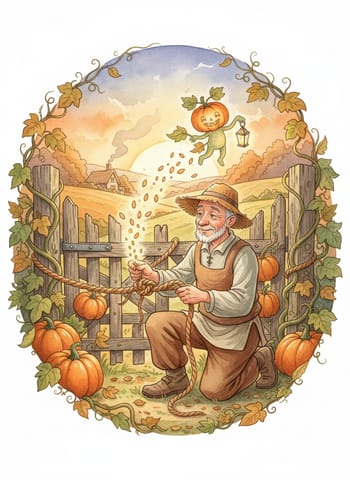
Zahra sold things from a wooden stall beside the farm gate on Orchard Road, and most of them were ordinary. She had jars of honey, bundles of firewood and eggs in cardboard cartons. The rope was different. It hung from a nail at the back of the stall. It was a thick brown length of hemp with so many knots that it looked like a necklace made by a nervous giant. Nobody had asked about it in three years.
Zahra vendía cosas desde un puesto de madera junto a la entrada de la granja, en el Camino del Huerto, y la mayoría eran corrientes. Tenía frascos de miel, atados de leña y huevos en cartones. La cuerda era diferente. Colgaba de un clavo al fondo del puesto. Era un largo grueso de cáñamo marrón con tantos nudos que parecía un collar hecho por un gigante nervioso. Nadie había preguntado por ella en tres años.
Ferran noticed it on a Saturday in late autumn. He had come to the gate, as he did every week, to sell pumpkins from the back of his cart. He had set up his scales on the empty trestle table next to Zahra's stall. He was a good grower and a poor seller. Customers who bought his pumpkins somehow always paid less than he had meant to charge. He went home each evening with a lighter purse than his arithmetic promised.
Ferran la notó un sábado a fines de otoño. Había venido a la entrada, como cada semana, a vender calabazas desde la parte trasera de su carreta. Había instalado su balanza en la mesa de caballetes vacía junto al puesto de Zahra. Era buen cultivador y mal vendedor. Los clientes que le compraban calabazas de algún modo siempre pagaban menos de lo que él había querido cobrar. Cada tarde volvía a casa con la bolsa más liviana de lo que prometían sus cuentas.
"That is a lot of knots," he said, nodding at the rope.
«Son muchos nudos», dijo, señalando la cuerda con la cabeza.
"Eighty-one," Zahra said, without looking up from her honey. "I counted them once."
«Ochenta y uno», dijo Zahra, sin levantar la vista de su miel. «Los conté una vez».
"What are they for?"
«¿Para qué sirven?».
"They are not for anything. Each one is a request that somebody made and never finished. The rope arrived on my counter when I took over this stall, and the woman who left it did not say where it came from." She wiped her hands on her apron. "She did say one thing, though. If you untie a knot and ask for something out loud, the rope will answer. It gives you what you ask for, not what you mean."
«No sirven para nada. Cada uno es un pedido que alguien hizo y nunca terminó. La cuerda llegó a mi mostrador cuando me hice cargo de este puesto, y la mujer que la dejó no dijo de dónde venía». Se limpió las manos en el delantal. «Pero sí dijo una cosa. Si desatas un nudo y pides algo en voz alta, la cuerda responde. Te da lo que pides, no lo que quieres decir».
Ferran laughed. It was a short, polite laugh, the kind people use when they suspect a seller of improving the story to raise the price. But the day was slow and the lane was empty. He was tired of doing sums in his head only to be proved wrong at closing time.
Ferran se rio. Fue una risa corta y cortés, de las que usa la gente cuando sospecha que un vendedor mejora la historia para subir el precio. Pero el día estaba lento y el camino vacío. Estaba cansado de hacer sumas de cabeza solo para que le demostraran su error a la hora de cerrar.
"May I try?" he asked.
«¿Puedo probar?», preguntó.
"It is free," Zahra said. "Choose a small one, though. The big knots are old, and nobody knows what is inside them."
«Es gratis», dijo Zahra. «Pero elige uno pequeño. Los nudos grandes son viejos y nadie sabe qué hay dentro».
He walked to the back of the stall and lifted the rope from its nail. It was heavier than it looked, and slightly warm, as if somebody had been holding it. At the very end, where the fibres were thinnest, he found a knot no bigger than a walnut. His fingers worked at it for a minute. Then it loosened and fell open, and the ends of the rope lay still in his palm.
Caminó hasta el fondo del puesto y levantó la cuerda de su clavo. Pesaba más de lo que parecía, y estaba ligeramente tibia, como si alguien la hubiera estado sosteniendo. En el mismo extremo, donde las fibras eran más delgadas, encontró un nudo no más grande que una nuez. Sus dedos trabajaron en él durante un minuto. Luego se aflojó y se abrió, y los extremos de la cuerda quedaron quietos en su palma.
"I wish," Ferran said, feeling foolish, "that I always knew exactly how much I had sold."
«Deseo», dijo Ferran, sintiéndose tonto, «saber siempre exactamente cuánto he vendido».
Nothing happened. A crow landed on the gatepost and left again. Ferran handed the rope back to Zahra, who hung it on its nail without comment. He packed up his scales a little earlier than usual.
No pasó nada. Un cuervo se posó en el poste del portón y se fue de nuevo. Ferran le devolvió la cuerda a Zahra, que la colgó en su clavo sin comentar nada. Recogió su balanza un poco más temprano que de costumbre.
On Sunday morning he went out to feed his hens and found the rope draped over his own gate. He stared at it for a long time. It had not been there the night before, and the nearest neighbour lived a mile away. He lifted it with two careful fingers. The knots had moved. At one end there was now a neat group of nine knots. After a gap came a group of four, then another gap and a single knot.
El domingo por la mañana salió a alimentar a sus gallinas y encontró la cuerda tendida sobre su propio portón. La miró durante un largo rato. La noche anterior no estaba ahí, y el vecino más cercano vivía a una milla. La levantó con dos dedos cuidadosos. Los nudos se habían movido. En un extremo había ahora un grupo ordenado de nueve nudos. Tras un espacio venía un grupo de cuatro, luego otro espacio y un solo nudo.
He walked to Zahra's stall with the rope coiled over his shoulder.
Caminó hasta el puesto de Zahra con la cuerda enrollada sobre el hombro.
"Nine big pumpkins, four small ones, one lumpy one," Zahra said, when she had examined it. "I think that is what you sold on Saturday."
«Nueve calabazas grandes, cuatro pequeñas, una deforme», dijo Zahra, cuando la hubo examinado. «Creo que eso es lo que vendiste el sábado».
"I sold nothing on Saturday. I was talking to you."
«No vendí nada el sábado. Estuve hablando contigo».
"You sold nine pumpkins before you came to talk to me. I remember them going. You were very pleased with yourself."
«Vendiste nueve calabazas antes de venir a hablar conmigo. Recuerdo cómo se iban. Estabas muy satisfecho contigo mismo».
Ferran counted in his head and found that she was right. He had forgotten the early customers entirely.
Ferran contó mentalmente y descubrió que ella tenía razón. Había olvidado por completo a los primeros clientes.
"But I asked to know how much I had sold," he said. "I did not ask for a rope to follow me home."
«Pero pedí saber cuánto había vendido», dijo. «No pedí que una cuerda me siguiera a casa».
"No," said Zahra. "You asked to always know. A rope that is only there on Saturdays would not be doing that, would it?"
«No», dijo Zahra. «Pediste saber siempre. Una cuerda que solo estuviera ahí los sábados no estaría cumpliendo eso, ¿verdad?».
So the rope stayed with him, and for a month it was the most useful thing he owned. He hung it from the front of his stall. By the end of each day it had tied itself into a clear record of everything that had changed hands. It showed how many pumpkins had gone, how many coins had come in, and which customers had paid before leaving. When the last buyer walked away, Ferran only needed to look at the knots to know whether his purse was full or short.
Así que la cuerda se quedó con él, y durante un mes fue lo más útil que tuvo. La colgó del frente de su puesto. Al final de cada día se había anudado a sí misma en un registro claro de todo lo que había cambiado de manos. Mostraba cuántas calabazas se habían ido, cuántas monedas habían entrado y qué clientes habían pagado antes de irse. Cuando el último comprador se alejaba, a Ferran le bastaba mirar los nudos para saber si su bolsa estaba llena o corta.
It was not always comfortable. One afternoon a man in a long coat lifted two pumpkins from the pile. He held out a single coin, hoping, perhaps, that nobody was watching. Before Ferran could speak, the rope slid off its hook and curled around the man's wrist like a friendly snake. Then it pulled itself into a tight, deliberate knot. The man looked down at it. Then he looked at Ferran, and Ferran, who had never in his life been brave about money, looked at the sky.
No siempre era cómodo. Una tarde un hombre de abrigo largo levantó dos calabazas de la pila. Extendió una sola moneda, esperando, quizás, que nadie lo estuviera mirando. Antes de que Ferran pudiera hablar, la cuerda se soltó de su gancho y se enroscó en la muñeca del hombre como una serpiente amistosa. Luego se anudó en un nudo apretado y deliberado. El hombre la miró. Luego miró a Ferran, y Ferran, que nunca en su vida había sido valiente con el dinero, miró al cielo.
"I think," the man said eventually, "that I owe you one more coin."
«Creo», dijo el hombre al fin, «que te debo una moneda más».
After that, word travelled along the lane. People who had once paid in a hurry now paid carefully, and a few of them started to bring exact change. Ferran noticed that his sales did not fall, as he had feared. They rose. Strangers told each other that his stall was the honest one, the one with the clever rope. They came from three villages away to see it work.
Después de eso, la noticia corrió por el camino. La gente que antes pagaba de prisa ahora pagaba con cuidado, y algunos empezaron a traer el cambio exacto. Ferran notó que sus ventas no bajaron, como había temido. Subieron. Los desconocidos se decían unos a otros que su puesto era el honesto, el de la cuerda lista. Venían desde tres pueblos más allá para ver cómo funcionaba.
On the last Saturday of the season, he carried the rope back to Zahra's stall and set it on her counter.
El último sábado de la temporada, llevó la cuerda de vuelta al puesto de Zahra y la dejó sobre su mostrador.
"It is a wonderful thing," he said. "But I do not think it belongs to me. I only ever wanted to know what I had earned."
«Es algo maravilloso», dijo. «Pero no creo que me pertenezca. Yo solo quería saber lo que había ganado».
"Then you have what you asked for," Zahra said. "Is something wrong with it?"
«Entonces tienes lo que pediste», dijo Zahra. «¿Le pasa algo?».
Ferran thought about the question honestly. "It is very good at its job. It is simply that I would like to understand why a rope is better at selling pumpkins than I am. I think I need a lesson, not a miracle."
Ferran pensó en la pregunta con honestidad. «Es muy buena en su trabajo. Es solo que me gustaría entender por qué una cuerda vende mejor las calabazas que yo. Creo que necesito una lección, no un milagro».
"You have just had one," Zahra said. "People watched the rope tie itself to the truth for a month. Some of that truth stuck to you. Haven't you noticed that you stand differently?"
«Acabas de tener una», dijo Zahra. «La gente vio a la cuerda atarse a la verdad durante un mes. Parte de esa verdad se te pegó. ¿No has notado que te paras diferente?».
He had not. But when he looked down at his hands, he saw that they were resting flat and steady on the table. They were not folded behind his back, as they usually were when a customer asked him a price.
No lo había notado. Pero cuando se miró las manos, vio que descansaban planas y firmes sobre la mesa. No estaban cruzadas a la espalda, como solían estar cuando un cliente le preguntaba el precio.
"Then I will keep the rope for the winter," he said at last, "if you will lend it to me. I will bring it back in spring."
«Entonces me quedaré con la cuerda durante el invierno», dijo al fin, «si me la prestas. La traeré de vuelta en primavera».
"It will be waiting," Zahra said. "But there is one condition. You must never ask it for a loan."
«Estará esperando», dijo Zahra. «Pero con una condición. Nunca debes pedirle un préstamo».
"Why not?"
«¿Por qué no?».
"Because it will want interest."
«Porque querrá intereses».
Ferran grinned, then looked down at the rope in his arms. It had already tied itself into a tiny, smug bow.
Ferran sonrió, y luego miró la cuerda en sus brazos. Ya se había anudado en un pequeño moño petulante.
"Is it honest?" he asked her, half joking.
«¿Es honesta?», le preguntó, medio en broma.
"Not exactly," said Zahra, turning back to her honey. "It is only tied to the facts."
«No exactamente», dijo Zahra, volviendo a su miel. «Solo está atada a los hechos».