The Priest with the Envious Eyes
A free B2-level English story for language learners, readable online in 7 languages, with an option to listen via the free Storyteller app.
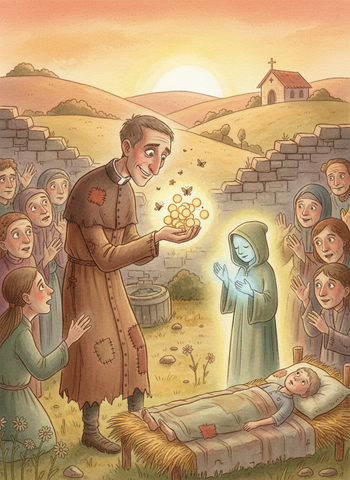
A destitute priest teams up with a mysterious stranger who can heal the dying — but his growing greed, and a broken promise over a handful of stolen wafers, threaten to cost him everything.
There was once a priest who lived in the parish of St. Nicholas. He served St. Nicholas for some years, and all his earnings were that he had neither house nor home, nor a roof over his head. So our good priest got together all his keys, and seeing the icon of St. Nicholas, struck it down, and left his parish to go whithersoever his eyes should guide him. And he went roaming on his way.
Había una vez un sacerdote que vivía en la parroquia de San Nicolás. Sirvió a San Nicolás durante algunos años, y todas sus ganancias fueron que no tenía casa ni hogar, ni un techo sobre su cabeza. Así que nuestro buen sacerdote juntó todas sus llaves, y viendo el icono de San Nicolás, lo derribó de un golpe, y dejó su parroquia para ir adondequiera que sus ojos lo guiaran. Y se fue vagando por su camino.
Suddenly an unknown man met him. “How do you do, good man?” he said to the pope. “Whither are you going? and whence do you come?” “Take me with you as a companion.” So they went off together. They went on some versts, and became tired. It was time to rest.
De repente se topó con un hombre desconocido. «¿Cómo está, buen hombre?», le dijo al pope. «¿Adónde va? ¿Y de dónde viene?» «Lléveme con usted como compañero». Así que se fueron juntos. Anduvieron unas verstas, y se cansaron. Era hora de descansar.
Now the pope had two biscuits, and his new friend had two wafers. The pope said to him: “We will first of all eat up your wafers, and we will then go on with the biscuits.”
Ahora bien, el pope tenía dos bizcochos, y su nuevo amigo tenía dos obleas. El pope le dijo: «Primero comeremos sus obleas, y luego seguiremos con los bizcochos».
“All right!” the unknown man said to him. “Let us first eat up my wafers, and leave your biscuits for a dessert.”
«¡Muy bien!», le dijo el hombre desconocido. «Comamos primero mis obleas, y dejemos sus bizcochos para el postre».
So they ate the wafers, ate them all up, and they were fully sated, and there were still wafers over.
Así que se comieron las obleas, se las comieron todas, y quedaron bien saciados, y aún quedaban obleas de sobra.
So the pope became envious. “Why,” he thought, “I will steal them.” The old man lay down to sleep after dinner, and the pope was all agog to see how he could steal those wafers. The old man went to sleep; so the pope abstracted the wafers from his pocket and silently began eating them.
Entonces el pope se puso envidioso. «Pues», pensó, «me las robaré». El viejo se acostó a dormir después de comer, y el pope estaba ansioso por ver cómo podría robar esas obleas. El viejo se durmió; así que el pope sacó las obleas de su bolsillo y en silencio empezó a comérselas.
The old man woke up and felt for his wafers, and could not find them anywhere. “Where are my wafers? Who has eaten them up? Have you, pope?”
El viejo se despertó y buscó a tientas sus obleas, y no pudo encontrarlas por ningún lado. «¿Dónde están mis obleas? ¿Quién se las comió? ¿Fue usted, pope?»
“No, I did not,” answered the pope.
«No, yo no fui», respondió el pope.
“Well, all right; I don’t mind.”
«Bueno, está bien; no me importa».
So they shook themselves up, and they went on their way and journey, went on and on, and the roads suddenly divided and they came to a carfax. So they both went on a single road and arrived at a kingdom. Now, in this kingdom the Tsar’s daughter was near her death, and the Tsar had promised any one who should cure her half of his reign and rule and realm; but any one who failed was to have his head cut off and placed on a pole.
Así que se sacudieron, y siguieron su camino y su viaje, anduvieron y anduvieron, y de repente los caminos se dividieron y llegaron a una encrucijada. Así que ambos siguieron por un solo camino y llegaron a un reino. Ahora bien, en este reino la hija del Zar estaba cerca de la muerte, y el Zar había prometido que a quien la curara le daría la mitad de su reino y gobierno y dominio; pero a quien fallara le cortarían la cabeza y la pondrían en un poste.
When they arrived in front of the Tsar’s courtyard, they got themselves up finely, and they called themselves doctors. The henchmen sallied out of the Tsar’s courtyard, and asked them: “What sort of people are you? What is your race? What is your city? What do you require?”
Cuando llegaron frente al patio del Zar, se arreglaron elegantemente, y se hicieron pasar por médicos. Los criados salieron del patio del Zar, y les preguntaron: «¿Qué clase de gente son ustedes? ¿Cuál es su raza? ¿Cuál es su ciudad? ¿Qué necesitan?»
“We,” they answered, “are doctors, and we can cure the Tsarévna.”
«Nosotros», respondieron, «somos médicos, y podemos curar a la Zarevna».
“Well, if you are doctors, come into the palace.”
«Bueno, si son médicos, entren al palacio».
So they went into the palace, looked at the Tsarévna, asked for special huts from the Tsar, for a can of water, for a curved sabre, and a large table. The Tsar gave them all they required.
Así que entraron al palacio, miraron a la Zarevna, pidieron unas chozas especiales al Zar, un cántaro de agua, un sable curvo, y una gran mesa. El Zar les dio todo lo que pidieron.
They then locked themselves up in the huts, tied the princess down on the big table, cut her up with the curved sabre into little bits, put them all into the cauldron, washed them, and rinsed them out. Then they began to put them together—bit by bit, fragment by fragment. And the old man breathed on them. Piece clove to piece, and made one. Then he took all the pieces, breathed on them for the last time, and the princess trembled all over, and woke alive and well.
Entonces se encerraron en las chozas, ataron a la princesa sobre la gran mesa, la cortaron con el sable curvo en pedacitos, los pusieron todos en el caldero, los lavaron, y los enjuagaron. Luego empezaron a juntarlos, pedazo por pedazo, fragmento por fragmento. Y el viejo sopló sobre ellos. Pedazo se pegó a pedazo, y formaron uno solo. Entonces tomó todos los pedazos, sopló sobre ellos por última vez, y la princesa tembló de pies a cabeza, y se despertó viva y sana.
The Tsar himself came into their hut. “In the Name of the Father, and of the Son, and of the Holy Ghost!”
El propio Zar entró en su choza. «¡En el Nombre del Padre, y del Hijo, y del Espíritu Santo!»
“Amen!” they answered.
«¡Amén!», respondieron ellos.
“Have you cured the Tsarévna?” asked the Tsar.
«¿Han curado a la Zarevna?», preguntó el Zar.
“Yes,” the doctors answered—“there she is!” The Tsarévna came out with the Tsar alive and well.
«Sí», respondieron los médicos, «¡ahí está!». La Zarevna salió con el Zar, viva y sana.
The Tsar said to the doctors: “What good thing do you desire—gold or silver? Ask and you shall have.” So they began to bring gold and silver. And the old man took as much as he could take with his thumb and two fingers, but the pope took it by handfuls, and he rammed it all into his wallet and hid it away, concealed it, lifted it up as much as ever his power could.
El Zar les dijo a los médicos: «¿Qué cosa buena desean, oro o plata? Pidan y la tendrán». Así que empezaron a traer oro y plata. Y el viejo tomó tanto como pudo agarrar con el pulgar y dos dedos, pero el pope lo tomó a puñados, y se lo metió todo en su morral y lo escondió, lo ocultó, y cargó tanto como su fuerza le permitió.
The old man then said to the pope: “Let us bury all the money in the earth and again go a-healing.”
El viejo entonces le dijo al pope: «Enterremos todo el dinero en la tierra y vayamos de nuevo a curar».
So they went on and went on, and they arrived at another kingdom in which there also was a princess on the verge of death, and the Tsar promised any one who should cure her half of his realm and rule and reign; but any one who failed was to have his head cut off.
Así que siguieron y siguieron, y llegaron a otro reino en el que también había una princesa al borde de la muerte, y el Zar prometió que a quien la curara le daría la mitad de su dominio y gobierno y reino; pero a quien fallara le cortarían la cabeza.
But the Evil One was tempting the envious pope—how he should manage to tell nothing to the old man, but to cure her by himself, and so get all the gold and silver for himself. So he dubbed himself a doctor, arrayed himself finely, and arrived at the Tsar’s courtyard, just as they had done before. In the same way he asked for the same implements from the Tsar, shut himself up in the special hut, tied the princess down on the table, took out the curved sabre; and however much the Tsarévna might cry out and wriggle, the pope disregarded all her shrieks, and all her yelpings, poor girl, and cut her to bits like mincemeat.
Pero el Maligno estaba tentando al envidioso pope: cómo podría arreglárselas para no decirle nada al viejo, sino curarla él solo, y así quedarse con todo el oro y la plata para sí mismo. Así que se hizo pasar por médico, se vistió elegantemente, y llegó al patio del Zar, tal como lo habían hecho antes. De la misma manera pidió los mismos instrumentos al Zar, se encerró en la choza especial, ató a la princesa sobre la mesa, sacó el sable curvo; y por más que la Zarevna gritara y se retorciera, el pope ignoró todos sus chillidos, y todos sus gemidos, pobre muchacha, y la cortó en pedazos como carne picada.
He then cut it all up fine, threw it into the cauldron, washed it and rinsed it, took it out, put piece to piece exactly the same as the old man had done. And he then wanted to put them altogether, breathed on them—and nothing happened! He pumped his lungs out, but nothing happened. It was all to no purpose. So he put all the fragments back into the water, rinsed and scoured them through, fitting the pieces together, and breathed on them. It was all of no good.
Luego lo cortó todo bien fino, lo echó en el caldero, lo lavó y lo enjuagó, lo sacó, y puso pieza con pieza exactamente igual que había hecho el viejo. Y luego quiso juntarlo todo, sopló sobre ellos, ¡y no pasó nada! Se quedó sin aliento de tanto soplar, pero no pasó nada. Todo fue en vano. Así que volvió a meter todos los fragmentos en el agua, los enjuagó y los frotó bien, encajando las piezas, y sopló sobre ellos. No sirvió de nada.
“Oh, whatever shall I do?” the pope thought. “This is simply horrible!”
«¿Ay, qué voy a hacer?», pensó el pope. «¡Esto es simplemente horrible!»
In the morning the Tsar went to him and saw that the doctor had had no luck. He had mixed up the whole body on the floor. So the Tsar ordered the doctor to the gallows.
Por la mañana el Zar fue a verlo y vio que el médico no había tenido suerte. Había dejado todo el cuerpo revuelto en el suelo. Así que el Zar ordenó que llevaran al médico a la horca.
The pope then began to beg. “Tsar! Tsar! I am a free man. Give me a short space of time. I will go and look out for another old man who can really cure the Tsarévna.” So the pope went to look for the old man, found him, and said: “Old man, I am a depraved sinner. The fiends tempted me. I wanted to cure the Tsar’s daughter all by myself, and I was not able, and they are now going to hang me. Do come and help me!”
El pope entonces empezó a suplicar. «¡Zar! ¡Zar! Soy un hombre libre. Deme un poco de tiempo. Iré a buscar a otro viejo que de veras pueda curar a la Zarevna». Así que el pope fue a buscar al viejo, lo encontró, y le dijo: «Viejo, soy un pecador depravado. Los demonios me tentaron. Quise curar a la hija del Zar yo solo, y no pude, y ahora me van a colgar. ¡Venga a ayudarme!»
So the old man went with the pope, and the noose was put round the pope’s neck. Then the old man said to the pope: “Pope, who ate up my wafers?”
Así que el viejo fue con el pope, y le pusieron la soga alrededor del cuello del pope. Entonces el viejo le dijo al pope: «Pope, ¿quién se comió mis obleas?»
“I really didn’t; I swear I didn’t!”
«¡De veras que no fui yo; lo juro que no fui yo!»
So they made him mount one rung higher, and again the old man said to him: “Pope, who ate my wafers up?”
Así que lo hicieron subir un escalón más, y de nuevo el viejo le dijo: «Pope, ¿quién se comió mis obleas?»
“I really didn’t; I swear I didn’t!”
«¡De veras que no fui yo; lo juro que no fui yo!»
So he went up the third rung, and again said he didn’t. This time he had his head in the noose tight, and still he said: “I did nothing of the sort!”
Así que subió el tercer escalón, y de nuevo dijo que no había sido él. Esta vez tenía la cabeza bien apretada en la soga, y aun así dijo: «¡No hice nada de eso!»
So the old man said to the Tsar: “I am a free man. Will you let me cure the Tsarévna, and if I do not succeed, have a second noose got ready for my neck: one for me and one for the pope.”
Entonces el viejo le dijo al Zar: «Soy un hombre libre. ¿Me dejará curar a la Zarevna, y si no lo logro, tenga lista una segunda soga para mi cuello: una para mí y una para el pope?»
Then the old man took the morsels of the Tsarévna’s body, bit by bit, breathed on them, and she arose alive and well.
Entonces el viejo tomó los pedacitos del cuerpo de la Zarevna, poco a poco, sopló sobre ellos, y ella se levantó viva y sana.
Then the Tsar rewarded them both with gold and silver.
Entonces el Zar los recompensó a ambos con oro y plata.
“Now let us go and divide the money,” said the old man.
«Ahora vayamos a repartir el dinero», dijo el viejo.
So they started. They put all the money into three little piles, and the pope looked on, and said: “What do you mean? There are only two of us. Who is to have the third?”
Así que partieron. Pusieron todo el dinero en tres montoncitos, y el pope miró, y dijo: «¿Qué quiere decir esto? Solo somos dos. ¿Quién se llevará el tercero?»
Said the old man: “That is for the thief who ate up my wafers.”
Dijo el viejo: «Ese es para el ladrón que se comió mis obleas».
“Oh, it was I who ate them up!” the pope cried out. “I really did! I swear it!”
«¡Ay, fui yo quien se las comió!», gritó el pope. «¡De veras que fui yo! ¡Lo juro!»
“Then you may have all the money, and my own share as well. Henceforth serve your parish faithfully. Do not be a miser, and do not beat St. Nicholas on the shoulders with the keys!” the old man said, and vanished.
«Entonces puede quedarse con todo el dinero, y también con mi parte. De ahora en adelante sirva a su parroquia fielmente. No sea avaro, y no vuelva a golpear a San Nicolás en los hombros con las llaves», dijo el viejo, y desapareció.
